
Smart city projects rarely fail because of technology. They fail because of cost expectations.
On paper, smart city infrastructure often looks straightforward: sensors, connectivity, data platforms, maybe some AI. Attached to that is a promise of efficiency, safety, and better quality of life. In reality, the price of building a smart city is shaped less by ambition and more by planning, integration, and long-term upkeep.
There is no single number that fits every city. A dense metropolitan area upgrading legacy systems faces very different costs than a smaller city starting with parking, lighting, or public Wi-Fi. What matters is understanding where the money actually goes, which parts demand the biggest investment, and which costs tend to show up later, long after the ribbon-cutting.
This article breaks down what it really costs to build smart city infrastructure today, what cities typically spend on each layer, and why the total price is often higher than initial estimates.
The Short Answer: What Does It Actually Cost?
The cost to build smart city infrastructure typically ranges from a few million dollars to several billion, depending on city size, existing infrastructure, and how broadly “smart” is defined. Most cities do not fund everything at once. They build in phases, starting with high-impact systems and expanding over time.
Typical Cost Ranges Look Like This
- Small cities or pilot programs: $2 million to $10 million. Focused deployments such as smart lighting, parking, environmental sensors, or public Wi-Fi in selected areas.
- Mid-sized cities: $20 million to $150 million. Broader rollouts covering traffic management, utilities, public safety systems, data platforms, and city-wide connectivity.
- Large cities and metropolitan areas: $250 million to several billion. Multi-year programs that integrate transportation, energy, public safety, digital services, analytics, and governance at scale.
These figures include not just hardware and installation, but also software platforms, integration, cybersecurity, and early operational costs. Over the full lifecycle, total spending is often two to three times higher than the initial build-out once maintenance, upgrades, and staffing are factored in.
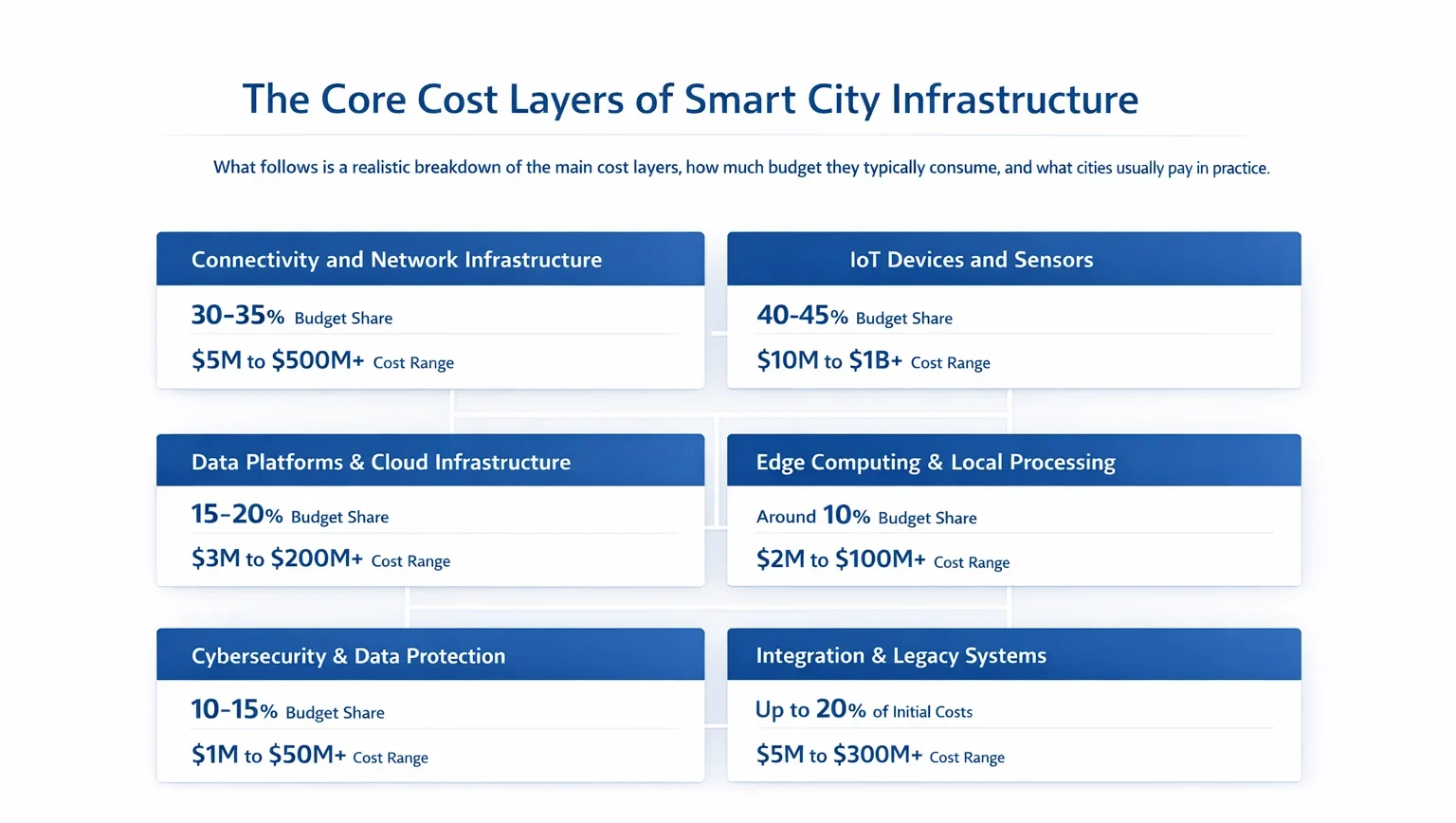
The Core Cost Layers of Smart City Infrastructure
Smart city budgets are usually spread across several interconnected layers. Each layer solves a different problem, and skipping any one of them tends to create blind spots that surface later as delays, overruns, or underperforming systems.
What follows is a realistic breakdown of the main cost layers, how much budget they typically consume, and what cities usually pay in practice.
Connectivity and Network Infrastructure
Typical Budget Share
30-35 percent
Typical Cost Range
$5 million to $500+ million
Connectivity is the foundation of every smart city system. Without reliable networks, sensors do nothing and data platforms sit idle.
Cities invest in a mix of fiber, public Wi-Fi, cellular networks, private LTE, 5G, and low-power wide-area networks. The right mix depends on use cases. Traffic control needs low latency. Environmental sensors prioritize coverage and battery life. Public safety systems need resilience under heavy load.
Costs in this layer include:
- Network hardware and access points
- Backhaul and fiber expansion
- Redundancy and failover planning
- Ongoing service and spectrum fees
Smaller cities might spend a few million to extend public Wi-Fi or private LTE coverage in key zones. Large metropolitan areas can easily reach hundreds of millions when upgrading fiber backbones and city-wide wireless networks.
IoT Devices and Sensors
Typical Budget Share
40-45 percent
Typical Cost Range:
$10 million to $1+ billion
Devices are the most visible part of smart city infrastructure. Cameras, smart meters, parking sensors, air quality monitors, lighting controllers, and utility sensors all fall into this category.
While individual devices may seem inexpensive, scale changes everything. Tens of thousands of endpoints quickly turn into a major budget line.
Costs go far beyond the device price itself:
- Installation and physical mounting
- Power supply and cabling
- Calibration and testing
- Firmware updates and replacements
Devices fail. Batteries need replacing. Sensors drift over time and require recalibration. Cities that budget only for procurement often underestimate the true cost of operating large device fleets.
Data Platforms and Cloud Infrastructure
Typical Budget Share
15-20 percent
Typical Cost Range
$3 million to $200+ million over time
Devices generate data, but without platforms to process it, that data has little value.
Cities spend heavily on cloud infrastructure, data storage, analytics platforms, dashboards, and integration layers that pull information together across departments. These systems support everything from traffic optimization to environmental reporting and emergency response.
This is one of the most persistent cost centers because it never truly ends. As more devices come online, data volumes grow. Processing requirements increase. Licenses, support contracts, and integration work continue year after year.
This is also where cities begin to feel vendor lock-in if open standards were not prioritized early.
Edge Computing and Local Processing
Typical Budget Share
Around 10 percent
Typical Cost Range
$2 million to $100+ million
As smart city deployments scale, sending all data to centralized cloud platforms becomes inefficient and expensive.
Edge computing shifts part of the processing closer to where data is generated. Traffic cameras can analyze video locally. Utility systems can detect anomalies instantly. Emergency systems can respond without cloud latency.
Edge infrastructure reduces bandwidth costs and improves response times, but it introduces new responsibilities:
- Managing distributed edge nodes
- Applying security patches and updates
- Monitoring performance and failures
While still a smaller share of budgets today, edge computing costs are growing steadily as cities push for real-time decision-making.
Cybersecurity and Data Protection
Typical Budget Share
10-15 percent
Typical Cost Range
$1 million to $50+ million annually
Cybersecurity is one of the most underestimated areas in smart city planning.
Every connected device is a potential entry point. Every data platform is a potential target. Cities now dedicate a growing share of budgets to securing networks, devices, and data.
Security costs typically include:
- Device and network encryption
- Identity and access management
- Continuous monitoring and threat detection
- Incident response planning
- Compliance with privacy and data protection laws
Underinvesting here does not just create technical risk. It creates political, legal, and reputational risk that can halt projects entirely.
Integration and Legacy System Retrofitting
Typical Budget Share
Up to 20 percent of initial costs
Typical Cost Range
$5 million to $300+ million
Very few cities start with a blank slate.
Existing traffic systems, utilities, surveillance platforms, and administrative software must be integrated into new smart infrastructure. Retrofitting legacy systems is often complex, unpredictable, and expensive.
Common challenges include incompatible data formats, undocumented interfaces, outdated hardware, and vendors that no longer exist.
This layer is rarely visible to the public, but it often determines whether a smart city system actually works. Integration is not glamorous, but it is frequently the difference between a functioning platform and an expensive pilot that never scales.

Designing Smart City With AI Superior
At AI Superior, we help cities move from smart city ideas to systems that actually work in the real world. Our focus is on building AI-driven infrastructure that delivers measurable value without creating long-term cost or complexity issues.
We work end to end, from AI consulting and system design to custom development and integration. That means helping cities identify where AI makes sense, designing solutions that fit existing infrastructure, and building systems that scale gradually instead of all at once. Our teams combine PhD-level data science expertise with hands-on engineering experience, which allows us to handle real constraints like legacy systems, fragmented data, and regulatory requirements.
Built With Long-Term Costs in Mind
Smart city projects break down when costs are planned only up to deployment. We help cities take a longer view by designing AI solutions that reduce operational effort over time, support multiple departments, and can be expanded as needs grow.
Our approach typically includes:
- Starting with focused MVPs to validate value early
- Building shared data and AI platforms instead of isolated tools
- Using predictive analytics and automation to lower ongoing costs
- Supporting internal teams through AI training and knowledge transfer
The goal is simple: help cities invest in AI that improves efficiency, supports better decisions, and remains sustainable long after the initial rollout.
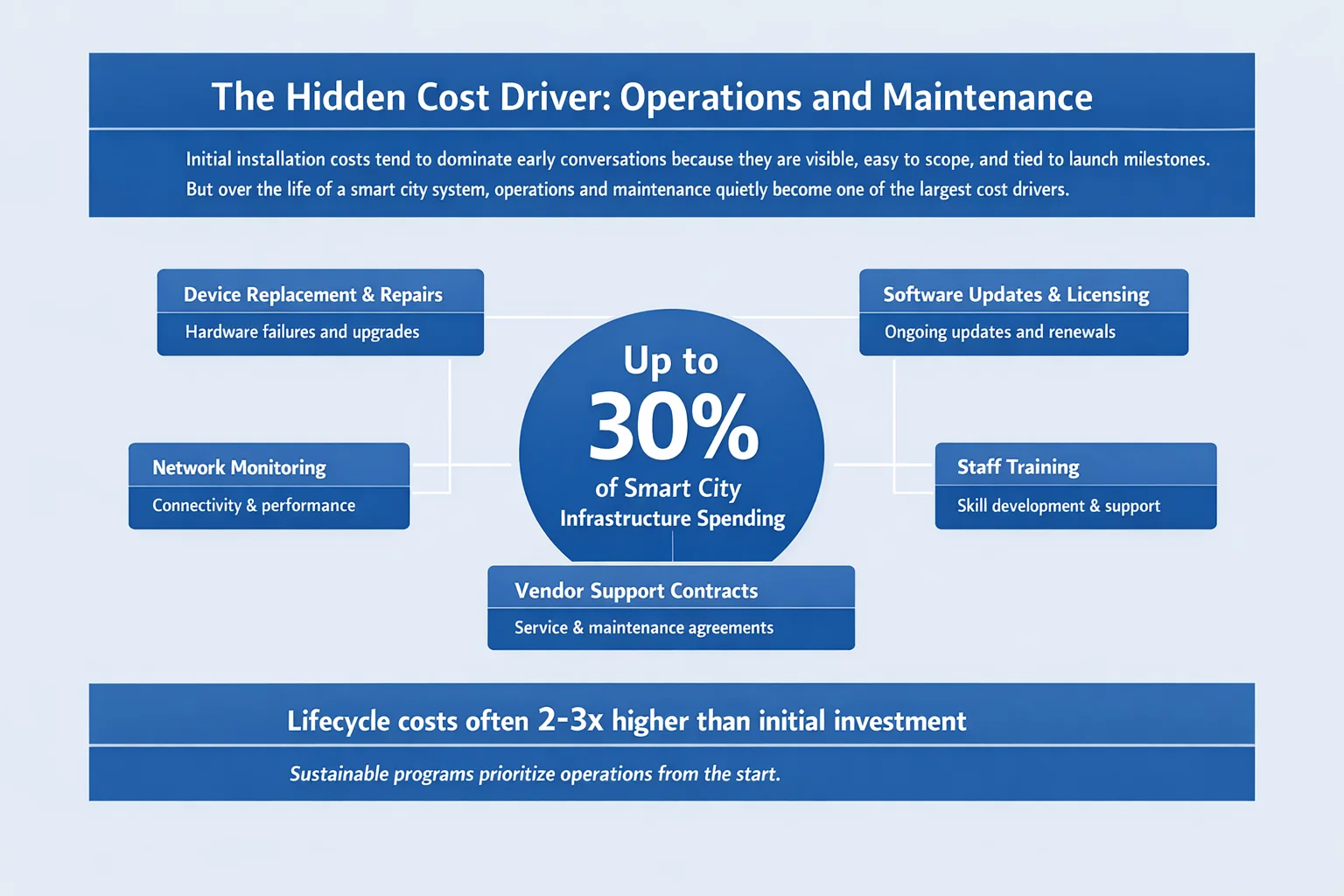
The Hidden Cost Driver: Operations and Maintenance
Initial installation costs tend to dominate early conversations because they are visible, easy to scope, and tied to launch milestones. But over the life of a smart city system, operations and maintenance quietly become one of the largest cost drivers.
In practice, ongoing operations account for up to 30 percent of total smart city infrastructure spending, and in some cases even more once systems reach scale. These are not optional expenses. They are the costs that keep the infrastructure reliable, secure, and usable year after year.
Operations and maintenance typically include:
- Device replacement and repairs. Sensors fail, cameras get damaged, batteries degrade, and physical hardware wears out. At city scale, even a small failure rate translates into constant replacement work.
- Software updates and license renewals. Operating systems, analytics platforms, and device firmware all require regular updates. License fees and subscriptions often increase as data volumes and user counts grow.
- Network monitoring and performance management. Connectivity issues do not announce themselves. Networks must be monitored continuously to detect outages, congestion, or degradation before they impact public services.
- Staff training and internal capacity building. Technology changes faster than municipal job descriptions. Cities must budget for training staff to operate, maintain, and troubleshoot systems rather than relying entirely on vendors.
- Vendor support and service contracts. Many systems depend on ongoing support agreements for maintenance, security patches, and emergency response. These contracts add recurring costs that extend far beyond deployment.
When all of this is added up, lifecycle costs are commonly two to three times higher than the initial capital investment. Cities that plan only for installation often find themselves cutting features, delaying upgrades, or abandoning systems altogether once operational costs begin to accumulate.
The most sustainable smart city programs treat operations as a first-class budget item from day one, not as an afterthought once the technology is already in the ground.
Funding Models That Shape Total Cost
How smart city infrastructure is funded matters as much as how much it costs.
Existing Budgets and Cross-Department Pooling
Many smart city investments are funded by reallocating existing budgets rather than creating new ones. Transportation, utilities, environmental compliance, and public safety budgets often overlap in smart infrastructure projects.
Pooling resources reduces duplication and increases return on investment.
Revenue-Generating Infrastructure
Some smart systems generate direct revenue. Smart parking, EV charging, digital kiosks, and advertising-supported Wi-Fi can offset operational costs.
These models require careful governance to avoid conflicts of interest or inequitable outcomes.
Public-Private Partnerships
Public-private partnerships fund approximately 15-20 percent of smart city infrastructure globally.
They can reduce upfront costs and accelerate deployment, but they also introduce long-term contractual obligations. Cities must define data ownership, revenue sharing, and exit terms clearly.
Grants and National Programs
Many cities rely on national and international funding programs to support smart infrastructure. These funds often prioritize specific outcomes such as sustainability, safety, or equity, which influences system design and cost structure.
Grant-funded projects still require local capacity to operate and maintain systems once funding ends.
Why Low-Cost Smart Cities Are Possible, But Not Simple
Research into low-cost smart city models shows that affordability is less about cheaper technology and more about smarter architecture.
Strategies include:
- Using delay-tolerant networks where real-time data is not required
- Leveraging edge computing to reduce connectivity costs
- Sharing infrastructure across departments
- Designing systems around human behavior and mobility patterns
These approaches reduce dependency on constant high-bandwidth connectivity, but they require careful planning and technical expertise.
Low-cost does not mean low-effort.
Final Thoughts: Cost Is a Strategy, Not a Number
Building smart city infrastructure is not about buying technology. It is about designing systems that cities can afford to run for decades.
The most expensive smart city project is not the one with the highest upfront cost. It is the one that cannot be maintained, scaled, or trusted.
Cities that start small, focus on shared infrastructure, plan for operations, and measure outcomes tend to spend less in the long run. Cities that chase technology without governance tend to pay for it later.
Smart cities are not built cheaply. But they can be built wisely.
Frequently Asked Questions
How much does it cost to build smart city infrastructure?
There is no single price, but most smart city projects range from a few million dollars to several billion. Small cities often start with $2 million to $10 million for focused deployments, while large metropolitan areas may invest hundreds of millions or more over several years.
Why do smart city projects cost so much?
The cost is not just technology. Smart city infrastructure includes connectivity, devices, data platforms, integration with legacy systems, cybersecurity, and long-term operations. Ongoing maintenance and staffing often cost more over time than the initial build.
Are smart city costs mostly upfront or ongoing?
Both matter, but ongoing costs are often underestimated. Operations and maintenance can account for up to 30 percent of total spending, and lifecycle costs are commonly two to three times higher than the initial investment.
Can smart city infrastructure generate revenue?
Yes, in some cases. Smart parking, EV charging, digital kiosks, and advertising-supported public Wi-Fi can generate revenue. However, these systems still require upfront investment and careful governance to remain sustainable.
How long does it take to see a return on investment?
That depends on the use case. Energy efficiency, smart lighting, and predictive maintenance often show returns within a few years. Other systems, like data platforms or public safety tools, deliver value through improved services rather than direct financial returns.
 English
  German
  Arabic
  French
  Dutch
Dutch  Spanish