
Shorter processing times
Automated checks and approvals shorten the time it takes to assess requests and planned investments, so specialists can focus on strategic work and process quality.
Industries · Government and public sector
Public administrations handle large volumes of records, requests and approvals, many of them repetitive. We build AI systems that take on routine processing, support decisions in fiscal, legal and administrative work, and help cities inspect and maintain their infrastructure, designed with data protection, accessibility and transparency in mind.












Digital transformation in government is a long-term process. AI pays off where it removes routine work and gives officials better information.
Automated checks and approvals shorten the time it takes to assess requests and planned investments, so specialists can focus on strategic work and process quality.
Analysis of incoming records produces performance indicators that support tax planning and operational management, helping to increase revenue and reduce costs.
Chatbots answer common questions and route requests, so the public is served faster and staff handle fewer simple enquiries.
The most common use cases we see in public administration and municipal services.
Tools that verify contracts and bids, find inconsistent values, check dates, deadlines and signatures, and flag suspicious cases for review, supporting the fight against corruption.
Tax and legal departments receive high volumes of often similar requests. AI analyses this information and supports financial, legal and administrative decisions.
Regulatory agencies can automate parts of project approval and reduce the time needed to assess the viability of planned investments.
Assistants that speed up service to citizens, settle less complex enquiries and organise contact with the public more efficiently.
Models that help reduce risk in fiscal, legal and administrative processes by highlighting cases that need attention.
Less printing and material use, less time spent searching for reports, and software for simple activities such as contests and petitions.
Computer vision that detects potholes, road damage, graffiti and litter in video, vehicle-mounted camera or drone imagery.
Detections mapped in GIS applications with severity levels, filters and notifications, so maintenance teams know where to act first.
Not sure which of these you need? Describe the problem and we will recommend the approach.
Discuss your project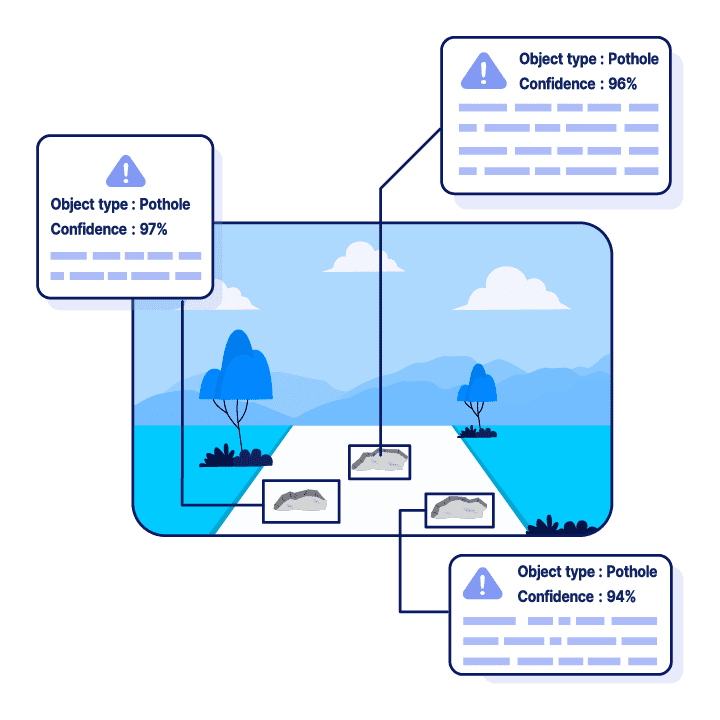
Automatedpothole detection, severity scoring and mapping
A deep learning platform that detects and evaluates potholes and road damage on different types of roads with minimal human intervention, and maps them for maintenance teams.
Read the case study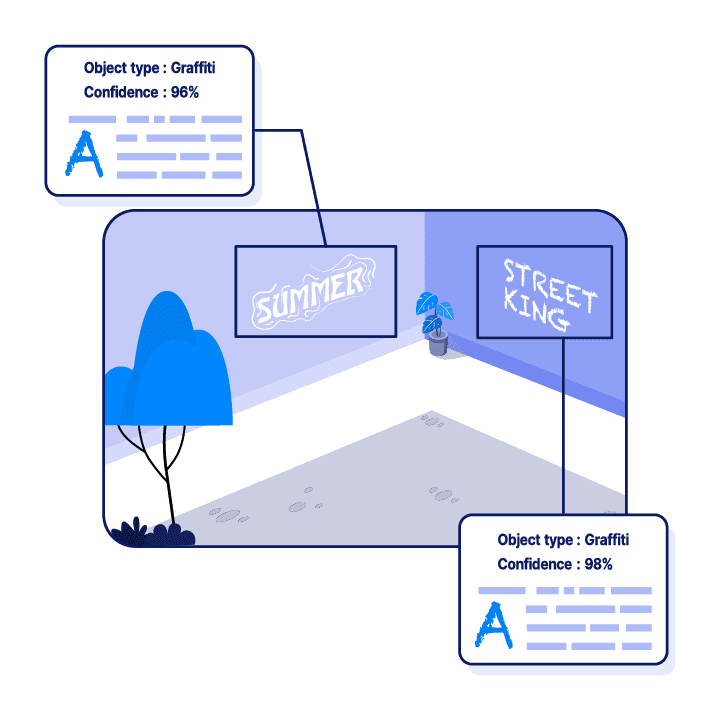
Real-time graffiti detection with GPS location
A deep learning system that detects and locates graffiti across a city in real time, so cleaning teams can find, prioritise and remove it faster.
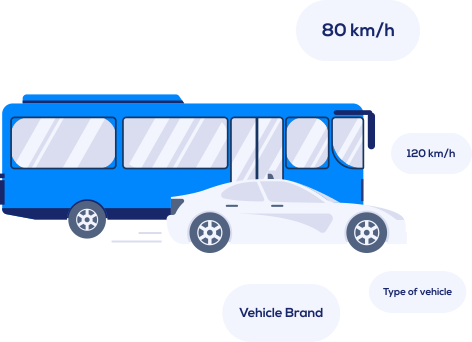
7,000+ car models recognised
A road traffic analysis system that processes traffic camera video to detect and track road users, recognise vehicles and plates, and flag traffic jams and violations without human monitoring.
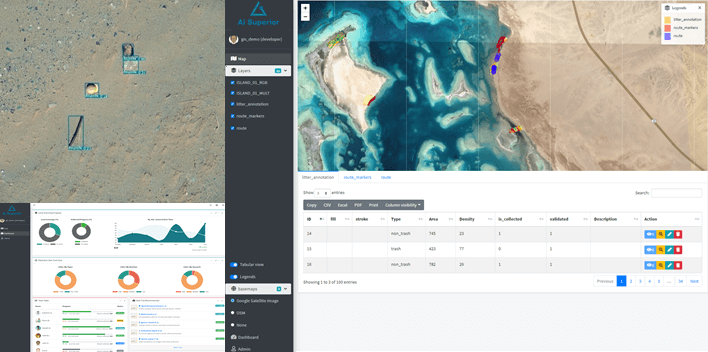
25x faster litter detection, with overall costs halved
A computer vision system that detects litter in drone images across roughly one thousand square kilometres of coastline, with a GIS application for planning and tracking collection.
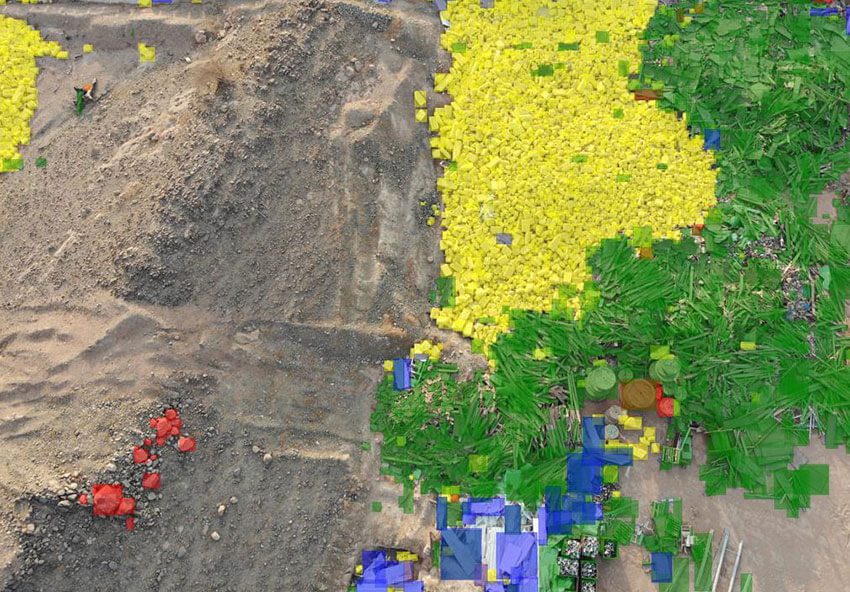
40% lower average inspection costs
A drone-based application that detects and reports 25 types of construction debris, automating construction site inspections and saving 320 man-hours per month.
Many vendors can build a demo. Making AI work reliably on real data, inside real business processes, is the hard part, and it needs a different kind of team.
AI Superior was founded in 2019 by AI researchers with published papers and patents, and the whole team works to that research standard.
Every project is de-risked in stages, with a go/no-go decision at each milestone, so budget only goes into approaches that have worked on your data.
Strategy, models and software are designed by one team, so nothing gets lost in hand-overs between vendors.
When data must not leave your organisation, we build on private, self-hosted models instead of third-party AI services.
Your project is led by senior data scientists and engineers with research backgrounds, supported by our product and development teams.
 Dr. Ivan Tankoyeu CEO
 PhD in Computer Science. Recognised by the IEEE GRSS Society, winner of the Global AI Hackathon 2017, Kaggle TOP500 data scientist (2014).
 Dr. Sergey Sukhanov Advisor
 PhD in Machine Learning, data scientist since 2013. Publications, patents and 30+ implemented AI use cases; several IEEE awards.
“AI Superior responded to all of our needs very carefully and considered them in the project.”
Built AI models and a dashboard for a pilot program that detects waste in drone imagery.
“They successfully fulfilled every component of the project and exceeded our expectations.”
Built an AI model that analyzes the roofs of residential and commercial properties, including data collection and labeling. All key deliverables were completed on time.
“I appreciate their approach, expertise, and the quality of information they provide.”
AI and machine learning consulting to identify the right use cases for a web design and graphics company.
Every stage ends with a result you can check, and you decide on the next one only after seeing the previous one work. You keep control of scope and budget.
We work through the business problem with your team and define the direction of the solution.
You get: Scope, approach and a high-level estimate of effort and expected results
We get to know your team and data and check whether AI is the right tool for this problem.
You get: A data assessment and a clear feasibility verdict before any build starts
We start small, using the data already available, to test the solution in practice.
You get: Measured results on your own data and a basis for the investment decision
We integrate the solution into your existing systems, fine-tune the models and adjust them where needed.
You get: A solution running inside your processes, compatible with your data and systems
We review the results with you and make sure they are read correctly.
You get: What the solution delivered and where to improve next
Recognised by international business awards and by independent B2B platforms that rank companies on verified client reviews.
 Top Artificial Intelligence Company Germany 2026 · Clutch
  Top Machine Learning Company Germany 2026 · Clutch
  Top Computer Vision Company Germany 2026 · Clutch
  Top Generative AI Company Germany 2026 · Clutch
  Go Global Awards Winner 2021 · International Trade Council
  Best Data Science & AI Service Provider, Europe 2021 · German Business Awards
  Top Artificial Intelligence Company 2023 · Clutch
  Top Machine Learning Company 2023 · Clutch
  Clutch Champion Fall 2023 · Clutch
  Clutch Global Fall 2023 · Clutch
  Top BI & Big Data Company Germany 2023 · Clutch
  Top IT Services Company Germany 2023 · Clutch
  Top Artificial Intelligence Companies 2023 · TrueFirms
  Top Machine Learning Companies 2021 · Techreviewer
  Most Reviewed IT Services Companies Germany · The Manifest
 In repetitive, high-volume work: checking documents, analysing tax and legal requests, approving routine projects and answering common questions from citizens. These processes are well defined and generate data that AI can learn from.
Yes. We have built systems that detect and assess potholes and road damage, detect graffiti from a vehicle-mounted 360-degree camera, and find litter in drone imagery. Results are mapped in GIS applications so teams can prioritise repairs and collection.
Public sector AI must follow ethical rules on data protection, accessibility and transparency, not only perform well. We take these requirements into account from the design stage, for example by processing only the data a use case needs.
No. AI components can be integrated into the systems and workflows your departments already use, and introduced step by step, starting with one process.
We follow an AI project lifecycle adapted from software development standards and extended for the scientific challenges of machine learning. Each phase has its own goals and quality criteria that must be met before the next stage starts.
Share a few details and our AI team will take it from there. Here is what happens next: