
Smart city IoT projects rarely fail because of technology. They fail because of budgeting assumptions.
On paper, deploying sensors, cameras, and connected infrastructure can look straightforward. In reality, costs spread across hardware, connectivity, software platforms, integration work, cybersecurity, and years of maintenance. What starts as a pilot can quietly turn into a multi-year investment that’s two or three times larger than the original estimate.
This article breaks down what it actually costs to deploy smart city IoT systems today. Not marketing numbers. Not best-case scenarios. Just a clear view of where the money goes, how budgets usually scale over time, and what cities and solution providers should plan for before committing to deployment.
Short Answer: How Much Does It Really Cost?
Deploying smart city IoT systems typically costs from $100,000 for a narrow pilot to $10–50+ million for a city-wide rollout, depending on scale, use cases, and infrastructure maturity. Most mid-sized cities investing seriously in IoT should expect $2–10 million over the first 3–5 years, including deployment and early operations. Over the full lifecycle, total costs often reach 2–3x the initial investment due to maintenance, connectivity, and system upgrades.
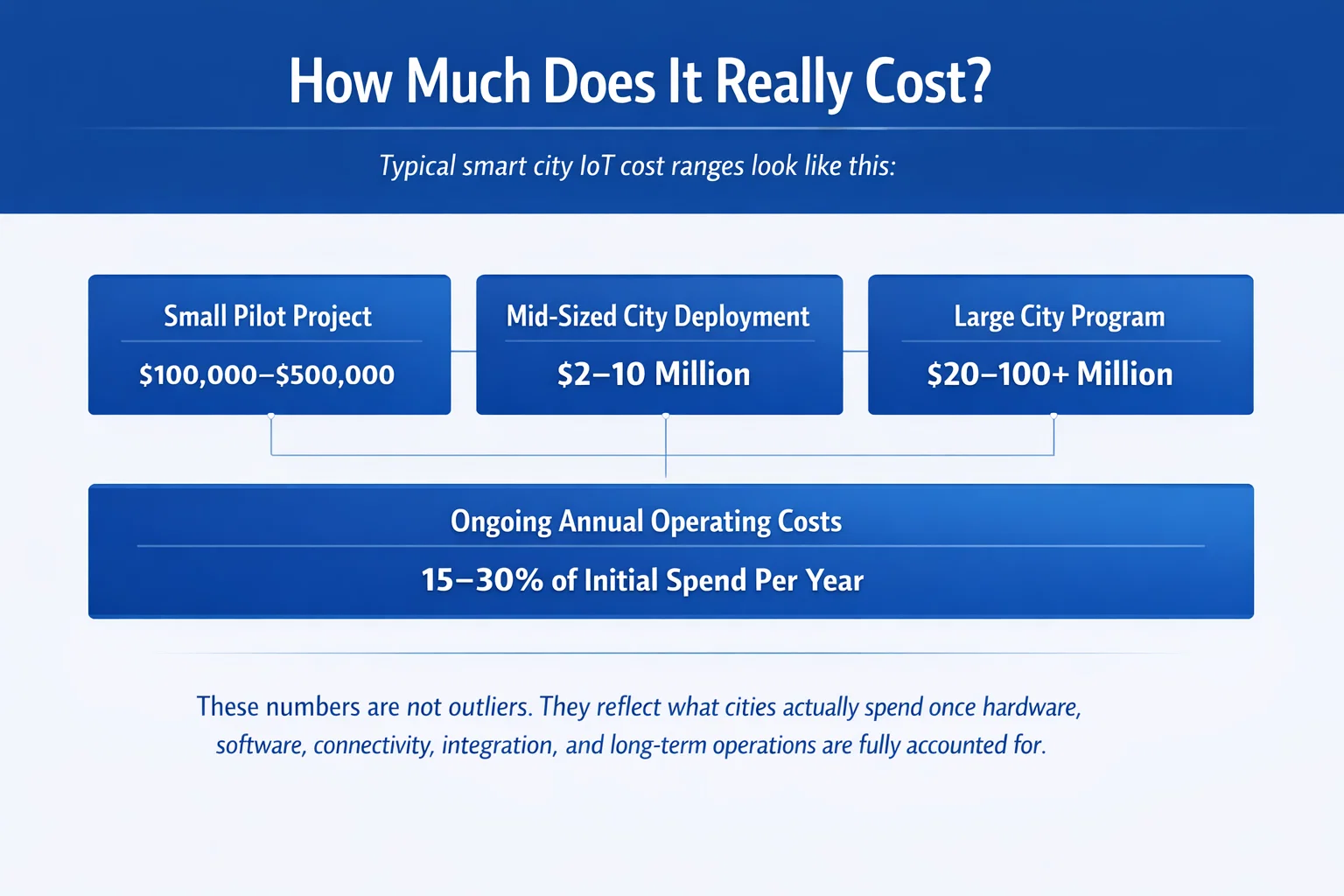
Typical smart city IoT cost ranges look like this:
- Small pilot or single-use case (parking, air quality, lighting): $100,000–$500,000
- Multi-department deployment in a mid-sized city: $2–10 million
- Large city, multi-year smart infrastructure program: $20–100+ million
- Ongoing annual operating costs after deployment: 15–30% of initial spend per year
These numbers are not outliers. They reflect what cities actually spend once hardware, software, connectivity, integration, and long-term operations are fully accounted for.
Core Cost Components of Smart City IoT Deployment
Smart city IoT budgets are rarely driven by a single line item. Costs are spread across multiple layers that build on each other, from physical devices in the field to software platforms, networks, and long-term operations. Focusing on only one area, such as sensors or dashboards, gives a distorted picture of what deployment actually costs.
The sections below break down the six core cost components that shape most smart city IoT projects. Together, they explain why total budgets scale the way they do, where overruns usually happen, and which expenses continue long after the initial rollout is complete.
Each component is interconnected. Decisions made at the hardware or connectivity level directly affect software, integration effort, security exposure, and maintenance costs down the line. Understanding these relationships is key to building realistic budgets and avoiding expensive surprises later.
Hardware Costs: The Visible but Incomplete Part of the Budget
Hardware usually accounts for 35 to 55 percent of initial smart city IoT deployment costs. In projects with dense sensor coverage or video infrastructure, hardware can reach up to 70 percent of upfront spending.
This category typically includes:
- Environmental sensors
- Traffic and transportation sensors
- Smart meters for water, energy, or gas
- Surveillance and public safety cameras
- Edge computing devices
- Gateways and controllers
Real-World Hardware Cost Ranges
Hardware costs vary widely based on quality, durability, and deployment scale:
- Simple sensors: $50 to $300 per unit
- Industrial-grade sensors: $300 to $2,000 per unit
- Smart cameras with AI support: $1,500 to $5,000 per unit
- Edge devices and gateways: $500 to $4,000 per unit
Installation costs often match or exceed device prices, especially when mounting, wiring, permits, lane closures, or traffic disruptions are involved.
The Hidden Hardware Problem: Lifecycle Reality
Hardware pricing is often negotiated aggressively upfront. What gets overlooked is lifespan.
Many devices operate in harsh urban environments. Heat, moisture, vibration, dust, and vandalism shorten usable life. Batteries degrade. Calibration drifts. Failure rates rise after three to five years.
Cities that plan only for initial hardware purchases usually face replacement cycles they did not budget for.
Connectivity Costs: The Foundation That Can Quietly Dominate Budgets
Without reliable connectivity, IoT systems fail regardless of hardware quality. Connectivity typically absorbs 25 to 40 percent of smart city IoT budgets, often as recurring operational costs.
Connectivity spending includes:
- Cellular data plans
- LPWAN network subscriptions
- Fiber or wired infrastructure upgrades
- Private network deployment
- Redundancy and failover planning
Typical Connectivity Spending Patterns
Most cities use a hybrid network model:
- 5G and LTE for high-bandwidth, low-latency use cases
- LPWAN for battery-powered, low-data sensors
- Fiber for backbone connectivity and aggregation
Recurring connectivity costs typically range from:
- $1 to $5 per device per month for LPWAN
- $5 to $20 per device per month for cellular
- Six-figure annual costs for private network operations
Connectivity budgets grow as device counts increase. What looks manageable during a pilot often becomes a major expense at city-wide scale.
Software Platforms: Where Data Becomes Value or Waste
Software platforms account for roughly 15 to 25 percent of smart city IoT deployment budgets. These costs go far beyond licensing.
They usually cover:
- Device management platforms
- Data ingestion and storage
- Analytics and dashboards
- Alerting and automation
- API access and system integrations
Typical Platform Cost Structures
Most platforms use subscription pricing based on:
- Number of connected devices
- Data volume
- Feature tiers
- User access levels
Annual software costs typically range from:
- $50,000 to $200,000 for small deployments
- $300,000 to $1 million or more for large cities
The Real Risk: Underused Platforms
Many cities purchase powerful platforms that few teams actively use. Dashboards look impressive but do not influence decisions. Alerts go ignored. Data is stored but rarely acted on.
The cost is not just financial. It is lost operational value.
Integration Costs: Where Most Budgets Break
Integration is the most underestimated cost in smart city IoT projects and a common source of budget overruns.
Integration work includes:
- Connecting IoT data to legacy city systems
- Normalizing data formats
- Building workflows across departments
- Custom development and middleware
- Testing and validation
Typical Integration Cost Ranges
Integration typically consumes 15 to 30 percent of total project budgets. In complex environments, it can exceed hardware spending.
For mid-sized cities, integration costs often fall between:
- $250,000 to $750,000 for limited-scope projects
- $1 million to $3 million for multi-department deployments
The more fragmented a city’s existing systems are, the higher integration costs climb.
Cost Breakdown by Smart City Use Case
Traffic and Transportation
- Sensors, cameras, and adaptive signals
- Integration with emergency services
- High connectivity and low latency requirements
Typical deployment costs: $2 million to $10 million for mid-sized cities
Utilities and Energy
- Smart meters and grid sensors
- Predictive analytics
- Long hardware lifespans but high integration needs
Typical deployment costs: $1.5 million to $8 million
Public Safety and Surveillance
- Cameras, analytics, storage
- Strong privacy and security requirements
Typical deployment costs: $3 million to $15 million depending on scale
Environmental Monitoring
- Distributed sensors
- Lower data volumes
- High value for compliance and public trust
Typical deployment costs: $500,000 to $3 million

Getting Real Value From Smart City IoT With AI Superior
At AI Superior, we help cities move beyond pilots and turn smart city IoT investments into systems that hold up over time. Our focus is on combining IoT infrastructure with AI, analytics, and clear decision workflows so budgets translate into measurable outcomes, not unused dashboards.
We work with public-sector teams from early assessment through deployment and scaling. That means helping prioritize the right use cases, designing architectures that integrate with existing systems, and building custom AI solutions for areas like traffic management, utilities, public safety, and maintenance.
Cost control is a big part of our approach. We help cities validate ideas through proof-of-concepts, scale only what works, and avoid overbuilding. And after deployment, we stay involved to support integration, performance optimization, and long-term system value.
The goal is not cheaper technology. It’s smarter investment across the full lifecycle.
Cybersecurity and Compliance: The Cost Cities Can No Longer Avoid
Security Is No Longer Optional
Cybersecurity typically represents 12.5 to 15 percent (or more) of smart city IoT budgets, and that share continues to grow as systems become more connected and data volumes increase. Security spending goes well beyond basic protections. It includes securing devices through authentication and encryption, monitoring networks for suspicious activity, managing user access and permissions, meeting regulatory and compliance requirements, and preparing incident response plans in case something goes wrong.
As more critical infrastructure depends on connected systems, the scope of security work expands. Each additional device, integration, or data stream increases the surface area that must be protected, which directly affects long-term costs.
The Cost of Ignoring Security
Cities that underinvest in cybersecurity often pay a much higher price later. Data breaches, service disruptions, public backlash, and legal exposure can quickly outweigh any short-term savings made during deployment. Emergency remediation, audits, and system shutdowns are expensive, disruptive, and damaging to public trust.
For this reason, security budgets should scale with system size and risk profile. Treating cybersecurity as a fixed add-on rather than a core cost component almost always leads to higher total spending over the life of the system.
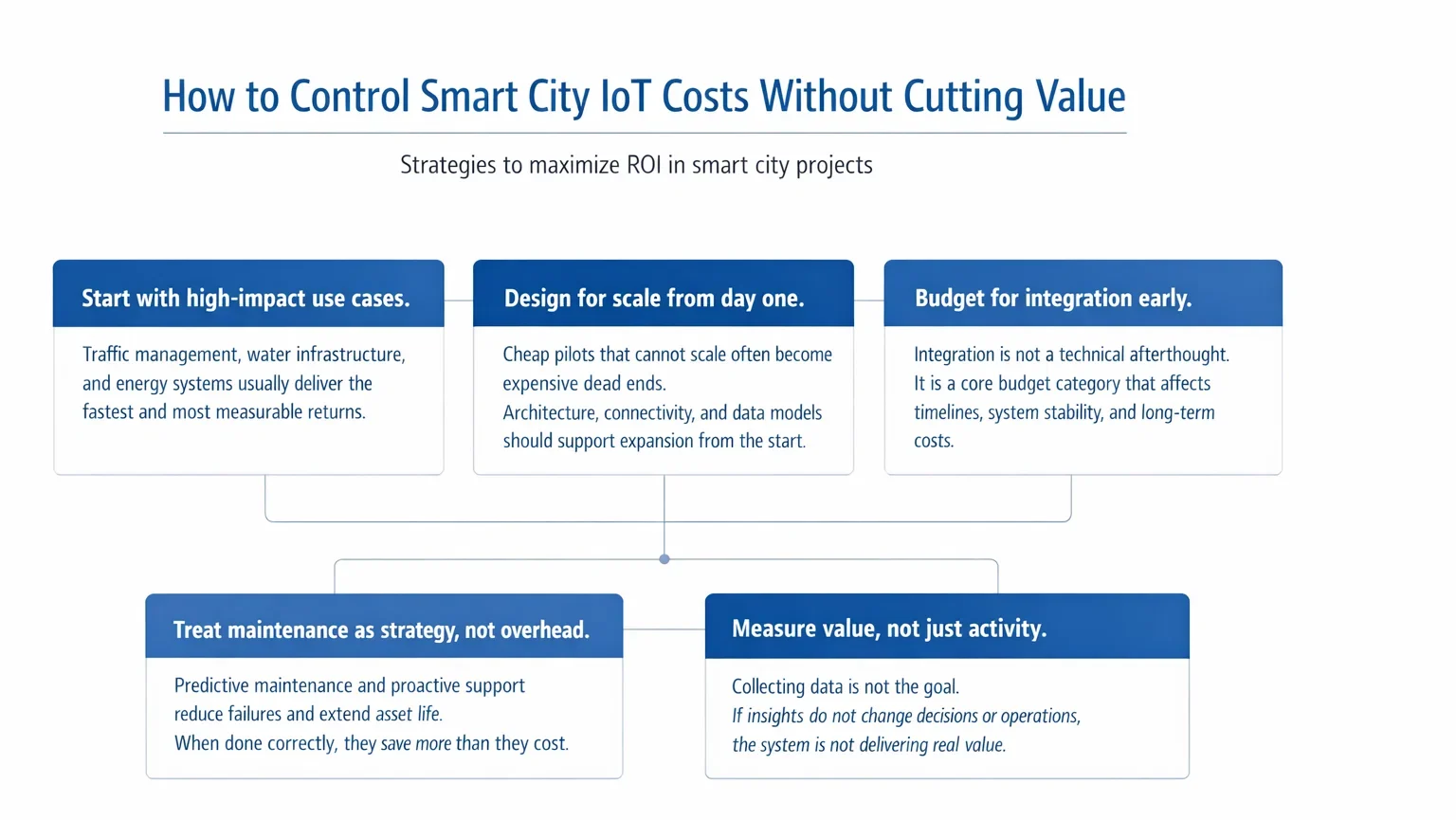
How to Control Smart City IoT Costs Without Cutting Value
- Start with high-impact use cases. Not every system needs to be connected first. Traffic management, water infrastructure, and energy systems usually deliver the fastest and most measurable returns.
- Design for scale from day one. Cheap pilots that cannot scale often become expensive dead ends. Architecture, connectivity, and data models should support expansion from the start.
- Budget for integration early. Integration is not a technical afterthought. It is a core budget category that affects timelines, system stability, and long-term costs.
- Treat maintenance as strategy, not overhead. Predictive maintenance and proactive support reduce failures and extend asset life. When done correctly, they save more than they cost.
- Measure value, not just activity. Collecting data is not the goal. If insights do not change decisions or operations, the system is not delivering real value.
Final Thoughts: Smart City IoT Is a Financial Commitment, Not a Gadget Purchase
Smart city IoT deployment is not about installing devices. It is about building digital infrastructure that operates quietly, reliably, and continuously for years.
Cities that succeed treat IoT as a long-term financial and operational strategy. They budget realistically. They invest in integration and people, not just technology. They accept that the real cost is not the first year, but the next ten.
When done right, smart city IoT systems pay for themselves through efficiency, safety, resilience, and trust. When done poorly, they become expensive reminders of shortcuts taken too early.
Understanding the real numbers is the first step toward getting it right.
Frequently Asked Questions
How much does it cost to deploy smart city IoT systems?
Smart city IoT deployment costs range widely based on scope and scale. Small pilots usually start around $100,000 to $500,000, while multi-department deployments in mid-sized cities often reach $2–10 million over several years. Large cities running city-wide programs can invest $20–100+ million. Over the full lifecycle, total costs are typically 2–3 times the initial deployment budget.
What is the biggest cost driver in smart city IoT projects?
There is no single dominant cost, but integration, connectivity, and long-term operations are the most common budget drivers. Hardware gets the most attention early, yet integration with existing city systems and ongoing connectivity fees are where budgets often expand beyond expectations.
Why do smart city IoT projects go over budget?
Projects usually exceed budgets because of underestimated integration work, unclear ownership between departments, missing cybersecurity planning, and underfunded maintenance. Many cities budget for deployment but not for operations, upgrades, and replacements, which creates cost pressure later.
How much do operating and maintenance costs add over time?
Operations and maintenance typically account for 25–35 percent of total smart city IoT spending over time. When connectivity fees, software renewals, device replacement, and staff time are included, lifecycle costs often reach two to three times the original deployment investment.
Can small or mid-sized cities afford smart city IoT systems?
Yes, if deployments are focused. Smaller cities often see the best ROI by starting with one or two high-impact use cases, such as water monitoring, traffic optimization, or smart lighting. Cloud platforms and phased rollouts allow cities to scale gradually without large upfront commitments.
 English
  German
  Arabic
  French
  Dutch
Dutch  Spanish