
There’s no one-size-fits-all price tag for building a smart city. Some projects launch with modest budgets to upgrade a few intersections. Others? They’re greenfield cities planned from scratch, costing billions and taking decades. The difference usually comes down to what’s being built, where, and why.
If you’re trying to get a realistic sense of what smart city construction actually costs – from fiber and sensors to full digital infrastructure – you’re in the right place. Let’s break it down by scale, scope, and the hidden drivers that push numbers higher than many expect.
What Is a Smart City?
A smart city uses technology, data, and connected infrastructure to improve the quality of life for its residents. It combines digital tools with physical systems to manage traffic, energy use, public services, and environmental impact more efficiently. The goal is to make urban life more sustainable, responsive, and efficient by using sensors, data analytics, and intelligent systems to support day-to-day operations and long-term planning.
Determining the True Average Cost of Building a Real Smart City
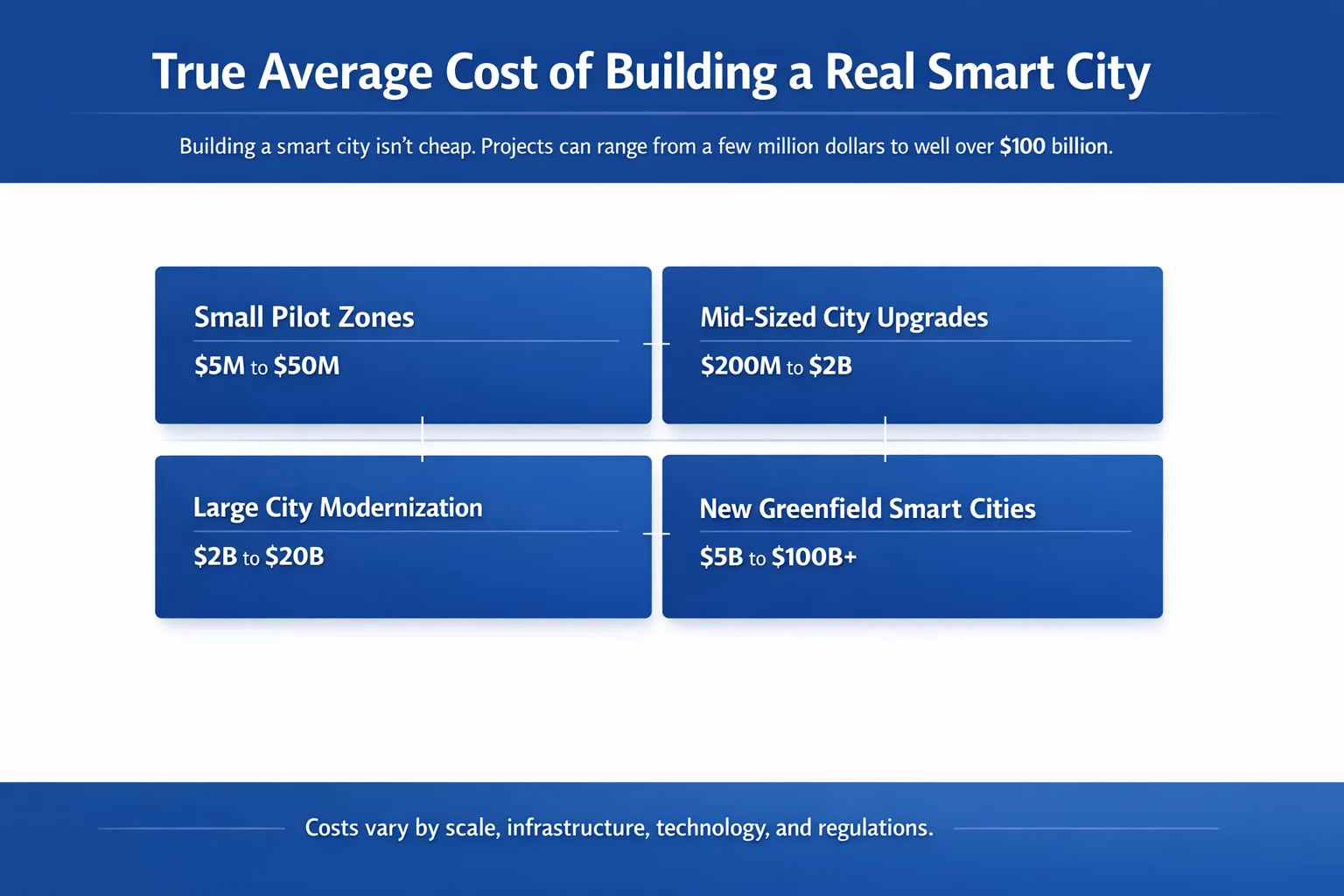
Building a smart city isn’t cheap. Depending on the size, location, and ambition of the project, total construction costs can range from a few million dollars for a pilot zone to well over $100 billion for a full-scale, purpose-built city. And those numbers aren’t just pulled from theory. They’re based on planned projects like Quayside in Toronto, and qualitative planning frameworks proposed by institutions such as Harvard Business School.
But let’s start with a clear baseline. There’s no universal price tag, but here’s the rough range:
- Small pilot zones or districts: $5 million to $50 million
- Mid-sized city upgrades (100k-300k population): $200 million to $2 billion
- Large city modernization (1M+ residents): $2 billion to $20+ billion
- New greenfield smart cities: $5 billion to $100+ billion
That’s a wide spectrum, and for good reason. Smart city costs depend on more than just square footage. They’re shaped by the project’s scale, infrastructure maturity, tech stack, regulatory landscape, and the type of “smartness” being built.
What Makes a City “Smart” (And Why It Matters for Budgeting)
Smart cities use technology to improve how urban systems function. That includes traffic, utilities, safety, governance, and services. But not every smart city invests in the same things.
Some cities lean into AI and predictive analytics to improve how transportation systems or law enforcement respond in real time. Others prioritize building out IoT networks that monitor waste levels, energy use, and water systems across neighborhoods. You’ll also see heavy investment in 5G and broadband infrastructure to ensure digital connectivity is reliable and fast.
In places focusing on utilities, smart grids and meters are key to modernizing how electricity and water are delivered. And for broader coordination, many cities set up centralized command centers that oversee operations and respond to events as they happen.
Others, especially in low-density or developing regions, may prioritize basic automation or localized services like traffic signals and public Wi-Fi.
The bottom line? The more connected, coordinated, and data-intensive a city aims to be, the higher the price tag.

Where AI Fits Into Smart City Construction Decisions
When cities start breaking down smart city construction costs, one of the first questions is where advanced analytics and AI actually make financial sense. From our side at AI Superior, we usually see AI coming into play not as a flashy layer on top, but as a way to reduce uncertainty in planning and long-term operations. Smart traffic systems, predictive maintenance for utilities, demand forecasting for energy, or early fault detection in infrastructure all rely on solid data foundations and carefully built models, not generic software.
We work on AI-based systems that support exactly these kinds of decisions. That often means helping city stakeholders assess where data is available, where it is fragmented, and whether AI is the right tool at all. In many smart city projects, the biggest cost risk is not the hardware itself, but poor assumptions about usage, growth, or behavior. Careful modeling and incremental validation can prevent expensive overbuilding and reduce long-term operational costs once the city is live.
In practice, this kind of work usually happens in phases. We start small, often with a limited dataset or a pilot use case, and test whether an AI-driven approach actually delivers value before anything is scaled city-wide. For large smart city construction projects, this approach helps keep budgets grounded. Instead of locking into massive upfront investments, decision-makers can align technology spending with real outcomes, adjust plans early, and avoid turning complex AI ambitions into cost overruns later on.
Core Budget Categories in Smart City Construction
Whether you’re retrofitting an old city or building from scratch, most smart city budgets break down into a mix of:
- Physical infrastructure: Roads, housing, energy grids, buildings.
- Digital infrastructure: Fiber, 5G nodes, sensors, servers.
- Software and platforms: Analytics, dashboards, data systems.
- Devices and hardware: Meters, cameras, smart poles, kiosks.
- Integration and deployment: Interoperability and system design.
- Operations and maintenance: Cloud costs, support teams.
- Training and governance: Staffing, upskilling, legal compliance.
Let’s take a closer look at some of the typical unit-level costs involved.
Typical Cost Breakdown by Component
Here’s an overview of average price ranges for key smart city components, based on planning estimates and case studies:
| Component | Estimated Cost |
| Fiber optic backhaul | $20,000 – $100,000 per km |
| 5G small cell node | $5,000 – $30,000 per site |
| IoT sensors (air, traffic, utilities) | $50 – $1,000 each |
| Smart LED streetlights | $300 – $1,200 per unit |
| Smart traffic lights & controllers | $10,000 – $50,000 per intersection |
| Urban command center | $1 million – $50 million |
| Smart grid (per household) | $300 – $1,500 |
| Electric buses | $500,000 – $1.2 million each |
| Public Wi-Fi infrastructure | $10,000 – $100,000 per area |
Keep in mind: this table covers only hardware and infrastructure. Software platforms, data integration, and long-term maintenance often double or triple the initial spend.
Comparing Smart City Sizes: From Pilots to Full Cities
Different smart city efforts carry very different cost profiles. Here’s how they typically stack up.
1. Pilot Projects and Innovation Zones
These small-scale experiments often cover a single district or function, like a smart mobility corridor or IoT-enabled downtown. They’re meant to validate tech and measure ROI before scaling.
- Typical cost: $5M – $50M
- Timeframe: 1-3 years
- Goal: Proof of concept
2. Mid-Sized City Upgrades
In cities with populations around 200k-500k, upgrades usually focus on utilities, mobility, public safety, and data platforms. These cities often build incrementally over a decade.
- Typical cost: $200M – $2B
- Timeframe: 5-10 years
- Goal: City-wide modernization
3. Large-City Overhauls
Think New York, London, or Singapore. These are massive retrofits across multiple departments, often involving AI-driven operations, resilience planning, and integrated platforms.
- Typical cost: $2B – $20B+
- Timeframe: 10-20 years
- Goal: Integrated, digital-first systems
4. Greenfield Smart Cities
Entire cities built from the ground up fall into a different category due to their exceptional scale and complexity, with publicly cited cost estimates reaching approximately $500 billion. These developments combine large-scale physical construction with advanced technology and carry higher execution risk than typical greenfield projects.
- Typical cost: $5B – $100B and more
- Timeframe: 15-30 years
- Goal: New, purpose-built urban model
Real-World Example: Westown, South Africa
Westown, a smart city currently under construction in KwaZulu-Natal, South Africa, carries a projected budget of $805 million and is planned over a 15-year timeline. The development is designed as a mixed-use urban area, combining residential housing with commercial space while integrating technology across key services. Its plans include smart systems for managing waste and utilities, along with real-time traffic coordination and law enforcement support through digital infrastructure.
Once fully operational, the city is expected to create more than 23,000 jobs and generate around $26 million in annual revenue. Still, Westown isn’t South Africa’s first attempt at this kind of project. Earlier efforts, like the Lanseria Smart City, show that even well-intentioned plans can stall without consistent funding and strong governance. A smart city’s success depends just as much on execution as on vision.
What Influences Final Cost the Most?
Every smart city project has its own financial fingerprint, but a few factors consistently push costs up or down:
Major Cost Drivers
Land acquisition and zoning often take up a large share of the budget, especially for new developments where land rights, permitting, and planning approvals can stretch timelines and costs. In existing cities, integrating smart systems with legacy infrastructure is another major expense, as older networks were rarely designed to support real-time data or automation. Cybersecurity and data governance also add to the overall cost, since connected systems require strong protection and compliance frameworks from the start.
On top of that, the complexity of the technology itself and the need for different systems to work together smoothly can drive up both initial and ongoing spending. Public engagement and regulatory processes may seem less technical, but they frequently slow projects down and increase costs. Finally, long-term operational expenses such as cloud services, software licenses, and staff training are often underestimated during early planning.
Risk Areas to Watch
One common risk is vendor lock-in, where cities become dependent on proprietary systems that are expensive to modify or replace later. Cost overruns are another frequent issue, usually caused by unclear project scope or shifting requirements once construction is underway. Smart city initiatives can also suffer from uneven rollout, with some departments moving ahead while others lag behind, creating gaps and inefficiencies.
Privacy concerns and legal challenges may arise if surveillance technologies are deployed without clear safeguards or public trust. Finally, the tightly connected nature of smart infrastructure means that a single system failure can disrupt multiple services at once, making resilience planning a critical but sometimes overlooked part of the budget.
How to Plan a Smart City Budget (Without Losing Your Mind)
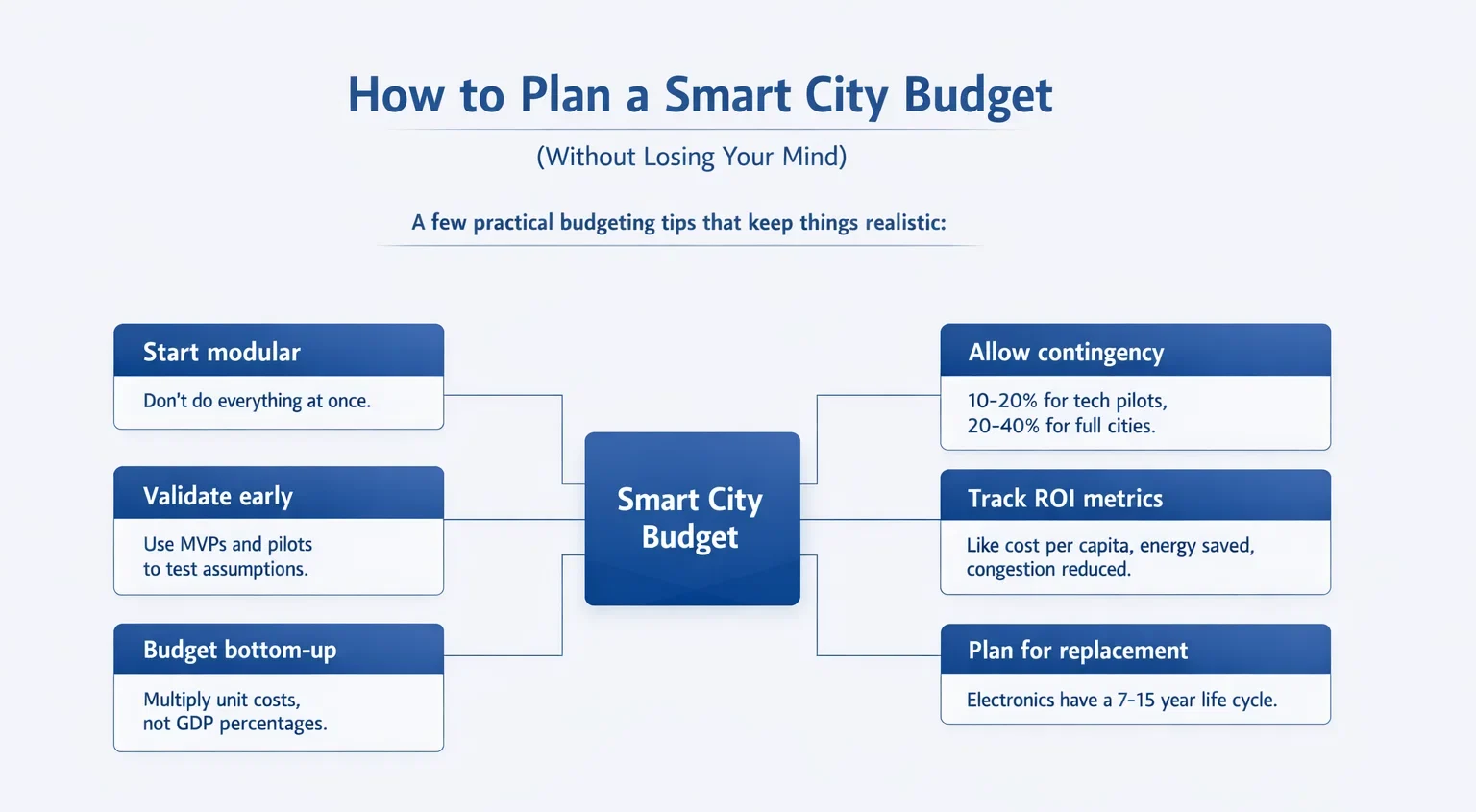
A few practical budgeting tips that keep things realistic:
- Start modular: Don’t do everything at once.
- Validate early: Use MVPs and pilots to test assumptions.
- Budget bottom-up: Multiply unit costs, not GDP percentages.
- Allow contingency: 10-20% for tech pilots, 20-40% for full cities.
- Track ROI metrics: Like cost per capita, energy saved, congestion reduced.
- Plan for replacement: Electronics have a 7-15 year life cycle.
Final Thoughts
Smart city construction is expensive. But it’s not just about the price tag. It’s about whether the investment aligns with real public value, long-term sustainability, and local context. Some cities need fiber and automation. Others just need smarter ways to manage water or waste. Not every city has to be a digital twin or a data powerhouse.
The smartest investments are the ones that solve the right problems at the right scale, with enough flexibility to grow and adapt over time.
If you’re planning a smart city, start small, build iteratively, and never forget that people, not sensors, are the ones who need to live in what you’re building.
FAQ
1. What’s the cheapest way to start a smart city project?
Start small. Seriously. A pilot zone with focused goals, like upgrading streetlights or adding smart traffic signals, can cost under $10 million. It’s not flashy, but it gives you proof of value before scaling. The smartest cities usually didn’t try to do everything at once.
2. Why do some smart cities cost $100 billion?
Because they’re building from the ground up. New cities like The Line aren’t just installing tech – they’re developing land, laying roads, building housing, and wiring in infrastructure from scratch.
3. How long does it take to build a smart city?
Anywhere from a few years to a few decades. Pilot zones can be up and running in 2 to 3 years. Full-scale smart cities, especially greenfield ones, often plan for 15 to 30 years. It’s not just construction – it’s about integration, testing, and adjusting as the city grows.
4. What part of the budget usually gets underestimated?
Operations and long-term maintenance. Everyone budgets for hardware and software, but fewer account for the cost of cloud services, data teams, system updates, or AI model tuning. These costs add up, especially after year three.
5. Who typically pays for smart city construction?
It depends. Municipal governments usually fund early phases, but private investors, developers, and public-private partnerships often step in for larger-scale or long-term funding. Revenue later comes from utility fees, services, or land sales.
 English
  German
  Arabic
  French
  Dutch
Dutch  Spanish