
AI agents are showing up everywhere – from customer support chatbots to tools that automate internal workflows. But while the tech sounds futuristic, the question businesses still ask is simple: how much does it cost to build one?
The answer depends on what you’re trying to create. A lightweight support bot won’t cost the same as an autonomous system that makes decisions or interacts with sensitive data. Features, data requirements, infrastructure, and long-term upkeep all play a role in the final budget.
This article breaks down the real numbers, key cost factors, and what to expect at each stage of AI agent development.
What Is an AI Agent and Why Does It Cost So Much?
An AI agent is a software program designed to act intelligently and independently on behalf of a user or system. It can process inputs, make decisions, and even learn from new data. Depending on its capabilities, it might answer customer questions, schedule tasks, run reports, or support high-stakes decisions in fields like healthcare or finance.
The average cost to develop an AI agent typically starts around $5,000 to $10,000 for basic assistants, and may rise to $200,000 or more for complex autonomous systems. In some cases, especially with ongoing training, integrations, and compliance needs, the total cost can exceed $300,000.
The reason AI agents vary so widely in cost is simple: they’re not one-size-fits-all. Some use pre-built models and basic rule-based logic. Others require custom development, deep integration into your existing systems, or access to sensitive data. The more autonomy, memory, and context awareness you want, the more complex and expensive the system becomes.

Our Perspective on AI Agent Development at AI Superior
When it comes to building AI agents, we bring the same systematic process and technical depth that we apply to all our AI projects. At AI Superior, we begin by working closely with clients to understand the problem they are trying to solve, the data they have, and the outcomes they expect. This early discovery and estimation phase gives a clear picture of scope and helps shape a realistic development plan rather than guessing at features and costs up front.
We’ve found that starting with a proof of concept or a minimum viable product is often the most sensible way to approach AI agent development. By testing the core idea with a small, focused version first, we can validate assumptions, refine requirements, and avoid investing heavily in features that don’t deliver meaningful value. Once the prototype proves its worth, we integrate and scale the solution, fine‑tuning models and connecting it to existing systems in a way that supports business continuity.
Throughout development, we prioritise transparency and communication so clients always understand what is being built and why. That approach doesn’t just help manage cost expectations, it also ensures that the AI agent we deliver is tailored to real needs and delivers measurable results rather than being a black box with unclear value.
AI Agent Cost by Type
There are several common categories of AI agents. Each serves a different purpose and requires different levels of effort to develop.
| Type of AI Agent | Description | Estimated Cost (USD) |
| Simple Reflex Agent | Responds to immediate input using predefined rules (no memory, no learning). Ideal for basic FAQ bots and form fillers. | $5,000 – $25,000 |
| Model-Based Agent | Tracks internal state to make better decisions based on previous inputs. Suitable for slightly dynamic interactions. | $20,000 – $50,000 |
| Goal-Based Agent | Makes decisions by evaluating possible outcomes to achieve specific objectives. Often used in assistants with planning abilities. | $40,000 – $100,000 |
| Utility-Based Agent | Chooses actions based on maximizing utility (value functions). Used in scenarios with multiple good outcomes. | $60,000 – $120,000 |
| Learning Agent | Continuously improves over time through feedback and new data (supervised, unsupervised, reinforcement learning). | $80,000 – $150,000+ |
| Context-Aware Agent | Maintains short-term memory for multi-turn conversations or workflows. Good for HR assistants or helpdesk bots. | $30,000 – $80,000 |
| Autonomous Agent | Plans and executes complex tasks independently, often across systems and tools. Includes logic, memory, and sometimes learning. | $100,000 – $200,000+ |
| Multi-Agent System | Composed of several agents collaborating or acting independently to solve distributed problems. Used in logistics, smart homes, simulations. | $150,000 – $300,000+ |
| Domain-Specific Agent | Customized for regulated or high-risk sectors (e.g. finance, healthcare). Usually adds compliance, security, and specialized reasoning. | $120,000 – $250,000+ |
Cost estimates vary depending on the development team’s location, in-house vs outsourced work, and existing infrastructure. Ranges shown are for initial development only and exclude long-term ownership costs.
Also note that these categories often represent a natural progression in AI maturity – from simple rule-based agents to more autonomous, adaptive, and collaborative systems.
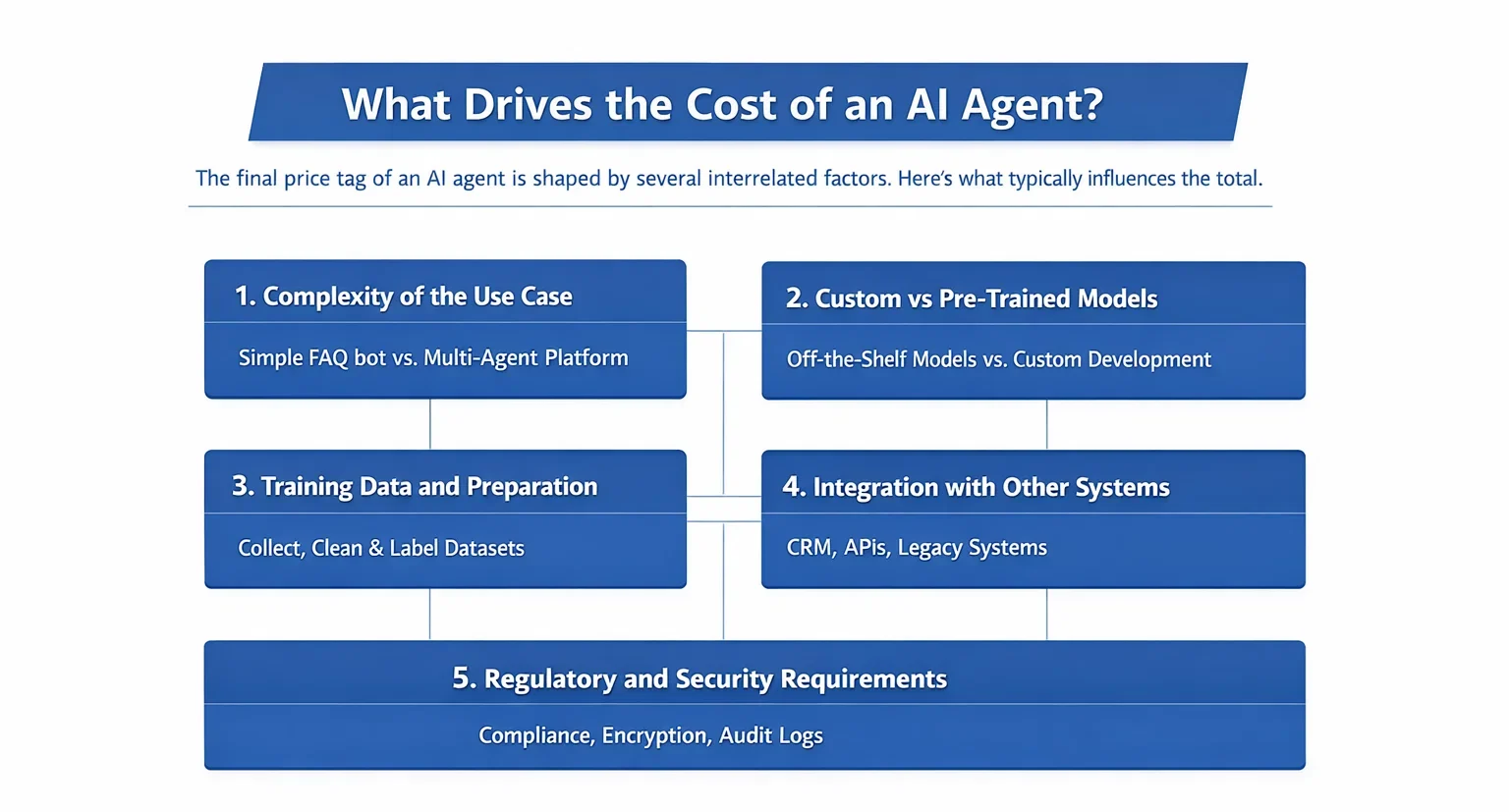
What Drives the Cost of an AI Agent?
The final price tag of an AI agent is shaped by several interrelated factors. Here’s what typically influences the total:
1. Complexity of the Use Case
An FAQ bot with a predefined script is cheap. A multi-agent orchestration platform managing tasks across departments is not. If your agent needs reasoning, planning, or contextual understanding, you’ll need a larger budget and more development time.
2. Custom vs Pre-Trained Models
Using pre-trained AI models can save you time and money. But if you need specialized features, data handling, or language understanding, your team may need to build or fine-tune a model from scratch. This step alone can add tens of thousands of dollars.
3. Training Data and Preparation
You can’t build a smart AI agent without data. You’ll need to collect, clean, and label relevant datasets. If you’re dealing with customer behavior, finance, or medical records, data preparation becomes even more critical (and expensive).
4. Integration with Other Systems
Your agent probably won’t exist in a vacuum. It might need to connect with CRMs, APIs, data warehouses, or legacy systems. Integration work requires time, testing, and sometimes custom infrastructure to handle security, traffic, and scalability.
5. Regulatory and Security Requirements
If your AI agent handles sensitive data or operates in a regulated environment (like insurance or pharmaceuticals), the bar is higher. Encryption, audit logs, access control, and compliance checks add cost but are non-negotiable.
AI Agent Development Cost Breakdown
Let’s take a closer look at how the cost breaks down across different development phases:
| Development Phase | Estimated Cost | Details |
| Discovery & Design | $5,000 – $15,000 | Use case mapping, requirements, system architecture |
| Model Setup & Training | $10,000 – $40,000 | AI model selection, training, fine-tuning |
| Integration & Orchestration | $20,000 – $50,000 | Connecting to APIs, databases, CRMs |
| Testing & Validation | $5,000 – $15,000 | Accuracy checks, performance QA, security validation |
| Deployment & Monitoring | $10,000 – $30,000 | Hosting setup, CI/CD pipelines, dashboards |
| Maintenance (Annual) | $10,000 – $50,000+ | Ongoing updates, retraining, support |
These numbers vary based on the scale of the agent and how much infrastructure you already have in place.
Ongoing (and Often Overlooked) Costs
The development bill isn’t the end of the story. Many companies underestimate what it takes to keep their AI agent running reliably.
Here are common long-term costs to plan for:
- Model retraining: Keeping your AI up-to-date as user behavior, market conditions, or regulations change.
- Cloud usage: Storage, compute time, and API call costs add up fast, especially for high-traffic applications.
- Monitoring and logging: To catch bugs, prevent bias, and meet audit requirements.
- Security updates: Critical if you’re handling customer data, payments, or personal information.
- Third-party API usage: Some services charge per query, so costs scale with usage.
Teams that skip planning for these often find their total cost of ownership doubling within a year.
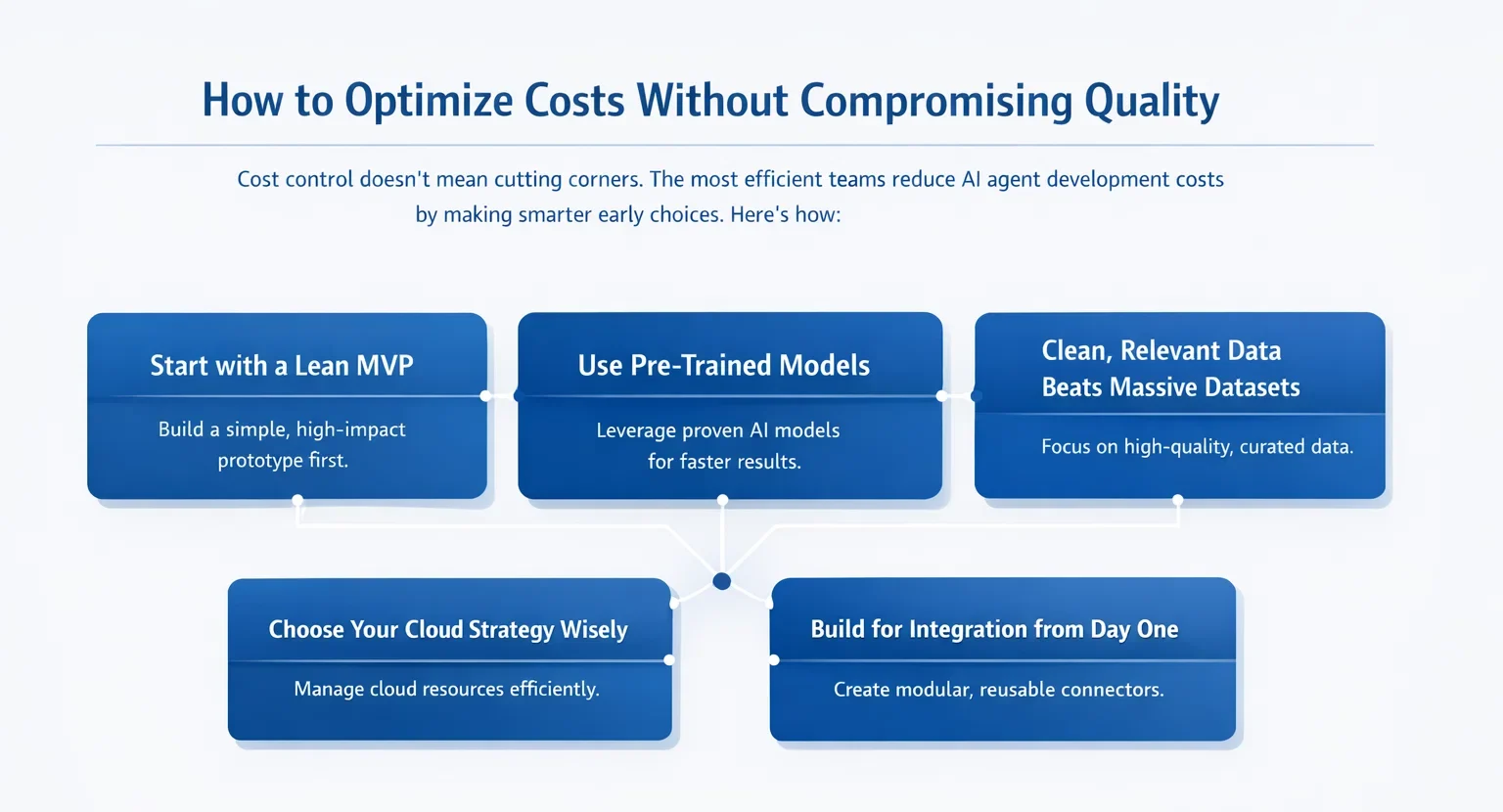
How to Optimize Costs Without Compromising Quality
Cost control doesn’t mean cutting corners. The most efficient teams reduce AI agent development costs by making smarter early choices. Here’s how:
Start with a Lean MVP
Don’t aim for a fully autonomous, multi-function agent on day one. Build a version that solves one high-impact problem really well, then test it in the real world. If it works and users rely on it, that’s your signal to invest more, not before.
Use Pre-Trained Models
Unless your application truly needs custom logic or training from scratch, stick with proven pre-trained models. They’ll save you time, reduce infrastructure costs, and still deliver solid results in most use cases. You can always fine-tune later if needed.
Clean, Relevant Data Beats Massive Datasets
It’s tempting to chase volume, but in practice, a well-curated dataset beats a giant messy one every time. High-quality data improves performance and reduces the need for frequent retraining, which means lower costs and fewer headaches down the line.
Choose Your Cloud Strategy Wisely
Cloud bills have a way of creeping up fast if you don’t plan ahead. Use autoscaling, set usage alerts, and consider hybrid infrastructure if it helps keep sensitive workloads in-house. A few early optimizations can save thousands later.
Build for Integration from Day One
Don’t treat integrations as an afterthought. If your agent needs to connect to CRMs, databases, or analytics tools, build modular connectors that can be reused across use cases. It’s a small upfront investment that can prevent weeks of rework later.
Example Budget Scenarios
Here are a few realistic examples of what different AI agent projects might cost:
1. Basic Support Chatbot (Type: Simple Reflex Agent)
This type of AI agent focuses on handling straightforward, repetitive queries using rule-based logic. It doesn’t retain memory between sessions, nor does it learn or adapt over time. Most of the time, it’s integrated with a single system like a CRM to automate responses to frequently asked questions or form-style interactions. It’s simple, functional, and effective when used for narrow use cases.
- Estimated cost: $25,000 – $35,000
- Ongoing costs: Minimal (cloud + maintenance only)
2. Internal HR Assistant (Type: Context-Aware Agent)
An internal HR assistant steps things up by managing conversations that span multiple turns, while tracking what the user has said across sessions. It can connect with internal platforms, including systems like Slack or HR databases, to help employees find information, complete requests, or navigate company policies. This type of agent delivers a smoother, more personalized experience, which means it needs more planning and training during development.
- Estimated cost: $50,000 – $80,000
- Ongoing costs: Moderate (cloud, retraining, usage-based APIs)
3. Autonomous Workflow Agent (Type: Autonomous Agent or Learning Agent)
These agents are built to actively plan and carry out tasks on their own, often across departments or tools. Some of them can be designed to adapt their behavior based on feedback or historical results, though many rely on predefined logic and do not continuously self-learn. In practice, this might look like automating multi-step workflows, coordinating between systems, or managing internal processes without manual oversight. They require careful design, detailed logic, and strong infrastructure.
- Estimated cost: $100,000 – $150,000+
- Ongoing costs: High (data pipelines, compliance, frequent updates)
4. Domain-Specific AI Agent (Type: Domain-Specific Implementation + Goal-Based or Utility-Based)
In industries like finance, where data sensitivity and compliance are non-negotiable, AI agents need to meet strict technical and regulatory standards. These systems often carry advanced forecasting capabilities, detailed reasoning modules, and strong audit trails. Because they operate under higher scrutiny and often touch regulated data, they demand a higher upfront investment and more rigorous ongoing oversight.
- Estimated cost: $150,000 – $250,000+
- Ongoing costs: Very high (monitoring, security, retraining, legal oversight)
Final Thoughts
AI agent development isn’t cheap, but it doesn’t have to be unpredictable either. Costs range widely depending on the complexity, autonomy, and data requirements of your project. What matters most is knowing where your investment is going and making smart trade-offs early.
Instead of focusing on building the most advanced system possible from day one, the better strategy is to solve one real problem well, prove the value, and grow from there. The teams that plan realistically and iterate carefully tend to get the most from their AI investments and avoid the painful surprises that come with chasing trends or overengineering a solution.
If you’re budgeting for an AI agent in 2026, plan for flexibility, ongoing improvement, and enough headroom to keep learning after launch. That’s what turns a one-time build into a long-term advantage.
FAQ
1. What’s the most budget-friendly way to build an AI agent?
If you’re watching the budget, the smart move is to start small. Build a lean version that solves one specific task well – think an internal assistant or a simple support bot. Use pre-trained models, skip fancy integrations at first, and keep the scope tight. You can always scale up once it’s proven useful.
2. Why do AI agents cost so much to maintain after launch?
Because they don’t stay “done.” Models need retraining, data pipelines shift, users find edge cases, and cloud bills creep up if you’re not careful. Maintenance isn’t just about fixing bugs – it’s keeping the system smart, secure, and compliant as everything around it changes.
3. Do I really need custom AI development, or can I use a no-code platform?
It depends on what you’re building. If your agent just answers basic questions or pulls from a static database, a no-code tool might be enough. But once you need memory, logic, planning, or secure integrations, you’ll likely hit a wall. That’s when a custom solution starts to pay off.
4. How long does it take to build a working AI agent?
Timelines vary a lot, but here’s a ballpark: a basic agent might take 4-6 weeks, something contextual could run 2-3 months, and anything autonomous or regulated can stretch past 6 months. It mostly depends on your scope, data readiness, and how fast decisions get made.
5. What’s the biggest mistake companies make when budgeting for AI agents?
Focusing only on build cost and ignoring the “long tail” – things like retraining, cloud usage, compliance, and monitoring. Those hidden costs add up fast if you don’t plan for them early. It’s like buying a car and forgetting you’ll need insurance, gas, and oil changes.
 English
  German
  Arabic
  French
  Dutch
Dutch  Spanish