
Let’s be honest, AI agents sound exciting until you sit down with the budget sheet. That’s when things get real. Whether you’re thinking about a simple support bot or a more complex AI system that connects with your tools and makes decisions on its own, the costs can swing wildly.
In this guide, we’re breaking it all down: what you’ll actually spend (not just the headline numbers), where the budget goes, and which parts of the process can quietly drain resources if you’re not careful. We’ll also look at how different types of agents, industries, and tech choices change the financial picture. No fluff, just the numbers, decisions, and trade-offs that matter.
What Does “Implementation” Actually Mean, And What Does It Cost?
When people talk about AI agents, most jump straight to features or models. But “implementation” is where the real work (and cost) begins. It’s the process of taking an AI agent – whether it’s a chatbot, a task assistant, or a decision-making system – and making it function reliably within a specific business environment.
That means more than just writing code. Implementation covers everything from planning and system design to data preparation, model integration, infrastructure setup, testing, and long-term support. You’re embedding AI into live workflows, not building a demo.
Implementation costs can vary significantly based on the complexity of the agent, your existing tech stack, data availability, and how deeply the system needs to integrate with your operations.
Here’s what you’re generally looking at:
- Entry-level implementation for a simple agent: Usually ranges from $10,000 to $30,000, including planning, setup, and integration.
- Mid-tier implementation: Typically lands between $30,000 and $60,000+.
- High-complexity or enterprise implementations: Can range from $100,000 to $250,000 or more, depending on requirements.
These are just implementation costs, not including long-term maintenance, retraining, or usage-based fees.
The variance is wide because every AI agent needs a different level of orchestration. A retail chatbot might need basic training and frontend integration. A finance-focused risk analysis agent may require a secure data pipeline, auditing, fallback protocols, and strict compliance layers. A multi-agent setup in logistics could demand months of orchestration logic, MLOps infrastructure, and post-launch optimization.
So while the word “implementation” might sound straightforward, it often involves the most resource-intensive part of the AI agent journey, and it’s the phase where many hidden costs tend to show up. Getting it right means planning not just what the agent should do, but how it should do it in your actual business context.

Our Experience with AI Implementation in Business Processes
At AI Superior, we focus on helping businesses implement AI solutions that actually fit into real workflows and create value. We build custom AI‑driven software, including intelligent systems that connect with existing business tools and processes. When companies bring us a project, our team of data scientists and engineers work with them to understand where AI can drive real improvements, whether that’s automating tasks, enhancing decision‑making, or reducing operational friction.
We pride ourselves on transparency and close collaboration throughout the implementation process. That means not just developing models, but helping organizations recognize the right areas for AI, assess data readiness, and define priorities before a single line of code is deployed. By taking the time to align the solution with business needs, we help reduce surprises and deliver results that are easier to integrate and support over the long term.
AI Agent Implementation Costs by Project Scope
Not all implementation projects are created equal. Some AI agents slot into your business with minimal fuss, while others require full system redesigns, data pipelines, and ongoing MLOps infrastructure. The cost of implementation depends on how far the agent needs to reach into your workflows, and how much intelligence it needs to carry out tasks reliably.
Below is a more accurate breakdown based specifically on implementation scope, not just the type of agent:
| Implementation Scope | Typical Features | Estimated Cost Range |
| Basic Implementation | Simple integration, rule-based agent, minimal custom logic | $10,000 – $30,000 |
| Moderate Implementation | NLP-driven agent, connects to APIs/CRMs, light customization | $30,000 – $60,000+ |
| Advanced Implementation | Multi-turn reasoning, RAG pipelines, domain tuning, internal tool integrations | $60,000 – $100,000+ |
| Enterprise Implementation | Multi-agent systems, custom LLMs, compliance support, observability, scaling | $100,000 – $250,000+ |
Keep in mind: these are one-time development and setup costs that can significantly vary depending on the case. Once the agent is live, you’ll still need to budget for infrastructure, usage-based LLM/API fees, maintenance, and retraining – costs that often amount to 15% to 30% of the initial investment annually.
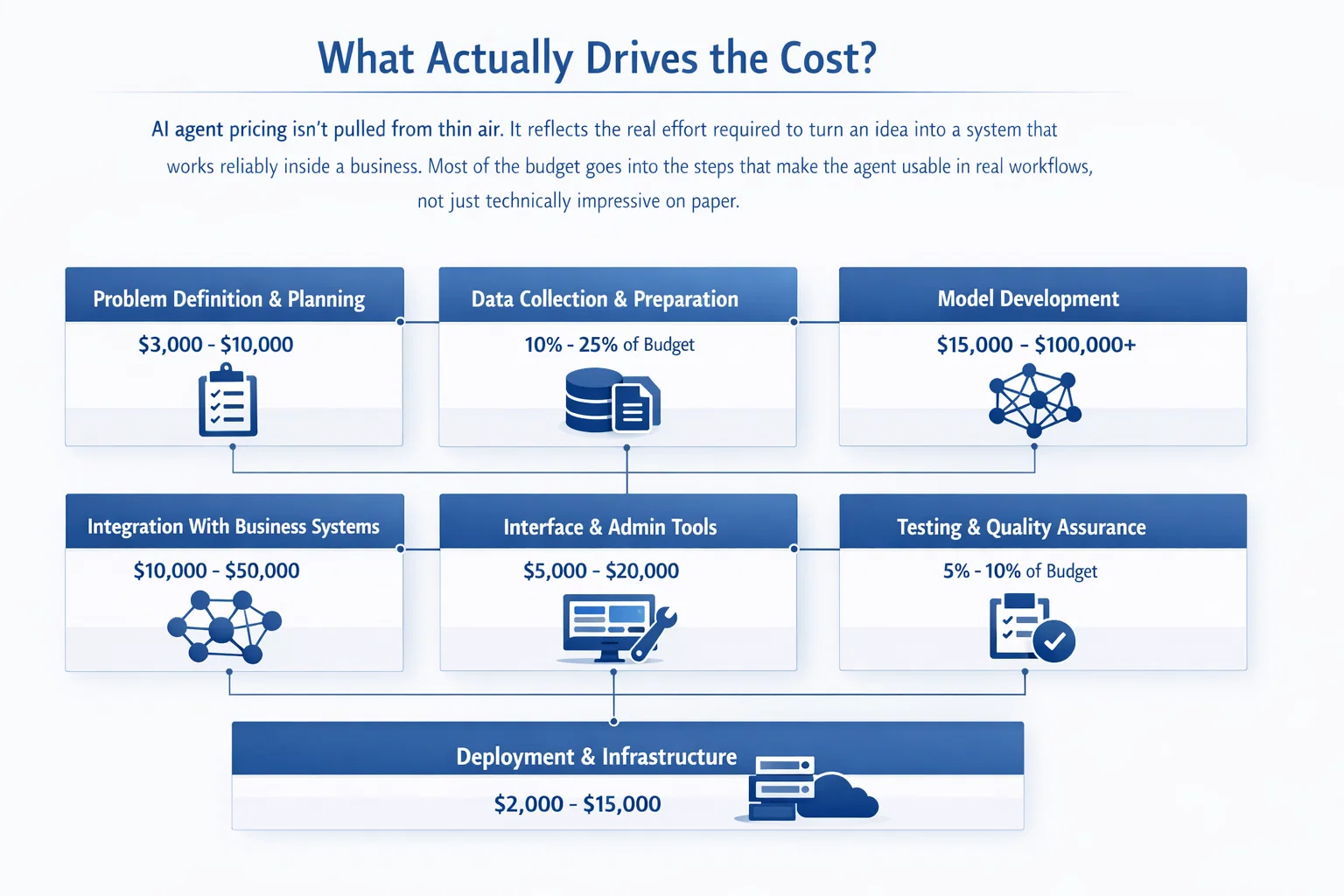
What Actually Drives the Cost?
AI agent pricing isn’t pulled from thin air. It reflects the real effort required to turn an idea into a system that works reliably inside a business. Most of the budget goes into the steps that make the agent usable in real workflows, not just technically impressive on paper.
Problem Definition & Planning
Every AI agent implementation starts with understanding what problem the agent is supposed to solve and how it fits into existing processes. This stage usually involves business analysis, defining use cases, and checking technical feasibility. It’s where teams align on goals, constraints, and success metrics before anything is built.
Even though no code is written yet, this phase matters because poor planning leads to expensive rework later. In most projects, this stage alone can cost between $3,000 and $10,000.
Data Collection & Preparation
Data is the fuel for any AI agent, and preparing it often takes more effort than expected. This includes identifying relevant data sources, labeling or cleaning datasets, and structuring them so the agent can actually use the information.
In industries with messy or sensitive data, this step can easily consume 10% to 25% of the total budget. It’s not the most visible part of implementation, but it has a direct impact on how accurate and reliable the agent will be once deployed.
Model Development
Model development is where costs start to climb. This phase covers selecting the right base model, adapting it to the business context, and testing its behavior under real conditions.
Using pre-trained models can keep costs lower, but agents that require domain-specific logic, multi-step reasoning, or higher accuracy need additional fine-tuning and validation. Depending on complexity, this part of the implementation can range from $15,000 to well over $100,000.
Integration With Business Systems
An AI agent only becomes useful when it connects to the systems your business already uses. That might include CRMs, ERPs, internal databases, or communication tools. Integration work often involves building custom APIs, handling data permissions, and making sure the agent can operate without breaking existing workflows.
If your systems are outdated or poorly documented, this step becomes more expensive. Integration costs commonly fall between $10,000 and $50,000.
Interface and Admin Tools
Most businesses need visibility and control over how an AI agent behaves. This is where dashboards, monitoring views, and manual override options come in. These tools allow teams to track performance, intervene when needed, and stay compliant with internal policies. While not always mandatory for small projects, they are essential in larger or regulated environments. Building these interfaces typically adds $5,000 to $20,000 to the overall cost.
Testing and Quality Assurance
Testing an AI agent goes beyond checking whether it runs. Teams need to validate how it behaves under edge cases, unexpected inputs, or high load. In some cases, ethical safeguards and bias checks are also required. This phase usually accounts for 5% to 10% of the total budget, but skipping it often leads to operational issues after launch. When AI systems fail in production, the cost of fixing them is usually much higher.
Deployment and Infrastructure
The final step is getting the agent live. This includes setting up cloud or on-prem infrastructure, configuring deployment pipelines, and planning for rollbacks if something goes wrong. While the initial setup might look affordable, ongoing usage of GPUs, APIs, and monitoring tools can add up quickly. Initial deployment and infrastructure setup generally costs between $2,000 and $15,000, depending on scale and performance requirements.
Ongoing Costs to Expect After Launch
Most teams under-budget for post-launch. But AI agents need babysitting. Here’s what you’ll keep paying for:
- LLM or API usage fees: $100 – $10,000+/month
- Cloud hosting and compute: $500 – $5,000/month
- Monitoring and maintenance: $2,000+/month
- Model retraining and fine-tuning: Quarterly or as needed
- Security and compliance: $1,000+ annually
A solid rule of thumb: annual upkeep will cost you 15% to 30% of the initial build price.
Budgeting Tips That Actually Help
When you’re building a custom AI agent, the biggest risk isn’t always overspending – it’s spending on the wrong things too early. Many teams burn through budget chasing every feature at once or scaling before they’ve validated anything. That’s why starting with a focused, testable MVP is often the smartest move. Keep it lean, prove the value, and build from there.
- Start with an MVP: You don’t need perfection from day one.
- Use pre-trained models: Custom training is pricey. Fine-tune instead.
- Outsource what you can: External AI teams are often faster and cheaper.
- Define your integrations early: Adding them late costs more.
- Keep prompts clean and efficient: Messy logic inflates token spend.
Final Thoughts
Implementing AI agents into business workflows is rarely cheap, but it doesn’t have to spiral. The wide cost range reflects the many shapes these systems can take. If you know your problem well, define scope early, and stay honest about your team’s capacity, you can keep costs predictable.
Start small, think long-term, and treat your AI agent like a living system that evolves with your business. Because once it’s in place and running well, the return often outweighs the upfront spend.
FAQ
1. What’s the biggest cost driver when building an AI agent?
It usually comes down to complexity. A simple chatbot that spits out pre-written responses is cheap. But if you want something that understands context, interacts with your data, and makes decisions on its own? That’s where costs start climbing fast. Integrations, security, training time – they all add up.
2. Is it cheaper to use an off-the-shelf AI agent instead of building one?
Short-term, yes. Long-term, maybe not. A prebuilt solution might save you money upfront, but you’ll likely hit limits quickly – in functionality, customization, or data handling. Building your own gives you control, but only if you actually need it. Sometimes, the “build vs buy” question is really about how unique your problem is.
3. Can startups afford custom AI agents?
Some can, some shouldn’t. A focused MVP version, like a basic internal assistant, might cost $25K to $50K, which some early-stage teams can swing. But trying to build an autonomous, multi-system AI agent from day one? Probably not wise unless you’ve already raised serious funding.
4. How long does it take to develop a working AI agent?
A lightweight version could go live in a few weeks. A full-featured agent, especially one that works across departments or needs advanced reasoning, might take 3-6 months or more. And even then, it’s never really “done” – you’ll likely keep tuning and retraining as your needs evolve.
5. What’s often forgotten when budgeting for AI agent development?
Ongoing costs. People budget for development, but forget about maintenance, retraining, security updates, or API fees. Also, rollout time. Just because it’s coded doesn’t mean your team is ready to use it right away. Adoption takes planning too.
 English
  German
  Arabic
  French
  Dutch
Dutch  Spanish