
Integrating an AI agent into your existing software stack sounds great in theory, until the bills start adding up. Sure, the core AI platform might have a flat subscription fee or an open-source label, but getting that agent to actually talk to your CRM, ERP, or ticketing system? That’s where the real costs live.
This guide walks through the pricing puzzle of AI agent integration – what you’re really paying for, where the hidden costs sneak in, and how to avoid blowing your budget before the thing even runs. Whether you’re building from scratch or stitching an AI tool into your current setup, understanding the scope (and cost) early on can save a lot of time, cash, and regret down the line.
What AI Agent Integration Is and the Average Cost
Integrating an AI agent with existing software means making that agent a functional part of your current systems, not a standalone experiment. Instead of sitting in isolation, the agent connects to your tools, reads and writes data, follows business rules, and fits into real workflows used by employees or customers.
In practice, this can mean linking an AI agent to a CRM to answer customer questions, an ERP to pull order or inventory data, or internal tools to automate reporting, approvals, or task routing. The agent needs secure access, clear logic, error handling, and monitoring. Without those pieces, it cannot operate safely or reliably.
On average, AI agent integration costs range from $20,000 to $250,000, with most real-world projects landing somewhere in the middle. Smaller integrations tend to stay closer to $30,000 to $60,000, while deeper, multi-system integrations often exceed $100,000. The price depends less on the AI model itself and more on how complex your software environment and workflows are.
Why AI Agent Integration Costs More Than Most Expect
Many teams assume the main cost of AI is the model or the subscription. In reality, the AI component is often the smallest part of the budget. The real work happens when the agent is wired into existing systems that were never designed to work with autonomous decision-making.
Legacy software, fragmented data, inconsistent APIs, and undocumented processes all increase integration effort. Even modern SaaS tools can require custom logic to ensure data is interpreted correctly and actions happen at the right time.
Another overlooked factor is organizational readiness. AI agents change how work gets done. If workflows are not adjusted, the agent either underperforms or creates confusion. Fixing that after launch usually costs more than addressing it upfront.

How We Support AI Integration and Software Alignment
At AI Superior, our work begins with a deep look at your business problem, your existing systems, and the data you already have. Before we build anything, we want to understand where AI can make a real difference and how it should fit with the software you already use. That means we take time at the start to define the direction of the solution and provide clear expectations about scope and outcomes, so the technical work that follows is grounded in a shared vision.
Once the goals are clear, we build an initial version of the solution using your own data and systems. This proof of concept or minimum viable product helps us confirm that the AI logic works as expected before we go further. After this early validation, we focus on connecting and scaling the solution so it works smoothly with your existing applications, services, or workflows. Throughout this process, we keep communication open and transparent, and we adjust our approach to fit your priorities and technical environment.
We also provide support in areas around the integration itself, like training teams, helping interpret insights, and ensuring the solution delivers real business value. For organizations that haven’t used AI before, this end-to-end support – from problem definition through delivery and evaluation – helps reduce risk and makes sure the AI-enhanced system becomes a productive part of your software landscape.
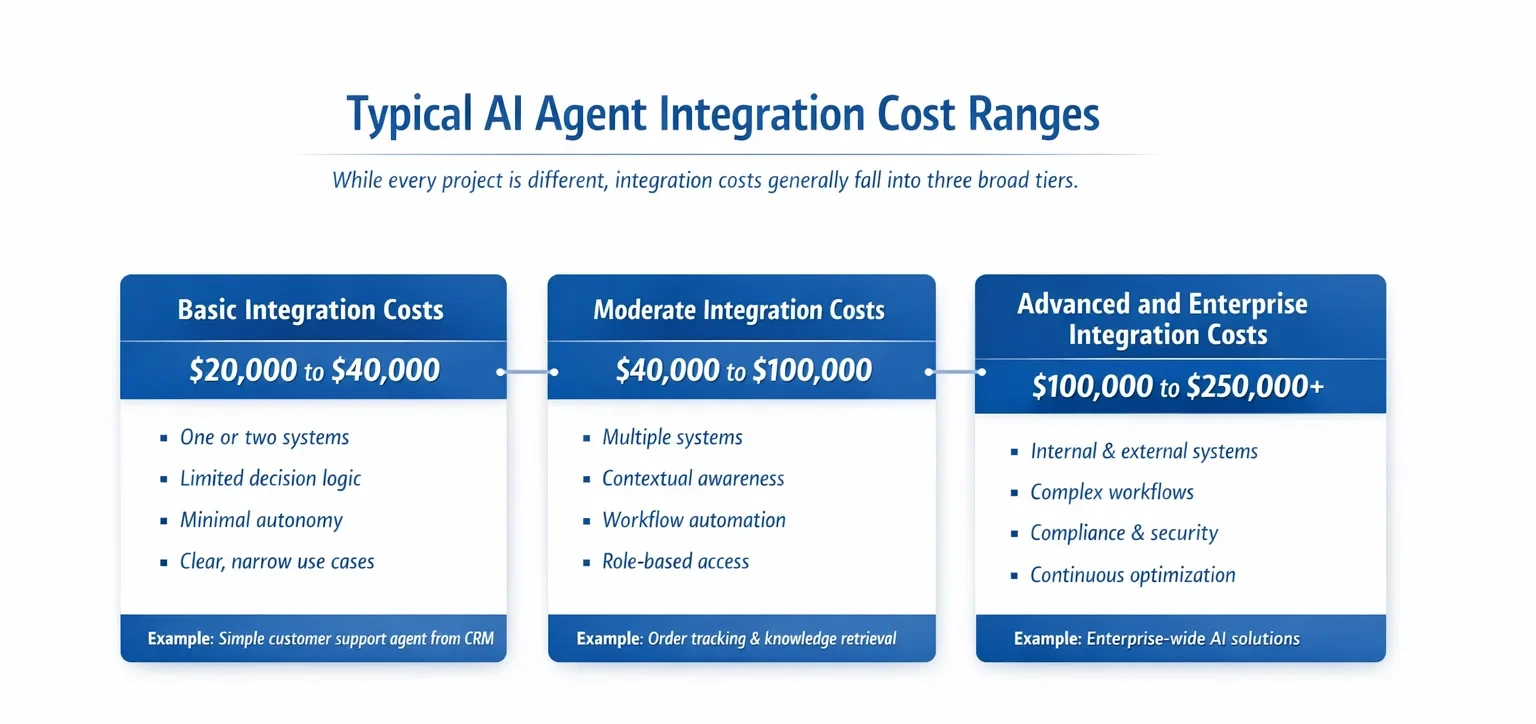
Typical AI Agent Integration Cost Ranges
While every project is different, integration costs generally fall into three broad tiers.
Basic Integration Costs
Basic integrations usually cost $20,000 to $40,000. These projects involve:
- One or two systems.
- Limited decision logic.
- Minimal autonomy.
- Clear, narrow use cases.
A common example is a customer support agent that pulls information from a CRM or help desk system and responds to simple queries. The agent does not make decisions beyond predefined rules and escalates anything complex to humans.
These integrations are relatively fast to build and easier to maintain, but they deliver limited business impact.
Moderate Integration Costs
Moderate integrations typically range from $40,000 to $100,000. This level includes:
- Multiple connected systems.
- Session memory or contextual awareness.
- Workflow automation beyond simple responses.
- Role-based access and permissions.
At this stage, the AI agent may handle tasks like order tracking, lead qualification, internal knowledge retrieval, or cross-system updates. It needs better data handling, logging, and error management.
Most businesses aiming for real productivity gains fall into this category.
Advanced and Enterprise Integration Costs
Advanced integrations often start at $100,000 and can exceed $250,000. These projects involve:
- Multiple internal and external systems.
- Complex workflows and dependencies.
- Compliance, security, and audit requirements.
- Ongoing optimization and monitoring.
Here, the AI agent may coordinate work across departments, make recommendations that affect revenue or risk, or operate with partial autonomy. These integrations require extensive testing and long-term maintenance planning.
What Drives the Cost of AI Agent Integration
Understanding cost drivers helps explain why two projects with similar goals can have very different budgets.
System Complexity
The more systems you’re connecting, the more layers you add, the more your integration bill grows. Each system likely brings its own quirks: different APIs, unique data formats, and its own set of permission rules. And when something fails, you need to know exactly where and why, which means handling error scenarios across every connection. If you’re dealing with older tools that don’t offer modern interfaces, expect to spend extra time building custom middleware or manually mapping data between platforms. These things aren’t always obvious upfront, but they add up fast.
Data Quality and Structure
AI agents are only as smart as the data you feed them. If your data is scattered, full of duplicates, or poorly labeled, the agent won’t perform well, and fixing that mess can take serious time and money. Data cleanup, normalization, and restructuring often fly under the radar during early planning, but once development starts, these tasks tend to eat a big chunk of the budget. It’s not the glamorous part of the project, but without clean inputs, even the best AI model can’t help you much.
Workflow Redesign
AI agents don’t just slot into existing processes – they often reshape how those processes function. That usually means redefining team roles, adjusting how escalations work, and sometimes rethinking what performance even looks like. If you skip this redesign and try to layer AI on top of old workflows, the result is often confusion, resistance, or an agent that gets ignored. This is where real adoption is won or lost, and where many projects quietly stall out after launch.
Security and Access Control
Letting an AI agent access internal systems introduces new security responsibilities. You’ll need to define who the agent can act on behalf of, log its actions clearly, and validate every input and output it handles. These controls aren’t optional, especially if you’re in a regulated industry. Building secure, compliant access adds time and cost to the project, but skipping it can leave you open to much bigger risks down the line.
One-Time vs Ongoing Integration Costs
Many budgets focus only on initial integration. That is a mistake.
One-Time Costs
One-time costs usually include:
- Discovery and planning.
- System analysis.
- Integration development.
- Testing and deployment.
This is where most of the $20,000 to $250,000 range applies.
Ongoing Costs
After launch, ongoing costs continue:
- Hosting and infrastructure.
- Monitoring and logging.
- Model updates or retraining.
- Adjustments as workflows change.
On average, ongoing integration-related costs range from $5,000 to $50,000 per year, depending on scale and usage.
A Realistic Cost Breakdown by Phase
Below is a simplified view of how integration budgets are typically allocated.
| Phase | Typical Share of Budget |
| Discovery and planning | 10 to 15% |
| System integration and APIs | 30 to 40% |
| Workflow design and logic | 15 to 20% |
| Testing and validation | 10 to 15% |
| Deployment and monitoring setup | 10% |
This breakdown highlights why integration is more than technical work. Nearly half the cost often goes to logic and workflows rather than AI itself.
Hidden Costs That Catch Teams Off Guard
Even well-planned projects run into surprises.
One common issue is data access fees. Some platforms now charge for API usage that used to be free. These costs add up over time and can shift operating budgets.
Another issue is internal resistance. Employees may use the AI agent inconsistently or work around it, forcing teams to invest more time in training and change management.
Finally, underestimating testing is expensive. AI agents behave unpredictably in real environments. Skipping robust testing often leads to costly fixes later.
How Integration Scope Affects ROI
Higher integration costs do not automatically mean better results. ROI depends on whether the agent is embedded into meaningful workflows.
A simple agent that reduces support tickets by 10% may pay for itself faster than a complex agent that nobody trusts or uses.
The most successful integrations usually start small, prove value, and then expand. This approach controls costs and builds confidence across teams.
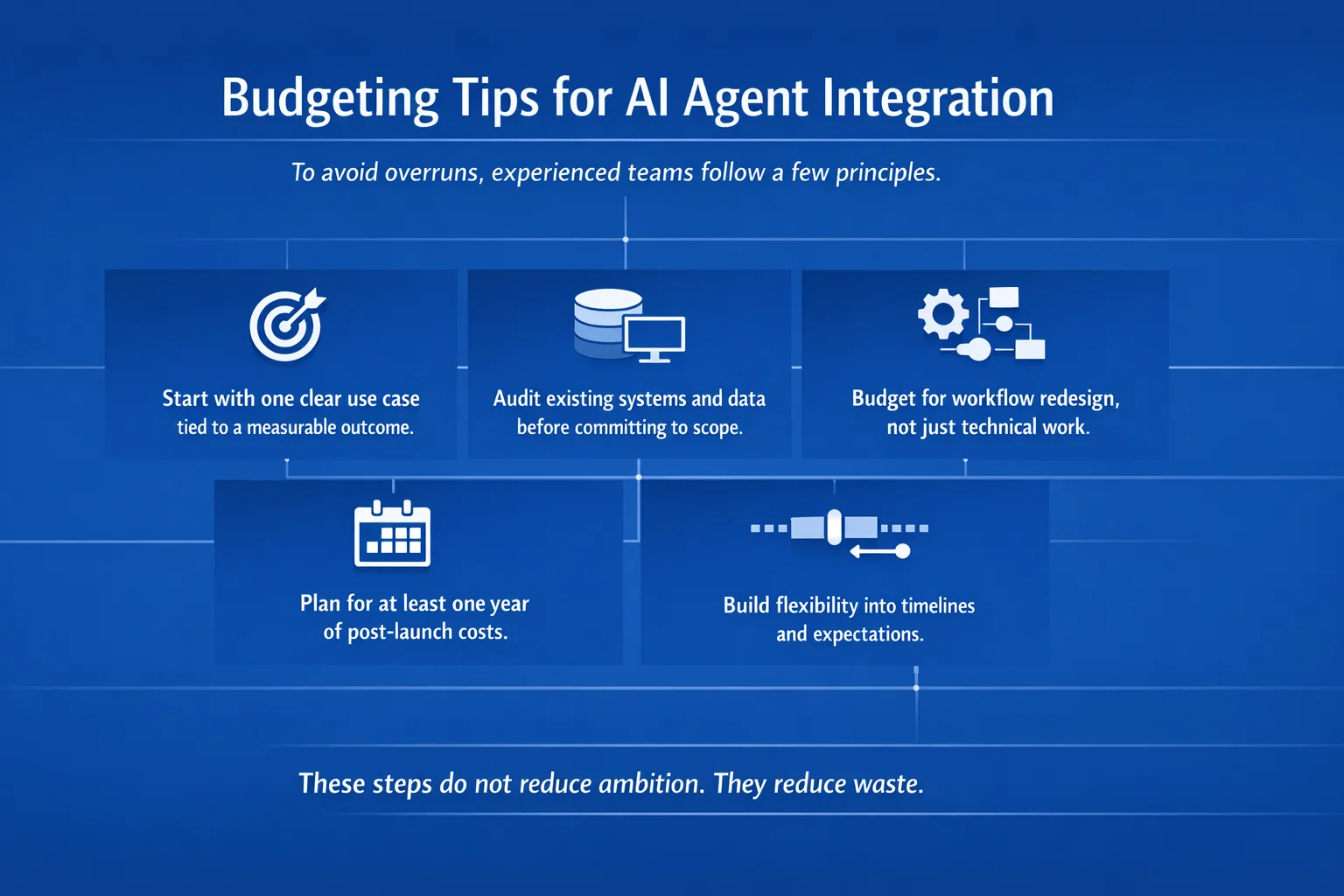
Budgeting Tips for AI Agent Integration
To avoid overruns, experienced teams follow a few principles.
- Start with one clear use case tied to a measurable outcome.
- Audit existing systems and data before committing to scope.
- Budget for workflow redesign, not just technical work.
- Plan for at least one year of post-launch costs.
- Build flexibility into timelines and expectations.
These steps do not reduce ambition. They reduce waste.
Is AI Agent Integration Worth the Cost?
For most businesses, the question is not whether AI agents are affordable, but whether poor integration is affordable.
When integration is done well, AI agents can reduce manual work, improve response times, and surface insights that were previously buried in systems. When integration is rushed or underfunded, costs rise without delivering value.
The real investment is not in AI itself. It is in aligning technology, data, and people so the agent can operate where real work happens.
Final Thoughts
Integrating an AI agent with existing software is a serious software initiative, not a quick add-on. Average costs range from $20,000 to $250,000, shaped by system complexity, data readiness, and workflow design.
Teams that approach integration as a business transformation, rather than a technical shortcut, consistently see better results. Those that treat it as a plug-in often pay twice.
The difference is not the AI. It is how well the integration is planned, executed, and supported over time.
FAQ
1. Why is AI agent integration so expensive compared to just building the model?
Because the real cost isn’t the AI model itself – it’s everything around it. Connecting that model to your actual systems, mapping it to your workflows, making sure it handles real data securely, and doesn’t break anything along the way. That’s where the complexity (and cost) comes in.
2. Can I integrate an AI agent without reworking my current systems?
Technically? Maybe. Realistically? Probably not if you want it to do anything meaningful. Most legacy systems weren’t built with AI in mind, so there’s usually some level of process redesign, API cleanup, or data alignment involved. The smoother your current systems are, the less work you’ll need but some tuning is almost always required.
3. What if we already use tools like a CRM or helpdesk – will that make integration easier?
It may help, especially if those tools have good APIs and documentation. But even then, it’s not plug-and-play. You’ll still need logic for how the agent interacts with that data, what it can access, what it should ignore, and what happens when something goes wrong. Integration gets easier with modern tools, but not effortlessly.
4. Can small businesses afford AI agent integration?
Yes, but the trick is staying focused. Trying to automate your entire company on day one will burn your budget fast. Start with a small use case that matters, like support ticket deflection or lead qualification, prove the value, and grow from there. A focused project under $40,000 is possible if you’re strategic about it.
5. How do I know if the AI agent is actually delivering value after it’s integrated?
You’ll know if you measure the right things. Look for time saved, manual steps reduced, resolution speed, or ticket volume deflected. What you don’t want is to launch an agent and then forget to track whether anyone’s using it, or worse, whether it’s causing new problems. Tie it to a real metric, not a feeling.
 English
  German
  Arabic
  French
  Dutch
Dutch  Spanish