
Overview: Digital transformation costs range from $50,000 for small-scope projects to $27.5 million for large enterprise initiatives, with most mid-sized companies investing $250,000-$5 million. Key cost drivers include technology infrastructure, change management, and strategic implementation, while successful transformations depend more on strategic agility and organizational reconfiguration than isolated technology investments.
Planning a digital transformation budget feels like trying to price a custom home without knowing whether it’s a cabin or a mansion. The numbers businesses encounter range dramatically—and for good reason.
Digital transformation isn’t a single product with a sticker price. It’s a strategic overhaul that touches everything from legacy systems to employee mindsets. Some companies spend $50,000 on targeted automation. Others invest tens of millions in comprehensive enterprise reinvention.
Here’s the thing though—the real question isn’t just “how much?” but “what drives these costs, and what returns should organizations expect?”
This guide breaks down actual spending patterns, hidden expenses that catch teams off guard, and the strategic factors that separate successful transformations from expensive failures.
What Organizations Actually Spend on Digital Transformation
According to Svitla Systems research citing the International Data Corporation (IDC), large enterprises typically invest around $27.5 million in comprehensive digital projects. Some allocate up to 5% of their annual revenue to digital transformation initiatives.
But that’s just the enterprise tier. The cost spectrum looks dramatically different depending on organizational size and scope.
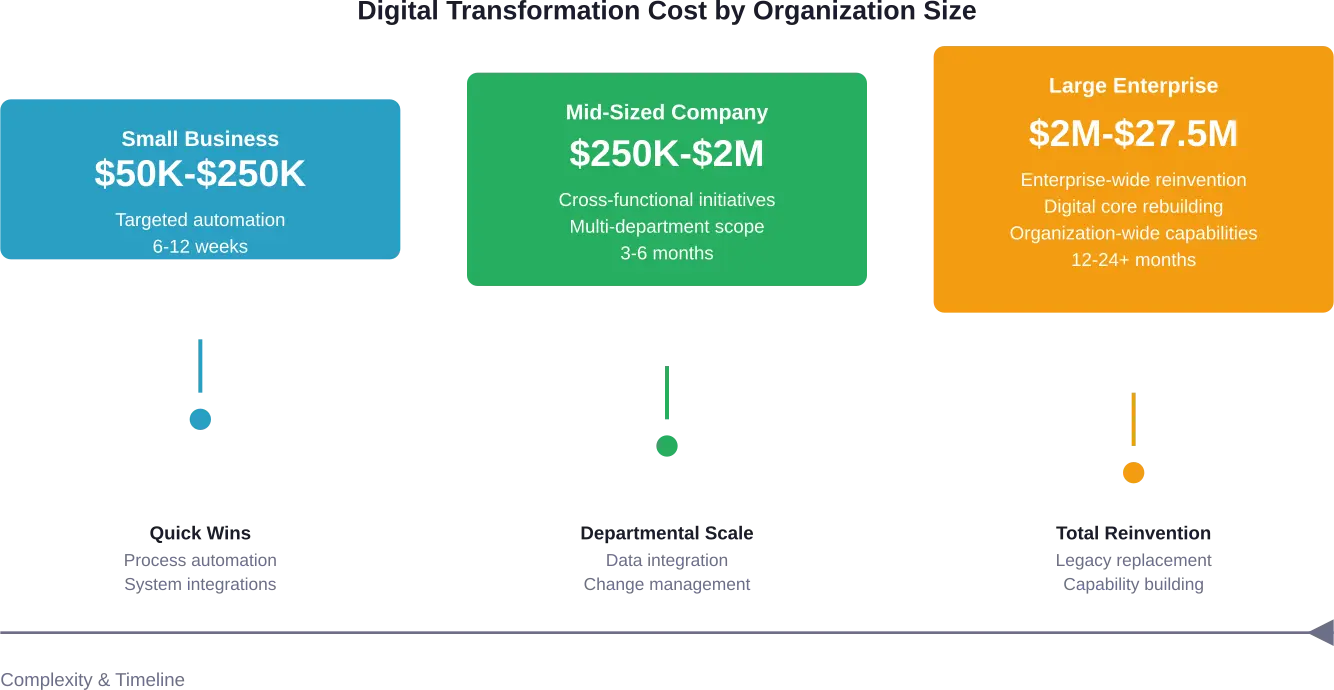
| Transformation Category | Budget Estimate | Details |
|---|---|---|
| Small-scope digitization | $50,000 – $250,000 | Deploying digital solutions in targeted business areas or enhancing current systems |
| Mid-level transformation | $250,000 – $2 million | Cross-functional initiatives affecting multiple departments |
| Enterprise-wide reinvention | $2 million – $27.5 million | Comprehensive transformation across all business units |
For Canadian businesses specifically, 2025-2026 implementation data shows process automation projects for SMEs typically cost between $25,000 and $120,000 for one-time implementation, with monthly recurring costs ranging from $1,200 to $4,500 due to increased labor rates and advanced AI integration requirements. These projects usually take 6-12 weeks to complete.
Midsize to enterprise companies looking at broader transformation initiatives should expect costs anywhere from $250,000 to five million dollars, depending on the scale and ambition of the transformation.
Breaking Down the Investment by Organization Size
Small businesses often start with focused automation—workflow tools, basic integrations, maybe a customer relationship management system upgrade. Real talk: these initiatives deliver quick wins without the complexity of enterprise-scale projects.
Mid-sized companies typically tackle departmental transformations. Marketing automation gets connected to sales systems. Supply chain visibility improves through real-time data integration. The costs climb because these projects require more stakeholders, more data migration, and more change management.
Large enterprises? They’re often rebuilding the entire digital core. That means cloud infrastructure overhauls, legacy system replacements, data architecture redesigns, and organization-wide capability building. According to Accenture’s Total Enterprise Reinvention research, companies pursuing this comprehensive approach—what Accenture calls “Reinventors”—realize 10% higher incremental revenue growth, 13% higher cost-reduction improvements, and 17% higher balance-sheet improvements compared to all other companies.
Estimate Your Digital Transformation Cost With AI Focus
Digital transformation costs vary widely depending on data readiness, system integration, and how much intelligence you want to embed in operations. AI Superior helps businesses assess their current systems, define a roadmap for modernization, and estimate the effort needed to integrate AI into workflows. Their team combines AI strategy, architecture planning, and technical estimation to produce a realistic cost overview. This gives you a transparent picture of investment from discovery to deployment.
Ready to Calculate Your Digital Transformation Investment?
Talk with AI Superior to:
- assess your current tech and data maturity
- define transformation objectives and phases
- receive a structured cost estimate tied to deliverables
👉 Request a digital transformation cost estimate from AI Superior.
What Drives Digital Transformation Costs
Technology licenses and infrastructure represent the obvious expenses. But they’re rarely the biggest cost drivers.
Research published in the International Journal of Aviation, Aeronautics, and Aerospace (IJAAA) analyzing digital transformation capabilities of low-cost airlines found that successful transformation depends less on isolated technology investments and more on strategic agility, data-driven insight generation, and organizational reconfiguration.
That study, which evaluated low-cost airlines using multi-criteria decision-making frameworks, revealed that digital seizing capabilities—specifically strategic digital agility, digital strategy development, and resource prioritization—carry the greatest weight in transformation success.
The Technology Stack
Cloud infrastructure migration, software licenses, API integrations, data storage, security tools—the technology components add up quickly. For enterprise implementations, cloud infrastructure alone can run hundreds of thousands annually.
But wait. Solutions designed for 100 users often break at 1,000. Performance degrades while costs escalate. What seemed like a bargain in the pilot phase becomes prohibitively expensive at scale.
Change Management and Training
Almost two-thirds (64 percent) of digital transformation projects start without a clear roadmap, while 56 percent of respondents claim that senior leadership doesn’t effectively support transformation initiatives.
That lack of strategic direction creates expensive course corrections. Teams build solutions that don’t align with business objectives. Employees resist new systems because they don’t understand the “why” behind changes.
Change management—the structured approach to transitioning people, teams, and organizations—often represents 15-25% of total transformation costs. For a $2 million project, that’s $300,000 to $500,000 dedicated purely to helping people adapt.
Integration and Data Migration
Legacy systems don’t play nice with modern platforms. Data lives in incompatible formats across disconnected databases. Integration work requires custom development, extensive testing, and meticulous data cleanup.
These integration costs catch organizations off guard. The new CRM system costs $50,000 annually. But connecting it to ERP, marketing automation, customer support, and analytics platforms? That integration project balloons to $200,000.
Ongoing Maintenance and Evolution
Digital transformation isn’t a one-time project. It’s a continuous capability.
Monthly recurring costs for process automation typically range from $500 to $3,000. Enterprise platforms require dedicated teams for maintenance, optimization, security updates, and feature enhancements.
According to Accenture’s January 2024 quantitative analysis, the rate of change affecting businesses has risen 183% since 2019—a nearly threefold increase over just four years. That accelerating pace means transformation initiatives must build in flexibility and ongoing evolution from day one.
Hidden Costs That Derail Budgets
The quoted project cost never tells the full story. Hidden expenses emerge throughout implementation, often adding 30-50% to initial estimates.
Technical debt remediation tops the list. Before new systems can go live, organizations must address years of accumulated shortcuts, workarounds, and outdated code in existing systems. That cleanup work wasn’t in the original scope, but it becomes non-negotiable when integration deadlines loom.
Productivity dips during transition periods. Employees take longer to complete tasks while learning new systems. Customer service quality sometimes drops temporarily. These productivity costs don’t show up on project budgets, but they impact the bottom line.
Vendor dependencies create ongoing costs that extend far beyond initial contracts. Proprietary platforms lock organizations into specific vendors. Custom integrations require specialized expertise that commands premium rates. Switching costs become prohibitive.
Compliance and security requirements add layers of complexity. Healthcare organizations must ensure HIPAA compliance. Financial services need SOC 2 certification. International operations require GDPR adherence. Each compliance framework adds specialized consulting, technical controls, and ongoing auditing expenses.
The Cost of Digital Transformation Inertia
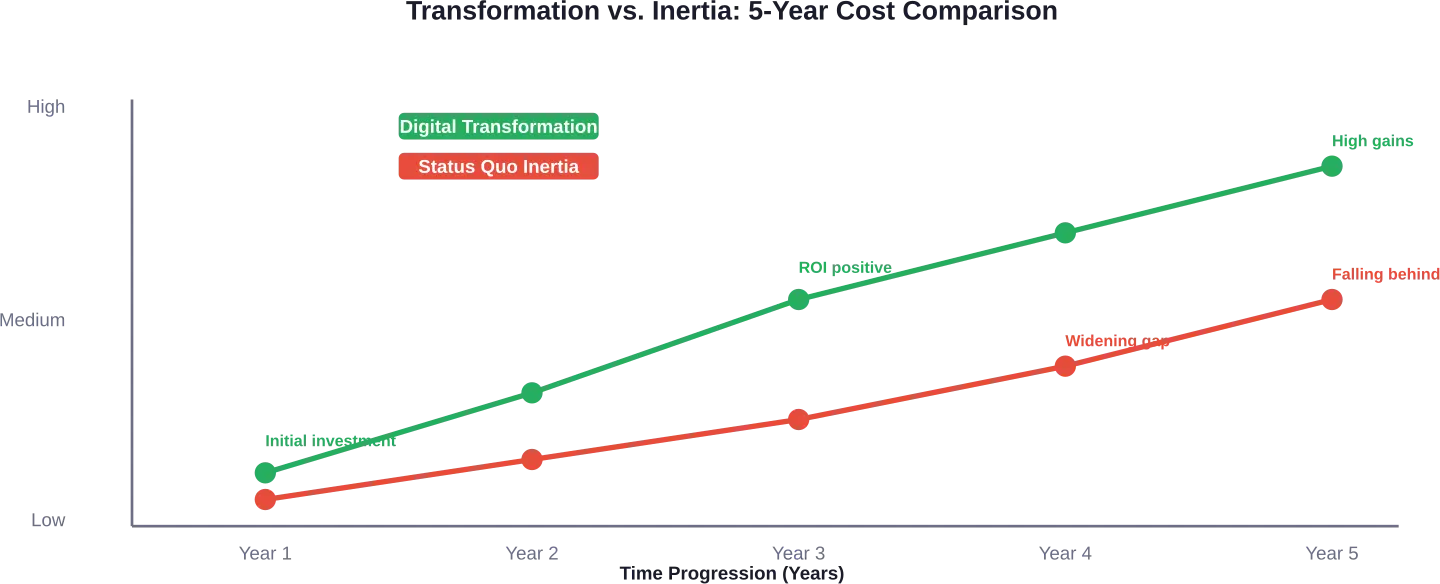
Now, this is where it gets interesting. Between 2000 and 2020, 52% of Fortune 500 companies vanished—not due to inferior products but because of delayed adaptation to digital trends.
Kodak’s hesitance to fully embrace digital photography. Blockbuster’s delay in digital streaming adoption. Nokia’s slow response to the smartphone revolution. These aren’t just business school case studies. They’re stark reminders that inaction carries costs far exceeding transformation investments.
But does that actually work as a decision-making framework? Organizations can’t transform out of fear alone.
The competitive gap widens measurably. Accenture projects a 2.4x increase in revenue growth gap by 2026 between companies pursuing total enterprise reinvention and those taking incremental approaches.
Talent acquisition and retention suffer when organizations lag digitally. According to organizational research, 60% of tech employees cite “opportunities for innovation” as a critical factor in deciding where to work. Companies stuck with legacy systems struggle to attract top talent.
Operational inefficiencies compound over time. Manual processes that cost $50,000 annually in wasted productivity balloon to $100,000, then $150,000 as the organization grows but systems don’t scale.
Calculating the Opportunity Cost
What revenue opportunities slip away because systems can’t support new business models? How many customers choose competitors with better digital experiences? What strategic partnerships become impossible because of technical limitations?
These opportunity costs dwarf transformation expenses for many organizations. A $2 million transformation investment that unlocks $10 million in new revenue opportunities delivers 5x returns—and that’s before considering efficiency gains and cost reductions.
Success Factors That Control Costs
According to Accenture’s Total Enterprise Reinvention research, 97% of executives surveyed agree technology plays a critical role in both their reinvention strategy and execution. But the ability to use technology as an execution enabler differentiates successful transformations from expensive failures.
Clear strategic vision from the start prevents costly pivots mid-project. Organizations that define specific business outcomes—not just technology implementations—stay focused and avoid scope creep.
Executive sponsorship matters more than most teams realize. That 56% of projects lacking effective senior leadership support? They experience budget overruns, timeline delays, and ultimately suboptimal results.
Phased implementation approaches spread costs over time while delivering incremental value. Rather than attempting a complete overhaul simultaneously, successful organizations identify high-impact areas, prove value quickly, then expand.
Prioritizing Strategic Digital Agility
The research on low-cost airline digital transformation capabilities revealed something crucial: digital seizing capabilities—the ability to rapidly develop strategy, prioritize resources, and maintain agility—outweigh pure technology investments.
Organizations that build these capabilities first create frameworks for making smart technology choices later. They avoid expensive vendor lock-in because they’ve developed the strategic capacity to evaluate alternatives. They sidestep failed implementations because they’ve built organizational readiness before deploying new systems.
Building Internal Capabilities vs. Buying Services
The build-versus-buy decision fundamentally shapes transformation costs. External consultants bring expertise and accelerate timelines, but they’re expensive and don’t leave lasting internal capabilities.
A hybrid approach often works best. Bring in specialists for specific technical challenges while simultaneously building internal teams who’ll own systems long-term. That knowledge transfer costs more upfront but reduces ongoing dependency.
Industry-Specific Cost Variations
Healthcare organizations face unique compliance requirements that add 20-30% to baseline transformation costs. HIPAA compliance, electronic health record integrations, and patient data security create specialized needs.
Financial services institutions deal with stringent regulatory frameworks, legacy core banking systems, and high security standards. Their transformation costs often skew higher, but the efficiency gains and risk reductions justify investments.
Retail and e-commerce companies benefit from relatively standardized platforms and integrations. Their transformation costs trend toward the lower end of ranges, especially for mid-sized operations.
Manufacturing businesses juggle operational technology (OT) alongside information technology (IT). IoT sensors, supply chain systems, and production automation create complex integration challenges that drive costs upward.
ROI Timeline and Performance Metrics
When does digital transformation start paying back its investment? The short answer: it depends on scope and implementation quality.
Process automation projects targeting specific workflows often deliver positive ROI within 6-12 months. The math is straightforward—automation eliminates manual effort, reducing labor costs while improving accuracy.
Mid-level transformations affecting multiple departments typically achieve ROI in 12-24 months. These projects deliver efficiency gains across broader operations, but the benefits take longer to fully materialize.
Enterprise-wide reinvention requires 24-36 months for comprehensive ROI realization. But remember those Accenture numbers: Reinventors achieve 10% higher revenue growth, 13% better cost reductions, and 17% stronger balance sheet improvements compared to all other companies.
| Metric Category | Typical Improvement Range | Timeline to Realize |
|---|---|---|
| Operational efficiency | 15-30% reduction in process time | 6-12 months |
| Cost reduction | 10-20% in targeted areas | 12-18 months |
| Revenue growth | 5-15% incremental increase | 18-36 months |
| Customer satisfaction | 10-25% improvement in key metrics | 12-24 months |
| Employee productivity | 20-35% time savings on automated tasks | 6-18 months |
Measuring Beyond Financial Returns
Financial ROI tells part of the story, but strategic positioning, competitive advantage, and organizational resilience matter too.
Can the organization now enter markets that were previously inaccessible? Has customer experience improved measurably? Are employees more engaged and innovative?
These qualitative benefits resist easy quantification, but they compound over time. A more agile organization responds faster to market changes. Better data visibility enables smarter strategic decisions. Enhanced customer experiences drive loyalty that shows up in lifetime value metrics.
Common Cost Overrun Triggers
Scope creep tops the list of budget killers. Projects begin with defined objectives, then stakeholders request “just one more feature” repeatedly. Each addition seems small individually but collectively they derail timelines and budgets.
Underestimating change management creates expensive remediation work. Teams focus budgets on technology while skimping on training and communication. Then adoption stalls, forcing last-minute investments in change management support.
Data quality issues emerge during migration. Organizations discover their existing data is incomplete, inconsistent, or inaccurate. Cleaning that data becomes an unplanned project within the project.
Integration complexity exceeds initial assessments. Legacy systems use proprietary protocols or undocumented APIs. What seemed like a straightforward integration requires custom development and extensive testing.
Vendor management challenges multiply costs. Multiple vendors pointing fingers when things break. Integration issues falling into gaps between vendor responsibilities. Premium rates for coordinating across vendor teams.
Cost Optimization Strategies
Smart organizations control transformation costs without sacrificing outcomes. They start with ruthless prioritization—identifying the 20% of capabilities that will deliver 80% of business value.
Cloud-native architectures reduce infrastructure costs compared to traditional on-premise deployments. But watch the usage carefully. Unoptimized cloud implementations sometimes cost more than on-premise alternatives.
Open-source solutions offer alternatives to expensive proprietary platforms for certain use cases. The software license savings are real, but factor in implementation, support, and maintenance costs before assuming open-source is cheaper.
Standardization over customization reduces both initial costs and ongoing maintenance expenses. Custom features are tempting but they’re expensive to build, difficult to upgrade, and create technical debt.
Proof-of-concept pilots validate approaches before full deployment. Spending $50,000 on a pilot that reveals a solution won’t work saves millions in avoided full-scale implementation.
Negotiating Vendor Contracts
Vendor pricing isn’t fixed. Everything’s negotiable, especially for multi-year commitments or enterprise licenses.
Request itemized quotes that break down implementation, licensing, support, and optional services. That transparency helps identify areas for negotiation and reveals where vendors pad prices.
Multi-year contracts often secure discounts, but include flexibility clauses for scaling up or down. Business needs change—contracts should accommodate evolution.
Performance-based payment terms align vendor incentives with success. Rather than paying entirely upfront, structure payments around milestone achievements or performance metrics.
Building the Business Case
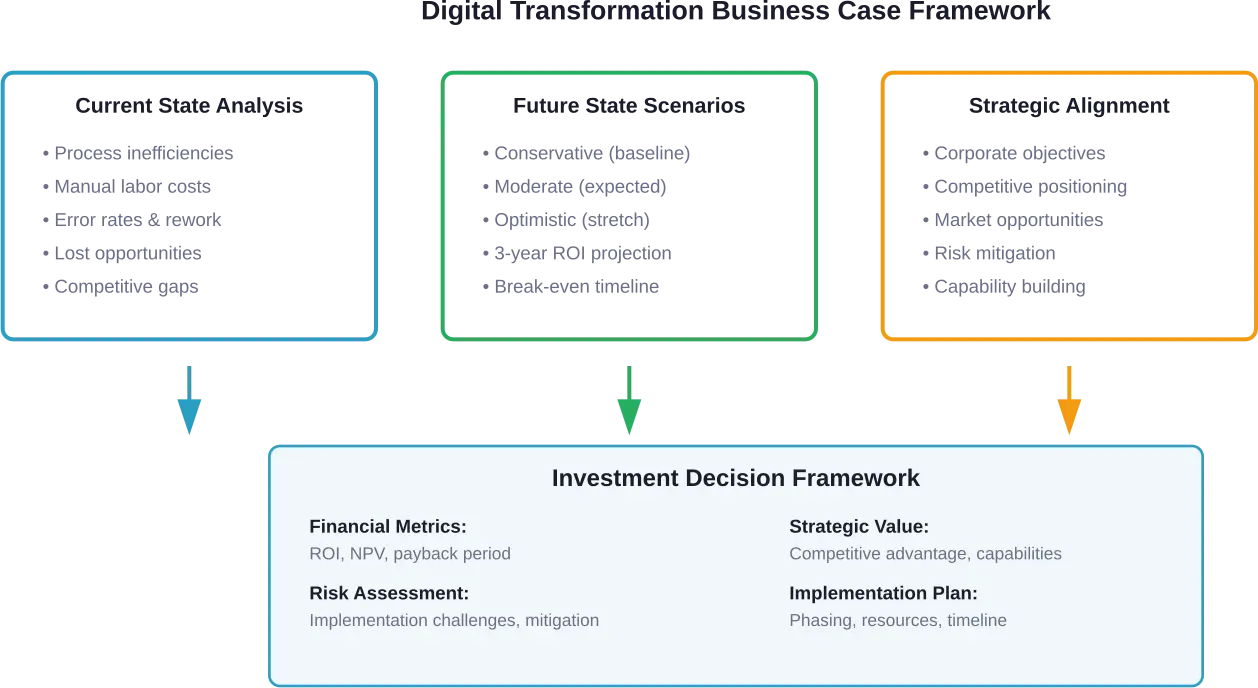
Securing executive approval requires quantified business cases that connect transformation investments to strategic outcomes.
Start with current-state cost analysis. What are existing processes actually costing in labor, inefficiency, errors, and lost opportunities? That baseline establishes the “cost of doing nothing.”
Project future-state scenarios with conservative, moderate, and optimistic assumptions. Conservative cases should still deliver positive ROI—that’s the minimum bar.
Include risk assessment that acknowledges implementation challenges while outlining mitigation strategies. Executives appreciate honest evaluation more than overly optimistic projections.
Connect transformation to strategic objectives. If the corporate strategy emphasizes customer experience, show how transformation enables that priority. If cost leadership drives competitive positioning, highlight efficiency gains.
2026 Market Trends Affecting Costs
Artificial intelligence integration is reshaping transformation budgets. AI capabilities that required custom development two years ago now come as platform features. That democratization reduces barriers but creates new cost considerations around data preparation, model training, and ongoing refinement.
Composable architecture approaches enable organizations to assemble best-of-breed solutions rather than committing to monolithic platforms. This flexibility controls costs but requires sophisticated integration capabilities.
Low-code and no-code platforms accelerate development while reducing dependency on specialized developers. These tools work brilliantly for specific use cases but hit limitations with complex logic or unique requirements.
The rate of change affecting businesses continues accelerating—that 183% increase since 2019 shows no signs of slowing. This acceleration means transformation approaches must emphasize adaptability over rigid long-term plans.
Frequently Asked Questions
What’s the average cost of digital transformation for a mid-sized company?
Mid-sized companies typically invest between $250,000 and $2 million for comprehensive digital transformation initiatives. The actual cost depends on scope, industry complexity, existing technology infrastructure, and organizational readiness. Focused projects targeting specific departments or processes fall toward the lower end, while enterprise-wide transformations requiring legacy system replacement approach the upper range.
How long does it take to see ROI from digital transformation?
ROI timelines vary by project scope. Process automation targeting specific workflows often delivers positive returns within 6-12 months through direct labor savings and efficiency gains. Mid-level transformations affecting multiple departments typically achieve ROI in 12-24 months. Comprehensive enterprise reinvention requires 24-36 months for full ROI realization, though incremental benefits materialize throughout implementation.
What percentage of digital transformation projects fail?
Research indicates that 70% of digital transformation initiatives fail to meet their intended objectives. Primary failure factors include lack of clear strategic vision (64% of projects start without defined roadmaps), insufficient executive sponsorship (56% lack effective senior leadership support), inadequate change management, and underestimation of organizational complexity.
Should we build internal capabilities or hire external consultants?
A hybrid approach typically delivers optimal results. External consultants bring specialized expertise and accelerate timelines for complex technical challenges, but they’re expensive and don’t build lasting internal capabilities. Successful strategies combine selective external expertise for knowledge gaps while simultaneously developing internal teams who’ll own and evolve systems long-term. This approach costs more initially but reduces ongoing dependency and enables continuous improvement.
How much should we budget for change management?
Change management typically represents 15-25% of total transformation costs. For a $2 million digital transformation project, allocate $300,000 to $500,000 for structured change management activities including stakeholder communication, training development and delivery, adoption support, and cultural alignment initiatives. Underfunding change management is a primary reason projects fail to achieve expected benefits despite successful technical implementation.
What are the biggest hidden costs in digital transformation?
Technical debt remediation often adds unexpected costs when legacy system issues must be addressed before integration. Productivity dips during transition periods impact operational performance. Data quality problems require unplanned cleanup efforts. Integration complexity frequently exceeds initial estimates, particularly with proprietary legacy systems. Ongoing maintenance, security updates, and system evolution create recurring costs that extend well beyond initial implementation budgets.
How do I calculate the cost of not transforming?
Calculate opportunity costs by quantifying competitive disadvantages, lost revenue opportunities, operational inefficiencies, and talent challenges. Assess market share losses to digitally advanced competitors, revenue growth constraints from technical limitations, cumulative costs of manual processes and inefficiencies, and talent acquisition difficulties when lacking modern systems. Between 2000 and 2020, 52% of Fortune 500 companies disappeared primarily due to delayed digital adaptation—the cost of inaction can exceed transformation investments by orders of magnitude.
Making the Transformation Decision
Digital transformation costs represent significant investments, but framing them purely as expenses misses the strategic picture. These are capability investments that enable organizations to compete effectively, serve customers better, and build resilience against accelerating market changes.
The organizations succeeding in 2026 aren’t necessarily those spending the most. They’re the ones building strategic digital agility, maintaining clear vision throughout implementation, and viewing transformation as continuous evolution rather than one-time projects.
That research on low-cost airline capabilities proved something important: successful digital transformation depends less on isolated technology investments and more on strategic agility, data-driven insight generation, and organizational reconfiguration. Technology enables outcomes, but strategy and organizational readiness determine success.
So what’s the right investment level for a specific organization? It depends on strategic ambitions, competitive dynamics, current capabilities, and tolerance for the risks of inaction.
The companies disappearing between 2000 and 2020 didn’t fail because they refused to invest. They failed because they waited too long, moved too slowly, or pursued transformation without strategic clarity.
Start With Strategic Clarity
Before discussing budgets or technologies, define what business outcomes matter most. Revenue growth? Cost reduction? Customer experience? Market expansion? Operational resilience?
Those outcomes drive technology choices, not the reverse. Organizations that start with shiny new technologies and reverse-engineer business cases often end up with expensive systems that don’t move strategic needles.
Look, transformation costs will feel significant regardless of organization size. But maintaining status quo operations carries costs too—they just accumulate gradually rather than appearing as line items on project budgets.
The strategic question isn’t whether to invest in digital transformation. It’s whether the organization will transform deliberately and strategically, or whether it’ll be forced into reactive, expensive changes when competitive pressures leave no alternatives.
Ready to develop a strategic transformation approach tailored to specific business needs? Start by assessing current-state capabilities, defining clear business outcomes, and building business cases that quantify both transformation costs and the costs of inertia. The organizations thriving in 2026’s accelerating business environment made those investments 18-36 months ago.
 English
  German
  Arabic
  French
  Dutch
Dutch  Spanish