
Overview: AI software development costs typically range from $5,000 for basic models to over $500,000 for complex, custom solutions. The total investment depends on model complexity (accounting for 30-40% of costs), data infrastructure, development team expertise, hardware requirements, and ongoing maintenance. According to research from the Wharton School of Business, AI is projected to increase productivity and GDP by 1.5% by 2035, making it a strategic investment rather than just an expense.
The question isn’t whether AI will transform your business—it’s how much that transformation will cost. But here’s the thing: AI pricing isn’t like buying software off the shelf. It’s more like building a custom house where every decision affects the final price tag.
In 2026, simple AI models start around $5,000, while sophisticated deep learning applications can exceed $500,000. The wide range isn’t arbitrary. It reflects fundamental differences in what these systems actually do and how they’re built.
With computing expenses potentially increasing significantly over the coming years, understanding these cost drivers matters more than ever. The good news? Breaking down the pricing structure makes budgeting significantly more predictable.
Understanding the AI Development Cost Landscape
AI development costs span an enormous range because “AI” encompasses vastly different technologies. A basic chatbot uses pre-trained models and standard APIs. A custom computer vision system for medical diagnostics? That requires original research, massive datasets, and specialized infrastructure.
The baseline for simple AI implementations starts around $5,000. These projects typically involve integrating existing AI services—think adding a recommendation engine to an e-commerce site using off-the-shelf tools.
Mid-complexity projects involving custom machine learning models range from $50,000 to $150,000. These require data preparation, model training, and integration work but don’t push the boundaries of AI research.
Complex AI systems utilizing deep learning and neural networks? Those run $150,000 to $500,000 or more. Projects at this level often involve multiple models, real-time processing, and extensive testing across edge cases.
What the Data Actually Shows
According to the U.S. Bureau of Labor Statistics, computer systems analysts earned a median annual wage of $103,790 in May 2024. Software developers and database administrators command similar rates, directly impacting project costs.
The BLS acknowledges that AI may support demand for computer occupations, as software developers may be needed to develop AI-based business solutions and maintain AI systems. This sustained demand keeps development costs elevated.
The UK AI market is expected to reach £21.3 billion ($26.89 billion) by 2030, up from £6.3 billion ($7.95 billion) expected by the end of 2025. That explosive growth reflects massive investment across industries—and proves companies see the ROI despite substantial upfront costs. 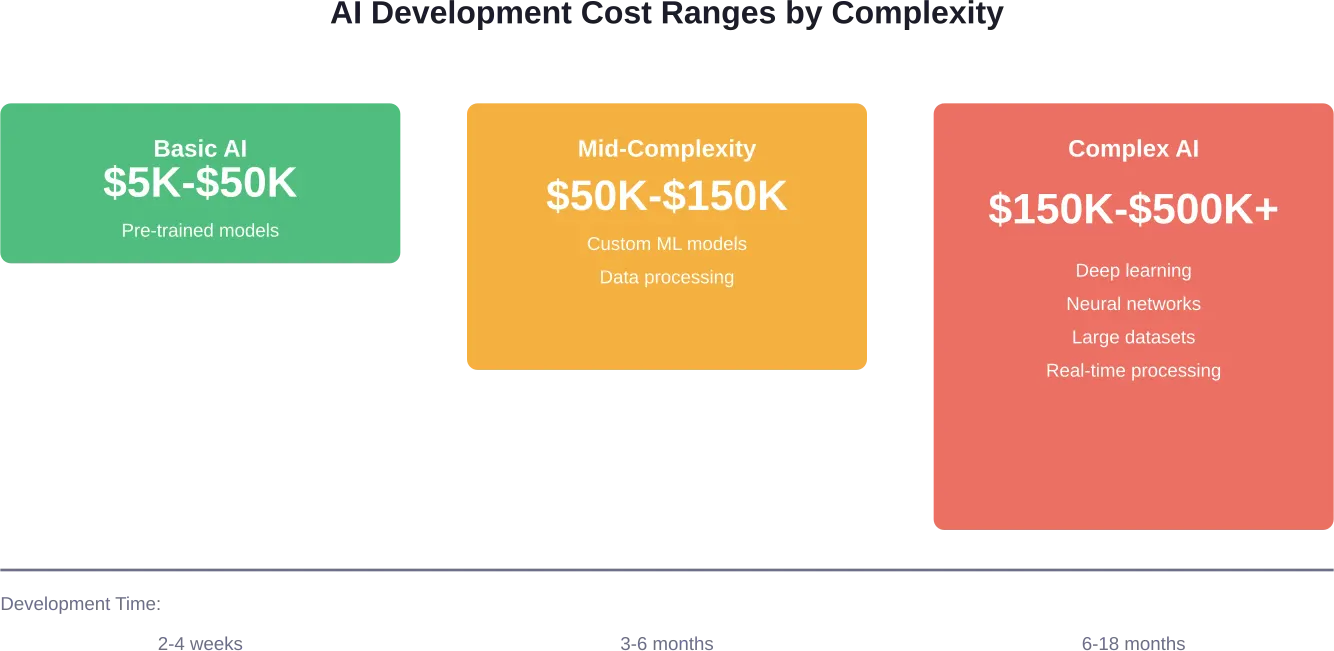
Key Factors Influencing AI Development Costs
AI project budgets aren’t pulled from thin air. Several concrete factors determine whether a project costs $50,000 or $500,000. Understanding these variables helps set realistic expectations.
Model Complexity and Architecture
The complexity of the AI model accounts for 30-40% of total project costs. This single factor drives more expense than any other component.
Simple rule-based systems or basic machine learning models cost less because they require fewer computational resources and shorter development cycles. A sentiment analysis tool using standard natural language processing? Relatively straightforward.
Deep learning models with multiple neural network layers? Those demand extensive training on powerful hardware. Meta’s LLaMA models, for instance, required massive computational infrastructure and months of training time.
The choice between using pre-trained models versus training from scratch dramatically impacts costs. Transfer learning—adapting existing models to new tasks—can reduce expenses by 60-70% compared to building from the ground up.
Data Infrastructure and Quality
Quality data forms the foundation of effective AI. But acquiring, cleaning, and preparing that data isn’t cheap.
Data collection costs vary wildly based on availability. Publicly available datasets cost nothing but may not fit specific needs. Proprietary data collection—especially for niche applications—can run $20,000 to $100,000 or more.
Then comes data cleaning. Real-world data arrives messy, inconsistent, and full of errors. Data scientists typically spend 60-80% of project time on preparation and cleaning rather than actual model building.
Storage and processing infrastructure adds ongoing costs. According to a 2024 United States Data Centre Energy Usage Report, data centers account for 4.4% of the nation’s total electricity consumption, with projections indicating that by 2028, half of this demand will be driven by AI-related workloads. Those energy costs get passed to cloud computing customers.
Development Team Composition and Location
Who builds the AI system significantly affects the budget. Team composition matters as much as team size.
A typical AI development team includes data scientists, machine learning engineers, software developers, and DevOps specialists. According to BLS data, these professionals command median salaries around $98,670 to $103,790 annually.
Location creates substantial cost variations. Development teams in major tech hubs charge premium rates. Offshore development can reduce costs by 40-60%, though it introduces communication challenges and potential quality concerns.
In-house versus outsourced development presents trade-offs. Building an internal AI team requires recruitment, training, and retention costs that exceed $200,000 annually per specialist. Hiring external experts provides flexibility but typically costs $100-$250 per hour for experienced AI developers.
Infrastructure and Computing Resources
AI models need serious computational power, especially during training. Infrastructure costs break down into several categories.
Cloud computing platforms like Amazon EC2 charge based on usage. A typical setup might cost $20,959 monthly for compute instances, $1,233 for storage, and $275 for networking—totaling over $250,000 annually for a moderately complex system.
Hardware choices matter too. GPUs accelerate deep learning but cost significantly more than standard processors. Training large models might require specialized TPUs (Tensor Processing Units) available only through specific cloud providers.
The energy consumption of AI systems continues escalating. Training a single large language model can consume as much electricity as several households use in a year. Those costs appear in cloud bills or infrastructure expenses.
| Infrastructure Component | Monthly Cost (USD) | Annual Cost (USD) | Primary Use Case
|
|---|---|---|---|
| Amazon EC2 (Compute) | $20,960 | $251,520 | Model training and inference |
| Elastic Block Storage | $1,233 | $14,796 | Data storage |
| S3 Standard Storage | $471 | $5,652 | Dataset and backup storage |
| VPN Connection | $275 | $3,300 | Secure data transfer |
| Total | $22,939 | $275,268 | Complete infrastructure |
Integration and Deployment Requirements
Building the AI model represents just one piece of the puzzle. Integration with existing systems often costs as much as initial development.
Legacy system integration presents unique challenges. Older systems may lack APIs or use incompatible data formats. Custom middleware development can add $30,000 to $100,000 to project costs.
Deployment architecture decisions impact ongoing expenses. Edge deployment—running models on local devices rather than cloud servers—requires optimization and testing across different hardware configurations.
Security measures can’t be optional. AI systems handling sensitive data need encryption, access controls, and compliance with regulations like GDPR. According to Brookings Institution research, companies with high cybersecurity exposure see roughly 0.33% lower stock market returns per month compared to more secure peers, quantifying the real economic cost of vulnerabilities.

Know Your AI Software Development Cost
AI-based software costs depend on data complexity, model choice, infrastructure, and integration needs. AI Superior evaluates data quality, technical scope, and deployment requirements before estimating development effort. Their specialists factor in training cycles, engineering iterations, and test validation to create a budget anchored in real work, not guesswork. This helps avoid surprise costs later in the project.
Ready to Estimate Your AI Software Budget?
Talk with AI Superior to:
- analyze project requirements and data needs
- select appropriate models and architecture
- receive a detailed development cost breakdown
👉 Request an AI software development quote from AI Superior.
Industry-Specific AI Development Costs
AI implementation costs vary dramatically across industries. Regulatory requirements, data sensitivity, and accuracy demands all influence the final price tag.
Healthcare AI Applications
Healthcare represents one of the most expensive sectors for AI development. The reasons are clear: high accuracy requirements, strict regulatory compliance, and sensitive patient data.
Diagnostic imaging systems using computer vision to detect diseases typically cost $150,000 to $1,200,000. These systems require FDA approval in the US, extensive validation studies, and integration with existing medical equipment.
Patient triage bots and virtual health assistants fall on the lower end, ranging from $80,000 to $300,000. These systems still need HIPAA compliance and careful handling of protected health information.
Drug discovery platforms utilizing AI for molecular modeling and screening can exceed $1 million. These systems process enormous datasets and require collaboration with pharmaceutical researchers.
Financial Services and Fintech
Financial applications demand high reliability and security. Companies like Revolut use machine learning algorithms to provide personalized financial services, but developing similar systems requires substantial investment.
Fraud detection systems typically cost $100,000 to $500,000. These systems analyze transaction patterns in real-time, requiring low-latency infrastructure and continuous model updates as fraud patterns evolve.
Algorithmic trading platforms range from $200,000 to over $1 million. Financial regulations, audit trails, and risk management features add complexity beyond basic prediction models.
Credit scoring and loan approval systems cost $80,000 to $400,000. Regulatory requirements around fair lending practices demand explainability features that increase development time.
Cybersecurity Applications
Cybersecurity AI focuses on threat detection, anomaly identification, and automated response systems. These applications need to process massive data volumes in real-time.
Anomaly detection systems for network monitoring typically cost $120,000 to $600,000. These systems learn normal behavior patterns and flag deviations that might indicate security breaches.
The National Institute of Standards and Technology (NIST) published an AI Risk Management Framework emphasizing the importance of trustworthy AI systems. Implementing frameworks that align with NIST guidelines adds development time but reduces long-term risk.
| Industry | AI Application Examples | Estimated Cost Range | Key Cost Drivers
|
|---|---|---|---|
| Healthcare | Diagnostic imaging, patient triage, drug discovery | $150,000 – $1,200,000 | Regulatory compliance, accuracy requirements |
| Finance | Fraud detection, algorithmic trading, credit scoring | $80,000 – $1,000,000+ | Security, real-time processing, regulations |
| Cybersecurity | Anomaly detection, threat hunting, automated response | $120,000 – $600,000 | Data volume, real-time requirements |
| Retail | Recommendation engines, inventory optimization | $40,000 – $300,000 | Scale, personalization depth |
| Manufacturing | Predictive maintenance, quality control | $100,000 – $500,000 | IoT integration, sensor data processing |
Breaking Down AI Development Cost Components
Understanding where money actually goes helps identify potential savings without compromising quality. AI projects contain several distinct cost categories.
Design and Planning Phase
Every AI project starts with research, planning, and design. This phase typically represents 10-15% of total costs.
Requirements gathering involves stakeholder interviews, technical feasibility studies, and defining success metrics. Expect $5,000 to $20,000 for this phase depending on project scope.
UI/UX design for AI applications requires special consideration. Users need to understand when they’re interacting with AI, what the system can and can’t do, and how to interpret results. Basic design runs $5,000 to $15,000, while advanced custom interfaces with animations reach $15,000 to $40,000.
Architecture planning determines technology stack, data flow, and scalability approach. Experienced architects charge $150-$250 per hour, with planning taking 40-80 hours for typical projects.
Data-Related Expenses
Data costs often catch organizations off guard. This category includes acquisition, processing, storage, and ongoing management.
Data acquisition ranges from free (public datasets) to $100,000+ for specialized proprietary data. Medical imaging datasets, for example, require licensing from hospitals and research institutions.
Data labeling and annotation represents tedious but essential work. Human annotators review and label training data so models learn correctly. Costs run $0.05 to $5 per label depending on complexity. A dataset requiring 100,000 labeled images could cost $25,000 to $50,000 for annotation alone.
Data cleaning and preprocessing takes substantial developer time. At $75-$150 per hour for data engineers, cleaning a messy dataset might add $10,000 to $50,000 to project costs.
Model Development and Training
This phase consumes the largest portion of the budget—typically 40-50% of total costs.
Algorithm selection and experimentation involves testing multiple approaches to find what works best. Data scientists try different model architectures, feature engineering techniques, and training strategies.
Training costs depend on model complexity and required compute resources. Simple models train on standard hardware in hours. Complex deep learning models might need weeks on expensive GPU clusters.
Hyperparameter tuning optimizes model performance through systematic testing of different configurations. This process can multiply training costs by 10-50x as teams test hundreds of parameter combinations.
Testing and Validation
Thorough testing ensures AI systems work reliably in real-world conditions. Budget 15-20% of total costs for this phase.
Performance testing measures accuracy, precision, recall, and other relevant metrics. Testing requires holdout datasets separate from training data to prevent overfitting.
Edge case testing identifies failure modes. What happens with incomplete data? Unusual inputs? Adversarial examples designed to fool the model? Finding and fixing these issues prevents costly failures in production.
User acceptance testing validates that the system actually solves the intended business problem. Technical accuracy matters less than practical utility.
Deployment and Integration
Getting AI models into production involves infrastructure setup, integration, and monitoring. This phase typically costs 15-20% of the development budget.
Production infrastructure must handle expected load with acceptable latency. This might require load balancers, caching layers, and auto-scaling configurations.
API development enables other systems to interact with the AI model. RESTful APIs with proper authentication, rate limiting, and error handling take 80-200 developer hours.
Monitoring and logging systems track model performance over time. AI models can degrade as real-world conditions change, so continuous monitoring catches problems before they impact users.
Ongoing Maintenance and Operational Costs
Initial development represents just the beginning. AI systems require continuous maintenance, updates, and monitoring to remain effective.
Infrastructure and Hosting
Cloud hosting costs continue as long as the system runs. Monthly infrastructure expenses typically range from $1,000 for simple applications to $50,000+ for enterprise-scale systems.
Compute costs scale with usage. More users or more complex queries increase server requirements. Auto-scaling helps manage costs but requires careful configuration to avoid runaway bills.
Storage costs grow as systems accumulate more data. AI applications often log all inputs and outputs for quality monitoring and retraining, causing storage needs to expand continuously.
Model Retraining and Updates
AI models drift over time as real-world conditions change. Regular retraining maintains accuracy and relevance.
Retraining frequency depends on the application. Fraud detection models might need weekly updates as criminals adapt. Recommendation systems might retrain monthly. Stable applications could go six months between retraining cycles.
Each retraining cycle costs roughly 10-20% of initial training expenses. Budget $5,000 to $50,000 per retraining cycle depending on model complexity.
Monitoring and Support
Production AI systems need constant monitoring to catch performance degradation, errors, and security issues.
Monitoring tools track prediction accuracy, response times, error rates, and resource usage. Commercial AI observability platforms charge $500 to $5,000 monthly depending on scale.
Support staff address issues as they arise. A dedicated AI engineer for maintenance typically costs $8,000 to $15,000 monthly, though part-time support suffices for simpler systems.
Bug fixes and improvements represent ongoing expenses. Plan for 15-20% of initial development costs annually for maintenance and incremental improvements.
Calculating ROI for AI Software Development
According to research from the Wharton School of Business, AI is projected to increase productivity and GDP by 1.5% by 2035, nearly 3% by 2055, and 3.7% by 2075. But how do individual organizations measure returns on specific AI investments?
Quantifying AI Benefits
ROI calculation starts with identifying measurable benefits. These typically fall into several categories.
Cost reduction through automation represents the most straightforward benefit. If AI handles tasks that previously required human labor, calculate the salary savings minus AI operational costs.
Revenue increase from improved customer experiences, better recommendations, or new capabilities. An AI recommendation engine that increases conversion rates by 2% has quantifiable value.
Risk reduction from fraud prevention, quality control, or compliance monitoring. Calculate the average cost of incidents the AI system prevents.
Productivity gains let existing staff accomplish more. According to research from the Wharton School of Business, AI’s boost to annual productivity growth is strongest in the early 2030s, with a peak annual contribution of 0.2 percentage points in 2032.
ROI Calculation Methods
Several formulas help quantify AI returns. The simplest approach divides net benefit by total investment.
Basic ROI = (Gains – Costs) / Costs × 100%
Example: An AI customer service bot costs $120,000 to develop and $30,000 annually to operate. It handles 60% of inquiries that previously required human agents, saving $100,000 yearly in labor costs. First-year ROI = ($100,000 – $120,000 – $30,000) / $150,000 = -33%. Second-year ROI accounting for cumulative benefits = ($200,000 – $180,000) / $180,000 = 11%.
Payback period calculation shows how long until the investment breaks even. Using the example above, payback occurs roughly 18 months after deployment.
Net Present Value (NPV) accounts for the time value of money by discounting future cash flows. This method helps compare AI investments to alternative uses of capital.
Hidden Benefits and Considerations
Some AI benefits resist easy quantification but still matter.
Competitive advantage from AI capabilities may not show immediate ROI but positions the organization for long-term success. First-movers in AI often establish market leadership that competitors struggle to overcome.
Data assets accumulate as AI systems operate. The datasets generated during AI deployment have value for future projects and business intelligence.
Organizational learning from AI projects builds internal capabilities. Teams gain experience with AI methodologies, creating a foundation for subsequent initiatives.
Strategies to Optimize AI Development Costs
Smart approaches to AI development can dramatically reduce costs without sacrificing quality. Here’s what actually works.
Start with Pre-trained Models
Building models from scratch costs 3-5x more than adapting pre-trained models. Transfer learning leverages existing models trained on massive datasets.
OpenAI, Google, and Meta release pre-trained models for various tasks. Fine-tuning these models for specific needs costs $10,000 to $50,000 versus $100,000+ for training from scratch.
This approach works well for common applications like natural language processing, image recognition, and sentiment analysis. Highly specialized domains may still require custom models.
Adopt a Phased Approach
Build AI capabilities incrementally rather than attempting everything at once. Start with a minimum viable product that solves one specific problem.
Phase 1 might cost $50,000 and deliver 60% of the total value. Phase 2 adds another $40,000 for 25% more value. Phase 3 completes the vision for $60,000 and the final 15%.
This staged approach reduces risk. Organizations can validate assumptions and measure results before committing to full investment.
Leverage Cloud Services and APIs
Cloud providers offer AI services that eliminate infrastructure management. Amazon Rekognition, Google Vision API, and Azure Cognitive Services provide ready-made capabilities.
These services charge per API call—typically $0.001 to $0.01 per request depending on the service. For low to moderate volumes, this costs less than building and hosting custom models.
The trade-off: less customization and potential vendor lock-in. But for standard use cases, managed AI services deliver fast time-to-value at predictable costs.
Invest in Quality Data Early
Poor data quality multiplies costs throughout the project. Investing in proper data collection and cleaning upfront prevents expensive rework later.
Allocate 15-20% of the budget to data quality initiatives. This pays dividends through faster model convergence, better accuracy, and fewer training iterations.
Consider synthetic data generation for scenarios where real data is scarce or expensive. Techniques like GANs (Generative Adversarial Networks) can create training data at lower cost than manual collection.
Use Open Source Tools and Frameworks
Commercial AI platforms charge substantial licensing fees. Open source alternatives like TensorFlow, PyTorch, and Scikit-learn provide enterprise-grade capabilities at zero licensing cost.
Development might take 10-20% longer with open source tools, but the savings typically exceed $20,000 to $100,000 per project in licensing fees.
Open source also provides flexibility. Organizations own their entire technology stack without vendor dependencies or usage restrictions.

Choosing Between In-House and Outsourced Development
One of the most impactful cost decisions involves team structure. Building internal AI capabilities versus hiring external experts presents distinct trade-offs.
In-House Development Considerations
Building an internal AI team provides maximum control and alignment with business goals. The organization retains all intellectual property and builds lasting capabilities.
But recruitment costs are substantial. Finding qualified AI specialists takes 3-6 months on average. Salaries for experienced AI engineers range from $120,000 to $200,000+ annually according to BLS data.
A basic in-house AI team needs at least three people: a machine learning engineer, data scientist, and software developer. Total annual cost including benefits and overhead: $400,000 to $700,000.
Training and retention present ongoing challenges. AI specialists are in high demand, and turnover rates exceed 20% annually in many markets. Each departure means lost knowledge and recruitment costs.
Outsourced Development Benefits
External AI development firms bring immediate expertise across multiple domains. Teams have experience with similar projects and established best practices.
Costs are more predictable with fixed-price contracts. Organizations pay for deliverables rather than salaries, benefits, and overhead.
Typical outsourced AI development rates range from $100 to $250 per hour depending on location and expertise. A $150,000 project might require 750-1,500 hours of work.
The downside: less control over day-to-day development and potential knowledge transfer gaps. Organizations must invest in documentation and knowledge sharing to maintain the system long-term.
Hybrid Approaches
Many organizations find success with hybrid models. A small internal AI team of 1-2 people provides strategic direction and owns the roadmap. External specialists augment the team for specific projects.
This approach balances cost efficiency with internal capability building. The internal team learns from external experts while maintaining ownership of critical systems.
Hybrid models cost 20-30% less than fully internal teams while providing more control than complete outsourcing.
Future AI Development Cost Trends
AI pricing continues evolving as technology matures and competition intensifies. Understanding these trends helps with long-term planning.
Compute Costs Rising
Computing expenses are projected to increase over the coming years. This reflects growing model size and training requirements.
Models like GPT-4 contain hundreds of billions of parameters. Training these models requires data center-scale infrastructure and weeks of compute time costing millions of dollars.
According to a 2024 United States Data Centre Energy Usage Report, data centers account for 4.4% of US electricity consumption. Energy costs will increasingly influence AI economics.
But hardware efficiency improves simultaneously. New GPU architectures deliver better performance per dollar, partially offsetting increased demands.
Commoditization of Basic AI
Standard AI capabilities are becoming commodity services. Cloud providers now offer pre-built models for common tasks at decreasing prices.
What cost $50,000 to build three years ago might now be available as a $0.01-per-call API. This trend continues as more capabilities transition to platform services.
Custom AI development costs won’t drop proportionally. Specialized applications requiring unique models, proprietary data, or domain expertise will maintain premium pricing.
Productivity Improvements
According to research from the Wharton School of Business, AI will increase productivity and GDP by 1.5% by 2035. AI is also affecting the occupation landscape—the BLS acknowledges that AI may support demand for developers to build and maintain AI systems.
Developer tools incorporating AI assistance can reduce coding time by 30-40%. This productivity boost will gradually reduce development costs for AI and non-AI projects alike.
The highest-earning occupations face less AI exposure, while lowest-earning occupations see the least exposure. Middle-skill occupations face the most disruption, potentially creating labor market shifts that affect development costs.
Regulatory Compliance Costs
Government oversight of AI is increasing. The National Institute of Standards and Technology published an AI Risk Management Framework providing guidelines for trustworthy AI development.
Compliance with emerging regulations will add 10-20% to development costs for applications in regulated industries. Documentation, explainability features, and audit trails require additional development effort.
Organizations investing in compliance now will gain advantages as regulations solidify. Retrofitting compliance into existing systems costs 2-3x more than building it in from the start.
Common Cost Estimation Mistakes
AI project budgets frequently underestimate true costs. Avoiding these common mistakes improves financial planning.
Underestimating Data Requirements
Organizations often assume existing data will suffice for AI training. Reality rarely matches expectations.
Data might exist but prove inaccessible due to format issues, system silos, or access restrictions. Extracting and consolidating data from legacy systems can cost $50,000 to $200,000.
Data quality issues require extensive cleaning. Duplicates, missing values, inconsistent formats, and errors all need resolution before model training begins.
Ignoring Integration Complexity
Building a working model represents just half the challenge. Integration with production systems often costs as much as initial development.
Legacy systems may lack APIs or use outdated protocols. Custom integration layers add $30,000 to $100,000 to project costs.
Security requirements around data access, encryption, and audit logging increase complexity. These essential features rarely make early cost estimates but prove mandatory for deployment.
Overlooking Ongoing Costs
AI isn’t fire-and-forget technology. Models require regular maintenance, monitoring, and updates to remain effective.
Annual maintenance typically costs 15-25% of initial development. A $200,000 AI project requires $30,000 to $50,000 annually for upkeep.
Infrastructure costs continue as long as the system operates. Cloud hosting bills never stop, and usage often grows over time as adoption increases.
Unrealistic Timeline Expectations
AI projects take longer than traditional software development. Experimentation, training iterations, and model tuning consume substantial time.
Rushed timelines force compromises that increase costs. Teams take shortcuts in data quality or skip proper testing, leading to production issues that require expensive fixes.
Buffer project timelines by 25-30% beyond initial estimates. This provides room for inevitable challenges without forcing quality compromises.
Practical Budgeting Framework
Creating realistic AI budgets requires systematic thinking about all cost components. Here’s a practical framework.
Initial Assessment Phase
Start with a feasibility study before committing to full development. Budget $5,000 to $20,000 for this phase.
The assessment should answer several key questions: Is AI the right solution? What data exists and what quality? What accuracy is required? What regulations apply?
This upfront investment prevents costly mistakes. Organizations often discover AI isn’t needed—simpler solutions solve the problem at lower cost.
Minimum Viable Product Budget
Plan for an MVP that proves core functionality. Allocate 30-40% of total expected costs to this phase.
For a $200,000 total project, the MVP might cost $60,000 to $80,000. This delivers working functionality that validates assumptions before full investment.
MVP scope should focus on one specific use case with clear success metrics. Resist the temptation to include every desired feature.
Contingency Planning
Add 20-30% contingency to base estimates. AI projects encounter unexpected challenges more frequently than traditional development.
Data quality problems, model performance issues, or integration challenges often require additional work. Contingency budgets prevent project stalls when issues arise.
Track contingency spending carefully. If the budget remains largely unused, that indicates accurate initial estimation. Frequent contingency draws suggest the need for better scoping.
Multi-Year Planning
Think beyond initial development to 3-5 year total cost of ownership. This includes infrastructure, maintenance, updates, and team costs.
A $150,000 development project might cost $200,000 in year one (including infrastructure setup), then $40,000 to $60,000 annually for years 2-5. Total five-year cost: $350,000 to $450,000.
This long-term view enables better ROI calculations and ensures operational budget exists to support the system.
Questions to Ask Development Partners
When evaluating external AI development firms, specific questions reveal expertise and help avoid overpriced proposals.
Technical Approach Questions
Ask about model selection methodology. Reputable firms explain trade-offs between different approaches rather than pushing a single solution.
“What pre-trained models could accelerate this project?” tests whether the firm defaults to expensive custom development or considers cost-effective alternatives.
“How will you handle model drift and retraining?” ensures the proposal accounts for long-term maintenance, not just initial development.
Cost Structure Questions
“What’s included in your base price versus add-ons?” prevents surprise charges. Reputable firms provide detailed breakdowns of included scope.
“What factors could increase the final cost?” identifies risk areas. Good answers acknowledge potential variables like data quality issues or integration complexity.
“What’s your payment schedule?” reveals risk distribution. Balanced schedules tie payments to deliverables rather than front-loading all costs.
Experience and Process Questions
“Can you provide examples of similar projects with actual costs?” validates claims with concrete data. Vague responses suggest limited relevant experience.
“How do you handle underperforming models?” tests problem-solving approach. AI projects don’t always hit accuracy targets on first attempts.
“What knowledge transfer do you provide?” ensures the organization can maintain the system after development concludes.
Frequently Asked Questions
What’s the minimum budget needed to start an AI project?
Basic AI implementations using pre-trained models and cloud APIs can start around $5,000 to $10,000. These projects typically involve integrating existing AI services rather than building custom models. For example, adding a chatbot using a platform like Dialogflow or implementing image recognition through Google Vision API falls into this range. Custom machine learning projects start around $50,000 for simple models with clean data. Complex enterprise AI systems requiring custom development, extensive data processing, and specialized infrastructure typically begin at $150,000 to $200,000.
How long does AI software development typically take?
Development timelines vary dramatically based on complexity. Simple integrations using existing AI services take 2-4 weeks. Custom machine learning models with moderate complexity require 3-6 months from initial planning through deployment. Complex systems involving deep learning, large datasets, and extensive integration work typically need 6-18 months. The timeline includes requirements gathering, data preparation, model development and training, testing, integration, and deployment. Data quality issues often extend timelines—organizations should expect data preparation to consume 60-80% of development time for projects involving messy or unstructured data.
What ongoing costs should organizations budget for AI systems?
Annual maintenance and operational costs typically run 15-25% of initial development expenses. This includes cloud infrastructure hosting ($1,000 to $50,000+ monthly depending on scale), model retraining and updates (10-20% of initial training cost per cycle), monitoring and observability tools ($500 to $5,000 monthly), and support staff time. Infrastructure costs scale with usage—more users and queries increase compute and storage requirements. Organizations should also budget for periodic model improvements and feature additions, typically another 10-15% of original development costs annually. A $200,000 AI project might cost $30,000 to $50,000 yearly to operate and maintain.
Is it cheaper to build an AI team in-house or outsource development?
The cost comparison depends on project volume and timeline. A basic in-house AI team of three people (ML engineer, data scientist, developer) costs $400,000 to $700,000 annually including salaries, benefits, and overhead according to BLS wage data. Outsourced development typically charges $100-$250 per hour, making a $150,000 project cost-effective compared to annual team expenses. In-house teams make sense for organizations with multiple ongoing AI initiatives or strategic importance requiring deep internal expertise. Outsourcing works better for one-time projects or organizations testing AI capabilities. Hybrid approaches—a small internal team augmented by external specialists—often provide optimal cost-benefit balance, running 20-30% less than fully internal teams.
How much does it cost to train a custom AI model versus using pre-trained models?
Training custom models from scratch costs 3-5x more than fine-tuning pre-trained models. Custom training for a moderately complex model might run $100,000 to $300,000 including data preparation, computational resources, and iterative refinement. Pre-trained models like those from OpenAI, Google, or Hugging Face can be adapted to specific needs for $10,000 to $50,000 through fine-tuning. The cost difference reflects training time and computational resources—custom models require weeks or months on expensive GPU clusters, while fine-tuning typically completes in days on more modest infrastructure. Custom training makes sense only for highly specialized applications where pre-trained models lack relevant knowledge or where proprietary data provides competitive advantage.
What factors most significantly impact AI development costs?
Model complexity accounts for 30-40% of total costs and represents the single biggest cost driver. Complex deep learning architectures require more data, longer training times, and more expensive infrastructure than simpler models. Data quality and availability rank second—poor data quality can double project costs through extensive cleaning and preparation work. Development team expertise affects both cost and timeline—experienced AI specialists command premium rates ($150-$250/hour) but complete projects faster and with fewer iterations. Infrastructure requirements scale with model size and usage—real-time processing, high availability, and large-scale deployments multiply infrastructure costs. Integration complexity with existing systems often surprises organizations, sometimes costing as much as initial model development.
What ROI should organizations expect from AI investments?
According to research from the Wharton School of Business, AI is projected to increase productivity and GDP by 1.5% by 2035, with the strongest boost to productivity growth occurring in the early 2030s. For individual organizations, ROI varies dramatically by application. Cost reduction through automation typically shows 12-24 month payback periods when AI replaces manual processes. Revenue-generating applications like recommendation engines or personalized marketing often deliver 200-400% ROI within two years through increased conversion and customer lifetime value. Risk reduction applications (fraud detection, quality control) provide ROI through prevented losses rather than direct revenue. Organizations should calculate ROI across multiple dimensions including direct cost savings, revenue impact, productivity gains, and competitive positioning. Most AI projects achieving their technical goals deliver positive ROI within 18-36 months.
Conclusion: Making Smart AI Investment Decisions
AI software development costs reflect genuine complexity, not arbitrary pricing. Projects range from $5,000 for basic implementations to over $500,000 for sophisticated custom solutions because they solve fundamentally different problems with different technical requirements.
The key to successful AI investment lies in understanding cost drivers before committing resources. Model complexity, data quality, team expertise, infrastructure needs, and integration requirements all substantially impact the final price tag.
Smart organizations approach AI development strategically. They start with feasibility studies to validate assumptions. They build MVPs to prove value before full investment. They leverage pre-trained models and cloud services where appropriate. And they plan for multi-year total cost of ownership rather than just initial development.
According to research from the Wharton School of Business, AI’s boost to annual productivity growth peaks in the early 2030s with a 0.2 percentage point contribution in 2032. Organizations making thoughtful AI investments now position themselves to capture this productivity wave.
But success requires realistic budgeting. Add contingency. Plan for ongoing maintenance. Invest in data quality upfront. Choose development partners carefully. And remember that AI represents strategic investment in capabilities, not just a software purchase.
Ready to explore AI development for your organization? Start with a focused feasibility study to understand specific costs for your use case. The investment in proper planning pays dividends throughout the project lifecycle.
 English
  German
  Arabic
  French
  Dutch
Dutch  Spanish