
Overview: AI chatbot development costs range from $3,000 for basic rule-based bots to over $1 million for enterprise-grade custom solutions. The total investment depends on chatbot type (rule-based, NLP-driven, or LLM-powered), feature complexity, integration requirements, and ongoing maintenance needs. According to Google Cloud data, operational costs for a chatbot handling 100,000 daily interactions can run approximately $3.75 for input processing and additional output costs, while development expenses vary significantly by region and expertise level.
The chatbot market reached $7.76 billion in 2024 and is projected to hit $27.29 billion by 2030. That’s explosive growth.
But here’s what matters more: understanding exactly what it’ll cost to build one for your business. The pricing landscape is complicated. A simple FAQ bot might run a few thousand dollars, while an enterprise-grade conversational AI platform can push seven figures.
This isn’t about finding the cheapest option. It’s about matching investment to capability, understanding where money actually goes, and avoiding the hidden expenses that derail budgets.
Understanding the AI Chatbot Cost Spectrum
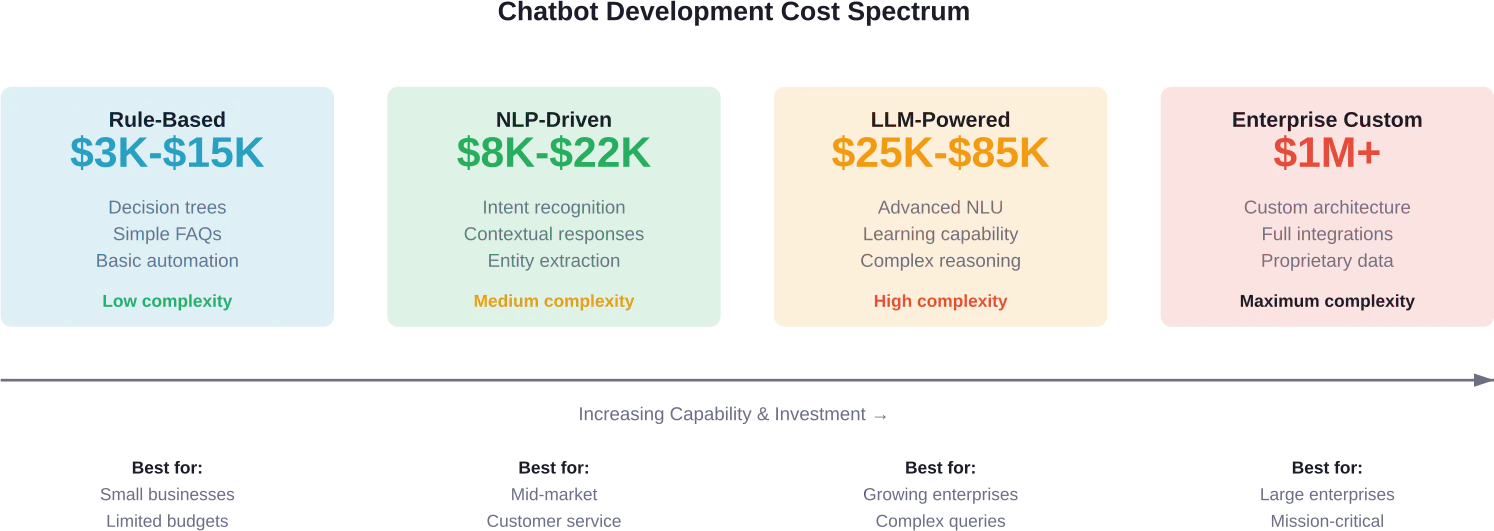
Not all chatbots are created equal. The cost difference between a basic rule-based system and an advanced LLM-powered assistant is massive, and the gap reflects fundamental differences in capability.
Rule-based chatbots operate on predefined decision trees. They’re effective for straightforward tasks like FAQs or appointment scheduling. Development costs typically range from $3,000 to $15,000, making them accessible for small businesses testing the waters.
NLP-driven chatbots understand natural language, interpret user intent, and handle more complex conversations. These systems cost between $8,000 and $22,000 for standard implementations. They’re the middle ground—sophisticated enough for real customer service work but not bleeding-edge expensive.
LLM-powered chatbots leverage models like GPT-4 or Claude. They generate contextual responses, learn from interactions, and handle nuanced queries. Development costs start at $25,000 and commonly exceed $85,000. According to the Stanford AI Index, training costs for state-of-the-art models have reached unprecedented levels. For example, OpenAI’s GPT-4 used an estimated $78 million worth of compute to train, while Google’s Gemini Ultra cost $191 million for compute.
Enterprise custom solutions represent the top tier. These aren’t off-the-shelf products—they’re built from scratch with proprietary data, complex integrations, and specific security requirements. Costs frequently exceed $1 million when factoring in development, infrastructure, and initial deployment.
Breaking Down the Core Cost Factors
Chatbot pricing isn’t arbitrary. Specific factors drive costs up or down, and understanding these variables helps in budget planning.
Complexity and Functionality
Feature scope directly impacts development time and technical resources required. A chatbot that only answers five predefined questions takes days to build. One that handles product recommendations, processes returns, and escalates complex issues takes months.
Machine learning capabilities add substantial cost. Training models, curating datasets, and implementing continuous learning mechanisms require specialized expertise. According to research from arXiv analyzing AI substitution patterns, businesses aren’t replacing labor dollar-for-dollar with AI—the technology represents a cost-saving approach, but initial development investment remains significant.
Multi-language support multiplies complexity. Each additional language requires translation, cultural adaptation, and separate testing. A chatbot supporting ten languages can cost 3-5 times more than a single-language version.
Integration Requirements
Standalone chatbots are rare. Most need to connect with existing systems—CRMs like Salesforce, e-commerce platforms like Shopify, payment gateways, inventory databases, and help desk software.
Each integration point adds development time. Simple API connections might take a few days. Complex custom integrations with legacy systems can consume weeks. Integration costs typically represent 20-30% of total development budgets.
Real-time data synchronization increases complexity. If the chatbot needs live inventory data or instant order status updates, backend architecture becomes more sophisticated and expensive.
Design and User Experience
Conversational design isn’t just writing scripts. It’s mapping user journeys, handling edge cases, designing fallback responses, and creating personality that aligns with brand voice.
Professional UX design for chatbot interfaces costs between $5,000 and $20,000 depending on complexity. This includes conversation flow mapping, prototype development, and user testing.
Visual interface design matters too. If the chatbot appears on websites or mobile apps, designers create custom widgets, message bubbles, and interactive elements that match brand guidelines.
Platform and Deployment
Where the chatbot lives affects costs. Web-based deployment is straightforward. Mobile app integration requires separate iOS and Android development. Omnichannel deployment across web, mobile, WhatsApp, Facebook Messenger, and SMS multiplies technical requirements.
Cloud infrastructure choices matter. According to Google Cloud documentation, for a chatbot handling 100,000 daily interactions with an average of 1,000 input characters and 500 output characters per interaction, the cost is approximately $3.75 per day for input processing at $0.0375 per million characters, plus $7.50 per day for output at $0.15 per million characters.
That’s roughly $112.50 monthly for input processing alone at that volume ($3.75/day × 30 days), plus approximately $225 monthly for output processing ($7.50/day × 30 days), for a total of approximately $337.50 monthly. Scale to a million interactions daily, and costs multiply proportionally.
Data and Training
AI chatbots need data to learn. Creating training datasets involves collecting conversation logs, labeling intents, annotating entities, and building knowledge bases.
Data preparation can consume 30-40% of total project time. For specialized industries like healthcare or finance, domain experts must review training data for accuracy and compliance. This specialized labor adds significant cost.
Ongoing model retraining keeps chatbots accurate as products change and customer needs evolve. Budget for quarterly or monthly retraining cycles depending on business volatility.

Calculate Your AI Chatbot Development Cost
AI chatbots vary in complexity based on use cases, integrations, language coverage, and context handling. AI Superior assesses conversational goals, backend integrations, NLP requirements, and hosting needs before estimating effort. Their approach ties cost to clearly defined functionalities such as intent handling, escalation flows, and analytics. This gives you a clear cost view before development starts.
Ready to Plan Your AI Chatbot Project?
Talk with AI Superior to:
- define target use cases and channels
- outline NLP and integration needs
- receive a structured chatbot cost estimate
👉 Request an AI chatbot development quote from AI Superior.
Development Cost Breakdown by Project Phase
Understanding where money goes during development helps with realistic budgeting and milestone tracking.
| Project Phase | % of Total Cost | Activities Included | Typical Duration
|
|---|---|---|---|
| Planning & Strategy | 10-15% | Requirements gathering, use case definition, technical architecture, project scoping | 1-3 weeks |
| UX & Design | 15-20% | Conversation flow design, user journey mapping, interface design, prototyping | 2-4 weeks |
| Backend Development | 40-50% | NLP model setup, API development, database architecture, integration coding, ML training | 6-12 weeks |
| Frontend Development | 15-25% | Chat interface coding, widget development, mobile app integration, responsive design | 3-6 weeks |
| Testing & QA | 10-15% | Functional testing, conversation testing, integration testing, performance optimization | 2-4 weeks |
| Deployment & Training | 5-10% | Production deployment, team training, documentation, initial monitoring setup | 1-2 weeks |
Backend development dominates costs because that’s where AI capabilities live. Natural language processing, machine learning model integration, and complex business logic all reside in backend systems.
Testing deserves more attention than it typically gets. A poorly tested chatbot frustrates users and damages brand reputation. Comprehensive testing should cover conversation accuracy, integration reliability, edge case handling, and performance under load.
Geographic Cost Variations
Developer location dramatically impacts hourly rates and total project costs. The same chatbot that costs $150,000 in San Francisco might cost $45,000 with a team in Eastern Europe.
| Region | Hourly Rate Range | Quality Level | Communication
|
|---|---|---|---|
| North America (USA, Canada) | $150 – $300 | Highest standards, cutting-edge AI/ML expertise | Native English, same time zones |
| Western Europe (UK, Germany) | $100 – $200 | Excellent quality, strong technical skills | Fluent English, minor time differences |
| Eastern Europe (Poland, Ukraine) | $50 – $100 | Very good quality, solid AI capabilities | Good English, manageable time zones |
| South Asia (India, Pakistan) | $25 – $75 | Variable quality, growing AI expertise | Adequate English, significant time differences |
| Latin America (Argentina, Mexico) | $40 – $90 | Good quality, improving AI capabilities | Good English, favorable time zones for US |
Lower hourly rates don’t always mean lower total costs. Projects with offshore teams sometimes require more management overhead, longer communication cycles, and additional quality assurance.
Time zone differences matter. Real-time collaboration accelerates problem-solving. Waiting 12 hours for answers to technical questions extends project timelines.
Hidden Costs That Catch Teams Off Guard
The quoted development price rarely tells the whole story. These commonly overlooked expenses inflate actual costs.
Maintenance and Updates
Chatbots need ongoing maintenance. Software updates, security patches, bug fixes, and performance optimization don’t stop after launch.
Annual maintenance typically runs 15-20% of initial development costs. A $50,000 chatbot might require $7,500-$10,000 yearly for basic maintenance.
Content updates add expense. As product catalogs change, FAQs evolve, and business policies update, someone must modify chatbot responses. For dynamic businesses, content management becomes a part-time job.
Infrastructure and Hosting
Cloud hosting costs scale with usage. Low-traffic chatbots might cost $50-$200 monthly. High-volume enterprise chatbots processing millions of messages can run $2,000-$10,000 monthly or more.
API costs add up. If the chatbot uses third-party services for NLP (like Google Dialogflow or OpenAI), each API call incurs charges. According to Google Cloud documentation, for a chatbot handling 100,000 daily interactions with an average of 1,000 input characters and 500 output characters per interaction, the cost is approximately $3.75 per day for input processing at $0.0375 per million characters, plus $7.50 per day for output at $0.15 per million characters.
Database costs grow with conversation history. Storing millions of chat logs for analytics and compliance requires database capacity that increases monthly spending.
Training and Change Management
Staff need training to manage chatbots effectively. Customer service teams must learn when to intervene, how to handle escalations, and how to improve bot responses based on user feedback.
Training programs typically cost $2,000-$10,000 depending on team size and complexity. Ongoing training for new hires adds recurring expense.
Change management efforts help organizations adapt to AI-assisted workflows. Resistance to automation is real. Successfully integrating chatbots often requires dedicated change management resources.
Monitoring and Analytics
Chatbot analytics tools track conversation success rates, user satisfaction, escalation frequency, and performance metrics. Enterprise-grade analytics platforms cost $500-$5,000 monthly.
Someone must analyze this data. Monthly performance reviews identify improvement opportunities but require dedicated time from analysts or product managers.
Compliance and Security
Industry-specific compliance adds cost. Healthcare chatbots must meet HIPAA requirements. Financial services need SOC 2 compliance. E-commerce platforms require PCI DSS adherence for payment processing.
Security audits, penetration testing, and compliance certifications typically cost $10,000-$50,000 initially, with annual recertification expenses.
Data privacy compliance (GDPR, CCPA) requires legal review, privacy impact assessments, and specialized data handling. Budget $15,000-$40,000 for comprehensive privacy compliance work.
ROI Analysis: Justifying the Investment
According to Google Cloud’s three-part framework for measuring AI value impact, successful AI projects should drive business growth, not just incur costs. The framework identifies four universal business categories for measuring value drivers.
Operational Efficiency Gains
Chatbots automate routine inquiries, freeing human agents for complex issues. Google Cloud documentation cites an example where a company automated 60% of routine inquiries through an AI chatbot solution.
Calculate potential savings: If ten customer service agents spend 30 hours weekly on repetitive questions, and a chatbot handles 60% of that volume, the company saves 180 agent hours weekly. At $20/hour fully loaded cost, that’s $3,600 weekly or $187,200 annually.
A $50,000 chatbot investment pays for itself in under four months at that rate.
Revenue Impact
Chatbots support sales through product recommendations, abandoned cart recovery, and 24/7 customer engagement. Even modest conversion improvements generate significant revenue.
If a chatbot increases e-commerce conversion by 0.5% on $10 million annual sales, that’s $50,000 additional revenue yearly. At a 30% margin, the business gains $15,000 profit annually.
Lead qualification chatbots help B2B companies identify high-intent prospects. Improving lead quality by 20% can dramatically increase sales team efficiency and close rates.
Customer Experience Improvements
Immediate response times improve satisfaction scores. Customers don’t wait in queue or navigate phone trees. Research consistently shows that faster resolution correlates with higher satisfaction.
Quantifying experience improvements requires tracking NPS scores, CSAT ratings, and customer retention rates before and after chatbot deployment. Even small retention improvements have substantial lifetime value impact.
Scalability Benefits
Human teams scale linearly. Doubling support volume requires roughly doubling headcount. Chatbots scale logarithmically—handling 10x more conversations might only double infrastructure costs.
This scalability becomes valuable during growth phases, seasonal spikes, or unexpected demand surges. Businesses avoid the lag time and costs of rapidly hiring and training human agents.

Build vs. Buy: Strategic Decision Framework
The build-versus-buy decision shapes total cost of ownership and strategic flexibility.
SaaS Platforms
Software-as-a-service chatbot platforms offer subscription pricing starting around $30 monthly for basic plans. Enterprise plans can run $500-$5,000+ monthly depending on conversation volume, features, and support levels.
Benefits include rapid deployment, minimal upfront investment, included hosting and maintenance, and regular feature updates. The tradeoff is limited customization and ongoing subscription costs that accumulate.
A $200 monthly SaaS platform costs $2,400 annually. Over five years, that’s $12,000—potentially more than building a simple custom chatbot.
Custom Development
Custom-built chatbots offer maximum flexibility, complete control over data and algorithms, and deep integration with proprietary systems. They’re essential for unique use cases or highly regulated industries.
Downsides include higher upfront costs, longer development timelines, and responsibility for ongoing maintenance. Teams need internal technical capability or retained development partners.
Custom development makes sense when competitive differentiation matters, data privacy is critical, or unique workflows require specialized logic that platforms can’t support.
Hybrid Approaches
Many organizations start with platform solutions to validate use cases, then transition to custom development once requirements crystallize and volume justifies the investment.
Another hybrid approach uses platform NLP engines (like Dialogflow or IBM Watson) but custom-develops the surrounding application, integrations, and interface. This balances speed-to-market with customization needs.
Cost Optimization Strategies
Smart planning reduces expenses without sacrificing capability.
Start Simple, Then Expand
Launch with a minimum viable chatbot focused on the highest-value use case. A bot that handles password resets perfectly beats one that mediocrely handles twenty tasks.
Incremental expansion based on real usage data ensures development dollars target actual user needs rather than theoretical requirements.
Leverage Existing Data
Mine existing customer service logs, FAQ databases, and help documentation for training data. Creating datasets from scratch is expensive—using what already exists saves substantially.
Customer service teams know the most common questions. Their expertise dramatically accelerates conversation design compared to starting blind.
Choose the Right AI Level
Not every chatbot needs cutting-edge LLM capabilities. Rule-based systems work excellently for straightforward workflows. Mid-tier NLP handles most customer service scenarios.
Reserve expensive LLM-powered solutions for genuinely complex reasoning tasks that justify the cost premium.
Optimize Infrastructure
Cloud cost optimization techniques apply to chatbots. Organizations should define SMART objectives—specific, measurable, attainable, relevant, and time-bound. For example: “Reduce chat handling time for customer support by 15% in 6 months by using an AI chatbot.”
Right-size infrastructure based on actual load. Development environments don’t need production-grade resources. Use auto-scaling to match capacity with demand patterns.
Monitor API usage carefully. Unnecessary API calls from inefficient code waste money at scale.
Establish Clear Governance
Scope creep inflates costs. Clear project governance with defined requirements, change control processes, and approval workflows prevents expensive mid-project pivots.
Regular stakeholder reviews keep projects aligned with business objectives and budget constraints.
Industry-Specific Cost Considerations
Different sectors face unique requirements that impact pricing.
Healthcare
HIPAA compliance is mandatory. Secure data handling, audit logging, and privacy controls add 20-30% to development costs.
Medical chatbots handling triage or symptom checking require clinical validation. Engaging healthcare professionals for content review and testing adds expense.
Liability concerns mean extensive testing and careful conversation design. Healthcare chatbots can’t afford mistakes.
Financial Services
Banking regulations require strong authentication, fraud detection, and transaction security. Compliance frameworks like SOC 2 and PCI DSS add certification costs.
Integration with core banking systems requires specialized expertise. Legacy system connections are notoriously complex and expensive.
E-commerce
E-commerce chatbots need real-time inventory data, order tracking integration, and payment processing capability. Product catalog integration can be complex for large inventories.
Personalization engines that recommend products based on browsing history and preferences require machine learning sophistication that increases costs.
B2B Enterprise
Enterprise software companies need chatbots that handle technical support queries, guide complex product configurations, and integrate with CRM systems.
Long sales cycles mean chatbots must nurture leads over months, requiring sophisticated workflow automation and CRM integration.
Future-Proofing Your Investment
Technology evolves rapidly. Building chatbots with longevity in mind protects investment.
Modular Architecture
Design systems with separable components. If NLP engines improve, swapping providers shouldn’t require rebuilding the entire application.
API-first architecture enables easy integration of new services and future functionality expansions.
Data Portability
Maintain ownership of conversation data and training datasets. Platform lock-in creates risk if business needs change or better solutions emerge.
Export capabilities ensure data remains accessible regardless of technology choices.
Vendor Independence
When possible, avoid deep dependencies on single vendors. Using widely-adopted standards and open-source components preserves flexibility.
Balance convenience with strategic independence. Sometimes proprietary platforms offer significant advantages, but understand the tradeoffs.
Continuous Learning Systems
Build chatbots that improve automatically from interaction data. Machine learning models that retrain periodically maintain accuracy without manual intervention.
Feedback loops where users rate response quality provide ongoing training signals that enhance performance over time.
Common Cost Mistakes to Avoid
These pitfalls inflate budgets and delay projects.
Underestimating Data Requirements
Assuming existing data is “good enough” without validation leads to poor chatbot performance. Budget adequate time for data cleaning, labeling, and quality assurance.
Skipping User Research
Building chatbots based on assumptions rather than actual user needs results in features nobody uses. Investing in upfront research saves money by focusing development on high-value capabilities.
Ignoring Change Management
Technical success means nothing if teams don’t adopt the solution. Budget for training, communication, and organizational change support.
Over-Customizing Too Soon
Premature optimization wastes resources. Start with standard features, validate with users, then customize based on proven needs.
Neglecting Security from the Start
Retrofitting security is expensive. Build it in from day one through secure coding practices, encryption, authentication, and access controls.
Real-World Budget Examples
Concrete scenarios illustrate how factors combine into total costs.
Small Business FAQ Bot
A local service business wants a website chatbot answering common questions about hours, services, and booking.
- Type: Rule-based chatbot
- Platform: SaaS solution
- Setup cost: $500-$1,500 (minimal custom configuration)
- Monthly subscription: $30-$100
- Annual total: $860-$2,700
Mid-Market Customer Support Bot
A growing SaaS company needs a chatbot handling tier-1 support, integrating with Zendesk, covering common troubleshooting questions.
- Type: NLP-driven chatbot
- Development: Custom with platform NLP
- Development cost: $25,000-$40,000
- Zendesk integration: $5,000-$8,000
- Training data preparation: $3,000-$5,000
- Infrastructure (annual): $2,400-$4,800
- Maintenance (annual): $5,000-$8,000
- First year total: $40,400-$65,800
Enterprise Multi-Channel Bot
A large retailer deploys an LLM-powered chatbot across web, mobile app, and WhatsApp, handling product questions, order tracking, and returns processing.
- Type: LLM-powered custom solution
- Development: Fully custom
- Core development: $120,000-$180,000
- Multi-channel deployment: $30,000-$50,000
- E-commerce integrations: $25,000-$40,000
- LLM fine-tuning: $20,000-$35,000
- Security & compliance: $15,000-$25,000
- Infrastructure (annual): $18,000-$36,000
- Maintenance (annual): $30,000-$45,000
- First year total: $258,000-$411,000
Selecting the Right Development Partner
Partner selection dramatically influences project success and cost effectiveness.
Evaluation Criteria
Look for demonstrated AI expertise with relevant portfolio projects. Generic software shops may lack specialized chatbot knowledge that prevents costly mistakes.
Domain experience in your industry accelerates development. Partners who understand healthcare workflows, financial regulations, or e-commerce challenges deliver better solutions faster.
Technical stack alignment matters. If internal teams use specific technologies, choosing partners with compatible expertise simplifies ongoing maintenance.
Vetting Process
Request detailed proposals outlining approach, timeline, and itemized costs. Vague estimates signal inadequate planning.
Check references thoroughly. Speaking with past clients reveals communication style, problem-solving ability, and how partners handle challenges.
Evaluate communication quality during the sales process. Partners who listen carefully and ask insightful questions will likely deliver better outcomes than those pushing standard solutions.
Contract Considerations
Define clear deliverables, success metrics, and acceptance criteria. Ambiguity breeds disputes and cost overruns.
Include intellectual property provisions ensuring code ownership and data rights. The business should own its chatbot and training data.
Establish change order processes. Scope changes happen, but they need documented approval and cost agreements.
Measuring Success Beyond ROI
Financial returns matter, but comprehensive success measurement includes operational and strategic metrics.
Conversation Metrics
Track containment rate—the percentage of conversations resolved without human escalation. Higher rates indicate effective automation.
Monitor conversation success rate measuring whether users achieved their goals. Low success rates reveal gaps in chatbot capability or conversation design.
Analyze conversation duration. Efficient bots resolve issues quickly. Extended conversations often indicate confusion or inadequate training.
User Satisfaction
Implement post-conversation satisfaction surveys. Simple thumbs up/down ratings provide immediate feedback.
Track NPS scores specifically for chatbot interactions. Compare against human support NPS to gauge relative satisfaction.
Business Impact
Measure changes in support ticket volume. Effective chatbots reduce ticket creation.
Monitor first-response time across all channels. Chatbots handling initial interactions lower average response times.
Track cost per conversation. Divide total support costs by conversation volume to quantify efficiency gains.
Emerging Trends Affecting Costs
Understanding technological trends helps anticipate future cost trajectories.
Generative AI Commoditization
Large language models are becoming more accessible and affordable. What cost hundreds of thousands to implement in 2023 now costs tens of thousands as API pricing drops and open-source alternatives mature.
This trend favors businesses planning chatbot projects—capabilities improve while costs decrease.
No-Code and Low-Code Platforms
Visual development platforms reduce technical barriers. Business users can build simple chatbots without coding expertise, lowering labor costs.
That said, complex enterprise solutions still require developer expertise. No-code tools excel at simple use cases but hit limitations quickly.
AI Agent Capabilities
Research indicates that around 80% of U.S. workers may see LLMs affect at least 10% of their tasks, with 19% potentially seeing over half impacted.
As chatbots evolve into autonomous agents capable of complex multi-step workflows, development complexity and costs increase, but so does business value.
Voice and Multimodal Interfaces
Voice-enabled chatbots require speech recognition and synthesis, adding technical complexity. Multimodal interfaces combining text, voice, and visual elements create richer experiences but increase development costs.
Frequently Asked Questions
What’s the minimum budget needed for an effective AI chatbot?
For basic functionality, $3,000-$5,000 covers simple rule-based chatbots handling straightforward tasks like FAQs or appointment booking. These work well for small businesses with limited requirements. For NLP-driven chatbots with genuine conversational ability, budget at least $15,000-$20,000. Enterprise solutions with advanced AI capabilities typically start around $50,000. The key is matching investment to actual business needs—starting simple and expanding often provides better ROI than over-investing upfront.
How much does chatbot maintenance cost annually?
Annual maintenance typically runs 15-20% of initial development costs. A $50,000 chatbot would require roughly $7,500-$10,000 yearly for updates, bug fixes, security patches, and performance optimization. This doesn’t include infrastructure costs (hosting, APIs), which run separately. High-traffic enterprise chatbots with frequent content updates may require 25-30% of initial costs annually. Factor in potential retraining expenses if the chatbot uses machine learning—quarterly model updates can add $2,000-$5,000 per cycle depending on complexity.
Is it cheaper to build a custom chatbot or use a SaaS platform?
For simple use cases and short time horizons, SaaS platforms cost less. A $100 monthly subscription ($1,200 annually) beats building a custom $20,000 solution—unless the project extends beyond 16 months. Custom development becomes cost-effective when unique requirements demand flexibility that platforms can’t provide, when integration complexity justifies the investment, or when high conversation volumes make per-message platform pricing expensive. Calculate total cost of ownership over 3-5 years, including subscription fees, add-on costs, and potential platform limitations that force eventual migration.
What factors increase chatbot development costs most significantly?
Integration complexity tops the list—connecting chatbots to multiple backend systems (CRM, ERP, databases, payment processors) can double development time. Advanced AI capabilities like sentiment analysis, multilingual support, or context retention across long conversations add substantial cost. Compliance requirements for regulated industries (healthcare, finance) increase expenses 20-40% due to security measures, audit trails, and certification needs. Custom UI development for branded experiences and omnichannel deployment (web, mobile, messaging apps) multiply frontend costs. Data preparation for machine learning models often consumes 30-40% of project budgets when starting from scratch.
How long does ROI take for a typical chatbot investment?
ROI timelines vary dramatically by use case and implementation quality. Customer service chatbots often break even in 6-12 months through labor cost savings—if a $50,000 bot automates 60% of routine inquiries, freeing $187,000 in annual agent costs, it pays for itself in under four months. Sales chatbots may take 12-18 months as conversion improvements compound gradually. Internal HR or IT support bots might take 18-24 months with softer productivity benefits. The key is defining clear success metrics upfront. According to Google Cloud’s three-part framework for measuring AI value impact, successful implementations tie directly to measurable business outcomes with specific targets and timelines.
What hidden costs should I budget for beyond development?
Infrastructure costs (cloud hosting, databases) run $50-$500+ monthly depending on scale. API fees for NLP services or third-party integrations accumulate with usage—according to Google Cloud pricing, a chatbot handling 100,000 daily interactions incurs approximately $3.75 daily just for input processing. Training and change management typically cost $2,000-$10,000 to ensure teams adopt the solution effectively. Analytics and monitoring tools add $500-$5,000 monthly for enterprise platforms. Compliance and security audits run $10,000-$50,000 initially with annual recertification. Content management for keeping chatbot responses current becomes a part-time role costing $15,000-$30,000 annually. Budget an additional 25-35% beyond quoted development costs for these ongoing expenses.
Should I start with a pilot project before full deployment?
Absolutely. Pilot projects reduce risk by validating assumptions before major investment. Start with a focused use case—perhaps the top five customer questions or a single department’s needs. A $10,000-$15,000 pilot reveals whether chatbot technology fits the organization, identifies integration challenges early, and provides usage data informing full-scale design. Three-month pilots generate enough interaction data to measure success metrics like containment rate, user satisfaction, and efficiency gains. Successful pilots build internal support and justify larger budgets to stakeholders. Failed pilots cost far less than failed full deployments. Structure pilots with clear success criteria and decision points for proceeding, pivoting, or stopping.
Conclusion: Making Smart Investment Decisions
AI chatbot development costs span an enormous range—from $3,000 rule-based bots to seven-figure enterprise platforms. That range isn’t arbitrary. It reflects real differences in capability, complexity, and business value.
Smart investment decisions start with honest assessment of actual needs. Not every business requires cutting-edge LLM capabilities. Many achieve excellent ROI with mid-tier NLP solutions costing $15,000-$30,000.
The most expensive mistake isn’t overspending—it’s building the wrong solution. A perfectly executed chatbot that solves the wrong problem wastes every dollar invested.
Start by defining clear business objectives. What specific outcomes matter? Reduced support costs? Higher conversion rates? Improved customer satisfaction? Better lead qualification? Concrete goals enable effective budget allocation and success measurement.
Prioritize ruthlessly. The temptation to build comprehensive solutions with every possible feature inflates costs and extends timelines. Launch with focused capability, prove value, then expand based on real usage patterns.
Plan for total cost of ownership, not just development expenses. Infrastructure, maintenance, updates, and ongoing optimization consume 25-35% of initial costs annually. Projects with incomplete financial planning struggle when these expenses emerge.
Choose development partners carefully. Experience, communication quality, and cultural fit matter as much as technical capability. A slightly more expensive partner who truly understands business needs often delivers better value than the lowest bidder.
The AI software market reached US$467 billion in 2030 according to ABI Research forecasts, with generative AI representing the fastest growing segment.
But market size doesn’t guarantee individual success. The businesses winning with chatbots approach them strategically—as tools aligned with clear objectives, not technology deployed for its own sake.
The economics favor action. Labor costs continue rising while AI capabilities improve and costs decline. Businesses that master conversational AI now build competitive advantages that compound over time.
Ready to explore chatbot development for your business? Start with a clear business case. Define the specific problem to solve, estimate potential value, and match budget to genuine requirements. Whether that’s a $5,000 pilot or a $200,000 enterprise platform, informed investment drives results.
The question isn’t whether chatbots cost too much. It’s whether the value they deliver justifies the investment. For most businesses today, the answer is increasingly yes.
 English
  German
  Arabic
  French
  Dutch
Dutch  Spanish