
Overview: AI consulting costs vary widely based on engagement model and scope. Project-based fees range from $5,000 for small assessments to $500,000+ for enterprise transformations, while hourly rates for senior consultants typically fall between $300-$500. Value-based pricing is becoming the preferred model, with 73% of clients favoring it over traditional hourly billing.
Artificial intelligence has shifted from experimental tech to strategic necessity. Organizations across industries now face a pressing question: what should they actually budget for AI consulting?
The answer isn’t a simple number. AI consulting costs span a dramatic range depending on engagement type, deliverables, and strategic value. Understanding the pricing landscape helps businesses make informed decisions about their AI investments.
Here’s what business leaders need to know about AI consulting costs in 2026.
Understanding AI Consulting Pricing Models
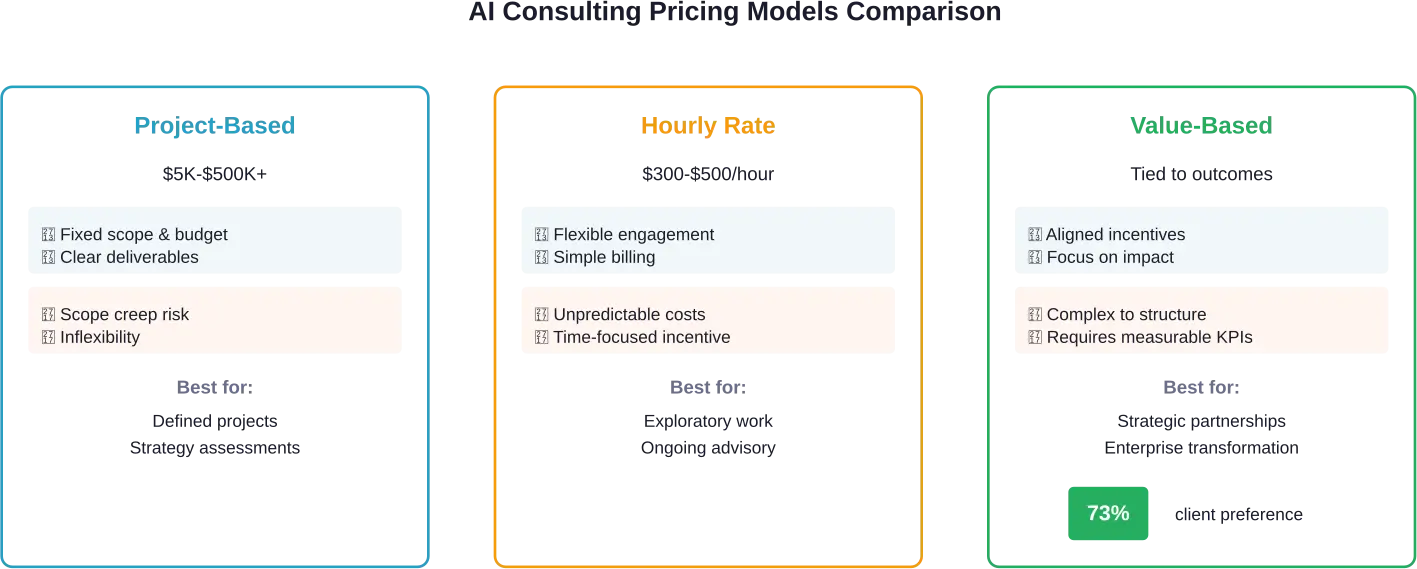
AI consulting firms typically offer three primary pricing structures. Each has distinct advantages depending on project scope and organizational needs.
Project-Based Pricing
Fixed fees for specific deliverables offer budget certainty and reward efficiency. This model works well when scope is clearly defined.
Typical project-based ranges include:
- Small AI strategy assessments: $5,000-$25,000
- Mid-size opportunity analyses: $25,000-$100,000
- Enterprise AI transformations: $100,000-$500,000+
Project-based pricing provides predictability but requires upfront clarity about objectives and deliverables. Scope creep can become an issue if requirements aren’t well-documented.
Hourly Rate Structures
Time-based billing remains common for exploratory work or ongoing advisory relationships. Senior AI consultants typically charge $300-$500 per hour, reflecting strategic judgment rather than just technical skills.
Hourly rates scale with expertise level and specialization. Healthcare AI consultants command 25-40% higher rates due to compliance complexity and regulatory knowledge requirements.
But here’s the thing—hourly pricing can misalign incentives. Consultants get paid for time spent rather than value delivered, which doesn’t always serve client interests.
Value-Based Pricing
This model ties consultant compensation to measurable business outcomes. According to industry data, 73% of clients prefer value-based pricing over hourly models.
Value-based structures align consultant and client objectives. When compensation depends on achieving specific KPIs—cost reduction, revenue growth, efficiency gains—both parties focus on impact rather than billable hours.
Big consulting firms command $350+ per hour by explicitly connecting AI initiatives with enterprise-level outcomes. The pricing reflects strategic positioning, not just technical implementation.
AI Agency Pricing Breakdown for 2026
AI agencies structure services differently than traditional consulting firms. Understanding these distinctions helps businesses evaluate options.
Service-Specific Cost Ranges
Different AI services carry different price tags based on complexity and expertise requirements.
| Service Type | Monthly Retainer | Hourly Rate
|
|---|---|---|
| AI Strategy & Consulting | $2,000-$20,000+ | $100-$300 |
| SEO with AI Tools | $1,200-$6,500 | $75-$150 |
| AI Automation Implementation | $99-$5,000+ | $100-$250 |
| Custom AI Development | $10,000-$500,000+ | $150-$400 |
These ranges reflect market rates as organizations increasingly separate platform costs from consulting fees. For example, OpenAI charges between $0.003 and $0.012 per 1,000 tokens for GPT-4 Turbo, with additional fees for image and file processing.
Agencies increasingly separate platform costs from their service fees. This transparency helps clients understand where budget goes.
Usage-Driven and Hybrid Models
A new wave of hybrid pricing structures is reshaping how AI services are billed. Performance-based and usage-driven models are becoming more common.
Some agencies now offer packages starting at $99 per month for basic automation, scaling to $500,000+ for custom AI builds. The wide range reflects vastly different service complexity and business value.
Token-based costs vary significantly depending on workload. This creates variable monthly expenses that require careful budget planning.
Operating Costs for AI Consulting Firms
For those considering launching an AI consulting practice, understanding the operational expense structure is crucial. Fixed costs create a baseline that must be covered regardless of revenue.
Core Monthly Operating Expenses
AI consulting firms face seven primary cost categories that define their monthly burn rate:
- Payroll & Wages: Consultant salaries and contractor fees typically represent the largest expense
- Cloud & AI Platform Licenses: AWS, Azure, OpenAI API access, and specialized tools
- Third-Party Data Access: Datasets, APIs, and proprietary information sources
- Office Rent: Physical space or coworking memberships
- Legal, Accounting & Insurance: Professional services and liability coverage
- Marketing & Business Development: Lead generation, content creation, events
- Professional Development: Training, certifications, conference attendance
According to financial planning models for AI consulting firms, fixed costs start at approximately $21,700 per month. This baseline requires a minimum cash buffer of $836,000 to reach the seven-month breakeven point projected for July 2026.
Real talk: these numbers can feel daunting. But they reflect the reality of running a knowledge business in a rapidly evolving technical field.

Understand Your AI Consulting Cost
AI consulting costs depend on scope, whether it’s strategy, proof of concept, vendor evaluation, or deployment support. AI Superior provides advisory services that start with problem framing, data assessment, and feasibility testing before moving into planning. Their estimates reflect time spent on workshops, documentation, and architectural guidance. This gives you cost clarity before engagement begins.
Ready to Discuss AI Strategy and Costs?
Talk with AI Superior to:
- clarify your AI goals and constraints
- map necessary consulting work
- receive a transparent consulting cost estimate
👉 Request an AI consulting quote from AI Superior.
Industry-Specific Rate Variations
Not all AI consulting costs the same across industries. Regulatory complexity and domain expertise requirements create significant price variations.
Healthcare AI consultants command 25-40% higher rates than general AI consultants. Compliance with HIPAA, FDA regulations, and clinical validation requirements demands specialized knowledge that justifies premium pricing.
Financial services AI consulting similarly carries premium rates due to regulatory oversight and risk management complexity. Consultants working in banking, insurance, or investment management need deep understanding of both AI technology and financial regulations.
Manufacturing and logistics AI consulting tends toward the middle of the pricing spectrum. While technical complexity can be high, regulatory requirements are generally less stringent than healthcare or finance.

Choosing the Right Engagement Model
So how should organizations decide which pricing structure makes sense? The answer depends on project maturity, budget flexibility, and strategic objectives.
When Project-Based Pricing Makes Sense
Fixed-fee projects work best when deliverables are well-defined. Organizations with clear AI strategy questions or specific implementation goals benefit from the budget certainty.
Small businesses exploring AI for the first time often start with project-based assessments in the $5,000-$25,000 range. This provides concrete deliverables without ongoing commitment.
When Hourly Rates Are Appropriate
Flexible hourly engagements suit exploratory phases where scope isn’t yet clear. Organizations beginning their AI journey often need advisory support without knowing exactly what questions to ask.
Hourly billing also works for ongoing relationships where consultants provide periodic guidance rather than delivering specific projects. Think of it as having an AI advisor on retainer.
When Value-Based Pricing Delivers Most
Strategic AI transformations with measurable business outcomes are ideal candidates for value-based pricing. When success can be quantified—cost savings, revenue growth, efficiency improvements—linking consultant compensation to results aligns incentives perfectly.
Large enterprises typically prefer value-based structures for significant AI initiatives. The pricing reflects strategic partnership rather than transactional service delivery.
The Hidden Costs of AI Implementation
Consulting fees represent only one component of total AI investment. Organizations should budget for several additional cost categories.
Infrastructure and Platform Expenses
Cloud computing resources, API access, and specialized AI platforms create ongoing operational costs. According to recent Deloitte analysis, AI has become the fastest-growing line item in corporate technology budgets, consuming a quarter to one-half of IT spending in many organizations.
According to Deloitte’s analysis, NVIDIA’s CEO said that AI computing demand will surge by a billion times. According to Deloitte’s analysis, Google now processes 1.3 quadrillion tokens per month—a 130-fold increase in just over a year.
These infrastructure costs scale with usage. Organizations should plan for variable monthly expenses that fluctuate with AI adoption.
Data Preparation and Quality
AI models are only as good as their training data. Organizations often underestimate the cost of data cleaning, labeling, and preparation.
Third-party data access can add significant expense. Proprietary datasets, specialized APIs, and licensed information sources create recurring costs beyond consulting fees.
Change Management and Training
Technical implementation is just the beginning. Successful AI adoption requires organizational change management and employee training.
Many AI initiatives fail not because of technical problems but because organizations don’t invest in helping people adapt. Budget should include change management support alongside technical consulting.
What Authoritative Sources Say
According to the Deloitte AI Institute’s State of AI in the Enterprise report, more than half of companies (58%) report at least limited use of physical AI today. That figure is projected to reach 80% within two years, with Asia Pacific leading in early adoption.
NIST promotes innovation and cultivates trust in the design, development, use and governance of artificial intelligence through frameworks like the AI Risk Management Framework. These resources assist in testing, evaluation, verification, and validation of AI systems.
Academic institutions are adapting to prepare future consultants. HEC Paris, in partnership with Capgemini Invent, launched the Generative AI for Business Consulting Mission, immersing students in current challenges of generative AI in consultancy. The University of Florida’s Warrington College similarly launched Strategic Consulting and AI-Driven Practices, providing MBA students with experiential learning aligned with careers in global advisory firms.
Questions to Ask Potential Consultants
Before engaging an AI consultant, organizations should evaluate several key factors beyond just pricing.
Experience and Track Record
Ask for specific case studies in your industry. Generic AI expertise doesn’t always translate to domain-specific value.
Request references from similar organizations. Understanding how consultants performed on comparable projects provides valuable insight.
Technical Approach
Understand what technologies and platforms the consultant recommends. Vendor-agnostic advisors often provide more objective guidance than those tied to specific platforms.
Ask how they stay current with rapidly evolving AI capabilities. The field changes quickly—consultants must continuously update their knowledge.
Success Metrics
Define how success will be measured. Clear KPIs prevent misalignment and provide objective evaluation criteria.
For value-based engagements, establish specific measurable outcomes upfront. Ambiguous success criteria create friction later.
Frequently Asked Questions
What’s the average cost of AI consulting for small businesses?
Small businesses typically spend between $5,000 and $25,000 for initial AI strategy assessments. This includes opportunity analysis, use case identification, and implementation roadmaps. Hourly consulting for small businesses ranges from $100-$200 per hour depending on consultant expertise and project complexity.
Why do healthcare AI consultants charge more?
Healthcare AI consultants command 25-40% premium rates due to regulatory complexity. HIPAA compliance, FDA validation requirements, and clinical trial knowledge demand specialized expertise. The higher rates reflect both technical AI skills and deep healthcare domain knowledge.
Is value-based pricing better than hourly rates?
Value-based pricing aligns consultant and client incentives around measurable outcomes. Industry data shows 73% of clients prefer this model over hourly billing. However, it requires clearly defined success metrics and works best for strategic initiatives with quantifiable business impact rather than exploratory work.
What hidden costs should businesses expect beyond consulting fees?
Organizations should budget for cloud infrastructure, API access (like OpenAI’s $0.003-$0.012 per 1,000 tokens), data preparation, third-party data sources, change management, and employee training. According to Deloitte, AI now consumes one-quarter to one-half of IT spending in many organizations, making it the fastest-growing technology budget line item.
How much does it cost to run an AI consulting firm?
AI consulting firm fixed costs start around $21,700 monthly, covering payroll, cloud platforms, data access, office space, legal services, insurance, marketing, and professional development. Financial models suggest firms need approximately $836,000 in working capital to cover costs until reaching breakeven, typically projected around seven months for new practices launched in early 2026.
How do AI agency prices compare to traditional consulting firms?
AI agencies often structure pricing differently than traditional consultants, offering monthly retainers ($2,000-$20,000+) or usage-based models. Traditional consulting firms typically charge higher hourly rates ($350+) but may provide broader strategic services. AI-focused agencies increasingly separate platform costs from service fees for transparency.
What questions should I ask when evaluating AI consultant pricing?
Ask about industry-specific experience, technical approach and platform recommendations, success metrics and KPIs, what’s included versus excluded from quoted fees, infrastructure and ongoing operational costs, change management support, and whether pricing is fixed, hourly, or value-based. Understanding the full cost structure prevents surprises and helps compare consultants effectively.
Making the Right Investment Decision
AI consulting represents a significant investment. But it’s an investment in competitive advantage and operational efficiency.
The key is matching engagement model to organizational needs. Small businesses exploring AI might start with a $10,000 assessment. Mid-market companies implementing specific use cases might budget $50,000-$150,000. Enterprise transformations can justify $500,000+ investments when tied to measurable business outcomes.
Look beyond the price tag. Consider consultant expertise, track record, industry knowledge, and cultural fit. The cheapest consultant isn’t always the best value.
And remember—consulting fees are just one component of total AI investment. Budget for infrastructure, data preparation, change management, and training alongside advisory services.
The organizations winning with AI aren’t necessarily spending the most on consultants. They’re making smart, strategic investments aligned with clear business objectives and measurable outcomes.
Ready to explore AI consulting for your organization? Start by defining clear objectives and success metrics. Then evaluate consultants based on relevant experience, technical approach, and pricing model fit. The right partnership can accelerate your AI journey and deliver measurable business value.
 English
  German
  Arabic
  French
  Dutch
Dutch  Spanish