
Key Points: Custom AI chatbot development costs range from $5,000 for basic rule-based bots to over $75,000 for enterprise multi-agent systems in 2026. Key factors include AI model selection (GPT-4, custom LLMs), integration complexity, training data volume, and ongoing operational costs. Most mid-market businesses invest $15,000-$35,000 for intelligent NLP-powered chatbots with CRM integrations.
The chatbot market is projected to reach $27.3 billion by 2030, growing at 23.3% annually. Businesses racing toward that future face one immediate question: what does custom AI chatbot development actually cost?
The answer isn’t straightforward. A basic FAQ bot might run $5,000. An enterprise-grade conversational AI platform? Expect $75,000 or more. The gap between those numbers depends on factors most buyers don’t consider until they’re already deep in the process.
This guide breaks down real 2026 pricing across every tier—from rule-based systems to multi-agent LLM architectures. What follows isn’t marketing fluff. These are actual cost structures, hidden expenses, and decision frameworks used by development teams working on production chatbot systems.
Understanding the Cost Spectrum
Custom chatbot pricing falls into distinct tiers based on technical complexity and business requirements. The range spans from simple scripted responses to sophisticated AI systems that handle multi-turn conversations across dozens of data sources.
Here’s what the landscape looks like right now:
| Chatbot Tier | Cost Range | Development Time | Monthly Operations | Best For |
|---|---|---|---|---|
| Basic Rule-Based | $5,000 – $15,000 | 1-2 weeks | $500 – $1,000 | Small businesses, FAQs, lead capture |
| NLP-Driven Chatbot | $15,000 – $35,000 | 2-4 weeks | $1,500 – $3,000 | Mid-market SaaS, e-commerce support |
| Enterprise LLM System | $35,000 – $75,000 | 4-8 weeks | $3,000 – $8,000 | Large enterprises, complex workflows |
| Multi-Agent Platform | $75,000+ | 8+ weeks | $8,000+ | Custom enterprise AI, omnichannel |
The table tells only part of the story. Two chatbots in the same tier can have wildly different price tags depending on specific requirements.
Basic Rule-Based Chatbots: $5,000 – $15,000
Rule-based chatbots operate on decision trees. User says X, bot responds with Y. No machine learning, no context awareness, no natural language understanding.
These systems handle straightforward scenarios well: answering common questions, collecting contact information, routing support tickets to human agents. They break down the moment a user asks something outside the script.
What This Tier Includes
Development at this level typically covers:
- Fixed conversation flows with 20-50 predefined paths
- Button-based navigation or keyword matching
- Basic integration with one or two platforms (website widget, Facebook Messenger)
- Simple analytics dashboard tracking conversation volume and completion rates
- Up to three rounds of revision during development
The $5,000 end of this range gets a templated solution with minimal customization. The $15,000 end includes custom branding, moderately complex decision trees, and integration with a CRM like HubSpot or Salesforce.
Operating Costs
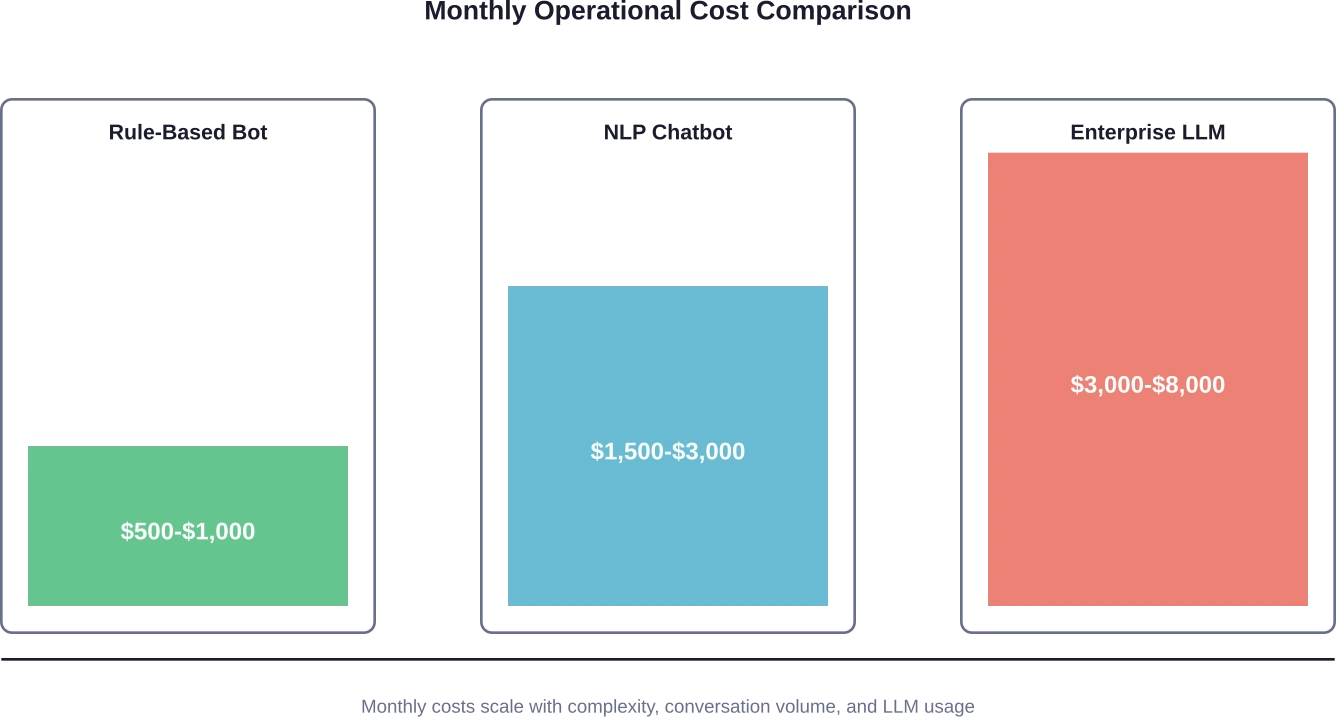
Monthly expenses run $500 to $1,000 and cover hosting, bot platform fees, and basic maintenance. That assumes conversation volume stays under 10,000 interactions monthly. Higher volume adds costs through platform usage fees.
One limitation often surfaces six months in: these bots require manual updates for every new scenario. Business launches a new product? Someone needs to map new conversation paths. Policy changes? More manual updates. The maintenance burden accumulates.
NLP-Powered Chatbots: $15,000 – $35,000
Natural language processing changes the game. Instead of matching exact keywords, these chatbots understand intent. Users can phrase questions dozens of ways, and the system extracts meaning.
This tier represents the sweet spot for most mid-market companies. The technology is mature, costs are predictable, and capabilities match real business needs.
Technical Components
Development involves:
- Intent classification models trained on 500-2,000 sample conversations
- Entity extraction for pulling specific information (dates, product names, account numbers)
- Context management across multi-turn conversations
- Integration with 3-5 business systems (CRM, helpdesk, payment processor, knowledge base)
- Fallback handling that routes complex queries to human agents
- Custom analytics tracking resolution rates, conversation paths, and user satisfaction
The development timeline stretches to 2-4 weeks because training NLP models requires iteration. Initial models perform poorly. Teams review failed conversations, add training examples, and retrain. The cycle repeats until accuracy hits acceptable levels—typically 85-90% for intent recognition.
LLM Integration Costs
Many chatbots in this tier now incorporate large language models for certain functions. According to pricing data from September 2025, GPT-5 and other model costs vary by provider:
- OpenAI direct API: Most cost-effective for pure inference
- Azure OpenAI: Consumption-based pricing measured in tokens (1,000 tokens ≈ 750 words)
- AWS Bedrock: Tightest security controls with pay-per-use model
- Google Vertex AI: Cleanest integration for Google Cloud environments
Research shows open models achieve roughly 90% of closed model performance at 87% lower inference costs. For high-volume chatbots, that difference matters. A system processing 100,000 conversations monthly might spend $800 on closed models versus $100 on optimized open alternatives.
But here’s the catch: open models require more engineering effort. Teams need expertise to deploy, fine-tune, and monitor them. The upfront development cost increases even as operational costs decrease.
Monthly Operations
Expect $1,500 to $3,000 monthly for:
- NLP platform fees (Dialogflow, Rasa, or similar)
- LLM API costs for conversation generation
- Cloud infrastructure (compute, storage, databases)
- Monitoring and logging services
- Model retraining as new conversation data accumulates
Azure’s Batch API offers a 50% discount compared to standard pricing for non-interactive workloads processed within 24 hours. Chatbots that generate training data or run overnight analytics can leverage this for significant savings.
Enterprise LLM Chatbots: $35,000 – $75,000
Enterprise chatbots handle complex scenarios that would overwhelm simpler systems. Multi-department workflows, authenticated user sessions, integration with legacy systems, compliance requirements, and omnichannel consistency.
Development at this level isn’t just more features—it’s different architecture. These systems need to scale to millions of conversations, maintain consistent performance, and provide audit trails for regulated industries.
What Drives Costs Higher
Several factors push development into this range:
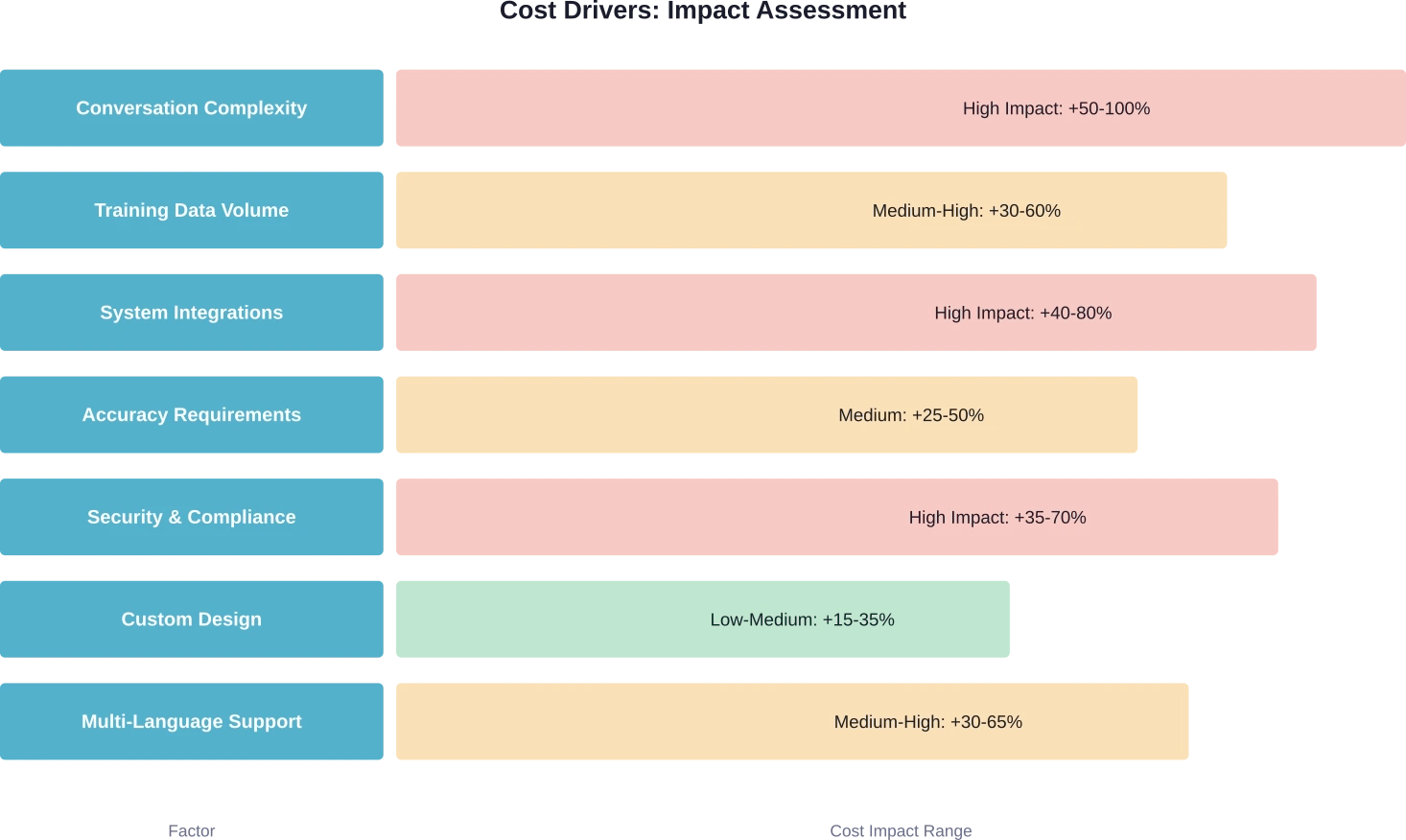
- Custom model training. Instead of using off-the-shelf NLP, teams train models on company-specific data. A financial services chatbot needs to understand industry jargon, product names, and regulatory context. Training that specificity requires thousands of labeled examples and multiple model iterations.
- Security and compliance. Healthcare chatbots must be HIPAA compliant. Financial services need SOC 2 certification. Every compliance framework adds engineering work: encryption, access controls, audit logging, data retention policies. One team reported spending $12,000 just on security review and penetration testing before launch.
- System integration depth. Enterprise chatbots don’t just read from business systems—they write to them. Creating support tickets, updating customer records, processing refunds, scheduling appointments. Each integration requires custom API work, error handling, and testing across scenarios.
- Multi-language support. Global companies need chatbots that work in 5, 10, or 20 languages. NLP models perform differently across languages. Spanish might hit 90% accuracy while Japanese struggles at 75%. Teams end up training and maintaining separate models per language, multiplying costs.
Development Timeline
Expect 4-8 weeks minimum. Complex projects stretch to three months. The timeline breaks down roughly as:
- Week 1-2: Requirements gathering, system architecture, integration planning
- Week 3-4: Core development, model training, API integration
- Week 5-6: Testing, refinement, security review
- Week 7-8: Deployment, monitoring setup, team training
That assumes no major scope changes. Real projects rarely go that smoothly.
Operational Expenses
Monthly costs hit $3,000 to $8,000 for established systems at scale. The breakdown:
- LLM inference costs: $800-$2,500 depending on volume and model choice
- Infrastructure: $500-$1,500 for load balancing, redundancy, databases
- Platform fees: $400-$1,000 for enterprise chatbot platforms
- Monitoring and analytics: $300-$800
- Ongoing training and optimization: $1,000-$2,200
According to OpenAI revenue data from the first half of 2025, the company generated approximately $4.3 billion while spending $2.5 billion on research, development, and compute. That cost structure signals ongoing infrastructure investment across the LLM ecosystem—expenses that eventually flow to customers through API pricing.
Multi-Agent and Custom Platforms: $75,000+
The highest tier involves custom AI platforms where multiple specialized agents coordinate to handle sophisticated workflows. Think of a system where one agent handles natural conversation, another manages task execution, a third handles analytics, and a coordinator orchestrates between them.
Projects at this level might cost $150,000, $500,000, or exceed $1,000,000 for the most complex implementations.
What Justifies These Costs
These aren’t just chatbots—they’re conversational AI platforms. Capabilities include:
- Agentic AI that can plan multi-step workflows and execute them autonomously
- Custom LLM fine-tuning on proprietary datasets
- Real-time learning and adaptation based on conversation outcomes
- Integration with dozens of enterprise systems
- Advanced analytics with predictive modeling
- White-label solutions that companies can resell
One example: a healthcare company built a multi-agent platform where patients could schedule appointments, ask medical questions (routed to appropriate specialists), manage prescriptions, and handle billing inquiries—all in one conversation. The system needed to maintain context across all these domains, enforce strict privacy rules, and provide seamless handoffs between agents. Development cost exceeded $200,000.
The Build vs. Buy Decision
At this level, companies face a critical choice: build proprietary technology or license enterprise platforms and customize them.
Building proprietary systems makes sense when:
- Core business involves conversational AI (you’re selling chatbot services)
- Requirements are so specific that existing platforms can’t accommodate them
- Data sensitivity prohibits using third-party infrastructure
- Long-term total cost of ownership favors internal development
Licensing and customizing existing platforms works better when:
- Speed to market matters more than perfect customization
- Internal teams lack AI expertise
- Requirements fit within platform capabilities
- Budget constraints limit upfront investment
Neither approach is universally better. The decision depends on specific business context.

Estimate Your Chatbot Budget with AI Superior
When calculating the cost of a custom AI chatbot, the biggest variables are scope, data complexity, integrations, and required accuracy. AI Superior helps companies define these variables before development starts, so budgets are based on real technical requirements, not rough guesses.
Their team typically covers:
- Use case analysis and feasibility assessment
- Model selection or custom model development
- Integration with CRMs, internal systems, or APIs
- Ongoing optimization and maintenance
If you need a realistic chatbot cost breakdown tailored to your business case, request a technical consultation with AI Superior and get a structured estimate instead of a generic price range.
Key Factors That Impact Development Costs
Two chatbots with similar surface features can cost vastly different amounts. Understanding the underlying drivers helps explain why.
Conversation Complexity
Simple FAQ bots handle isolated questions. Each interaction stands alone. More sophisticated systems maintain context across long conversations, remember past interactions, and adapt based on user behavior.
Context management adds significant complexity. The system needs to track what’s been discussed, what the user wants, and what information is still needed. That requires state management, memory systems, and logic to determine when context should persist versus when to start fresh.
Training Data Requirements
NLP models are only as good as their training data. A basic intent classifier might work with 500 examples. Domain-specific models need thousands or tens of thousands of labeled conversations.
Getting that data presents challenges:
- New companies don’t have existing conversation logs to train on
- Existing logs might not be labeled (someone needs to tag each message with intent and entities)
- Data might contain sensitive information requiring careful scrubbing
- Edge cases and rare scenarios need sufficient examples to train accurately
Data preparation often consumes 30-40% of total development effort for NLP chatbots. Teams either pay data labeling services ($2-5 per conversation) or allocate internal resources to the work.
Integration Complexity
Every system the chatbot needs to connect with adds cost. Simple read-only integrations (pulling knowledge base articles) are straightforward. Complex two-way integrations (creating records, updating databases, triggering workflows) require more engineering.
Legacy systems present special challenges. Modern APIs use REST or GraphQL with clear documentation. Older systems might require SOAP protocols, custom authentication schemes, or undocumented endpoints. Integration work with legacy infrastructure can double development time.
Accuracy Requirements
An 80% accurate chatbot might satisfy some use cases. Others demand 95%+ accuracy. That gap between 80% and 95% represents disproportionate engineering effort.
Achieving high accuracy requires:
- Extensive training data covering edge cases
- Multiple rounds of testing and refinement
- Sophisticated fallback handling for ambiguous situations
- Confidence scoring to identify uncertain responses
- Graceful handoff to humans when appropriate
Research from Harvard Business School, published in May 2025, found that customer service agents using AI-based suggestions experienced a 22% reduction in response times while improving customer sentiment by 0.45 points on a five-point scale. The study analyzed over 250,000 chat conversations. Those results came from systems engineered for high accuracy and appropriate human-AI collaboration—not from quick implementations.
Customization and Branding
Template-based chatbots cost less because most work is already done. Custom design, unique conversation flows, and branded experiences require additional development.
Customization spans several dimensions:
- Visual design: custom UI, animations, branding elements
- Conversation design: unique personality, tone, and response style
- Business logic: company-specific workflows and decision rules
- Analytics: custom reporting matching internal metrics
Each layer of customization adds cost. A fully custom chatbot might cost 2-3x more than a template-based equivalent with similar underlying functionality.
Hidden Costs That Catch Teams Off Guard
Published pricing covers obvious expenses. Several less visible costs emerge during and after development.
Conversation Design and Content
Someone needs to write all the chatbot responses. That sounds simple until teams realize they’re writing hundreds or thousands of variations to handle different scenarios, tones, and user states.
Professional conversation designers charge $100-200 per hour. A well-designed chatbot might require 40-80 hours of conversation design work—$4,000 to $16,000 that doesn’t appear in base development quotes.
Testing and Quality Assurance
Chatbots need extensive testing across scenarios:
- Functional testing: do all conversation paths work correctly?
- Integration testing: do connections to other systems behave reliably?
- Load testing: does the system handle expected conversation volume?
- Edge case testing: what happens with unexpected inputs?
- User acceptance testing: do real users find it helpful?
Thorough QA might add 20-30% to development time and cost.
Training and Change Management
Deploying a chatbot affects workflows. Customer service teams need to understand how to handle conversations escalated from the bot. Sales teams need training on how the chatbot qualifies leads. Management needs dashboards explaining bot performance.
Internal training often gets overlooked during planning. Budget 10-20 hours of training development and delivery for each team the chatbot affects.
Ongoing Optimization
Launch day is just the beginning. Real conversation data reveals problems that testing missed. Users phrase questions in unexpected ways. New edge cases surface. Business requirements evolve.
Successful chatbot deployments include ongoing optimization. Budget 10-20 hours monthly for reviewing conversation logs, updating training data, and refining responses. Over a year, that’s $12,000 to $24,000 at typical consulting rates.
API and Platform Cost Increases
Third-party platforms change pricing. That $500/month NLP platform might jump to $800/month next year. LLM inference costs fluctuate based on demand and provider pricing changes.
Build a buffer into operational budgets. Assume costs will increase 10-20% annually unless contracts lock rates.
ROI: Does the Investment Pay Off?
Cost discussions mean little without understanding returns. What do businesses actually get from chatbot investments?
Customer Service Cost Reduction
Chatbots handling routine inquiries reduce human agent workload. The economics work like this:
A customer service agent costs $35,000-$50,000 annually (salary, benefits, infrastructure). Each agent handles roughly 1,500-2,000 conversations monthly. A chatbot successfully resolving 30% of inquiries in a 10,000 conversation/month operation eliminates the need for 1-2 full-time agents.
That’s $35,000-$100,000 in annual savings. A $25,000 chatbot development investment pays for itself in 3-9 months.
But the math only works if the chatbot actually resolves conversations. A poorly designed bot that frustrates users and requires human intervention doesn’t generate savings—it adds cost.
Lead Generation and Sales
Sales chatbots qualify leads 24/7. Instead of waiting for business hours, prospects get immediate responses. Qualification happens automatically, routing high-quality leads to sales teams.
Some implementations show that chatbot-powered sales funnels may improve conversion rates through improved lead qualification. Customer value and qualification criteria determine the financial impact for each business.
Operational Efficiency
Beyond direct cost reduction, chatbots improve operational efficiency in ways harder to quantify:
- Consistent information delivery (no variation based on agent knowledge)
- Reduced training burden for human agents
- Data collection providing insights into customer needs and pain points
- Faster response times improving customer satisfaction
- Scalability during traffic spikes without hiring temporary staff
These benefits matter even when direct ROI calculations are ambiguous.
DIY Platforms vs. Custom Development
Not everyone needs custom development. DIY chatbot platforms offer templates and drag-and-drop builders at much lower cost.
When DIY Platforms Work
Consider template-based solutions when:
- Requirements are straightforward (FAQs, lead capture, appointment scheduling)
- Budget is constrained (under $5,000 total investment)
- Speed matters more than perfect customization
- Technical resources are limited
- Conversation volume is predictable and moderate
DIY platforms typically cost $15-500 monthly depending on features and volume. Examples include tools from Drift, Intercom, Zendesk, and standalone platforms.
The tradeoff: limited customization, platform lock-in, and constraints on what the chatbot can do. Integration options are limited to pre-built connections. Conversation design follows templates. Advanced AI capabilities might not be available.
When Custom Development Makes Sense
Custom development becomes necessary when:
- Business logic is complex and specific
- Deep integration with internal systems is required
- Brand experience needs precise control
- Data cannot leave internal infrastructure for security/compliance reasons
- Platform limitations block required functionality
- Long-term cost of ownership favors building versus subscribing
The investment is higher upfront but provides complete control. Architecture decisions, data handling, integration approaches, and future direction are all internal choices rather than dictated by platform vendors.
Reducing Development Costs Without Sacrificing Quality
Several strategies help control chatbot development expenses without compromising effectiveness.
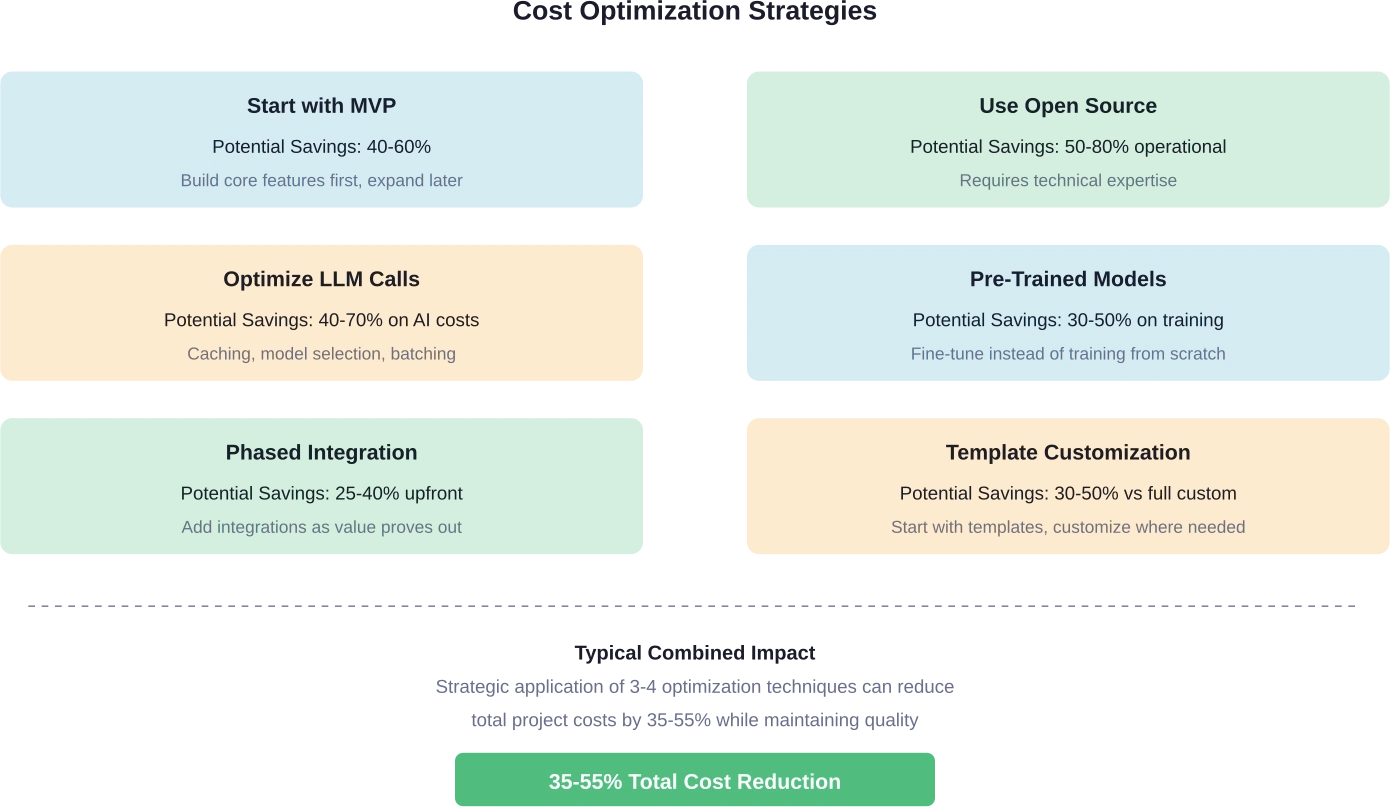
Start with Minimum Viable Bot
Don’t try to handle every scenario in version one. Identify the 3-5 most common use cases and build for those first. Launch, gather data, and expand incrementally.
A focused MVP might cost $8,000 instead of $25,000 for a comprehensive system. Once deployed, conversation data reveals which additional features actually matter versus which seemed important during planning.
Use Open Source Where Possible
Open source NLP frameworks like Rasa provide enterprise-grade capabilities without licensing fees. The tradeoff is engineering complexity—teams need expertise to deploy and maintain these systems.
For companies with technical resources, open source can cut operational costs by 50-80% compared to commercial platforms. Development costs might be 20-30% higher due to additional engineering work.
Optimize LLM Usage
LLM API calls are often the largest operational expense. Several tactics reduce these costs:
- Cache frequent responses instead of regenerating them
- Use cheaper models for simple tasks, reserving expensive models for complex scenarios
- Implement response templates for common patterns
- Fine-tune smaller models for specific domains rather than using general-purpose large models
- Leverage batch processing for non-time-sensitive work (50% discount on Azure)
Strategic use of caching, model selection, and optimization techniques can significantly reduce LLM operational costs.
Leverage Pre-Trained Models
Training custom NLP models from scratch is expensive. Pre-trained models for common domains (customer service, e-commerce, healthcare) provide good baseline performance.
Teams can fine-tune pre-trained models with company-specific data—a process that costs 30-50% less than training from scratch while achieving comparable accuracy.
Phase Integration Work
Instead of integrating with ten systems at launch, start with two or three critical ones. Add others as the chatbot proves value.
Phased integration spreads costs over time and reduces risk. If the chatbot doesn’t gain traction, the project hasn’t consumed budget for integrations that would have gone unused.
Selecting the Right Development Partner
For businesses pursuing custom development, partner selection matters as much as budget.
Evaluation Criteria
Look for teams with:
- Demonstrable NLP expertise. Ask to see previous chatbot projects. Request metrics on accuracy, resolution rates, and user satisfaction. Generic AI experience doesn’t translate directly to chatbot development.
- Conversation design capability. Technical implementation is half the challenge. Designing natural, helpful conversations requires different skills. The best development teams include conversation designers, not just engineers.
- Integration experience. Ask about the most complex integration they’ve built. How did they handle API limitations? What error handling patterns do they use? Teams that have solved hard integration problems will handle typical scenarios smoothly.
- Post-launch support approach. What happens after deployment? How do they handle ongoing optimization? What’s included in maintenance versus what costs extra? Clear answers here prevent future disputes.
Red Flags
Avoid teams that:
- Promise exact costs without understanding requirements
- Claim their chatbot will handle “any question”
- Don’t ask about training data availability
- Have portfolios showing only simple FAQ bots
- Can’t explain their testing methodology
- Dismiss conversation design as unimportant
These signals indicate either inexperience or dishonesty—neither leads to successful projects.
Real-World Cost Examples
Abstract ranges help, but concrete examples provide better context.
E-commerce Support Bot: $18,000
Mid-size online retailer handling 15,000 customer inquiries monthly. Requirements:
- Answer questions about order status, shipping, returns policy
- Integration with order management system and helpdesk
- Escalation to human agents for complex issues
- Email and website widget deployment
Development timeline: 3 weeks. Monthly operational cost: $1,200. First-year resolution rate: 58% of inquiries handled without human intervention. ROI: positive within 5 months.
SaaS Product Assistant: $32,000
B2B SaaS company with complex product and feature set. Requirements:
- Answer technical questions about product capabilities
- Guide users through common workflows
- Integration with knowledge base, CRM, and product analytics
- Slack and in-app deployment
- Custom conversation design matching brand voice
Development timeline: 5 weeks. Monthly operational cost: $2,400. First-year resolution rate: 42% (lower due to technical complexity). ROI: improved customer satisfaction scores, reduced support ticket volume by 35%.
Healthcare Appointment System: $68,000
Healthcare provider with multiple locations and specialties. Requirements:
- Appointment scheduling across 40+ providers
- Insurance verification and pre-authorization
- HIPAA compliance and security review
- Integration with EHR, scheduling system, and billing
- Multi-language support (English, Spanish)
- SMS, web, and phone channel deployment
Development timeline: 10 weeks. Monthly operational cost: $4,800. First-year impact: 23% of appointments booked through chatbot, $180,000 annual reduction in scheduling staff costs.
Frequently Asked Questions
How long does custom chatbot development take?
Timeline ranges from 1-2 weeks for basic rule-based bots to 8-12 weeks for complex enterprise systems. Most NLP-powered chatbots require 3-5 weeks for development, testing, and deployment. Factors that extend timelines include extensive integration requirements, custom model training, security compliance reviews, and scope changes during development.
What’s included in monthly operational costs?
Operational expenses typically cover infrastructure hosting, NLP platform fees, LLM API costs, monitoring and logging services, data storage, and regular model retraining. Depending on the chatbot tier, monthly costs range from $500 for simple rule-based systems to $8,000+ for enterprise LLM-powered platforms handling high conversation volumes. These figures don’t include ongoing optimization work, which is usually billed separately or handled by internal teams.
Can a chatbot replace human customer service entirely?
Not for most businesses. Chatbots excel at handling routine, repetitive inquiries—typically 30-70% of total conversation volume depending on complexity. Complex scenarios, emotional situations, and edge cases still require human judgment. The most effective approach combines chatbots for initial triage and common questions with seamless escalation to human agents when needed. Research from Harvard Business School shows that AI tools actually help human agents perform better, improving both efficiency and customer sentiment.
What happens if conversation volume grows significantly?
Scaling costs vary by architecture. Cloud-based chatbots handle volume spikes automatically but incur higher API and infrastructure costs as usage grows. Many NLP platforms tier pricing by conversation volume—expect costs to increase 20-40% when moving to the next tier. LLM-powered chatbots face the steepest scaling costs since inference charges are per-token. Planning for growth means architecting with caching, efficient prompting, and model selection strategies that keep per-conversation costs manageable.
Should we build in-house or hire a development agency?
Build in-house if the team has NLP expertise, capacity to manage the project, and plans to maintain the chatbot long-term. Agencies make sense when internal expertise is limited, speed to market matters, or the chatbot isn’t core to business operations. Hybrid approaches work well—agencies handle initial development while internal teams manage ongoing optimization and content updates. Total cost of ownership over three years often favors building in-house for companies with technical resources, while agencies provide better ROI for businesses lacking AI expertise.
How accurate do chatbots need to be?
Minimum viable accuracy is around 80% for intent recognition—below that, user frustration outweighs benefits. Most successful chatbots target 85-90% accuracy for common scenarios. Achieving 95%+ accuracy requires disproportionate effort and expense. The key is less about perfect accuracy and more about graceful failure handling. Chatbots that recognize when they’re uncertain and smoothly escalate to humans provide better user experience than systems that insist on answering everything incorrectly.
What’s the typical ROI timeline for chatbot investments?
ROI timelines depend on use case and cost structure. Customer service chatbots often achieve positive ROI within 6-12 months through reduced staffing needs. Sales and lead generation chatbots may see returns faster—within 3-6 months—if they meaningfully increase conversion rates. Enterprise implementations with high upfront costs ($50,000+) typically require 12-18 months to justify investment through operational savings and efficiency gains. The most successful deployments track multiple metrics beyond direct cost savings, including customer satisfaction improvements and data insights that inform business decisions.
Making the Investment Decision
Custom AI chatbot development represents a significant investment. Costs span from $5,000 for basic implementations to $75,000 or more for sophisticated enterprise systems.
The numbers matter, but context matters more. A $30,000 chatbot that eliminates $80,000 in annual operational costs is cheaper than a $5,000 bot that frustrates customers and creates more work for support teams.
Smart investment decisions start with clear requirements. What problems need solving? What conversation volume will the chatbot handle? What systems need integration? What accuracy is acceptable? How will success be measured?
Teams that answer these questions before approaching developers get better outcomes at lower costs. Requirements clarity reduces scope creep, prevents misunderstandings, and enables accurate cost estimates.
The chatbot market continues evolving rapidly. LLM capabilities improve while costs decrease. Open source tools mature. But fundamental principles remain constant: successful chatbot projects align technical capabilities with business needs, invest in conversation design alongside engineering, and commit to ongoing optimization after launch.
The cost of custom AI chatbot development in 2026 is higher than many expect but lower than it’s ever been. For businesses ready to invest thoughtfully, the technology delivers measurable returns.
Start by identifying the specific problem a chatbot should solve. Then find partners or platforms that have solved similar problems before. The right investment decision isn’t about finding the cheapest option—it’s about finding the approach that delivers the best value for specific business needs.
 English
  German
  Arabic
  French
  Dutch
Dutch  Spanish