
Quick Summary: Artificial intelligence strategic cost management combines AI technologies with financial oversight to optimize spending, predict cost overruns, and align IT investments with business value. Organizations using AI-driven cost management report 13-25% reductions in operational expenses while improving resource allocation and decision-making accuracy.
The global artificial intelligence market was projected to expand from $294.16 billion in 2025 to $1.77 trillion by 2032. That’s nearly five times the entire enterprise software market, which reached $316.69 billion in 2025.
But here’s the thing—throwing money at AI doesn’t guarantee results. More than half of companies (56%) miss AI cost forecasts by 11%-25%, with nearly one in four (24%) missing them by more than 50%.
Strategic cost management isn’t about cutting corners. It’s about making intelligent decisions that align technology spending with measurable business value. And artificial intelligence has fundamentally changed how finance teams approach this challenge.
The Cost Challenge Nobody Expected
According to MIT Sloan research, artificial intelligence is transforming how finance leaders manage teams, processes, and overall strategy. CFOs at the recent MIT Sloan CFO Summit detailed how AI in forecasting, budgeting, and automation helps teams focus on strategic work rather than repetitive tasks.
The problem? Tech complexity compounds rapidly due to decentralized procurement, shadow IT, and poor asset visibility. Research from Ivanti found that 38% of IT professionals point to tech complexity as a major barrier to effective operations.
Traditional cost management methods fall short because they’re reactive. Organizations discover overspending after it happens—outdated hardware, unused software licenses, over-provisioned cloud resources bleeding budget monthly.
Real talk: 39% of IT professionals cited outdated hardware as a considerable source of wasteful spend, while nearly one in three (31%) pointed to outdated, unused, and expired software.
How AI Changes the Cost Management Game
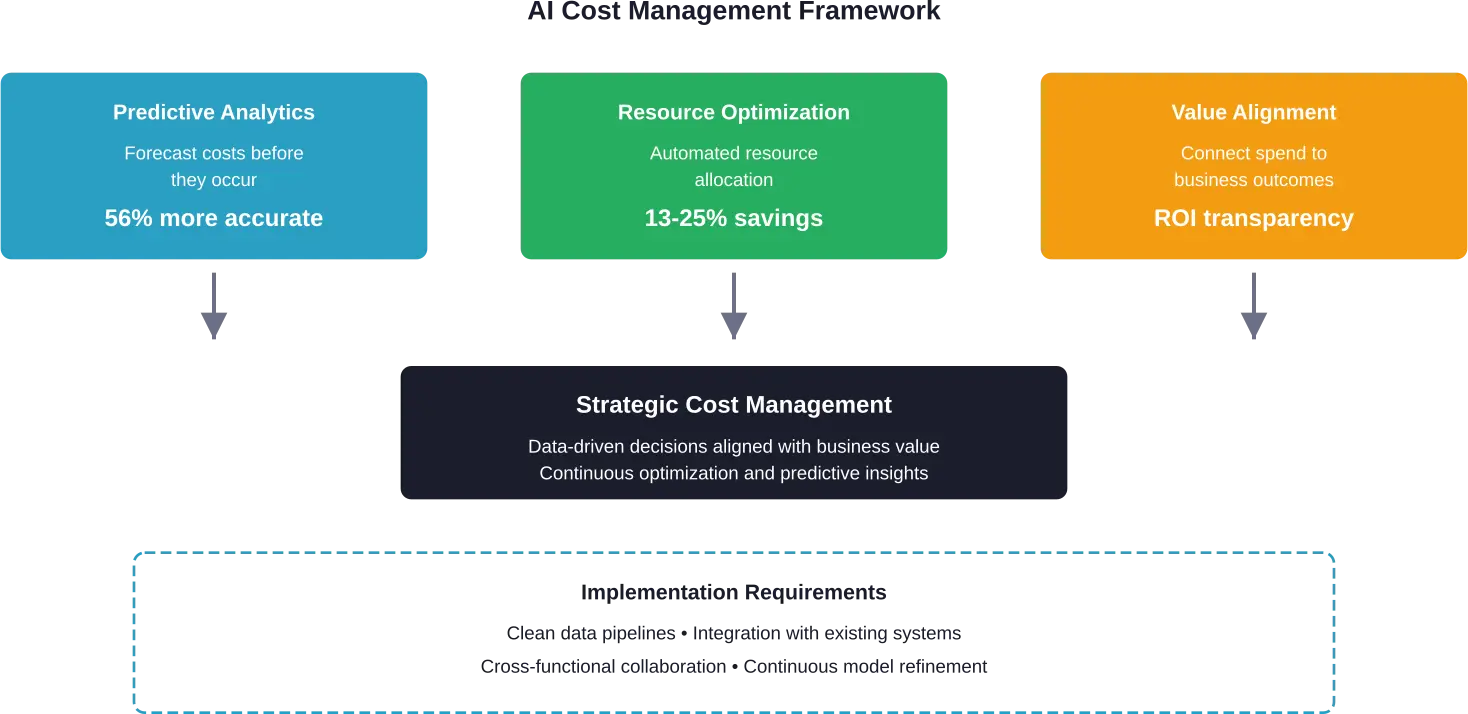
Artificial intelligence addresses cost optimization through three fundamental capabilities that traditional methods can’t match.
Predictive Cost Management
Machine learning models analyze historical spending patterns, project trajectories, and resource utilization to forecast future costs with remarkable accuracy. This isn’t guesswork—it’s pattern recognition at scale.
Capital construction projects demonstrate this perfectly. One thing that’s certain about capital projects is their inherent cost uncertainty. With projects becoming increasingly complex, AI-powered predictive models help project managers anticipate cost overruns before they happen.
Jeff Hoffmeister, CFO of Shopify, emphasized the importance of starting small: “Picking specific areas is probably the best approach. Put something out there, test it, figure out where it breaks.” About 60% of Arm Holdings’ revenue comes from royalties paid on approximately 8 billion chips—the kind of scale where predictive accuracy translates directly to millions in cost optimization.
Automated Resource Optimization
AI continuously monitors infrastructure usage, identifying underutilized resources and recommending optimizations. Cloud spending represents a particularly volatile area where organizational spend can spike overnight.
A Syracuse University study showed that AI-powered customer support agents could handle 13.8% more inquiries per hour—the kind of efficiency gain that compounds across operations.
The automation extends beyond simple monitoring. Intelligent systems proactively right-size cloud instances, shut down idle resources, and consolidate redundant applications without manual intervention.
Strategic Value Alignment
Perhaps the most transformative capability is AI’s ability to connect spending directly to business outcomes. According to HBS Online research, becoming an AI-enabled organization requires significant investment in technology, data, integration, and talent—but the key is building strategies that deliver lasting ROI.
This means moving beyond “cost per transaction” metrics to “value delivered per dollar spent.” AI systems track not just what organizations spend, but what they get in return.

Build an AI Strategy That Controls Costs
AI projects can fail financially when organizations scale models without a clear cost management strategy. Strategic planning helps balance experimentation with operational expenses.
AI Superior supports companies in designing AI roadmaps that align technical decisions with long term budgets.
Typical areas they address include:
- prioritizing high ROI AI use cases
- defining scalable architecture
- estimating infrastructure and training costs
- planning phased AI deployment
For organizations adopting AI at scale, AI Superior provides strategic guidance that connects AI initiatives with sustainable cost structures.
Real Implementation: What Actually Works
BCG research shows more than 90% of executives recognize AI’s pivotal role in reducing costs over the next 18 months. But translating productivity gains into lasting financial value remains tough.
So what separates successful implementations from expensive failures?
Start with Specific Use Cases
Organizations that succeed don’t try to boil the ocean. They identify high-impact areas where AI can deliver measurable results quickly.
One company focused on three use cases across three functions. In marketing, they used GenAI to develop content for existing campaigns, which reduced production costs. The key? They validated outputs rigorously before scaling successful programs.
This approach follows the Shopify model: test in contained environments, measure results precisely, then expand based on proven ROI.
Measure Value Rigorously
Spend Under Management (SUM) provides one framework for tracking AI cost optimization effectiveness. The calculation is straightforward: divide managed spend by total organizational spend, then multiply by 100.
If an organization spends €100 million annually and procurement manages €70 million under approved contracts through official channels, its SUM is 70%. As SUM increases, organizations gain better visibility and control over costs.
| SUM Range | Control Level | Typical Savings Opportunity | Risk Exposure |
|---|---|---|---|
| Below 60% | Low visibility | 15-30% | High (shadow IT, maverick spending) |
| 60-75% | Moderate control | 10-20% | Medium (some unmanaged spend) |
| 75-85% | Good governance | 5-15% | Low (minor optimization gaps) |
| Above 85% | Excellent oversight | 3-8% | Very low (fine-tuning only) |
Integrate with Traditional Methods
AI doesn’t replace traditional cost management—it amplifies it. The most effective strategies combine AI capabilities with established financial controls and governance frameworks.
This means maintaining vendor relationships, contract negotiations, and procurement processes while layering intelligent automation on top. The AI handles monitoring, prediction, and optimization. Humans handle strategy, relationships, and exceptions.
The Hidden Costs of AI Implementation
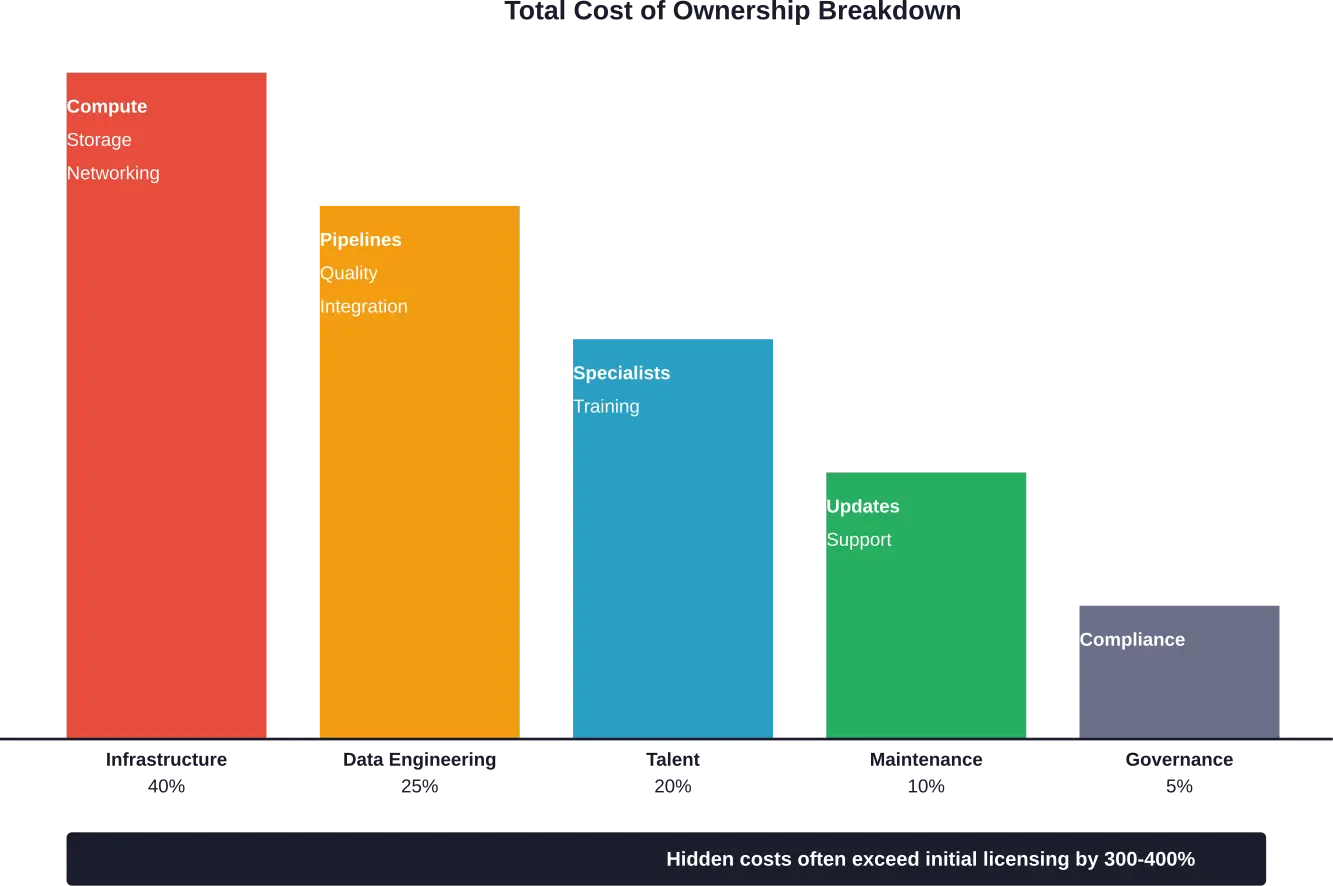
Here’s what nobody talks about enough: the total cost of ownership for AI extends far beyond initial licensing fees.
According to xenoss.io research on AI total cost of ownership, computational resource scaling with model parameter growth creates hidden cost multipliers. As models grow more sophisticated, infrastructure requirements scale exponentially, not linearly.
Continuous data pipeline maintenance represents another ongoing expense. AI systems require fresh, clean data to maintain accuracy. That means investing in data engineering, quality assurance, and governance—permanently.
The Infrastructure Reality
Worldwide AI spending was projected to reach $1.5 trillion by the end of 2025. A significant portion goes toward infrastructure that organizations didn’t anticipate needing.
The White House issued an executive order in July 2025 focused on accelerating federal permitting of data center infrastructure—recognizing that AI deployment requires massive computational resources that traditional IT budgets never accounted for.
For enterprise organizations, this means budgeting for cloud compute that scales with model complexity, storage for training data and model versions, networking bandwidth for real-time inference, and specialized hardware like GPUs for training and deployment.
Talent and Training Costs
Building an AI-enabled organization requires specialized skills that command premium salaries. Data scientists, machine learning engineers, and AI architects represent ongoing payroll expenses that compound over time.
But wait—there’s more. Existing staff need training to work effectively with AI systems. Finance teams need to understand model outputs. Procurement teams need to interpret AI recommendations. Operations teams need to trust automated decisions.
This change management represents a soft cost that organizations frequently underestimate by 50% or more.
Building a Strategic Framework
According to Berkeley’s California Management Review, the AI market represents one of the most significant economic opportunities in modern history. But capturing that opportunity requires structured approaches that balance innovation with cost discipline.
Assessment Phase
Before implementing AI cost management, organizations need clear answers to fundamental questions:
- Is AI a tactical experiment to see where it would be most effective?
- Or is it a strategic infrastructure investment necessary for competitive survival?
That distinction determines budget allocation, timeline expectations, and success metrics. Tactical experiments require rapid iteration and clear go/no-go decisions. Strategic infrastructure demands patient capital and long-term commitment.
Implementation Roadmap
Successful AI cost management follows a phased approach that builds capability progressively.
Phase one focuses on visibility. Deploy AI tools that monitor current spending patterns, identify waste, and establish baseline metrics. This generates quick wins that fund subsequent phases.
Phase two introduces predictive capabilities. Add forecasting models that anticipate cost trends, resource requirements, and budget pressures. This shifts organizations from reactive to proactive cost management.
Phase three integrates optimization. Implement automated systems that adjust resources, consolidate spending, and enforce policies without manual intervention.
Phase four achieves strategic alignment. Connect cost management directly to business outcomes, enabling value-based decision making at every level.
| Phase | Primary Goal | Timeline | Expected ROI |
|---|---|---|---|
| 1: Visibility | Identify waste and baseline metrics | 1-3 months | 5-10% savings |
| 2: Prediction | Forecast costs and trends | 3-6 months | Additional 5-8% |
| 3: Optimization | Automate resource management | 6-12 months | Additional 8-12% |
| 4: Alignment | Value-based decision making | 12-18 months | Sustained 20-25% |
Governance and Accountability
The White House issued an executive order in December 2025 on ensuring a national policy framework for artificial intelligence, recognizing that United States leadership in AI promotes national and economic security across many domains.
For enterprises, this translates to establishing clear governance frameworks that ensure AI cost management systems remain accountable, transparent, and aligned with organizational values.
IEEE standards emphasize the importance of responsible procurement and supply chain strategies when adopting AI technologies. Organizations should consider guidelines and regulatory compliance as foundational elements, not afterthoughts.
Common Pitfalls to Avoid
Even well-intentioned AI cost management initiatives fail when organizations make predictable mistakes.
The “Big Bang” Approach
Attempting to transform all cost management processes simultaneously overwhelms teams and guarantees failure. Organizations that try to implement comprehensive AI solutions across finance, procurement, operations, and IT simultaneously create change fatigue and resistance.
The MIT Sloan research emphasizes starting with specific areas, testing thoroughly, and expanding based on proven results.
Ignoring Integration Complexity
AI cost management systems don’t exist in isolation. They need data from ERP systems, procurement platforms, cloud providers, HR systems, and project management tools.
Organizations that underestimate integration complexity discover their AI initiatives stall while engineering teams struggle to connect disparate data sources. Budget adequate time and resources for integration from day one.
Focusing Solely on Cost Reduction
Strategic cost management isn’t just about spending less—it’s about spending smarter. Organizations that measure success purely by expense reduction miss opportunities to reallocate resources toward higher-value activities.
The goal is optimizing value delivered per dollar spent, not minimizing dollars spent regardless of value.
Frequently Asked Questions
What is artificial intelligence strategic cost management?
Artificial intelligence strategic cost management combines machine learning, predictive analytics, and automation to optimize organizational spending while aligning costs with business value. It goes beyond traditional cost cutting by using AI to forecast expenses, identify waste, automate resource allocation, and connect spending directly to measurable outcomes. Organizations implementing these systems typically see 13-25% cost reductions alongside improved decision-making accuracy.
How much does it cost to implement AI cost management systems?
Total cost of ownership typically breaks down as 40% infrastructure, 25% data engineering, 20% talent, 10% maintenance, and 5% governance. More than half of companies (56%) miss AI cost forecasts by 11%-25%. Organizations should expect implementation costs to span 12-18 months for full strategic alignment, with initial visibility phases delivering ROI within 1-3 months. Check with specific vendors for current pricing on platforms and tools.
Can small businesses benefit from AI strategic cost management?
Smaller organizations benefit most by starting with targeted use cases rather than comprehensive transformations. Cloud-based AI cost management tools offer scalable entry points that don’t require massive infrastructure investments. Focus on areas with highest waste—typically cloud resources, software licenses, or procurement spend—where AI can deliver measurable returns quickly. The key is right-sizing implementation to organizational scale and avoiding enterprise-level complexity.
What’s the difference between AI cost management and traditional cost management?
Traditional cost management reacts to historical data through manual analysis and periodic reviews. AI cost management predicts future costs using pattern recognition, automates optimization in real-time, and continuously learns from outcomes. While traditional methods might identify overspending quarterly, AI systems detect anomalies immediately and adjust resources automatically. The shift moves organizations from periodic cost audits to continuous cost optimization.
How long does it take to see ROI from AI cost management?
Initial visibility phases typically deliver 5-10% savings within 1-3 months as organizations identify obvious waste like unused licenses and over-provisioned resources. Predictive capabilities add another 5-8% over 3-6 months. Full optimization with automated resource management achieves cumulative 13-25% savings over 6-12 months. Strategic value alignment sustains these gains long-term while enabling better investment decisions across the organization.
What skills do teams need to implement AI cost management?
Finance teams need to understand AI model outputs and limitations without requiring deep technical expertise. Procurement professionals need skills in interpreting AI recommendations and validating automated decisions. Data engineering capabilities ensure clean pipelines feeding AI systems. Change management skills help organizations adopt new processes and trust AI-driven insights. Most organizations combine existing finance talent with targeted AI specialists rather than rebuilding entire teams.
How do you measure success in AI strategic cost management?
Beyond total cost reduction, track Spend Under Management (SUM) to measure control and visibility improvements. Monitor forecast accuracy to validate predictive capabilities. Measure time saved on manual cost analysis and reallocation to strategic work. Track value delivered per dollar spent rather than just dollars spent. Successful implementations show improved decision speed, reduced cost variance, and stronger alignment between spending and business priorities.
The Path Forward
Artificial intelligence has fundamentally changed strategic cost management from a defensive necessity to a competitive advantage. Organizations that implement AI-driven cost optimization don’t just spend less—they spend smarter.
The framework is straightforward: start with visibility, add prediction, implement optimization, achieve strategic alignment. But success requires discipline, patience, and realistic expectations about timelines and costs.
More than 90% of executives recognize AI’s role in cost reduction over the next 18 months. The gap between recognition and results separates those who treat AI as another tool from those who transform their entire approach to financial management.
Begin with specific, high-impact use cases. Measure rigorously. Expand based on proven ROI. And remember that AI cost management succeeds when it amplifies human decision-making rather than replacing it.
The organizations winning at strategic cost management in 2026 aren’t the ones spending the most on AI. They’re the ones using AI to ensure every dollar spent delivers measurable value aligned with business strategy.
 English
  German
  Arabic
  French
  Dutch
Dutch  Spanish