
Quick Summary: Building artificial intelligence costs between $5,000 for basic rule-based systems and over $500,000 for complex deep learning applications. Most enterprise AI projects fall in the $50,000-$300,000 range, with ongoing infrastructure and maintenance adding 15-30% annually. The biggest cost drivers are model complexity, data quality requirements, computing infrastructure, and specialized talent.
According to Harvard Business School research (online.hbs.edu, published November 25, 2025), many organizations eager to harness artificial intelligence’s potential underestimate what implementation actually requires. The investment goes far beyond initial development—technology, data infrastructure, integration, and specialized talent all contribute to the total bill.
But here’s the thing.
Most companies asking “how much does AI cost” don’t realize they’re asking the wrong question. The real question is: what are you trying to build, and what trade-offs are you willing to make?
This guide breaks down the actual costs based on real projects, academic research, and industry data. No fluff. Just the numbers that matter.
Understanding the AI Cost Spectrum: From Simple to Complex
AI isn’t one thing. The cost difference between a basic chatbot and a custom machine learning model is like comparing a bicycle to a Formula 1 car—both get you places, but the engineering complexity couldn’t be more different.
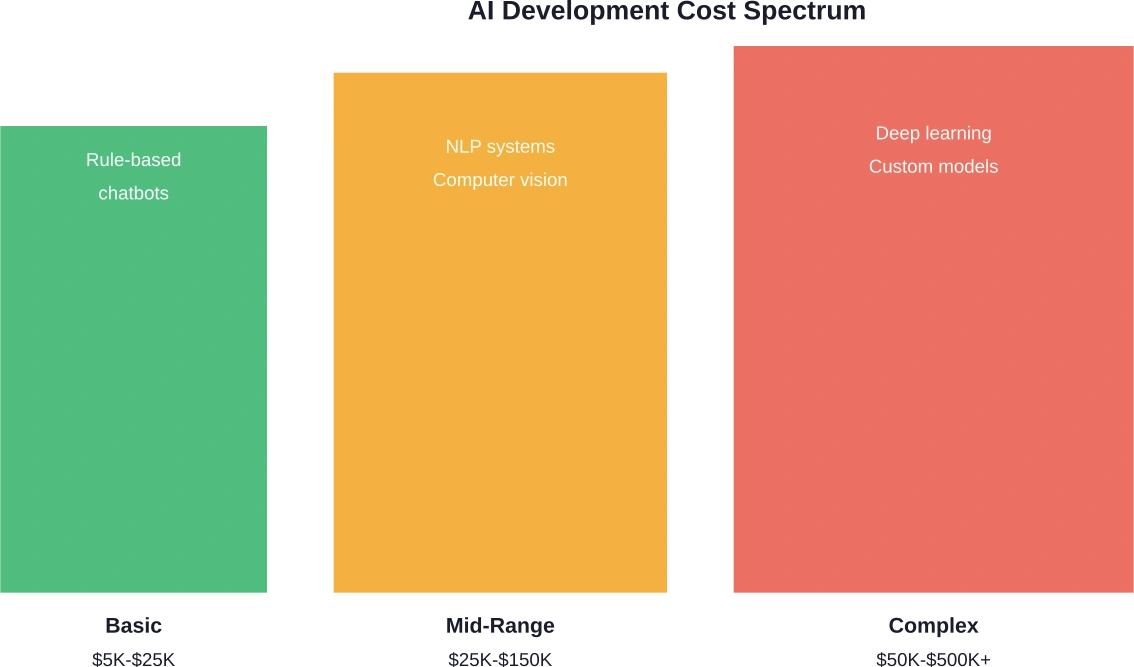
Basic rule-based AI systems start around $5,000. These handle straightforward tasks with predefined logic—think FAQ chatbots that match keywords to responses. Simple, predictable, cheap.
Mid-range AI solutions using natural language processing or computer vision typically run $25,000 to $150,000. This tier includes customer service bots that actually understand context, recommendation engines, and image recognition systems.
Complex deep learning applications? $50,000 to over $500,000. Custom models trained on massive datasets, autonomous systems, advanced predictive analytics—this is where costs escalate fast.
According to MIT xPRO’s course on Deploying AI for Strategic Impact, aligning AI technologies with business infrastructure and data strategy determines whether projects deliver long-term ROI or become expensive tech demos.
The Seven Major Cost Drivers in AI Development
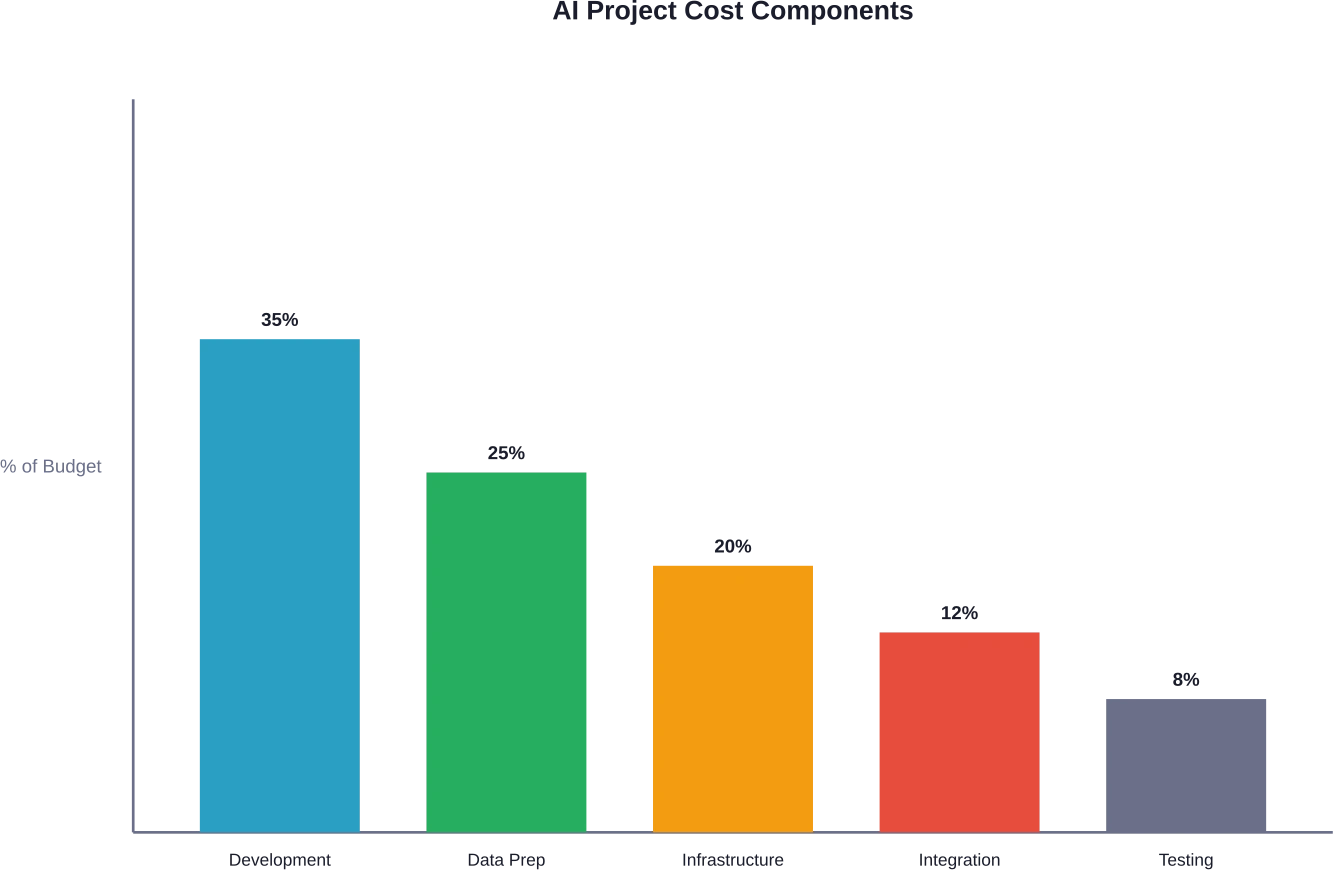
Model complexity alone can account for 30-40% of total project costs. But that’s just the start.
1. Model Complexity and Architecture
Training large-scale models from scratch requires massive computing power and substantial financial resources. Custom large language model training costs illustrate this reality—specific figures vary significantly by model generation and efficiency.
Pre-trained models reduce costs significantly. Instead of building from scratch, developers fine-tune existing models like GPT-4, Claude, or open-source alternatives. This approach can cut development time by 60-80% and reduce costs proportionally.
The accuracy target matters more than most realize. Getting to 95% accuracy? Fairly straightforward. Pushing from 95% to 99%? That final 4% can double or triple your budget. Diminishing returns hit hard at the high end.
2. Data: The Hidden Cost Monster
Data collection, storage, and management represent some of the most significant costs in AI projects. Not just gathering data—cleaning it, labeling it, structuring it for training.
Quality data costs money. Public datasets work for proof-of-concept projects. Production systems need proprietary data that accurately represents the problem domain. Depending on the industry, this means:
- Manual data labeling at $0.10-$5.00 per data point
- Synthetic data generation infrastructure
- Data validation and quality assurance teams
- Ongoing data pipeline maintenance
Healthcare AI, for instance, requires massive labeled datasets that meet privacy regulations. Financial models need historical transaction data with proper fraud labels. Computer vision systems need thousands of properly annotated images.
3. Computing Infrastructure That Scales
Cloud infrastructure costs run continuously once models are deployed. An Amazon AWS AI infrastructure estimate for a machine learning project shows monthly costs breaking down like this:
| Service | Monthly Cost (USD) | Annual Cost (USD) |
|---|---|---|
| Amazon EC2 (compute instances) | 20,959.76 | 251,517.10 |
| Elastic Block Store | 1,233.29 | 14,799.48 |
| S3 Storage | 471.04 | 5,652.48 |
| VPN Connection | 275.00 | 3,300.00 |
| Total | 22,939.09 | 275,269.06 |
That’s just one configuration. Scale up for larger models or higher traffic, and costs multiply.
According to Visual Capitalist data cited in Stanford research, data centers in Arizona use 7.4% of the state’s power, while Oregon centers use 11.4%. These infrastructure demands translate directly into operational costs.
4. Specialized Talent Commands Premium Rates
AI developers, data scientists, and machine learning engineers don’t come cheap. Hourly rates vary by experience and location:
- Junior ML engineers: $50-$100/hour
- Mid-level AI developers: $100-$175/hour
- Senior data scientists: $150-$250/hour
- AI architects and specialists: $200-$350/hour
A typical six-month AI project might need 2-3 developers working part-time, plus a data scientist and project manager. That’s 1,500-2,500 billable hours right there.
5. Integration With Existing Systems
Custom AI solutions rarely exist in isolation. Integration with legacy systems, databases, APIs, and workflows adds complexity. This phase often takes 20-30% of total development time.
APIs need to be built. Security protocols implemented. Data pipelines established between the AI system and existing infrastructure. Each integration point is a potential failure point that needs testing and monitoring.
6. Training Time and Iteration Cycles
Model training isn’t a one-shot deal. Initial training produces a baseline. Then comes fine-tuning based on performance metrics. Then retraining when results don’t meet expectations.
Research from the Center for Science and Thought at Bonn University on AI resource costs reveals training demands between 1,174 and 8,800 A100 GPUs depending on Model FLOPs Utilization and hardware lifespan. That computing time translates to substantial costs—whether using cloud infrastructure or purchasing hardware.
7. Ongoing Maintenance and Updates
According to Harvard Business School research, organizations must view AI implementation as a long-term commitment. Maintenance typically costs 15-30% of initial development annually.
Models drift over time as data patterns change. Regular retraining maintains accuracy. Security patches, infrastructure updates, and feature additions all require ongoing investment.
Real-World AI Cost Breakdowns by Project Type
Here’s what different AI implementations actually cost based on recent projects and market research.
Basic Rule-Based Chatbot
Cost range: $10,000 – $25,000
These handle FAQ responses and simple customer support queries using predefined rules and keyword matching. Development for rule-based chatbots typically requires 4-8 weeks with a small team. Perfect for businesses that need automated responses without complex understanding.
NLP-Powered Conversational AI
Cost range: $25,000 – $80,000
These understand context, handle multi-turn conversations, and provide intelligent responses. They use models like GPT or custom-trained language models. Development takes 2-4 months and requires more sophisticated data preparation.
Computer Vision Application
Cost range: $40,000 – $150,000
Image recognition, object detection, or facial recognition systems. Costs depend heavily on accuracy requirements and dataset size. Manufacturing quality control systems sit at the lower end; autonomous vehicle vision systems at the higher end.
Recommendation Engine
Cost range: $50,000 – $200,000
Think Netflix or Amazon product recommendations. These analyze user behavior, preferences, and patterns to suggest relevant content or products. The complexity scales with the number of items, users, and sophistication of recommendations.
Predictive Analytics Platform
Cost range: $75,000 – $300,000
Financial forecasting, demand prediction, or risk assessment systems. These require extensive historical data, sophisticated algorithms, and robust testing to ensure prediction accuracy meets business requirements.
Custom Large Language Model
Cost range: $100,000 – $500,000+
Training custom models on proprietary data for specialized domains. Training costs for GPT-4 (released in 2023) were estimated at over $100 million, while Gemini Ultra’s training costs are estimated to exceed $191 million.
The training of DeepSeek-V3 (costing approximately $5.58 million in GPU hours) utilized knowledge distillation from DeepSeek-V2.5 or earlier iterations, as DeepSeek-V3 was released prior to or alongside the full scale-up of the R1 reasoning series.
Infrastructure Costs: Cloud vs. On-Premise
The cloud versus on-premise decision dramatically affects both upfront and ongoing costs.
Cloud Infrastructure Advantages
Cloud platforms like AWS, Google Cloud, and Azure offer pay-as-you-go pricing. No massive capital expenditure. Scale up during training, scale down during inference. This flexibility appeals to startups and mid-sized companies.
But those monthly bills add up fast. The AWS infrastructure example above shows annual costs exceeding $275,000 for a mid-sized ML workload. High-traffic applications or frequent model retraining can push costs much higher.
On-Premise Hardware Investment
Purchasing hardware requires significant upfront capital but reduces long-term operational costs. A high-end GPU workstation with NVIDIA A100 or H100 GPUs runs $50,000-$150,000.
For companies running continuous AI workloads, ownership pays off within 12-24 months compared to equivalent cloud costs. The challenge? Hardware becomes obsolete. New GPU generations deliver better performance per dollar, making last year’s investment less attractive.
The Hybrid Approach
Many organizations use hybrid infrastructure. Development and experimentation happen in the cloud for flexibility. Production workloads run on owned hardware for cost efficiency. This balances capital expenditure with operational flexibility.
The Real Cost: What One Developer Spent Building an AI Startup
In a notable community discussion, one developer reported spending $47,000 over 18 months building an AI tool that ended up with 12 users. The breakdown revealed common pitfalls:
- Months 1-3: Building a bloated MVP with unnecessary features
- Custom AI training pipeline instead of using existing APIs
- 47 different UI templates when 3 would suffice
- Burning through OpenAI API credits testing features nobody wanted
The brutal lesson? Technical excellence doesn’t equal business success. Community discussions reveal that starting with “how can we integrate AI” instead of “what problem needs solving” leads to expensive tech demos, not viable products.
Cost-Saving Strategies That Actually Work
Smart teams reduce costs without sacrificing quality. Here’s what actually works in practice.
Start With Pre-Trained Models
Fine-tuning existing models like GPT-4, Claude, or open-source alternatives cuts development time and costs by 60-80%. Training from scratch only makes sense when no suitable pre-trained model exists for the domain.
Use Transfer Learning
Take a model trained on a large general dataset and adapt it to a specific task. Computer vision projects can start with models pre-trained on ImageNet. NLP projects leverage transformer models trained on massive text corpora.
Optimize Data Quality Over Quantity
1,000 high-quality, properly labeled data points often outperform 10,000 noisy examples. Investing in data quality upfront reduces training time and improves accuracy faster than simply collecting more data.
Prototype With APIs Before Building Custom
OpenAI, Anthropic, and Google offer powerful APIs for testing ideas quickly. Validate the concept before investing in custom development. Many successful AI products started as API wrappers before building proprietary models.
Choose the Right Accuracy Target
Don’t chase perfection when good enough solves the problem. If 92% accuracy delivers business value, don’t spend double the budget reaching 96%. Understand what level of accuracy the use case actually requires.
Leverage Open-Source Frameworks
TensorFlow, PyTorch, Hugging Face Transformers, and scikit-learn provide robust, tested implementations. Building custom frameworks from scratch rarely makes financial sense unless research goals require it.
Hidden Costs That Catch Teams Off Guard
Beyond obvious development expenses, several hidden costs emerge during AI projects.
Regulatory Compliance and Data Privacy
Healthcare AI must comply with HIPAA regulations. Financial AI faces SEC oversight. European projects require GDPR compliance. Each regulation adds legal review, security implementation, and audit costs.
Privacy-preserving techniques like differential privacy add complexity. Google’s VaultGemma, introduced September 12, 2025, demonstrates the feasibility of training models from scratch with differential privacy, but implementing such techniques requires specialized expertise.
Failed Experiments and Dead Ends
Not every approach works. Model architectures that seemed promising fail to deliver adequate accuracy. Data that looked sufficient proves inadequate. Budget 15-25% for experimentation that won’t make it to production.
Change Management and Training
Getting employees to actually use AI systems requires training, documentation, and change management. Technical success means nothing if users resist adoption. Budget for user training and ongoing support.
Bias Testing and Fairness Audits
AI models can perpetuate or amplify biases in training data. Testing for fairness across demographic groups, auditing decision patterns, and implementing bias mitigation techniques all require time and expertise.
API Rate Limits and Overage Costs
Third-party API pricing looks reasonable until usage scales. Rate limits require upgrading to enterprise tiers. Unexpected viral adoption can generate massive API bills. Always understand pricing tiers and overage costs upfront.
ROI and Measuring AI Investment Success
According to Harvard Business School research on AI implementation, finding the balance between cost and ROI requires strategies that deliver lasting business value.
Measuring ROI for AI projects differs from traditional software. The Federal Reserve’s analysis (October 6, 2025) of AI competition in advanced economies shows that while the US retains important advantages in infrastructure and compute capacity, other nations are investing heavily.
Quantifiable ROI Metrics
Effective AI projects define success metrics upfront:
- Cost reduction: Customer service automation reducing support tickets by X%
- Revenue increase: Recommendation engines driving Y% additional sales
- Efficiency gains: Predictive maintenance reducing downtime by Z hours
- Quality improvement: Vision systems reducing defect rates
Without concrete metrics, determining whether the investment paid off becomes impossible.
Time to Value Matters
Fast proof-of-concept delivery builds stakeholder confidence. Projects showing initial results within 3-4 months maintain momentum and funding. Those taking 12+ months to show value often face budget cuts or cancellation.
The Build vs. Buy Decision
Sometimes purchasing existing AI solutions costs less than building custom. When evaluating:
- Does commercial software solve 80% of the need?
- Is the use case truly unique enough to justify custom development?
- Can the business sustain ongoing development and maintenance costs?
Building makes sense when competitive advantage requires proprietary capabilities. Buying makes sense when the solution already exists and differentiation happens elsewhere.
Cost Differences: In-House vs. Agency vs. Freelance
Who builds the AI significantly impacts total costs and outcomes.
In-House Development
Hiring full-time AI talent provides maximum control and knowledge retention. Senior ML engineers command $150,000-$300,000 annual salaries plus benefits, equity, and overhead.
For one-off projects, these salaries represent poor ROI. For ongoing AI initiatives, in-house teams make sense. The breakeven point typically hits when AI work sustains 2-3 full-time roles continuously.
AI Development Agencies
Specialized AI consultancies offer complete teams—project managers, data scientists, ML engineers, DevOps. Project costs range from $75,000 to $500,000+ depending on scope.
Agencies bring experience from multiple projects, reducing trial-and-error costs. However, hourly rates run higher than in-house salaries. Knowledge transfer at project completion requires planning to avoid dependency.
Freelance Specialists
Individual contractors or small teams offer flexibility and lower rates. Experienced ML freelancers charge $100-$250/hour. Total project costs run 20-40% less than agencies for similar scope.
Risk increases with freelancers. Quality varies significantly. Project management falls on the client. Best for smaller projects or supplementing existing teams.
| Approach | Best For | Typical Cost | Risk Level |
|---|---|---|---|
| In-House Team | Ongoing AI initiatives | $200K-$500K/year per engineer | Low |
| AI Agency | Complex projects, limited internal expertise | $75K-$500K per project | Medium |
| Freelance | Smaller projects, supplemental capacity | $50K-$200K per project | Medium-High |
| Hybrid | Most mid-sized companies | Varies | Low-Medium |
The 2026 AI Infrastructure Investment Landscape
Tech giants have committed unprecedented resources to AI infrastructure. According to Harvard research from the Federal Reserve (published December 15, 2025, via Harvard Gazette), tech giants Amazon, Meta, Alphabet, Microsoft, and Oracle have invested billions in a race to build out AI ventures.
This infrastructure buildout has broader implications for project costs. As reported in a Medium article from October 23, 2025, the aggregate AI infrastructure investment between 2025 and 2030 totals $7.8 trillion across the industry. Microsoft’s $3.3 billion single data center campus in Wisconsin represents one of dozens facilities the company is building simultaneously.
For individual projects, this massive investment creates both opportunities and challenges. Cloud computing costs may decrease as infrastructure scales. But demand for AI computing resources grows even faster, keeping prices elevated.
Cost Considerations for Specific AI Applications
Healthcare AI Cost Factors
Research published in NPJ Digital Medicine on generative AI costs in large healthcare systems examined revenue cycle applications. Healthcare AI faces unique challenges:
- Extensive data privacy requirements under HIPAA
- Rigorous validation requirements for clinical applications
- Integration with existing electronic health record systems
- Higher liability and risk management costs
These factors can increase development costs by 40-60% compared to non-healthcare AI applications.
Financial Services AI
According to Cornell University’s AI in Finance certificate program (starting April 13, 2026), financial AI applications require sophisticated risk modeling and regulatory compliance. Real-time fraud detection, algorithmic trading, and credit risk assessment demand high accuracy and low latency.
Financial institutions spend extensively on AI—major banks invest $100 million to $1 billion annually on machine learning initiatives. Individual projects within those portfolios range from $200,000 to $10 million depending on scope.
Manufacturing and Computer Vision
Research on ML-based manufacturing cost prediction from Boğaziçi University highlights how geometric complexity and product diversity affect AI implementation costs. Quality control systems using computer vision typically cost $60,000-$200,000 for initial deployment.
The automotive supply sector faces particular pressure on speed and accuracy. AI systems that generate quotations from engineering drawings must deliver results within tight timeframes while maintaining pricing accuracy.

Get a Real AI Cost Estimate Before You Budget
AI development costs depend on model architecture, data preparation, infrastructure, and integration work. AI Superior helps companies design and build custom AI systems and large language models, focusing on the technical planning that determines how expensive a project becomes in practice.
If you want realistic numbers before investing in development, start with a technical review. Contact AI Superior to evaluate your AI project and understand the real development and infrastructure costs before you commit a budget.
Open Source vs. Commercial AI Models
The choice between open-source and commercial models significantly affects both development costs and ongoing expenses.
Open Source Advantages
Models like Llama, Mistral, and various Hugging Face offerings eliminate licensing costs. Development teams can inspect code, modify architectures, and deploy without usage restrictions.
However, open-source doesn’t mean free. Self-hosting requires infrastructure. Fine-tuning demands expertise. Support comes from community forums rather than vendor contracts.
Commercial API Benefits
OpenAI’s GPT models, Anthropic’s Claude, and Google’s Gemini offer powerful capabilities through simple APIs. No infrastructure management. Regular updates and improvements. Enterprise support options.
According to OpenAI developer documentation (updated August 7, 2025), the GPT-5 series provides enhanced developer controls for output formatting, verbosity, and response style. These capabilities reduce engineering time building output parsing logic.
The cost? API usage charges scale with volume. Heavy users spend $1,000-$50,000+ monthly. Lock-in risk exists if the product depends entirely on one vendor’s API.
The Hybrid Strategy
Many projects use commercial APIs for prototyping and lower-volume features, while deploying open-source models for high-volume, cost-sensitive workloads. This balances development speed with operational costs.
AI Project Failure Rates and Prevention
Not every AI project succeeds. Understanding common failure modes helps budget more accurately by accounting for risk.
Community discussions suggest that many AI startups struggle because they optimize for technical sophistication rather than solving painful problems. The pattern repeats: impressive demos that nobody pays for.
Common Failure Patterns
Projects fail when they:
- Start with technology and search for problems to solve
- Ignore data quality until late in development
- Underestimate integration complexity
- Chase accuracy improvements past the point of business value
- Build without validating market demand
Risk Mitigation Strategies
Reducing failure risk requires:
- Defining clear success metrics before development starts
- Validating data availability and quality in the first two weeks
- Building MVPs that test core assumptions quickly
- Regular stakeholder reviews to maintain alignment
- Phased funding tied to milestone achievements
Budget an extra 20% contingency for unexpected challenges. AI projects face more uncertainty than traditional software development.
Ongoing Costs: Maintenance and Operations
Launch day isn’t the finish line. Operational costs continue indefinitely.
Infrastructure and Hosting
Cloud computing bills run monthly. Model inference costs scale with usage. Popular applications generate hundreds of thousands or millions of predictions daily. At $0.002 per inference, that’s $400-$2,000+ daily.
Model Retraining and Updates
Models require periodic retraining as data distributions shift. Customer behavior changes. New edge cases emerge. Fraud patterns evolve. Budget retraining cycles every 3-6 months at 20-40% of initial training costs.
Monitoring and Performance Management
Production AI systems need monitoring for accuracy degradation, latency spikes, error rates, and bias drift. Monitoring tools cost $500-$5,000 monthly depending on scale. Engineer time investigating issues adds to operational overhead.
Security and Compliance Updates
Security vulnerabilities require patches. Compliance regulations change. Data retention policies need enforcement. These ongoing requirements consume 10-15% of maintenance budgets.
Feature Enhancements and User Feedback
Users request new features. Business requirements evolve. Competitive pressure demands continuous improvement. Successful AI products require ongoing development investment, not just maintenance.
Annual maintenance and operations typically run 15-30% of initial development costs. High-usage applications with frequent retraining hit the higher end of that range.
Regional Cost Variations in AI Development
Geographic location significantly affects development costs due to talent availability and wage differences.
United States development costs represent the high end globally. Eastern European, Latin American, and Asian development teams offer 40-60% cost savings with comparable technical capabilities.
However, coordination challenges with distributed teams can offset some savings. Time zone differences complicate communication. Cultural differences in project management styles require adjustment.
This global distribution of AI talent creates opportunities for cost optimization through strategic team placement.
How to Budget for an AI Project
Creating realistic budgets prevents surprises and secures adequate funding.
Step 1: Define Scope and Success Metrics
What problem does the AI solve? What accuracy level delivers value? What volume of predictions or interactions does the system need to handle? Concrete answers to these questions drive realistic cost estimates.
Step 2: Assess Data Readiness
Inventory existing data. Identify gaps. Estimate labeling costs. Poor data quality can double development timelines. Discovering data problems four months into development destroys budgets and timelines.
Step 3: Choose Build Approach
Will the project use pre-trained models, fine-tuning, or training from scratch? Commercial APIs or open source? This choice dramatically affects both initial and ongoing costs.
Step 4: Factor Infrastructure Needs
Calculate compute requirements for training and inference. Get quotes from cloud providers or hardware vendors. Don’t forget storage, networking, and backup costs.
Step 5: Add Contingency
Budget 20-30% contingency for AI projects. Technical challenges emerge. Assumptions prove wrong. Requirements evolve. Contingency funding prevents project stalls when issues arise.
Step 6: Plan for Operations
Don’t just budget development. Include 12-24 months of operational costs in the initial business case. AI systems that can’t sustain operational funding become expensive science experiments.
Frequently Asked Questions
How much does a basic AI chatbot cost to develop?
Basic rule-based chatbots start around $10,000-$25,000 for simple FAQ automation. Natural language processing chatbots that understand context and handle complex conversations range from $25,000-$80,000. Development time runs 4-12 weeks depending on complexity and integration requirements.
What’s the typical timeline for building a custom AI solution?
Simple AI implementations take 2-3 months. Mid-complexity projects using existing models with custom fine-tuning require 3-6 months. Complex custom models with extensive data preparation need 6-12 months. Timeline depends heavily on data availability, team experience, and requirement stability.
Should we build AI in-house or hire an agency?
Build in-house when AI represents core competitive advantage and the organization plans ongoing AI initiatives. Hire agencies for one-off projects, when internal expertise doesn’t exist, or when speed to market matters more than knowledge retention. Many organizations use a hybrid approach—agencies for initial development, in-house teams for maintenance and enhancements.
How much do ongoing AI maintenance costs run annually?
Annual maintenance typically costs 15-30% of initial development. This covers infrastructure, monitoring, periodic retraining, security updates, and minor enhancements. High-usage applications requiring frequent model updates hit the higher end. Simple implementations with stable requirements stay toward the lower end.
Can we start with a proof-of-concept before committing to full development?
Absolutely. Most successful AI projects begin with 4-8 week proof-of-concept phases costing $10,000-$40,000. POCs validate technical feasibility, test assumptions about data quality, and demonstrate potential ROI to stakeholders. This approach reduces risk significantly compared to committing full budgets upfront.
What’s the difference in cost between using OpenAI’s API versus building our own model?
OpenAI API usage starts at a few dollars monthly for low-volume applications but scales to thousands monthly at high volume. Custom model development costs $50,000-$500,000 upfront but reduces per-transaction costs to near zero once deployed. Break-even typically occurs at 100,000+ monthly interactions, though specific economics vary by use case.
How do we prevent our AI project from becoming one of the failures?
Start with a clear problem that AI genuinely solves better than alternatives. Validate data quality immediately—within the first two weeks. Define concrete success metrics before development begins. Build minimum viable versions quickly to test assumptions. Maintain regular stakeholder communication. Budget adequate contingency. Most failures stem from solving the wrong problem or discovering data issues too late.
Making Your AI Investment Decision
AI costs span an enormous range because AI encompasses vastly different technologies solving different problems at different scales.
A basic chatbot costs $10,000. A sophisticated recommendation engine costs $200,000. Training a custom large language model costs millions. The question isn’t “how much does AI cost”—it’s “what are we trying to accomplish, and what’s the most cost-effective approach?”
According to MIT xPRO’s course on Deploying AI for Strategic Impact, successful implementations align technology choices with business goals, infrastructure capabilities, and data strategy. This alignment determines whether projects deliver ROI or become expensive tech demos.
The organizations succeeding with AI in 2026 don’t chase the latest models or most sophisticated architectures. They identify specific, valuable problems where AI provides clear advantages. They validate data quality early. They build incrementally, testing assumptions before major investments.
Start small. Prove value. Scale what works.
AI investment makes sense when it solves expensive problems, enables new capabilities, or creates competitive advantages. It doesn’t make sense as a technology exercise or because competitors are doing it.
Before committing budget, answer these questions honestly:
- What specific problem does this AI solve?
- How will we measure success?
- Do we have adequate data quality and quantity?
- What’s the simplest approach that could work?
- Can we sustain operational costs long-term?
If those answers satisfy the business case, AI implementation can deliver substantial returns. According to Harvard Business School research, organizations that treat AI as a long-term commitment rather than a one-time project achieve better outcomes.
The technology has matured. The costs have become more predictable. The tools have improved dramatically. But success still requires strategic thinking, realistic budgeting, and disciplined execution.
Ready to explore AI for your organization? Start by auditing your data, defining concrete objectives, and consulting with experienced AI practitioners who can provide realistic cost estimates for your specific use case.
 English
  German
  Arabic
  French
  Dutch
Dutch  Spanish