
Quick Summary: Digital transformation for small business means integrating technology across operations, customer service, and workflows to work smarter and stay competitive. It’s not about buying expensive software—it’s about solving real problems with the right tools. Small businesses can start small, focus on high-impact areas, and scale gradually without massive upfront costs.
The phrase “digital transformation” gets thrown around so much that it’s easy to dismiss as corporate jargon. But here’s the thing: it’s not just for enterprises with million-dollar IT budgets. Small businesses are quietly using digital tools to streamline operations, serve customers better, and punch above their weight class.
Digital transformation doesn’t mean hiring a team of developers or ripping out everything that works. It means rethinking how technology can solve real problems in the business. Sometimes that’s automating invoices. Sometimes it’s moving customer data out of spreadsheets. Sometimes it’s just getting everyone on the same communication platform.
The U.S. Small Business Administration has published resources on digital strategy, recognizing that even small operations need a coherent approach to technology adoption. And the data shows something interesting: while only 3.8% of businesses reported using AI to produce goods and services according to the U.S. Census Bureau’s 2023 Annual Business Survey (data from late 2023), adoption patterns are shifting. Among the smallest businesses (1-4 employees), AI use increased from 4.6% to 5.8% over the measured period, though large firms still lead in advanced technology adoption overall.
This isn’t about keeping up with trends. It’s about survival and growth. The businesses that figure out how to work smarter—not just harder—are the ones that scale.
What Digital Transformation Actually Means for Small Businesses
Digital transformation is the process of using technology to fundamentally change how a business operates and delivers value to customers. For small businesses, that definition needs some unpacking.
It’s not just digitizing paper records or adding a website. It’s integrating digital tools across all areas of the business so they work together. Customer relationship management connects to inventory. Inventory connects to ordering. Ordering connects to accounting. Everything flows.
But the best definition comes from asking the right question: what problem are we solving? Before investing in any tool, that question needs a clear answer. Once the problem is clear, the right solution becomes obvious.
The U.S. Census Bureau’s research on advanced technology adoption shows that smaller firms have been slower to adopt technologies like robotics and AI compared to larger companies. But adoption doesn’t have to mean bleeding-edge tech. For many small businesses, transformation starts with cloud-based accounting, digital payment systems, or online scheduling.
The Core Components
Digital transformation typically touches five main areas:
- Operations: How work gets done internally—project management, communication, workflow automation
- Customer Experience: How customers interact with the business—websites, mobile apps, support channels, personalization
- Data and Analytics: How the business collects, stores, and uses information to make decisions
- Business Model: How the company creates and delivers value—subscription services, digital products, new revenue streams
- Culture and Skills: How employees adapt to new tools and ways of working
Not every business needs to transform all five areas at once. The smartest approach is identifying which area creates the biggest bottleneck or opportunity, then starting there.
Why Small Businesses Can’t Ignore Digital Transformation
Competitive pressure is real. Customers expect fast responses, easy online access, and personalized service. Businesses that can’t deliver lose to those that can.
The COVID-19 pandemic accelerated digital adoption by years in some sectors. Small businesses that already had online ordering, remote work capabilities, and digital customer service survived better than those scrambling to set everything up in crisis mode.
But beyond survival, digital transformation creates genuine advantages:
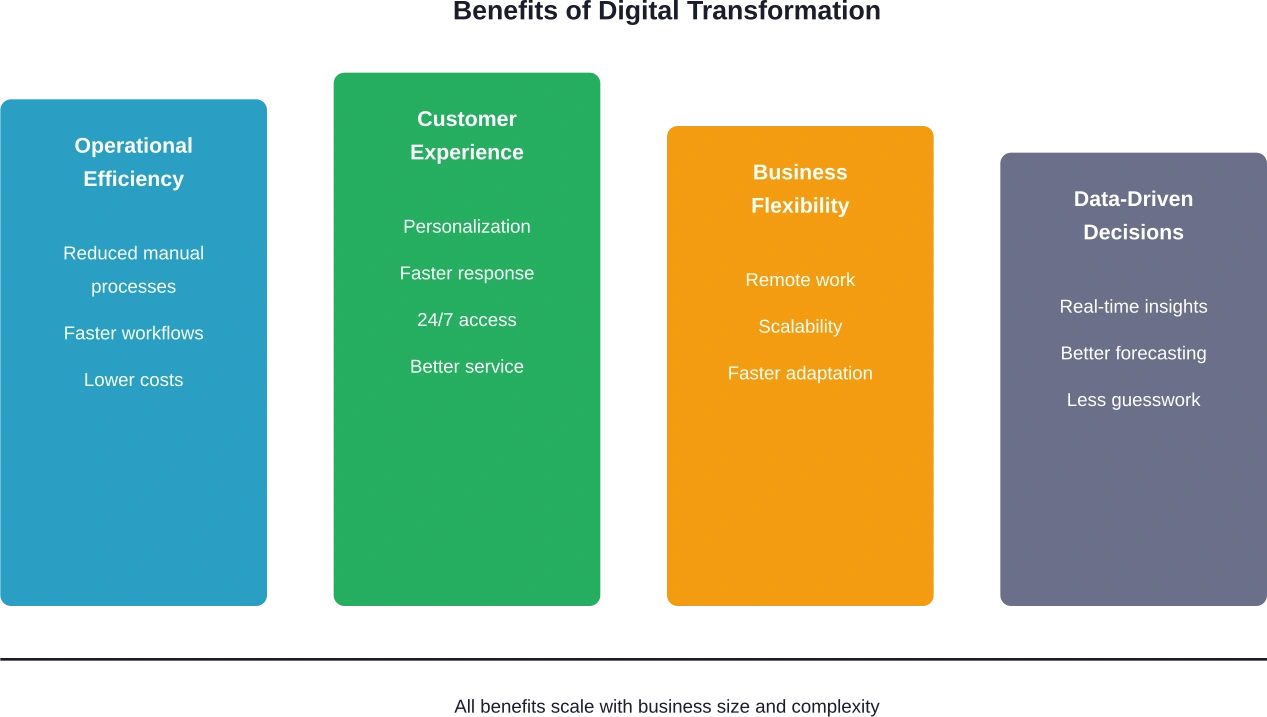
- Operational efficiency jumps. Manual processes that took hours can run in minutes. Automation handles repetitive tasks so people can focus on higher-value work. Cloud tools eliminate infrastructure costs and maintenance headaches.
- Customer experiences improve. Digital tools enable personalization at scale. Customer data reveals patterns and preferences. Response times drop. Convenience increases. According to the Small Business Digital Alliance, a partnership between the U.S. Small Business Administration and Business Forward, Inc., free digital tools from national members and Fortune 500 companies became available to help small businesses expand their customer base, manage their growth, find and retain talent, and enter new markets.
- Business flexibility increases. Cloud-based operations mean teams can work from anywhere. Digital processes scale up or down faster than physical ones. New products or services can launch without massive overhead.
- Data-driven decisions replace guesswork. Analytics show what’s actually working, not what feels right. Real-time dashboards surface problems before they become crises. Customer behavior data guides product development and marketing.
According to the U.S. Census Bureau’s 2023 Annual Business Survey, adoption of technology including AI had little impact on the number or skills of workers that businesses employ, with most businesses reporting ‘number of workers did not change overall’ between 2020 and 2022.

Plan Your AI-Driven Digital Transformation
Digital transformation for small businesses often includes automation, data analytics, and AI tools that improve efficiency and decision making.
Working with an experienced AI partner such as AI Superior can help small businesses identify practical AI use cases, estimate implementation costs, and build solutions that fit their existing systems.
Their team supports companies with:
- AI strategy and digital transformation planning
- custom AI solution development
- machine learning and data infrastructure implementation
If your small business is planning a digital transformation initiative, AI Superior can help design and implement AI solutions that support long term growth.
Key Technologies Driving Small Business Transformation
The technology landscape is massive, but small businesses don’t need to adopt everything. Focus on tools that solve specific problems and integrate well with each other.
Cloud Computing
Cloud services are the foundation of modern digital transformation. Instead of buying servers and managing infrastructure, businesses pay for what they use. Storage, software, and computing power all scale on demand.
Cloud tools enable remote work, automatic backups, and access from any device. The upfront costs drop dramatically compared to traditional IT infrastructure. Security and updates happen automatically.
Customer Relationship Management (CRM)
CRM systems centralize customer data—contact information, purchase history, preferences, support tickets, communication history. Everyone in the company sees the same information.
This eliminates the chaos of scattered spreadsheets and sticky notes. Sales teams know what customers bought. Support teams see previous issues. Marketing teams can segment and personalize.
Automation and Workflow Tools
Automation handles repetitive tasks without human intervention. Invoice generation, email responses, data entry, appointment reminders, social media posting—all can run automatically.
Workflow tools connect different apps and services so they talk to each other. When a customer completes a purchase, the workflow might update the CRM, send a confirmation email, notify the shipping team, and update inventory counts. All automatic.
Data Analytics and Business Intelligence
Analytics tools turn raw data into insights. Dashboards show key metrics at a glance. Reports reveal trends, patterns, and anomalies. Predictive analytics forecast future performance based on historical data.
Small businesses can now access analytics capabilities that were once exclusive to large enterprises. Cloud-based BI tools require no special infrastructure or data science teams.
Artificial Intelligence and Machine Learning
AI adoption among small businesses is still relatively low. The Census Bureau reported that only 3.8% of businesses used AI to produce goods and services as of late 2023. Among the smallest businesses (1-4 employees), use rates have been increasing but remain well below larger companies.
But AI is becoming more accessible. Chatbots handle basic customer service. AI tools predict customer satisfaction scores without surveys. Machine learning optimizes pricing, inventory, and marketing spend.
Research from the Economic Innovation Group shows that from 2022 to the beginning of 2025, unemployment rates actually rose less for workers in AI-exposed occupations (0.30 percentage points) compared to others (0.94 percentage points). The fear that AI destroys jobs doesn’t match the employment data so far.
E-Commerce and Digital Payments
Online sales channels and digital payment systems are no longer optional. Customers expect to browse, purchase, and pay digitally. Mobile payment adoption continues to grow.
Digital payment systems integrate with accounting software, making reconciliation automatic. Transaction data feeds directly into financial reports and analytics.
Cybersecurity Tools
The National Institute of Standards and Technology (NIST) provides cybersecurity frameworks and perspectives specifically intended to assist small and medium-sized businesses. The NIST Cybersecurity Framework helps small businesses build security programs from scratch or strengthen existing ones.
Cloud-based security tools provide enterprise-grade protection at small business prices. Multi-factor authentication, encrypted storage, automated threat detection, and regular security updates all help protect against breaches.
Building a Digital Transformation Strategy
Strategy matters more than spending. Small businesses can’t afford to buy tools that sit unused or don’t solve real problems. A clear strategy prevents that waste.
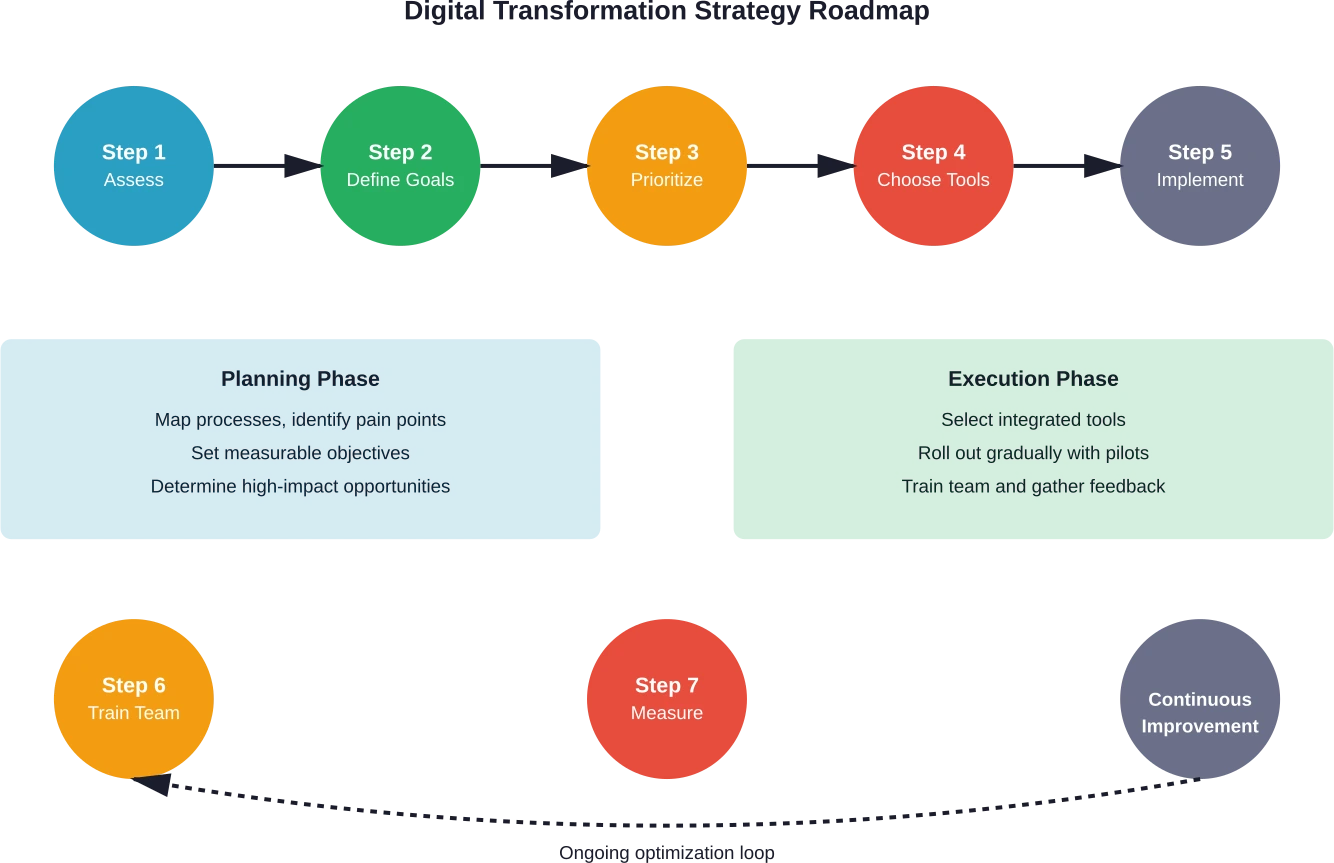
Step 1: Assess Current State
Map out existing processes, tools, and pain points. Where do bottlenecks happen? What takes too long? Where do errors occur? What frustrates customers and employees?
Document current technology usage. List all software, subscriptions, and tools. Identify redundancies and gaps. Check which systems talk to each other and which operate in silos.
Step 2: Define Clear Goals
Set specific, measurable objectives. Not “improve efficiency”—that’s too vague. Instead: “reduce invoice processing time from 3 days to 1 day” or “increase online sales by 25% in 6 months” or “cut customer support response time in half.”
Goals should tie directly to business outcomes that matter: revenue, costs, customer retention, employee productivity. If a goal doesn’t clearly impact the bottom line, reconsider it.
Step 3: Prioritize High-Impact Areas
Not everything needs transformation at once. Identify which changes will deliver the biggest results with reasonable effort and cost.
A simple prioritization matrix helps: plot potential initiatives by impact (high/low) and effort (high/low). Start with high-impact, low-effort wins. Build momentum and prove value before tackling bigger, harder transformations.
Step 4: Choose the Right Tools
Research tools that solve the identified problems. Read reviews from similar businesses. Test free trials before committing. Check integration capabilities—tools should work together, not create new silos.
The Small Business Digital Alliance published a library of free digital tools from national members including Amazon, Comcast, Google, Meta, PayPal, Principal Financial Group, Square (Block, Inc.), TriNet, Venmo, Verizon, Visa, and ZenBusiness on March 31, 2022. Many established companies offer free or low-cost tiers specifically for small businesses.
Evaluate total cost of ownership, not just subscription prices. Consider implementation time, training needs, and ongoing maintenance. Check current pricing and plans on official websites—pricing changes frequently.
Step 5: Implement Gradually
Big-bang implementations rarely work well. Roll out changes incrementally. Start with a pilot team or single department. Learn what works. Adjust. Then expand.
This approach reduces risk, makes training easier, and allows for course corrections before full commitment. It also prevents overwhelming the team with too much change at once.
Step 6: Train and Support the Team
New tools fail when people don’t know how to use them or resist adopting them. Invest in training. Create documentation. Designate power users who can help others.
Communicate why changes are happening and how they benefit the team, not just the business. When employees see how new tools make their jobs easier, adoption accelerates.
Step 7: Measure and Optimize
Track the metrics defined in the goals. Are things actually improving? If not, why? Collect feedback from employees and customers. Identify what’s working and what isn’t.
Digital transformation is ongoing, not a one-time project. Technology evolves. Business needs change. Continuous improvement beats periodic overhauls.
Common Challenges and How to Overcome Them
Digital transformation isn’t smooth sailing. Small businesses face specific obstacles that larger companies don’t—or can more easily overcome with dedicated resources.
Limited Budget
The perception that digital transformation requires massive investment stops many small businesses before they start. But transformation doesn’t require enterprise budgets.
Start with free or low-cost tools. Many platforms offer generous free tiers for small teams. Cloud services operate on pay-as-you-go models with no upfront costs. Open-source alternatives exist for many expensive enterprise tools.
Focus on ROI, not features. A tool doesn’t need every bell and whistle if it solves the core problem. Calculate expected returns before investing. If a tool saves 10 hours per week at $50/hour labor cost, it pays for itself quickly.
Lack of Technical Expertise
Small businesses rarely have dedicated IT staff or digital transformation experts on the team. That doesn’t have to be a dealbreaker.
Modern business software is designed for non-technical users. Drag-and-drop interfaces, templates, and wizards eliminate the need for coding or complex configuration. Documentation and tutorials are extensive.
Consider partnering with consultants or agencies for initial setup and strategy. The upfront cost can prevent expensive mistakes and accelerate time-to-value. After setup, internal teams can usually handle day-to-day operations.
Employee Resistance
People resist change, especially when it disrupts familiar workflows. “We’ve always done it this way” is a powerful force.
Combat resistance through involvement and communication. Include employees in the decision-making process. Ask for their input on pain points and desired improvements. When people feel heard and part of the solution, they’re more likely to adopt new tools.
Demonstrate quick wins. Show how new tools make jobs easier, not harder. Celebrate successes and share positive feedback. Momentum builds as early wins accumulate.
Integration Complexity
Different software systems often don’t talk to each other well. Data gets trapped in silos. Manual data entry between systems wastes time and introduces errors.
Prioritize tools with strong integration capabilities. Check what integrations are available before purchasing. Many modern platforms connect through APIs or use integration services like Zapier to bridge gaps.
Sometimes consolidation beats integration. Instead of connecting five different tools, find one platform that does all five jobs adequately. Fewer tools mean fewer integration headaches.
Security and Privacy Concerns
Moving data to the cloud and adopting digital tools creates new security vulnerabilities. Small businesses are increasingly targeted by cybercriminals who assume they have weaker defenses than large enterprises.
The National Institute of Standards and Technology (NIST) provides cybersecurity frameworks and perspectives specifically intended to assist small and medium-sized businesses. The framework helps build security programs from scratch or strengthen existing protections without requiring deep cybersecurity expertise.
Cloud providers typically offer better security than small businesses can implement on their own. Automatic updates, encryption, redundancy, and professional security teams all come standard with reputable cloud services.
Implement basic security hygiene: strong passwords, multi-factor authentication, regular backups, employee training on phishing, and least-privilege access controls. These fundamentals prevent most attacks.
Scope Creep and Overcomplication
Digital transformation projects can balloon out of control. What starts as simple invoice automation becomes a complete ERP overhaul. Costs explode. Timelines extend. Frustration grows.
Keep initial projects tightly scoped. Define clear boundaries. Resist the temptation to add “just one more thing” before launch. Ship the minimum viable solution, learn from it, then expand.
Remember that transformation is ongoing. It’s better to complete three small projects successfully than to abandon one massive project halfway through.
| Challenge | Impact | Solution
|
|---|---|---|
| Limited Budget | Delays adoption, limits tool options | Start with free/low-cost tools, focus on ROI, implement gradually |
| Lack of Technical Expertise | Implementation struggles, poor tool selection | Choose user-friendly tools, use consultants for setup, leverage vendor support |
| Employee Resistance | Low adoption rates, wasted investment | Involve team early, communicate benefits, show quick wins |
| Integration Complexity | Data silos, manual work, errors | Prioritize integrated platforms, use API connections, consider consolidation |
| Security Concerns | Data breaches, compliance issues | Follow NIST framework, use cloud security, implement basic hygiene |
| Scope Creep | Project delays, budget overruns | Keep projects tightly scoped, ship MVPs, expand incrementally |
Real-World Application: Where to Start
Theory is one thing. Practical application is another. Here’s how different types of small businesses might approach digital transformation based on their specific challenges.
Retail and E-Commerce
Retail businesses need integrated inventory management, point-of-sale systems, and online storefronts. The priority is connecting physical and digital sales channels so inventory updates in real-time regardless of where sales happen.
Customer data integration matters enormously. Whether someone shops online or in-store, the business should recognize them, know their history, and personalize their experience.
Digital payment systems reduce friction and speed up checkout. Analytics show which products sell, when, and to whom—enabling smarter inventory and marketing decisions.
Professional Services
Consultants, agencies, accountants, and other service providers need project management, time tracking, and client communication tools. Billable hours must be captured accurately and converted to invoices automatically.
Document management and collaboration platforms let teams work together efficiently regardless of location. Client portals provide transparency and reduce email overload.
CRM systems track leads, proposals, and client relationships. Automation handles appointment scheduling, follow-ups, and routine communications.
Food Service and Hospitality
Restaurants and hospitality businesses benefit from online ordering, reservation systems, and digital payment processing. Kitchen display systems replace paper tickets and reduce errors.
Inventory management connected to recipe costing shows exactly how profitable each menu item is. Ordering systems can automatically reorder ingredients when stock runs low.
Customer data platforms track preferences and enable personalized marketing. Loyalty programs become digital, making them easier to manage and more valuable for both business and customers.
Healthcare and Wellness
Healthcare providers need appointment scheduling, electronic health records, and patient communication tools that comply with privacy regulations.
Telehealth capabilities expanded dramatically during the pandemic and remain valuable. Digital intake forms reduce administrative burden and improve data accuracy.
Billing and insurance claim systems automate complex processes that previously required extensive manual work. Patient portals improve satisfaction and reduce phone calls.
Manufacturing and Wholesale
Manufacturers benefit from production planning, quality control tracking, and supply chain management tools. Sensors and IoT devices monitor equipment performance and predict maintenance needs.
Wholesale operations need order management, inventory tracking across multiple locations, and customer portals where buyers can place orders and track shipments.
Data analytics optimize production schedules, identify bottlenecks, and reduce waste. Digital twins simulate production changes before implementing them physically.
Measuring Success: Key Metrics
What gets measured gets managed. Digital transformation initiatives need clear success metrics tied to business outcomes.
Operational Metrics
- Process cycle time: How long does it take to complete key processes end-to-end?
- Error rates: How often do mistakes occur in automated vs. manual processes?
- Labor hours saved: How much time does automation free up?
- System uptime: How reliable are digital tools compared to legacy systems?
Financial Metrics
- ROI: What’s the return on technology investments?
- Cost per transaction: How much does it cost to process orders, invoices, or support tickets?
- Revenue impact: How do digital channels contribute to top-line growth?
- Customer lifetime value: Are digital tools helping retain and grow customer relationships?
Customer Metrics
- Customer satisfaction scores: Are customers happier with digital experiences?
- Net Promoter Score: Would customers recommend the business?
- Response time: How quickly does the business respond to inquiries and issues?
- Digital engagement: How many customers use digital channels vs. traditional ones?
Employee Metrics
- Tool adoption rate: What percentage of employees actively use new systems?
- Employee satisfaction: Do digital tools make jobs easier or harder?
- Training completion: Have employees completed necessary training?
- Productivity: Can employees accomplish more in less time?
Track these metrics before and after implementation. The difference shows real impact. Without baseline measurements, it’s impossible to prove whether transformation efforts are working.
The Role of Leadership and Culture
Digital transformation fails when it’s treated as purely a technology project. Technology is the enabler, but people and culture determine success.
Leadership must champion transformation actively, not just approve budgets. When leaders use new tools, talk about them positively, and celebrate wins, the rest of the organization follows. When leaders ignore new systems and stick to old methods, so does everyone else.
Creating a culture of experimentation and learning accelerates transformation. Encourage trying new approaches. Accept that some things won’t work perfectly the first time. Frame failures as learning opportunities, not career-limiting mistakes.
Communication matters enormously. Explain why changes are happening. Share progress and wins. Address concerns directly. People resist what they don’t understand, but support what they helped create.
According to the U.S. Census Bureau’s 2023 Annual Business Survey, adoption of technology including AI had little impact on the number or skills of workers that businesses employ, with most businesses reporting ‘number of workers did not change overall’ between 2020 and 2022. This finding should reassure employees that transformation isn’t about replacing people—it’s about enabling them to work more effectively on higher-value activities.
Looking Forward: Digital Transformation Trends for 2026
Digital transformation continues to evolve. Several trends are shaping how small businesses approach technology adoption in 2026.
AI Becoming More Accessible
While current AI adoption rates remain low among small businesses—3.8% according to Census Bureau data from 2023—accessibility is improving rapidly. AI features are being embedded into existing business tools rather than requiring separate AI platforms.
Predictive analytics, automated content generation, intelligent routing, and personalization are becoming standard features in CRM, marketing, and support tools. Small businesses access AI capabilities without needing data science expertise.
No-Code and Low-Code Platforms
Building custom applications and automations no longer requires programming knowledge. Visual development platforms let non-technical users create workflows, apps, and integrations through drag-and-drop interfaces.
This democratization of development allows small businesses to customize solutions to their specific needs without expensive custom software development.
Relationship-First Digital Strategies
Research published February 26, 2026 in the California Management Review highlights that digital transformation doesn’t have to privilege scale and automation to be effective for small financial institutions. Small financial institutions and other businesses can compete by focusing on relationship-building enhanced by technology rather than replaced by it.
Digital tools should deepen customer relationships, not create distance. Personalization, responsive communication, and thoughtful use of data build loyalty that pure automation can’t match.
Composable Business Architecture
Instead of monolithic enterprise systems, businesses are assembling best-of-breed tools that integrate well. This “composable” approach allows swapping components as better options emerge without replacing the entire technology stack.
APIs and integration platforms make this modular approach practical for small businesses. The flexibility to evolve technology choices over time reduces lock-in risks.
Sustainability and Digital Efficiency
Digital transformation increasingly connects to sustainability goals. Cloud computing uses less energy than on-premise servers. Digital processes reduce paper waste. Optimized logistics reduce fuel consumption. Analytics identify inefficiencies that waste resources.
Customers and employees increasingly value sustainability. Digital tools that demonstrably reduce environmental impact create competitive advantages beyond pure efficiency gains.
Frequently Asked Questions
What is digital transformation for small business?
Digital transformation is the process of integrating technology across all areas of a business to fundamentally change how it operates and delivers value to customers. For small businesses, this often means automating manual processes, moving to cloud-based tools, improving customer experiences through digital channels, and using data to make better decisions. It’s not about adopting every new technology—it’s about solving specific business problems with the right digital tools.
How much does digital transformation cost for a small business?
Costs vary widely depending on scope and ambition. Small businesses can start with free or low-cost cloud tools and pay-as-you-go services, spending as little as a few hundred dollars monthly. More comprehensive transformations involving custom integrations, consulting help, and premium enterprise tools can run thousands per month. The key is starting small, proving ROI, and expanding gradually rather than attempting everything at once. Check vendor websites for current pricing as subscription costs change frequently.
Do small businesses really need digital transformation?
Increasingly, yes. Customer expectations have shifted toward digital experiences—online access, fast responses, personalization. Competitors using digital tools operate more efficiently and can offer better prices or service. The federal government through the SBA recognizes this, publishing digital strategy resources and supporting the Small Business Digital Alliance to provide free digital tools. Businesses that don’t adapt risk losing customers to more digitally-capable competitors. But digital transformation doesn’t require massive change overnight—gradual, focused improvements deliver results.
What’s the biggest challenge in digital transformation for small businesses?
According to community discussions and industry observations, employee resistance and change management typically present the biggest obstacles. Technology is relatively straightforward—finding tools that work isn’t usually the problem. Getting people to actually use new tools and change established workflows is harder. This is why involving employees early, communicating benefits clearly, and demonstrating quick wins matter more than technical factors in determining success or failure.
How long does digital transformation take?
Digital transformation isn’t a project with a defined end date—it’s an ongoing process. Individual initiatives might take weeks to months depending on complexity. Implementing a new CRM might take 4-8 weeks from selection to full team adoption. Automating invoice processing might take 2-3 weeks. The larger transformation journey continues indefinitely as technology evolves and business needs change. Think of it as continuous improvement rather than a one-time overhaul.
Can a small business do digital transformation without IT staff?
Absolutely. Modern business software is designed for non-technical users with intuitive interfaces, templates, and extensive documentation. Cloud services eliminate infrastructure management. Many small businesses successfully implement digital tools without dedicated IT staff by choosing user-friendly platforms, leveraging vendor support, and potentially using consultants for initial setup and strategy. The key is selecting tools designed for business users rather than IT professionals.
What should a small business digitize first?
Start with the area causing the most pain or offering the highest return. Common starting points include accounting and invoicing automation, customer relationship management, online appointment scheduling, or e-commerce capabilities. The right answer depends on specific business bottlenecks. Ask: what manual process takes the most time, causes the most errors, or frustrates customers the most? That’s usually the best place to start. Early wins build momentum for broader transformation.
Conclusion: Start Small, Think Big
Digital transformation isn’t reserved for enterprises with massive budgets and dedicated IT departments. Small businesses can compete and win by thoughtfully applying technology to solve real problems.
The key is starting with strategy, not tools. Understand the problems that need solving. Set clear, measurable goals tied to business outcomes. Prioritize high-impact areas. Choose tools that integrate well and match the team’s technical capabilities.
Data from the U.S. Census Bureau and SBA shows that while small businesses lag larger companies in advanced technology adoption, the gap is narrowing. Free tools, cloud services, and no-code platforms are making capabilities that were once exclusive to large enterprises accessible to businesses of all sizes.
Implementation success depends more on people and process than technology. Involve the team. Communicate clearly. Demonstrate quick wins. Measure results. Optimize continuously.
Digital transformation is a journey, not a destination. Start small. Prove value. Build momentum. Scale what works. The businesses that commit to this ongoing evolution position themselves to compete effectively regardless of their size.
The question isn’t whether small businesses should pursue digital transformation. The question is how to do it strategically, affordably, and effectively. With the right approach, even the smallest business can leverage technology to work smarter, serve customers better, and build sustainable competitive advantages.
Ready to start? Pick one pain point. Find one tool that addresses it. Implement it well. Measure the results. Then do it again. That’s digital transformation in practice.
 English
  German
  Arabic
  French
  Dutch
Dutch  Spanish