
Quick Summary: The average cost of artificial intelligence ranges from $5,000 for basic models to over $500,000 for complex enterprise solutions. As of 2026, businesses face evolving pricing models including per-token charges, subscription tiers, and usage-based billing. Development costs, infrastructure expenses, and ongoing maintenance combine to create total AI costs that vary significantly based on complexity, data requirements, and deployment scale.
AI pricing has become one of the most confusing aspects of technology adoption. It’s inconsistent, complex, and constantly shifting.
When companies started integrating AI into their operations, many discovered unexpected costs lurking beneath the surface. One developer processes 1.6 billion tokens monthly through autonomous agents, spending $5,000-$7,000 per month. That same computational workload would have cost drastically different amounts just a year earlier.
The challenge isn’t just understanding what AI costs today. It’s predicting what it’ll cost tomorrow.
This guide breaks down the average cost of artificial intelligence across different use cases, deployment models, and business scales. Whether building custom solutions or subscribing to AI-powered software, understanding these cost structures helps businesses budget accurately and avoid billing surprises.
AI Cost Ranges: From Basic to Advanced
The cost spectrum for artificial intelligence is remarkably wide.
Basic AI models start around $5,000. These typically include simple machine learning implementations, rule-based systems, or straightforward automation tools. They’re sufficient for narrow use cases like basic chatbots, simple classification tasks, or entry-level predictive analytics.
Mid-range solutions utilizing more sophisticated algorithms cost between $50,000 and $150,000. These projects involve custom model training, integration with existing systems, and moderate data processing requirements.
Complex AI implementations leveraging deep learning can exceed $500,000. Enterprise-grade solutions with advanced natural language processing, computer vision, or multi-model architectures fall into this category.
But here’s where it gets tricky. These figures represent development costs only. They don’t account for infrastructure, ongoing maintenance, or the hidden expenses that emerge during deployment.
Cost Per Token: The New Pricing Standard
Many AI services now charge per token. A token roughly equals one word in a prompt or response.
Processing 1.6 billion tokens monthly costs approximately $1,700 with some providers and around $6,500 with others. That’s a nearly 4x difference for identical computational work.
Open models achieve about 90% of the performance of closed models when released, but the price of running inference is 87% less on open models. This pricing gap creates interesting strategic decisions for businesses weighing performance against budget.
According to a Finance Agent Benchmark study, even top-performing models like OpenAI’s o3 achieved only 46.8% accuracy on complex financial research tasks at an average cost of $3.79 per query. This underscores a critical point: higher costs don’t always guarantee better results for specific use cases.
Primary Cost Factors in AI Projects
Multiple variables influence the final price tag for artificial intelligence implementations.
Development Complexity
Simple projects with well-defined parameters cost less. Complex projects requiring novel architectures, multi-model coordination, or cutting-edge techniques drive costs upward significantly.
The difference between implementing an existing model and training a custom one can represent 10x cost variation.
Data Requirements
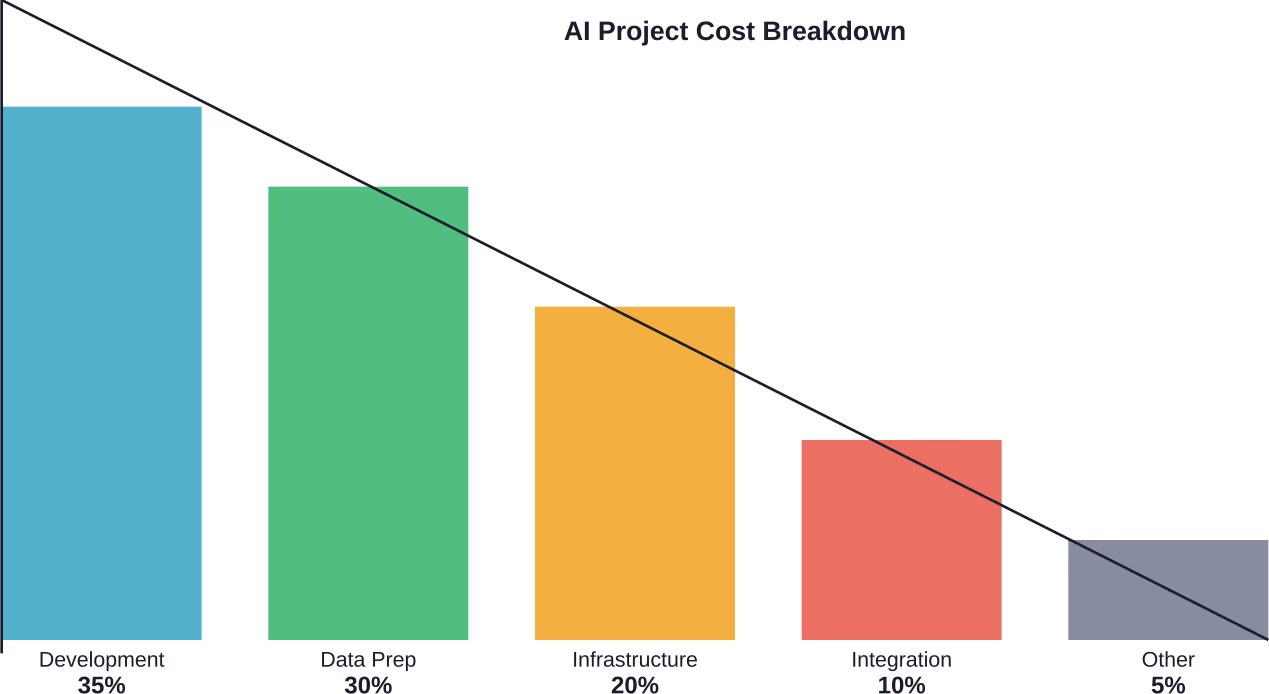
Data quality, volume, and preparation work heavily impact costs. Cleaning, labeling, and structuring data often consumes 60-80% of project timelines and budgets.
Companies with poor data infrastructure discover this quickly. What seemed like a $50,000 AI project becomes a $150,000 data engineering project with AI on top.
Infrastructure and Hardware
Training complex models requires substantial computational resources. Cloud infrastructure costs for AI workloads continue climbing as data center demand increases.
U.S. cities are now paying an average of $0.19/kWh—up from $0.13 just a few years ago. That’s a 45% increase in under a decade. A major driver? Data centers—especially those fueling AI. Data centers consumed 4.4% of U.S. electricity in 2023, up from ~1–2% a decade ago. By 2028, that could surge to 6.7–12%, depending on AI adoption.
These energy costs get passed along. Businesses using cloud AI services indirectly pay for this infrastructure through higher service fees.
Integration and Deployment
Connecting AI solutions to existing systems creates additional costs. Legacy infrastructure often requires middleware, API development, or even system overhauls to accommodate AI functionality.
Integration complexity varies wildly. Simple API integrations might add 10-15% to project costs. Complete system redesigns can double the total investment.
Maintenance and Updates
AI systems require ongoing maintenance. Models drift over time as real-world data distributions change. Retraining, monitoring, and updates create recurring expenses.
A general rule suggests allocating 15-25% of initial development costs annually for maintenance. Some complex systems require more.
AI Pricing Models in 2026
Pricing structures have evolved significantly. Businesses now encounter multiple billing approaches, each with distinct advantages and pitfalls.
Subscription-Based Pricing
Monthly or annual subscriptions provide predictable costs. Many SaaS platforms with embedded AI features use this model.
The challenge? AI features often come as premium add-ons. A platform charging $50/month might jump to $150/month with AI capabilities enabled. That 3x multiplier catches finance teams off guard.
Usage-Based Pricing
Pay-per-use models charge based on actual consumption—tokens processed, API calls made, or compute hours used.
This approach offers flexibility but creates budget uncertainty. One survey found 78% of IT leaders experienced unexpected costs from usage-based or AI features in 2026.
Usage spikes can happen fast. A chatbot that processes 10,000 queries monthly might suddenly handle 100,000 if customer interest surges. The bill increases proportionally.
Hybrid Models
Some providers combine base subscriptions with usage overages. Pay a flat fee for a certain volume, then per-unit charges beyond that threshold.
These models balance predictability with scalability but require careful monitoring to avoid overage surprises.
Per-Seat Licensing
Traditional per-user pricing still exists, particularly for AI tools integrated into productivity software. Each employee accessing AI features requires a license.
This works well for workforce tools but becomes expensive as organizations scale adoption.
| Pricing Model | Best For | Cost Predictability | Scalability |
|---|---|---|---|
| Subscription | Fixed workloads | High | Limited |
| Usage-Based | Variable demand | Low | Excellent |
| Hybrid | Growing businesses | Medium | Good |
| Per-Seat | Team tools | High | Medium |
Real-World Cost Examples
Abstract numbers help, but concrete examples provide better context.
Code Generation
A developer generates around 1 million lines of usable code monthly. The computational cost runs $5,000-$7,000 per month depending on the model provider.
Benchmarked against traditional labor, generating 1 million lines of code per month might superficially appear equivalent to the output of thousands of developers. However, this comparison is misleading. A realistic net output of a professional developer (after design, testing, review, refactoring and integration) is typically in the range of a few hundred to low thousands of usable lines per month. Moreover, no engineering organization can architecturally design, review, integrate and maintain such volume in a month without severe quality degradation. A more grounded measure of AI impact is a 20–55% increase in individual developer productivity on typical tasks.
But there’s a catch. According to MIT research, generative AI tools can make developers up to 55% more productive. However, the Consortium for Information & Software Quality estimates the cost of technical debt in the U.S. to be at least $2.4 trillion. AI-generated code may accelerate debt accumulation if quality controls aren’t rigorous.
Financial Analysis
The Finance Agent Benchmark evaluated LLMs on complex financial research tasks using real SEC filings. The best-performing model achieved 46.8% accuracy at $3.79 per query.
For an investment firm running 10,000 analyses monthly, that’s $37,900 in AI costs. The accuracy rate means half the outputs require human verification, adding labor costs back into the equation.
Building Management
NIST demonstrated AI-optimized HVAC controls in commercial buildings. While specific cost figures weren’t disclosed, AI control techniques showed potential for reducing energy costs in building operations through the Intelligent Building Agents Laboratory (IBAL) research infrastructure.
Predictive Maintenance
A rail network covering 665 miles deployed AI-powered sensors for defect detection. The system correctly identified 92% of defects found by human inspectors, at lower cost and higher speed than traditional manual inspections.
Traditional inspection methods proved costly and time-consuming. The AI pilot dramatically improved efficiency while reducing operational expenses.
Hidden Costs of AI Implementation
The sticker price rarely tells the complete story.
Training and Change Management
Employees need training to use AI tools effectively. Change management programs, workshops, and ongoing support create costs beyond software licensing.
Organizations often underestimate these expenses. Budget 10-20% of the technology cost for effective training programs.
Security and Compliance
AI systems handling sensitive data require robust security measures. According to the Thales Data Threat Report (May 2025), nearly 70% of organizations view the rapid pace of AI development as the leading security concern.
Implementing proper security controls, conducting audits, and maintaining compliance add recurring costs.
Data Storage and Processing
AI systems generate substantial data volumes. Storage costs compound over time, particularly for systems that log interactions, store training data, or maintain audit trails.
Processing this data for model updates or analysis creates additional computational expenses.
Technical Debt
Rushed AI implementations create technical debt that eventually demands repayment. Most organizations allocate less than 20% of technology budgets to addressing technical debt, despite its estimated cost in the U.S.
AI systems built without proper architecture, documentation, or testing standards become maintenance nightmares. The initial savings evaporate when systems require expensive refactoring.
In-House vs. External Development
Building AI capabilities internally versus hiring external experts presents distinct cost profiles.
In-House Development
Internal teams provide ongoing control and institutional knowledge. But building AI expertise from scratch is expensive.
Specialized AI talent typically commands significant salaries, with market rates varying based on experience and location. Building a competent team requires multiple specialists.
Infrastructure costs add up. Cloud computing, development tools, and training resources create recurring expenses before delivering any business value.
Timelines matter too. Internal teams learning on the job take 6-18 months longer than experienced external partners. Those months represent opportunity costs.
External Partners
AI development firms charge $100-$250 per hour depending on expertise and location. A mid-sized project requiring 500 hours costs $50,000-$125,000.
External partners bring proven expertise, faster timelines, and lower risk. But they don’t build internal capabilities. When the project ends, institutional knowledge walks out the door.
Hybrid Approaches
Many successful implementations combine both. External partners handle initial development while training internal teams for ongoing maintenance and future enhancements.
This approach balances speed with capability building but requires careful coordination.
AI ROI and Business Impact
Cost matters, but return on investment matters more.
Some AI implementations deliver immediate value. Automation that eliminates manual data entry or accelerates document processing shows clear ROI within months.
Other applications take years to prove their value. Advanced analytics, predictive models, or experimental AI features might not generate measurable returns for 2-3 years.
Measuring AI Success
Defining success metrics before implementation helps evaluate ROI accurately.
Efficiency gains represent one category. How many hours does the AI save? What’s the value of that time?
Revenue impact represents another. Does AI help close more deals, retain more customers, or enable new business models?
Cost reduction provides a third metric. Does AI reduce operational expenses, minimize waste, or optimize resource allocation?
Most successful AI implementations deliver returns across multiple dimensions. A customer service chatbot might reduce support costs, improve response times, and increase customer satisfaction simultaneously.
When AI Doesn’t Pay Off
Not every AI investment succeeds.
Projects targeting problems that don’t exist waste money. Building sophisticated prediction models for processes that don’t need prediction creates no value.
Implementations that ignore data quality fail reliably. Garbage in, garbage out applies forcefully to AI systems.
Solutions that don’t integrate with existing workflows get abandoned. If using the AI tool creates more work than it eliminates, adoption stalls.
Cost-Effective AI Testing Strategies
Smart organizations test before committing substantial resources.
Proof of Concept Projects
Small-scale POCs validate feasibility without full investment. Budget $10,000-$50,000 for focused pilots targeting specific use cases.
These projects answer critical questions. Does the technology work with our data? Can it integrate with our systems? Will users actually adopt it?
Failed POCs cost money but save organizations from much larger failed implementations.
Open Source Models
Open models achieve about 90% of the performance of closed models when released, but the price of running inference is 87% less on open models. For many use cases, that trade-off makes sense.
Testing with open source models provides low-risk experimentation. Organizations can evaluate AI applicability without vendor lock-in or substantial licensing costs.
Cloud AI Services
Major cloud providers offer AI services with minimal upfront costs. Pay-per-use pricing enables experimentation without infrastructure investment.
These services work well for testing but can become expensive at scale. Plan the migration strategy from testing to production carefully.
AI Pricing Trends for 2026 and Beyond
Several trends are reshaping AI economics.
Declining Compute Costs
Model efficiency continues improving. An MIT study from October 2025 mapping scaling laws against continued improvements in model efficiency suggests that in the next five to ten years, it could become harder to wring leaps in performance from giant models whereas efficiency gains could make models running on more modest hardware increasingly capable.
This shift could reduce the computational costs of running AI while maintaining acceptable performance for many applications.
Increasing Energy Costs
Energy costs for data centers continue rising. This trend pressures AI providers to pass costs along through higher service fees.
Organizations adopting AI must factor energy cost inflation into long-term budget planning.
Pricing Complexity
AI pricing models are becoming more sophisticated and more confusing. Tiered plans, usage caps, feature-based add-ons, and dynamic pricing create billing complexity.
Managing AI expenses requires dedicated attention. Many organizations underestimate the governance effort needed to control AI costs across multiple tools and platforms.
AI-Native Applications
New applications built AI-first from the ground up often deliver better value than AI bolted onto legacy software.
This trend favors startups and newer entrants over established enterprise software vendors retrofitting AI into decades-old architectures.
Managing and Controlling AI Costs
Controlling AI expenses requires proactive management.
Usage Monitoring
Implement systems that track AI consumption across the organization. Many businesses discover unauthorized tools or runaway usage only when unexpected bills arrive.
Real-time monitoring enables intervention before costs spiral.
Governance Policies
Establish clear policies governing AI tool adoption. Which departments can approve AI spending? What evaluation criteria must tools meet? How are costs allocated across business units?
Without governance, AI tool sprawl mirrors the SaaS sprawl that plagues many organizations.
Vendor Negotiation
AI pricing remains negotiable, particularly for enterprise contracts. Usage commitments, volume discounts, and multi-year agreements can substantially reduce costs.
Negotiating from an informed position requires understanding actual usage patterns and alternative options.
Regular Audits
Quarterly reviews of AI tools, usage, and costs identify waste. Tools that seemed promising during evaluation might deliver little value in practice.
Eliminating underutilized tools prevents budget drain.
| Cost Control Strategy | Effort Required | Potential Savings | Implementation Priority |
|---|---|---|---|
| Usage monitoring | Medium | 15-25% | High |
| Governance policies | Medium | 20-35% | High |
| Vendor negotiation | Low | 10-20% | Medium |
| Regular audits | Low | 10-15% | Medium |
| Architecture optimization | High | 25-40% | Low |

Get Your AI Budget Right Before You Start
AI costs in 2026 are rarely limited to development alone. A large share of the budget sits in data preparation, model tuning, and making systems usable in real environments. AI Superior works across this full cycle – from defining the use case and structuring data to building, training, and deploying models. Keeping these stages connected from the start helps avoid duplicated work and unexpected cost increases.
The work is usually focused on production-ready systems rather than isolated experiments. That means aligning infrastructure, model choice, and integration early, so spending stays under control as the project grows. If you are planning an AI build or trying to estimate realistic costs, it makes sense to review your setup before committing. Reach out to AI Superior to validate your approach and avoid unnecessary spend.
Future of AI Pricing
Looking ahead, several forces will shape AI costs.
Competition among providers should drive prices down. As more vendors enter the market, pricing pressure increases.
But infrastructure constraints might limit price decreases. Energy costs, chip shortages, and data center capacity all constrain supply.
Regulatory requirements could add compliance costs. As governments implement AI regulations, vendors will pass those costs to customers.
Model efficiency improvements provide the most promising path to lower costs. Better algorithms that deliver comparable results with less computation could dramatically reduce expenses.
This trend could reshape the competitive landscape, with big AI firms potentially having less of an edge in the future.
Organizations should plan for continued pricing volatility. AI costs won’t stabilize soon. Building flexibility into budgets and contracts helps manage this uncertainty.
Frequently Asked Questions
How much does it cost to start an AI project?
Basic AI projects start around $5,000 for simple implementations. Mid-range projects using custom models typically cost $50,000-$150,000. Complex enterprise AI solutions can exceed $500,000. Starting costs depend on project scope, data requirements, infrastructure needs, and whether you’re building in-house or hiring external developers.
What are the primary cost factors in AI projects?
Development complexity drives significant cost variation. Data preparation typically consumes 60-80% of project timelines and budgets. Infrastructure and computational resources add substantial expenses, particularly for training complex models. Integration with existing systems, ongoing maintenance, security measures, and training programs create additional costs beyond initial development.
Are there differences in cost between in-house and external AI development?
In-house development requires hiring specialized talent, plus infrastructure costs. External developers charge $100-$250 per hour, with mid-sized projects costing $50,000-$125,000. External partners deliver faster results with proven expertise, while in-house teams build long-term capabilities but take 6-18 months longer to deliver.
How much does it cost to maintain AI systems?
Maintenance typically runs 15-25% of initial development costs annually. This includes model retraining as data distributions change, monitoring system performance, security updates, infrastructure costs, and addressing technical debt. Complex systems with high reliability requirements may need higher maintenance budgets.
Can you test AI before fully investing?
Proof of concept projects costing $10,000-$50,000 validate feasibility before full implementation. Open source models provide low-cost experimentation, running 87% cheaper than closed alternatives while achieving about 90% of the performance. Cloud AI services with pay-per-use pricing enable testing without infrastructure investment.
What pricing models do AI vendors use?
Subscription-based models charge monthly or annual fees, often with AI as premium add-ons. Usage-based pricing charges per token, API call, or compute hour, creating flexibility but budget uncertainty. Hybrid models combine base subscriptions with usage overages. Per-seat licensing charges per user accessing AI features. Each model suits different use cases and scales differently.
How can ROI from AI investments be measured?
Measure efficiency gains by calculating time saved and its value. Track revenue impact through increased sales, better retention, or new business models enabled by AI. Monitor cost reduction from operational improvements, waste minimization, or resource optimization. Successful implementations typically deliver returns across multiple dimensions simultaneously rather than one metric alone.
Conclusion
The average cost of artificial intelligence varies dramatically based on complexity, scope, and deployment approach. Basic implementations start around $5,000, while sophisticated enterprise solutions exceed $500,000.
But focusing solely on initial development costs misses the bigger picture. Infrastructure expenses, data preparation, integration work, ongoing maintenance, and hidden costs like training and technical debt substantially impact total investment.
Pricing models continue evolving. Subscription plans, usage-based billing, per-token charges, and hybrid approaches each create different cost profiles and budgeting challenges.
The key to managing AI costs effectively lies in careful planning, realistic budgeting that accounts for all cost categories, proactive monitoring, and strong governance. Organizations that treat AI as a strategic investment rather than a technology purchase achieve better results.
Start small, test thoroughly, and scale based on proven value. The businesses succeeding with AI aren’t necessarily those spending the most. They’re the ones aligning technology investments with clear business objectives and managing costs deliberately.
Ready to understand your organization’s AI costs? Begin by auditing existing AI tools, mapping actual usage patterns, and identifying where expenses are going. That visibility provides the foundation for smarter decisions about future AI investments.
 English
  German
  Arabic
  French
  Dutch
Dutch  Spanish