
Quick Summary: AI will not replace marketers, but it will transform how marketing work gets done. According to the American Marketing Association’s 2026 Future Trends report, AI will automate transactional marketing tasks while human creativity, cultural fluency, and authentic storytelling become the primary differentiators. The Bureau of Labor Statistics projects marketing jobs to grow through 2034, with AI creating new opportunities even as it automates routine tasks.
The question keeping marketing professionals up at night isn’t new, but it’s gotten louder in 2026.
Will AI replace marketers?
Here’s what’s actually happening: AI is reshaping marketing roles faster than most predicted. But replacement? That’s not the story the data tells.
The U.S. Bureau of Labor Statistics projects total employment to grow from 170.0 million in 2024 to 175.2 million in 2034. Marketing occupations are part of this growth trajectory, not disappearing from it. Meanwhile, the American Marketing Association’s 2026 Future Trends in Marketing report, developed through a modified Delphi process with input from over 30 marketing professionals, confirms what practitioners already sense: AI will automate much of transactional marketing work, but human creativity and authentic storytelling will become the primary differentiators for brands.
So no, AI won’t replace marketers. But it will absolutely replace bad marketing.
The marketers who survive and thrive won’t be those who resist AI. They’ll be the ones who understand what AI can’t do—and double down on those irreplaceable human skills.
The Real Impact of AI on Marketing Jobs
Let’s cut through the hype and look at what’s actually changing.
According to BLS research on AI impacts in employment projections, AI primarily affects occupations whose core tasks can be most easily replicated by Generative AI in its current form. For marketing, that means repetitive, transactional tasks are getting automated first.
But here’s the nuance: AI may also support demand for certain roles. The BLS notes that software developers are needed to develop AI-based business solutions and maintain AI systems, and database administrators are expected to be needed to set up and maintain more complex data infrastructure.
The same pattern applies to marketing. As AI handles routine tasks, demand grows for marketers who can strategize, interpret AI-generated insights, and create genuinely compelling campaigns.
Which Marketing Tasks Are Being Automated
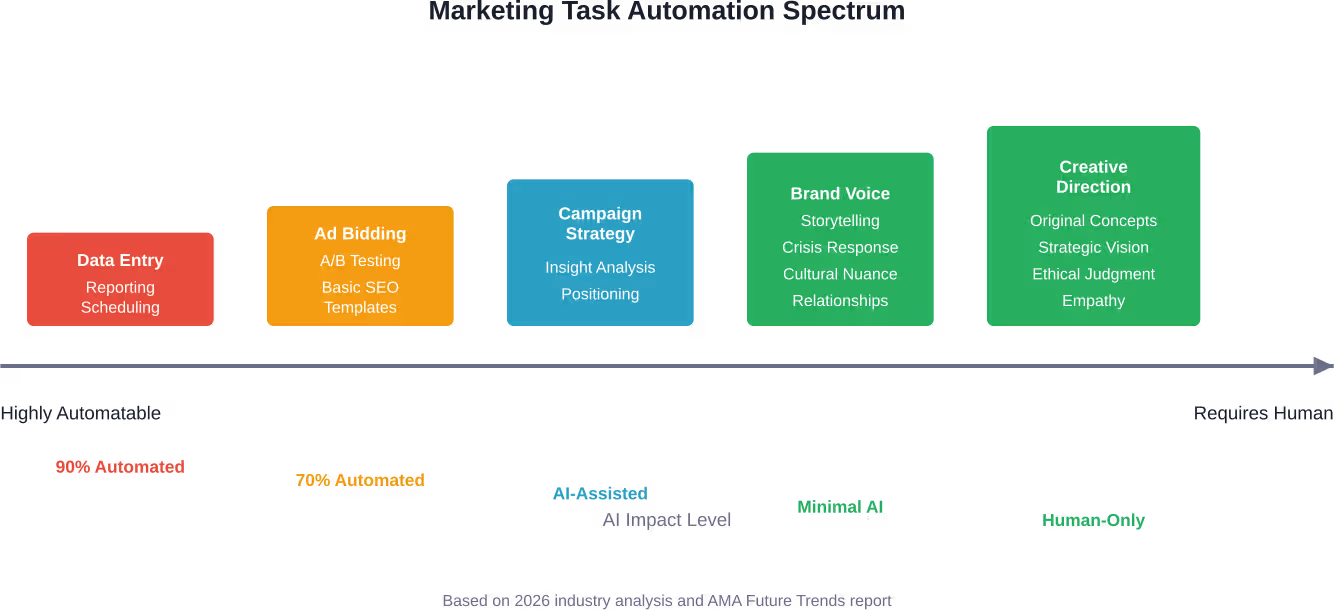
Community discussions and professional reports consistently identify these areas where AI is making the biggest impact:
- Basic content generation for product descriptions and email templates
- Social media post scheduling and optimization
- Ad bid management and budget allocation
- Initial customer segmentation and basic personalization
- Reporting and dashboard creation
- A/B test setup and statistical analysis
- Keyword research and SEO recommendations
These tasks aren’t disappearing. They’re becoming table stakes—things AI handles in the background while marketers focus on higher-value work.
What the Employment Data Actually Shows
Global digital advertising and marketing spending is projected to reach approximately $830+ billion by 2026 (GroupM, Statista, eMarketer), with total advertising spend exceeding $950+ billion for the first time. This is notably higher than older 2021 forecasts of $786.2 billion.
That’s not a shrinking industry. That’s explosive growth.
The BLS employment projections show much slower growth than the previous decade—3.1 percent compared to 13.0 percent over 2014–24. But growth nonetheless. The economy is adding jobs, not eliminating entire professions.
For marketing specifically, the shift is toward specialization. Generic “do everything” marketing roles are becoming less common. Specialized positions that combine AI fluency with deep domain expertise are expanding.
What AI Cannot Replace in Marketing
This is where the conversation gets interesting.
AI excels at pattern recognition, data processing, and executing predefined tasks at scale. What it can’t do—at least not yet, and probably not for a long time—is understand human experience in context.
Harvard’s Division of Continuing Education notes that AI presents marketers with opportunities to personalize customer experiences and build technological skills. The emphasis is on marketers using AI, not AI replacing marketers.
Cultural Fluency and Context
Real talk: AI doesn’t understand why a campaign that works perfectly in one market bombs spectacularly in another.
Cultural context, local sensitivities, historical references, emerging social movements—these require lived experience and cultural fluency that AI fundamentally lacks. According to the AMA’s 2026 report, cultural fluency will become one of the primary differentiators for brands.
A marketer who understands the cultural moment can craft messages that resonate. AI can optimize delivery, but it can’t create genuine cultural relevance.
Strategic Thinking and Business Judgment
AI can tell marketers what happened. It struggles to explain why it matters or what to do about it.
Strategic decisions require business judgment: understanding competitive dynamics, anticipating market shifts, balancing short-term tactics with long-term brand building, navigating organizational politics to get buy-in.
These aren’t tasks. They’re judgment calls that require experience, intuition, and an understanding of factors AI can’t quantify.
Authentic Storytelling and Emotional Connection
According to the AMA’s research, authentic storytelling will become a primary brand differentiator as AI automates transactional marketing.
Here’s why: AI can generate content that’s grammatically correct and on-brand. What it can’t do is create stories that genuinely move people.
Authentic storytelling requires vulnerability, perspective, and emotional intelligence. It requires understanding not just what people say they want, but what they actually need—sometimes before they know it themselves.
That’s a human skill.
Ethical Decision-Making and Crisis Management
When things go wrong—and in marketing, things absolutely go wrong—human judgment becomes critical.
According to the 2025 Edelman Trust Barometer, 68% of people believe leaders deliberately mislead the public, and trust in institutions is declining. In this environment, ethical marketing isn’t just nice to have. It’s a business imperative.
AI doesn’t have ethics. It has training data and optimization functions. When a campaign raises ethical questions, when a crisis hits, when trade-offs involve values and not just metrics—that’s when marketers earn their keep.
Which Marketing Roles Are Most Affected by AI
Not all marketing roles face the same AI impact. Some are being transformed rapidly. Others remain largely unchanged.
High-Impact Roles: Significant Transformation
These roles are experiencing substantial AI-driven changes:
- Performance Marketing Specialists: Ad bidding, budget allocation, and campaign optimization are increasingly AI-driven. The role is shifting from manual optimization to strategic oversight and creative testing.
- Content Marketers (Entry-Level): Basic blog posts, product descriptions, and templated content are easily AI-generated. Entry-level content roles focused on volume are declining. Demand is growing for senior content strategists who can craft narratives and maintain brand voice.
- Marketing Analysts: Routine reporting and dashboard creation are automated. The role is evolving toward insight interpretation and strategic recommendation rather than data compilation.
- Email Marketers: Template creation, send-time optimization, and basic segmentation are AI-handled. The focus is shifting to strategy, creative testing, and customer journey design.
Moderate-Impact Roles: AI-Assisted
These roles use AI as a tool but retain significant human elements:
- Social Media Managers: Scheduling and basic engagement are automated, but community management, crisis response, and authentic voice require human judgment.
- SEO Specialists: Technical audits and keyword research are AI-accelerated, but search strategy and content direction remain human-driven.
- Marketing Managers: AI handles execution and reporting, freeing managers to focus on strategy, team development, and cross-functional collaboration.
Low-Impact Roles: Minimal AI Disruption
These roles remain primarily human-driven:
- Brand Strategists: Brand positioning, messaging architecture, and strategic narrative development require deep business understanding and creative thinking.
- Creative Directors: Original concept development, creative vision, and aesthetic judgment remain firmly in human territory.
- Marketing Leadership (CMO, VP-level): Strategic decision-making, organizational leadership, and business partnership aren’t being automated.
- Customer Experience Designers: Understanding customer needs, designing experiences, and orchestrating touchpoints require empathy and holistic thinking.
| Role Type | AI Impact Level | Tasks Being Automated | Growing Responsibilities |
|---|---|---|---|
| Performance Marketing | High | Bid management, budget allocation, basic optimization | Strategic testing, creative direction, channel strategy |
| Content Marketing (Junior) | High | Templated content, basic blog posts, descriptions | Shifting toward senior strategic roles |
| Marketing Analytics | High | Report generation, dashboard creation, data compilation | Insight interpretation, strategic recommendations |
| Social Media Management | Moderate | Scheduling, basic engagement, posting | Community building, crisis response, authentic voice |
| SEO Specialist | Moderate | Technical audits, keyword research, reporting | Search strategy, content direction, authority building |
| Brand Strategy | Low | Research compilation | Positioning, messaging, strategic narrative |
| Creative Direction | Low | Asset resizing, template application | Original concepts, creative vision, aesthetic judgment |
How Marketers Can Stay Relevant in an AI-Driven Future
So what should marketers actually do about all this?
The answer isn’t to resist AI or pretend it’s not happening. The answer is to become the kind of marketer AI can’t replace.
Develop AI Fluency (Not Just AI Skills)
There’s a difference between using AI tools and understanding how AI thinks.
Marketers need to understand what AI is good at, where it falls short, and how to effectively collaborate with AI systems. That means experimenting with AI tools, understanding their limitations, and learning to prompt and guide them effectively.
But it also means understanding AI’s blind spots—what it misses, what it gets wrong, and when human judgment should override AI recommendations.
Double Down on Uniquely Human Skills
Based on the AMA’s 2026 Future Trends report, these skills will become primary differentiators:
- Cultural fluency: Understanding social context, cultural moments, and audience sensitivities
- Authentic storytelling: Creating narratives that genuinely connect with human experience
- Creative thinking: Generating original ideas and unexpected connections
- Strategic judgment: Making decisions with incomplete information and competing priorities
- Emotional intelligence: Reading people, building relationships, navigating organizational dynamics
- Ethical reasoning: Making values-based decisions in complex situations
These aren’t add-ons. They’re the core job.
Shift From Execution to Strategy
As AI handles more execution, the value shifts to strategic thinking.
Marketers need to move up the value chain: from writing content to developing content strategy, from running campaigns to designing marketing systems, from analyzing data to interpreting insights and making recommendations.
This requires developing business acumen, understanding financial impact, and connecting marketing activities to business outcomes.
Become T-Shaped: Deep Expertise Plus Broad Knowledge
The “generalist marketer who does everything okay” is being squeezed out. The future belongs to T-shaped marketers: deep expertise in one area plus broad working knowledge across marketing.
Pick a specialty where human judgment remains critical—brand strategy, creative direction, customer experience, strategic planning—and go deep. Then develop enough AI fluency and cross-functional knowledge to collaborate effectively.
Embrace Continuous Learning
The marketing landscape is changing faster than ever. Digital marketing spending is projected to reach $950+ billion, driven largely by AI-enabled capabilities.
Staying relevant means committing to continuous learning: new tools, new platforms, new methodologies, new customer behaviors. Marketers who stop learning become obsolete fast.
What Marketing Leaders Need to Get Right About AI
If individual marketers need to adapt, marketing leaders face an even bigger challenge: transforming how their teams work while maintaining performance.
Invest in AI Literacy Across the Team
According to the AMA’s 2026 Future Trends report, AI literacy is becoming a baseline requirement for marketing teams.
But here’s what that doesn’t mean: It doesn’t mean every marketer needs to become a data scientist or learn to code. It means everyone on the team needs to understand how to effectively collaborate with AI tools and when to trust or question AI recommendations.
Forward-thinking marketing leaders are investing in AI training not as a one-time workshop, but as ongoing capability building.
Restructure Around Strategy, Not Execution
As AI handles more execution, team structures need to shift.
The old model—lots of junior people doing execution work, managed by a few senior strategists—doesn’t make sense when AI handles the execution. The new model has fewer people, but they’re more senior, more strategic, and better compensated.
This is already happening. Community discussions note that entry-level marketing roles focused on repetitive tasks are declining, while demand for senior strategic roles is growing.
Redefine What Good Performance Looks Like
When AI can generate a dozen campaign variations in minutes, volume stops being impressive. Quality, strategic thinking, and business impact become the measures that matter.
Marketing leaders need to update performance expectations and evaluation criteria to reflect this shift. The marketer who produces one strategically brilliant campaign is more valuable than the one who cranks out ten mediocre AI-generated ones.
Address the Trust Gap
According to the 2025 Edelman Trust Barometer, trust in institutions is declining, with 68 percent of people believing leaders deliberately mislead the public. For consumers, trust ranks alongside value and quality as a top purchase consideration.
AI-generated content at scale can erode trust further if it feels impersonal, generic, or manipulative. Marketing leaders need to establish clear guidelines for AI use that prioritize authenticity and transparency.
That means being honest about when and how AI is used, maintaining human oversight on customer-facing content, and never sacrificing authenticity for efficiency.

See How AI Works In Marketing Before Making Assumptions
AI is already affecting marketing, but mostly through structured tasks – data analysis, automation, and predictive modeling – while strategy and decision-making remain human.
AI Superior works with companies that want to apply AI in a practical way. They help define where it fits inside existing workflows, then build custom solutions and integrate them into current systems so they support real day-to-day work instead of running separately. If you are evaluating AI in marketing, it makes more sense to start with specific processes and test them in your own setup.
Reach out to AI Superior and see what can be improved without changing how your team already operates.
The Future: AI-Powered Marketers, Not AI Replacing Marketers
Here’s where we land after examining the data, the trends, and the reality of 2026.
AI won’t replace marketers. But AI-powered marketers will absolutely replace marketers who don’t adapt.
The Bureau of Labor Statistics projects employment growth through 2034. The American Marketing Association confirms that while AI will automate transactional marketing, human creativity and storytelling will become primary differentiators. Harvard research emphasizes AI as an opportunity for marketers to build skills and personalize experiences.
The pattern is clear: AI is a tool that changes how marketing work gets done, not a replacement for marketing professionals.
But—and this is critical—the nature of marketing work is fundamentally shifting. Routine tasks are automated. Strategic thinking becomes more valuable. Human skills like creativity, cultural fluency, and authentic storytelling become the differentiators.
What This Means Practically
For individual marketers, the path forward is clear: Develop AI fluency, double down on uniquely human skills, shift from execution to strategy, and commit to continuous learning.
For marketing leaders, the mandate is to invest in team AI literacy, restructure around strategy, redefine performance standards, and maintain the trust that AI alone cannot build.
For the profession as a whole, this is actually an opportunity. Marketing has always been about understanding people and crafting messages that resonate. AI doesn’t change that fundamental mission. It just handles the repetitive parts, freeing marketers to focus on what actually matters: human connection.
The Marketers Who Will Thrive
The marketers who thrive in an AI-driven future won’t be those with the most technical skills or the deepest AI knowledge.
They’ll be the ones who combine AI fluency with irreplaceable human judgment. The ones who use AI to work faster and smarter, but never lose sight of what makes marketing actually work: understanding people, telling authentic stories, and building genuine connections.
They’ll be the ones who recognize that AI is an amplifier, not a replacement. It amplifies good marketing—and it exposes bad marketing faster than ever.
So no, AI won’t replace marketers. But it will separate the marketers worth keeping from those who were just going through the motions.
Frequently Asked Questions
Will AI completely replace marketing jobs by 2030?
No. The U.S. Bureau of Labor Statistics projects employment growth through 2034, including marketing-related occupations. AI will automate specific tasks, particularly repetitive and transactional work, but it creates demand for strategic marketing roles. The American Marketing Association’s 2026 Future Trends report confirms that human creativity, cultural fluency, and authentic storytelling will become primary differentiators as AI handles automation.
Which marketing jobs are most at risk from AI automation?
Entry-level roles focused on repetitive tasks face the highest impact: basic content creation, routine reporting, manual ad optimization, and templated email campaigns. However, these tasks are being automated, not the entire role. The positions are evolving toward more strategic responsibilities rather than disappearing entirely.
What marketing skills are AI-proof?
Cultural fluency, authentic storytelling, creative thinking, strategic judgment, emotional intelligence, and ethical decision-making remain firmly in human territory. According to the AMA’s 2026 research, these capabilities will become the primary brand differentiators. AI cannot replicate the lived experience, contextual understanding, and empathy required for these skills.
Should marketers learn AI and machine learning?
Marketers need AI fluency—understanding how to work with AI tools, interpret their outputs, and know their limitations—but don’t necessarily need to learn programming or machine learning at a technical level. The focus should be on becoming effective AI collaborators rather than AI developers. Understanding what AI can and cannot do is more valuable than understanding how it works internally.
How is AI changing content marketing specifically?
AI is automating basic content generation, SEO optimization, and performance analysis. This shifts content marketing from volume production to strategic narrative development. Entry-level content roles focused on churning out templated pieces are declining, while demand grows for senior content strategists who can craft authentic brand stories and maintain distinctive voices.
Can AI create effective marketing strategies?
AI can analyze data, identify patterns, and suggest tactical optimizations, but it cannot create comprehensive marketing strategies. Strategy requires business judgment, competitive understanding, cultural context, and the ability to synthesize qualitative and quantitative information in ways AI cannot replicate. AI assists with strategy execution and optimization, but strategic direction remains a human responsibility.
What should marketing teams do now to prepare for AI?
Invest in AI literacy training across the team, restructure roles around strategy rather than execution, update performance metrics to emphasize quality over volume, and establish clear guidelines for ethical AI use. According to the AMA’s research, organizations should focus on developing human skills that AI cannot replicate while building capabilities to effectively leverage AI tools.
Moving Forward in an AI-Driven Marketing Landscape
The question isn’t whether AI will impact marketing. It already has.
The question is whether marketing professionals will adapt to use AI effectively, or resist until they’re left behind.
The data from the Bureau of Labor Statistics, the American Marketing Association, and Harvard all point in the same direction: AI transforms how marketing work gets done, but increases rather than decreases the need for skilled marketing professionals who can think strategically, create authentically, and connect genuinely with audiences.
For marketers willing to develop AI fluency while doubling down on uniquely human skills, the future is full of opportunity. The mundane tasks that consume time and energy are increasingly automated, freeing professionals to focus on the creative and strategic work that actually moves businesses forward.
For marketing leaders, the path requires investment: in team development, in new ways of structuring work, and in maintaining the authenticity and trust that AI alone cannot build.
And for the profession as a whole, this represents an evolution, not an extinction. Marketing has always adapted to technological change. AI is just the latest tool in a long line of innovations that changed how marketers work—from printing presses to radio to television to the internet.
The marketers who survive and thrive won’t be those who resist change. They’ll be those who embrace it strategically, use AI to amplify their capabilities, and never lose sight of what marketing fundamentally is: the art and science of understanding people and communicating value in ways that resonate.
So will AI replace marketers? No. But it will absolutely replace marketers who refuse to evolve.
The choice is yours.
 English
  German
  Arabic
  French
  Dutch
Dutch  Spanish