
Quick Summary: AI won’t replace programmers entirely but will fundamentally transform their role. While AI tools can generate code snippets and automate routine tasks, software engineering requires complex problem-solving, system architecture, security considerations, and human accountability that AI cannot replicate. Developers who adapt by leveraging AI as a productivity tool while focusing on high-level design and critical thinking will thrive.
Fear is everywhere. Online forums buzz with nervous developers asking if they should abandon their coding careers. Headlines scream about AI agents writing entire applications. And every few weeks, a new AI coding assistant emerges claiming revolutionary capabilities.
But here’s the thing—the question isn’t really whether AI will replace coding. It’s what happens when AI becomes a fundamental part of how software gets built. And that future is already here.
According to the U.S. Bureau of Labor Statistics, AI may support demand for computer occupations rather than eliminate them, as software developers are needed to develop AI-based business solutions and maintain AI systems. The reality is more nuanced than the doomsday predictions suggest.
What AI Can Actually Do Today
Let’s cut through the hype and look at actual capabilities.
AI coding assistants have become impressively capable at specific tasks. Research from arXiv examining AI-assisted codebase generation found that these tools can generate basic code structures quickly. A developer working on a Python message queue consumer with retry logic can get skeleton code in seconds rather than spending 20 minutes on tedious typing.
That’s genuinely useful. But it’s not replacement—it’s acceleration.
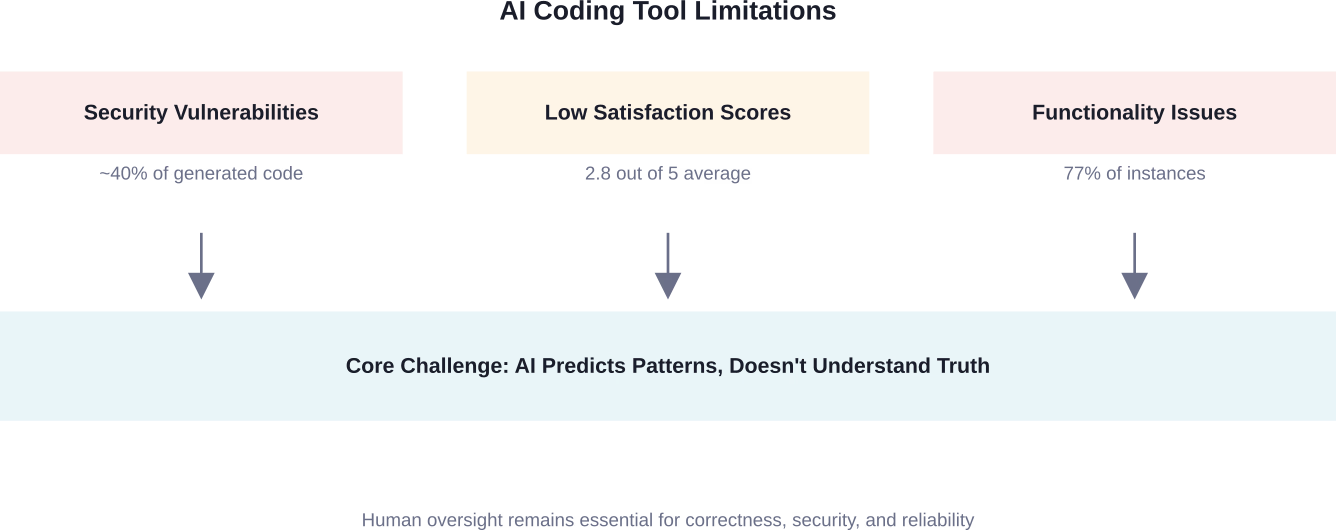
The same research revealed a critical limitation: overall satisfaction scores with AI-generated codebases remained low (mean=2.8, median=3, on a scale of one to five). Participants cited functionality issues in 77% of instances and poor code quality in 42% of cases.
GitHub Copilot, one of the most widely adopted AI coding tools, demonstrates both the promise and limitations. Research examining GitHub Copilot found that around 40% of generated code contained vulnerabilities (Pearce et al., 2025). While newer versions have improved by adding security filtering layers, the fundamental issue remains: AI predicts patterns without truly understanding correctness or security implications.
The Hidden Complexity of Software Engineering
Here’s where the “AI will replace programmers” narrative falls apart.
Coding represents a portion of what software engineers actually do. The rest? That’s where things get complicated.
According to MIT’s Computer Science & Artificial Intelligence Lab research, software engineering extends far beyond writing code to include understanding complex real-world problems, system architecture and design, testing and reliability, security and performance optimization, maintenance and long-term scaling, and collaboration with cross-functional teams.
AI doesn’t attend stakeholder meetings to decode vague requirements. It doesn’t make architectural decisions balancing technical debt against delivery timelines. And it certainly doesn’t take responsibility when a system fails in production.
The Accountability Problem Nobody Talks About
When AI-generated code causes a production outage, who’s responsible?
This isn’t theoretical. In healthcare systems, banking infrastructure, and transportation networks, software failures have real consequences. Regulatory frameworks and legal systems require human accountability.
An AI assistant can suggest code. But it can’t be held liable for failures. It can’t explain decisions during incident reviews. And it can’t appear in court when things go catastrophically wrong.
That responsibility stays with human engineers. And with responsibility comes the need for genuine understanding—not just the ability to prompt an AI tool effectively.
What Government Data Actually Shows
The U.S. Bureau of Labor Statistics incorporates AI impacts into employment projections. Their analysis provides a reality check against the panic.
According to BLS research published in March 2025, AI is expected to primarily affect occupations whose core tasks can be most easily replicated by generative AI in its current form. However, the same analysis notes that AI may support demand for computer occupations, as software developers are needed to develop AI-based business solutions and maintain AI systems, and database administrators and architects are expected to be needed to set up and maintain more complex data infrastructure.
The median annual wage for software developers was $133,080 in May 2024, according to BLS. Employment projections don’t suggest collapse—they suggest transformation.
Research from the Brookings Institution examining workers’ capacity to adapt to AI-driven job displacement found that among workers in the top quartile of occupational AI exposure, 26.5 million have above-median adaptive capacity. However, 6.1 million workers (4.2% of the workforce) face concentrated vulnerability.
The Productivity Paradox
AI coding tools genuinely increase developer productivity for certain tasks. Research examining GitHub Copilot’s impact on software development found that developers using the tool completed tasks 55.8% faster on average than control groups, though with no significant effect on task success.
That’s massive. But faster code generation doesn’t necessarily mean fewer developers.
History shows that productivity improvements in software development tend to increase demand rather than reduce headcount. When developers can build features faster, organizations typically build more features—not hire fewer developers.
The constraint in most organizations isn’t how fast developers can type code. It’s how quickly teams can understand requirements, make good architectural decisions, and deliver reliable systems that solve actual business problems.
The Rise of “Vibe Coding” and Its Risks
A concerning trend has emerged: developers building applications with AI-generated code they don’t fully understand.
Community discussions highlight this phenomenon, where someone can prompt an AI assistant to create a functional-looking application without grasping the underlying logic, security implications, or maintainability issues.
This works fine until something breaks. Then the real problems begin.
Debugging AI-generated code presents unique challenges. When engineers don’t write the original logic, understanding why it fails becomes exponentially harder. The code might follow unusual patterns, use obscure libraries, or implement solutions in non-standard ways.
Research on AI-assisted coding notes that AI hallucinations remain a major risk. Generative AI predicts patterns—it doesn’t understand the truth. It can confidently produce incorrect logic, security vulnerabilities, and hidden bugs that look correct on the surface but cause serious problems in production.
How Developers Are Actually Adapting
The smart move isn’t to compete with AI at writing boilerplate code. It’s to develop skills that AI can’t replicate.
Based on industry observations and community discussions, successful developers are focusing on several key areas. They’re deepening their understanding of system architecture and design patterns that AI tools struggle with. They’re developing stronger skills in requirements gathering and translating business needs into technical solutions.
Security expertise becomes more valuable, not less. Someone needs to review AI-generated code for vulnerabilities. Someone needs to understand the attack vectors that AI assistants blissfully ignore.
Communication skills matter more than ever. When AI can generate basic code, the differentiator becomes explaining technical concepts to non-technical stakeholders, mentoring junior developers, and facilitating cross-team collaboration.
| Skills Becoming More Valuable | Skills Becoming Less Valuable |
|---|---|
| System architecture & design | Writing boilerplate code |
| Security & vulnerability analysis | Memorizing syntax |
| Requirements translation | Basic CRUD operations |
| Cross-team communication | Simple bug fixes |
| Performance optimization | Standard implementations |
| Technical mentorship | Routine refactoring |
| Business domain expertise | Basic testing scripts |

Make AI Work Inside Your Development Process
AI can generate code, but building reliable systems still depends on how that code is structured, tested, and connected to real use cases. AI Superior focuses on the implementation side of AI in software development.
They work with teams to design and build custom AI solutions, integrate machine learning into existing products, and set up data pipelines that support real workflows. A lot of their work sits beyond code generation – things like aligning AI outputs with system architecture, handling edge cases, and making sure solutions are stable in production.
If you want to use AI in development without adding risk or technical debt, talk to AI Superior about how it can fit into your current setup.
What a Day Actually Looks Like
Consider a typical workday for a developer using AI tools effectively.
Morning starts with an AI assistant generating a basic message queue consumer in Python with retry logic and logging. That saves 20 minutes of typing. The skeleton code appears almost instantly.
Then the real work begins. Wiring that generated code into the actual system architecture. Handling the tricky edge cases the AI didn’t consider. Ensuring the retry logic plays nicely with the existing error-handling framework. Adding proper observability hooks for the monitoring system.
Afternoon involves reviewing a colleague’s pull request for a critical payment processing feature. The code was partially AI-generated, so extra scrutiny goes into security implications and edge cases. A subtle race condition appears that the AI missed entirely—one that could have caused duplicate charges under specific timing scenarios.
Late afternoon brings a meeting with product managers to scope next quarter’s features. This involves translating vague business requirements into feasible technical approaches, estimating complexity, and identifying potential architectural challenges.
The AI assistant helped with maybe 30 minutes of coding tasks. The other seven-plus hours? Pure human expertise.
The Legacy Code Reality
Here’s something the “AI will replace programmers” crowd often misses: most professional development isn’t greenfield projects.
It’s maintaining massive legacy codebases. Working with systems that have evolved over decades. Understanding architectural decisions made years ago by developers who’ve since left the company.
ArXiv research on AI for software engineering highlights the COBOL problem: COBOL powers 80% of in-person financial services transactions and 95% of ATM swipes while processing $3 trillion in commerce a day, with over 220 billion lines of COBOL code in production (Taulli, 2020).
AI tools trained in modern languages struggle with legacy systems. They certainly can’t navigate the institutional knowledge embedded in decades-old codebases—the undocumented business rules, the historical context for particular design decisions, the tribal knowledge about which systems can and can’t be modified safely.
What Enterprise Usage Actually Reveals
Brookings Institution research examining enterprise AI usage provides revealing insights. Analysis of Anthropic’s Claude chatbot showed that while about half of Claude chatbot usage was for augmenting purposes, the overwhelming majority (77%) of the tasks that business clients using Claude’s API deployed were for the purpose of automation (Anthropic).
That split matters. Augmentation means AI helps humans do their jobs better. Automation means AI replaces human tasks entirely.
The research notes that stability, not disruption, characterizes AI’s current labor market impacts. But that could change rapidly. Organizations are clearly exploring how to shift from augmentation to automation.
The key variable isn’t technical capability—it’s economic incentive. When automation becomes cheaper and more reliable than augmentation, business decisions follow predictable patterns.
The Training Challenge
For developers worried about displacement, retraining seems like an obvious solution. But research from Brookings examining worker retraining programs reveals sobering realities.
Training program participation varies significantly across the U.S., with classroom training ranging from 14% to 96% depending on the state. Outcomes vary wildly. A national randomized evaluation found that training programs show inconsistent effectiveness.
The challenge intensifies for developers. What exactly should they retrain for when the technology landscape shifts every few months? Learning a new framework provides little protection if AI tools master that framework six months later.
The Real Future of Coding
So what’s actually going to happen?
The most likely scenario isn’t mass displacement—it’s role evolution. Junior developers face the most immediate pressure. Entry-level positions focused on writing straightforward code become harder to justify when AI tools can generate similar output.
But mid-level and senior developers who understand systems thinking, architecture, and business domains? They’re not getting replaced. They’re getting powerful new tools that handle the tedious parts of their job.
The industry will likely see a bifurcation. Developers who adapt by leveraging AI while deepening their expertise in areas AI can’t touch will become more valuable. Those who compete with AI at writing basic code will struggle.
BLS projections support this view. Rather than projecting collapse in software development employment, the analysis suggests developers will be needed to build and maintain AI systems themselves—creating a somewhat circular demand pattern.
Frequently Asked Questions
Will AI completely replace programmers?
No. Research from MIT and employment data from the U.S. Bureau of Labor Statistics indicate that AI will transform developer roles rather than eliminate them. Software engineering involves far more than code generation—including system architecture, security, debugging complex issues, and accountability—areas where AI currently falls short. BLS projections suggest AI may actually increase demand for developers needed to build and maintain AI systems.
What percentage of coding tasks can AI actually automate?
Current AI tools excel at generating boilerplate code and handling routine implementations, but research shows significant limitations. Studies found that 77% of AI-generated codebases had functionality issues and 40% contained security vulnerabilities. AI handles perhaps 20-30% of what software engineers actually do, primarily the routine coding tasks rather than architecture, design, and problem-solving work.
Should new developers still learn to code?
Yes. Understanding code remains fundamental even as AI tools become more capable. Developers need to review, debug, and integrate AI-generated code—impossible without coding knowledge. Additionally, the skills that make developers valuable—system thinking, architecture, security awareness, and problem-solving—all require a solid coding foundation. AI tools make knowledgeable developers more productive rather than making coding knowledge obsolete.
What skills should developers focus on to stay relevant?
Focus on areas AI struggles with: system architecture and design, security and vulnerability analysis, translating business requirements into technical solutions, performance optimization, cross-team communication, and domain expertise in specific industries. These skills complement AI tools rather than compete with them. Technical mentorship and the ability to make good architectural decisions become more valuable as AI handles routine coding tasks.
How are AI tools actually being used in professional development?
Research on enterprise usage shows AI tools primarily augment rather than replace developer work. Common uses include generating boilerplate code, suggesting implementations for routine functions, and accelerating basic tasks. However, developers spend most time on activities AI can’t handle—wiring generated code into existing systems, handling edge cases, reviewing code for security issues, debugging complex problems, and making architectural decisions. A study found AI tools reduced completion time by 55.8% for specific tasks, but this increased productivity typically leads to building more features rather than reducing headcount.
What does BLS data show about software developer job outlook?
U.S. Bureau of Labor Statistics analysis from 2025 indicates that AI may support demand for computer occupations rather than reduce it. Developers are needed to create AI-based business solutions and maintain AI systems. Database administrators and architects are expected to be needed for increasingly complex data infrastructure. The median annual wage for software developers was $133,080 in May 2024, and employment projections show transformation rather than collapse in the field.
What’s the biggest risk developers face from AI?
The primary risk isn’t immediate replacement—it’s complacency. Developers who rely solely on AI-generated code without understanding it face serious challenges when systems fail or require debugging. Research shows debugging AI-generated code is harder because engineers may not understand the original logic. The rise of “vibe coding”—building applications without understanding the underlying code—creates developers who can’t solve problems when AI tools fall short. The risk is becoming dependent on tools without developing the expertise needed when those tools inevitably fail.
The Bottom Line
Will AI replace coding? Not in any straightforward way.
Will AI fundamentally change what it means to be a software developer? Absolutely. That change is already happening.
The developers who treat AI as a threat to avoid are making a mistake. So are those who assume AI will magically solve all their problems. The productive middle ground involves understanding what AI does well, recognizing its limitations, and developing skills that complement rather than compete with AI capabilities.
Coding isn’t going away. But the nature of coding work is shifting—probably faster than most people realize. The question isn’t whether to adapt. It’s how quickly developers can evolve their skills to match where the industry is heading.
And based on the data available today, that evolution favors developers who think deeply about systems, communicate effectively, and take responsibility for outcomes. The ones who see AI as a tool that handles the tedious parts while they focus on the parts that actually matter.
That’s not a replacement. That’s transformation. And developers who embrace it will likely find themselves more valuable, not less.
 English
  German
  Arabic
  French
  Dutch
Dutch  Spanish