
Quick Summary: AI will not completely replace analysts but will fundamentally transform the role. According to the Bureau of Labor Statistics, AI is expected to automate routine analytical tasks while creating demand for analysts with hybrid skills who combine technical capabilities with business acumen, strategic thinking, and domain expertise. The analysts at greatest risk are those focusing solely on technical execution without developing soft skills and business context.
The question keeping analysts up at night isn’t whether AI can write SQL queries or build dashboards anymore. It already can. The real question is whether there’s still a seat at the table for human analysts when machines can crunch numbers faster, spot patterns more reliably, and generate reports without coffee breaks.
Here’s what the data actually shows: AI is rewriting the job description, not necessarily eliminating the position.
According to the U.S. Bureau of Labor Statistics, total employment is projected to grow from 170.0 million in 2024 to 175.2 million in 2034, an increase of 3.1 percent. But that growth isn’t evenly distributed. AI is expected to primarily affect occupations whose core tasks can be most easily replicated by Generative AI in its current form.
So which analysts survive? And more importantly, what separates those who thrive from those who get automated out?
The Current State of AI in Analytics
AI has moved well beyond the experimental phase in analytics work. McKinsey reports that while only 1% of organizations describe their generative AI deployments as mature, 92% plan to increase their investments over the next three years.
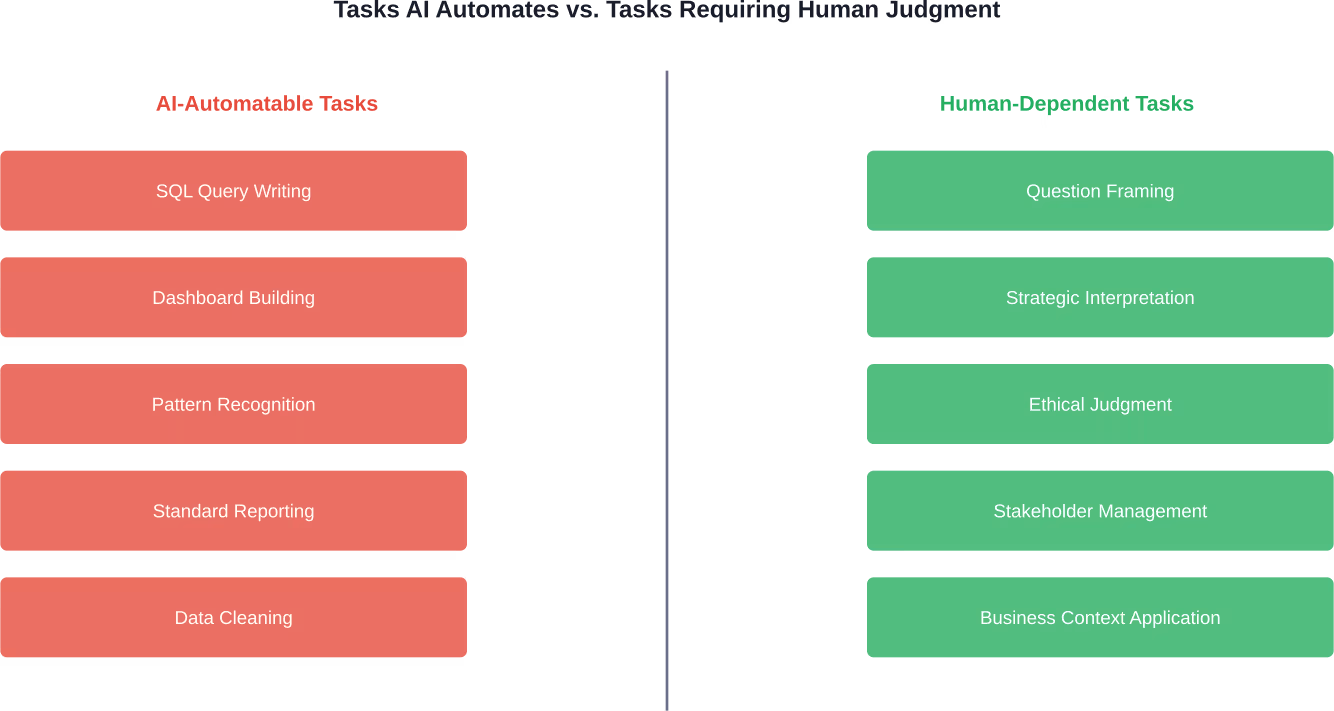
The technology handles tasks that once consumed the majority of an analyst’s day. SQL query generation, basic data visualization, pattern recognition in large datasets, and routine reporting all fall within AI’s current capabilities.
But here’s where it gets interesting.
The same BLS research notes that AI may also support demand for computer occupations, as software developers may be needed to develop AI-based business solutions and maintain AI systems. Database administrators and architects are expected to be needed to set up and maintain more complex data infrastructure.
Translation? AI creates new categories of analytical work even as it automates existing ones.
Which Analyst Roles Face the Greatest Risk
Not all analyst positions face equal pressure from AI automation. The vulnerability depends largely on task composition and data availability.
According to industry commentary, AI will replace some data analysts. Specifically, it threatens those who focus on technical skills over soft skills, those who don’t speak up in meetings because they’re too scared to share opinions, and those who refuse to learn data engineering skills.
Research from Harvard Business School examining job postings found that the largest reductions were in the finance and technology sectors. These data-rich environments provide AI with the abundant training material needed for effective automation.
Industries with substantial, high-quality data could see AI adoption rates around 60-70%. Meanwhile, sectors without extensive digitized data might struggle with less than 25% adoption.
Software development is getting hammered. Data-abundant finance jobs are ripe for disruption. Entry-level analytical positions in the US have fallen by 35% in the last 18 months, in large part because of AI.
The Pattern Behind Replacement
MIT economist David Autor used a large language model to classify tasks into three categories: abstract tasks that require creativity, reasoning, and interpersonal skills; routine tasks that follow clear procedures; and manual tasks requiring physical presence.
Analysts whose work centers on routine tasks face the highest displacement risk. These are roles built around executing predefined analytical procedures, generating standardized reports, and performing structured data transformations.
But there’s nuance here that matters.
According to BLS projections research, despite periodic concerns raised regarding mechanical technology in the 1950s and 1960s about computers and industrial automation leading to massive job losses, the impacts played out differently than feared.
The Transformation of Analyst Work
AI isn’t destroying jobs in analytics—it’s rewriting them. As models begin to handle underwriting, compliance, and asset allocation, the traditional architecture of analytical work is undergoing fundamental restructuring.
The Brookings Institution notes that hybrid roles are emerging. These combine technical proficiency with domain expertise, strategic thinking, and relationship management skills that AI can’t replicate.
For jobs still open, the nature of the work is changing fast as AI carries out routine task execution. This shifts analyst focus from data manipulation to insight generation and strategic application.
| Traditional Analyst Focus | Emerging Analyst Focus | Shift Driver |
|---|---|---|
| Writing SQL queries | Designing analytical frameworks | AI handles code generation |
| Building dashboards | Defining metrics that matter | Automation of visualization |
| Data cleaning | Data quality strategy | Automated preprocessing |
| Running standard reports | Translating insights to action | Self-service BI tools |
| Technical execution | Business problem framing | AI commoditizes technical tasks |
According to the World Economic Forum’s Future of Jobs Report 2023, employers estimate that 44% of workers’ skills will be disrupted in the next five years.
What AI Can’t Replace
AI can easily write SQL and build dashboards, but it doesn’t form opinions from years of experience or know how to translate conversations into actionable insights.
Several capabilities remain firmly in the human domain:
- Question framing: Determining what to analyze requires understanding business context, organizational politics, and unstated assumptions. AI excels at answering well-formed questions but struggles to identify which questions matter.
- Ethical judgment: Data analysis involves constant decisions about what to measure, how to measure it, and what conclusions are appropriate. These choices carry ethical weight that requires human accountability.
- Stakeholder navigation: Getting analytical work adopted means understanding organizational dynamics, building trust, and communicating in ways that resonate with different audiences. Technical correctness doesn’t guarantee organizational impact.
- Strategic interpretation: Raw patterns in data don’t explain themselves. Connecting analytical findings to business strategy, competitive positioning, and organizational capabilities requires contextual knowledge AI doesn’t possess.
Skills That Protect Your Analyst Career
The analysts thriving in this environment aren’t necessarily the most technically skilled. They’re the ones who combine technical capabilities with human judgment and business needs.
Based on available data from industry surveys and employment projections, several skill categories show increasing importance:
Business Acumen and Domain Expertise
Understanding the business context surrounding data matters more than ever. When AI handles technical execution, the value shifts to analysts who can connect analytical findings to business outcomes.
Domain expertise—deep knowledge of industry-specific patterns, regulations, and competitive dynamics—creates analytical insights that generic AI models can’t produce.
Communication and Influence
As a data analyst, the superpower isn’t SQL proficiency anymore. It’s the ability to connect to the business, get to the root of problems, and create scalable solutions that solve multiple issues simultaneously.
This requires communication skills that extend beyond presenting charts. Analysts need to facilitate discussions, challenge assumptions respectfully, and build consensus around data-driven decisions.
Data Engineering Fundamentals
Data quality is everyone’s responsibility. Analysts who understand data pipelines, infrastructure limitations, and engineering constraints can work more effectively and identify problems AI might miss.
This doesn’t mean becoming a full data engineer, but understanding enough to collaborate effectively and recognize when data quality issues undermine analytical conclusions.
AI Literacy and Tool Orchestration
The analysts who survive aren’t competing with AI—they’re orchestrating it. This means understanding what AI tools can and can’t do, knowing when to trust automated outputs versus when human verification is necessary, and combining multiple AI capabilities to solve complex problems.
Industry-Specific Impacts
AI’s impact on analysts varies dramatically by industry, driven primarily by data availability and regulatory environment.
Finance and Banking
Financial analysts face substantial disruption. Research examining job postings shows the largest reductions in finance sectors. Data abundance makes these roles particularly susceptible to automation.
That said, regulatory complexity and the need for human accountability in financial decision-making create ongoing demand for analyst oversight. The role shifts from data processing to judgment application within automated systems.
Technology Sector
Tech companies adopted AI analytics tools earliest and most aggressively. The 35% decline in entry-level analytical positions concentrates heavily in this sector.
However, the same sector shows growing demand for analysts who can work at the intersection of product development, user behavior, and business metrics—roles requiring context AI can’t provide.
Healthcare and Life Sciences
Healthcare analytics faces different dynamics. While AI excels at pattern recognition in medical data, regulatory requirements, patient privacy concerns, and the need for clinical judgment create persistent human analyst demand.
Data-poor subsectors within healthcare struggle with AI adoption below 25%, maintaining traditional analyst roles longer.
Retail and E-commerce
Retail analytics shows rapid AI adoption for routine tasks like inventory forecasting and customer segmentation. But strategic decisions about market positioning, promotional strategy, and customer experience still require human insight.
The Entry-Level Problem
The 35% decline in entry-level analytical positions creates a critical challenge. Traditional career paths assumed analysts would spend early years building technical skills through routine work before advancing to strategic roles.
When AI eliminates that entry-level training ground, how do analysts develop expertise?
Organizations are responding in several ways. Some create rotational programs that expose junior analysts to business context earlier. Others pair entry-level analysts with AI tools, positioning them as AI supervisors rather than task executors.
But the transition remains incomplete. The gap between educational preparation and market needs is widening.
What Employers Actually Want in 2026
Job posting analysis from Harvard Business School research shows employers seeking more AI-related skills in certain fields while demand for structured and repetitive tasks is waning.
According to World Economic Forum survey data, more than half of business executives globally expect AI to displace existing jobs, while 24% said AI will create new jobs. Nearly 45% also cited an increase in profit margins as a likely impact of AI.
Translation? Companies want analysts who deliver business value, not just technical outputs.
Real talk: the job descriptions haven’t fully caught up. Postings still list SQL, Python, and dashboard tools prominently. But hiring decisions increasingly favor candidates who demonstrate business thinking and communication skills alongside technical competencies.
| What Job Postings List | What Actually Gets You Hired |
|---|---|
| SQL proficiency | SQL proficiency + ability to frame business questions |
| Python/R experience | AI tool orchestration + knowing when to code vs. automate |
| Dashboard creation | Metrics selection + stakeholder influence |
| Statistical knowledge | Statistical judgment + communicating uncertainty |
| Data cleaning | Data quality strategy + cross-functional collaboration |
Career Strategies for Analyst Professionals
So what’s the playbook for analysts navigating this transformation?
Develop a Specialty Beyond Technical Skills
Generic analytical skills commoditize rapidly. Deep expertise in a specific domain—whether that’s supply chain analytics, customer lifecycle modeling, or financial forecasting—creates defensible value.
Combine that domain expertise with strong technical skills, and the role becomes difficult to automate.
Practice Strategic Thinking Publicly
Analysts who survive don’t stay quiet in meetings. They share opinions, challenge assumptions, and connect data to strategy.
This visibility matters. When organizations decide which analytical functions to maintain versus automate, they protect roles that demonstrate strategic value.
Build Cross-Functional Relationships
Analytical impact depends on organizational adoption. Building relationships with stakeholders in marketing, operations, product, and finance creates channels for applying insights.
These relationships also provide the business context that makes analysis relevant.
Learn Enough Engineering to Be Dangerous
Understanding data pipelines, infrastructure constraints, and engineering trade-offs enables more effective collaboration and better problem diagnosis.
This doesn’t mean becoming a data engineer, but learning enough to speak the language and understand limitations.
Embrace AI as Amplification, Not Competition
The analysts who thrive treat AI as leverage. They use it to handle routine tasks faster, explore more analytical approaches, and scale their impact.
Resisting AI adoption signals obsolescence. Orchestrating it signals evolution.

Define the Question Before AI Starts Answering It
AI is great at producing answers, but it doesn’t decide which questions actually matter or what the output should be used for. AI Superior works with teams that don’t start from models – they start from decisions.
Their work is less about generating dashboards and more about shaping how data flows into real business use: what gets measured, how metrics are defined, and how analytical outputs connect to actions inside a product or organization. In that setup, AI becomes one layer in a larger system, while analysts keep ownership over framing problems and interpreting results in context.
That shift matters because most analytical mistakes don’t come from wrong calculations – they come from asking the wrong question in the first place. If you’re looking to use AI in analytics but still need control over what decisions it supports, reach out to AI Superior to see how it can fit into your setup
The Long-Term Outlook
BLS projections show employment growing from 170.0 million in 2024 to 175.2 million in 2034—a 3.1 percent increase. This is much slower than the 13.0-percent employment growth recorded over 2014–24.
Within that slower growth, analytical occupations face restructuring rather than elimination. The Bureau’s research on AI impacts notes that technology has been a perennial factor impacting job outlooks for many occupations, and AI is a recent type of technology with potential impacts.
Historical parallels offer perspective. Digital cameras replaced film cameras, and employment impacts followed the speed and maturation of technological change. Despite the absence of historical data showing employment declines for photographic process workers, employment projections projected a 23.6 percent decline from 2004 to 2014.
But wait—here’s the thing that history also shows: technology creates categories of work that didn’t previously exist. The question isn’t whether AI will eliminate all analyst positions, but what analytical work looks like after AI handles routine tasks.
According to the World Economic Forum’s Future of Jobs Report 2025, about 170 million new jobs will be created this decade, driven by technological development, the green transition, economic and demographic shifts. Many involve analytical skills applied in new contexts.
Preparing for an AI-Augmented Analyst Career
The transition to AI-augmented analytics won’t wait for everyone to get comfortable. Organizations are moving fast, and the skills gap is already visible.
Educational institutions are adapting, though not uniformly. Some programs now emphasize business communication and strategic thinking alongside technical training. Others remain focused on statistical methods and programming languages that AI is rapidly commoditizing.
For current analysts, continuous learning isn’t optional. The half-life of purely technical skills is shortening. According to the World Economic Forum’s Future of Jobs Report 2023, employers estimate that 44% of workers’ skills will be disrupted in the next five years.
That’s not a gradual evolution. It’s fundamental restructuring.
What to Learn Right Now
Based on industry trends and employment projections, several learning priorities stand out:
- Business fundamentals: Understanding financial statements, competitive strategy, and operational metrics provides context that makes analysis relevant. Many technical analysts skip this, assuming business knowledge will come with experience. That assumption no longer holds.
- Communication frameworks: Learning to present data effectively, facilitate discussions, and influence without authority separates valuable analysts from automated systems. This includes written communication, presentation skills, and interpersonal navigation.
- AI tool proficiency: Familiarity with major AI platforms, understanding their limitations, and knowing how to verify outputs creates immediate value. Analysts who can effectively prompt and validate AI-generated analysis become force multipliers.
- Industry specialization: Deep knowledge in healthcare, finance, retail, or another sector creates expertise AI can’t easily replicate. This specialization becomes more valuable as general analytical skills commoditize.
The Bottom Line
Will AI replace analysts? The complete answer requires nuance.
AI will replace analysts whose value proposition centers on technical task execution. It will automate routine analytical work that follows established patterns. It will eliminate entry-level positions structured around learning through repetitive tasks.
But AI won’t replace analysts who deliver business value through judgment, context, and influence. It won’t eliminate roles that combine technical capability with strategic thinking. It won’t automate away the need for human accountability in consequential decisions.
The distinction isn’t subtle. Based on hiring trends, the analysts facing displacement are those who haven’t developed beyond technical execution. Those thriving are the ones who use AI as leverage while delivering value AI can’t provide.
BLS projections confirm this pattern. Over the 2023–33 period, AI is expected to primarily affect occupations whose core tasks can be most easily replicated by Generative AI in its current form. For analysts, this means routine pattern recognition, standard reporting, and structured data transformation.
Tasks requiring creativity, business judgment, ethical consideration, and stakeholder management remain human domains. Not because AI couldn’t theoretically handle them someday, but because organizations need human accountability for consequential decisions.
The question isn’t whether to compete with AI. That’s a losing proposition. The question is how to position analytical skills in ways that AI amplifies rather than replaces.
For analysts willing to evolve—learning business context, developing communication skills, building domain expertise, and embracing AI as a tool rather than a threat—the outlook is actually quite positive. Organizations need analytical thinking more than ever. They just don’t need it packaged the way they did five years ago.
The analysts who adapt to this reality won’t just survive the AI transition. They’ll define what analytical work means in the next decade.
Frequently Asked Questions
Will AI completely eliminate analyst jobs?
No. According to Bureau of Labor Statistics projections, AI will transform analyst roles rather than eliminate them entirely. While routine analytical tasks face automation, roles requiring business judgment, strategic thinking, and stakeholder management remain human-dependent. Total employment is projected to grow from 170.0 million in 2024 to 175.2 million in 2034, though the composition of analytical work will shift significantly.
Which analyst skills are most at risk from AI automation?
Technical execution skills face the highest automation risk. This includes SQL query writing, dashboard creation, basic data cleaning, pattern recognition in structured data, and standard report generation. MIT economist David Autor’s research shows that routine tasks following clear procedures are most susceptible to AI replacement, while abstract tasks requiring creativity and interpersonal skills remain more secure.
What skills should analysts develop to remain competitive?
Business acumen and domain expertise top the list, followed by communication and influence capabilities, AI tool orchestration, strategic interpretation skills, and cross-functional collaboration abilities. According to the World Economic Forum’s Future of Jobs Report 2023, employers estimate that 44% of workers’ skills will be disrupted in the next five years, with emphasis shifting from pure technical execution to business integration and strategic application.
How has AI affected entry-level analyst positions?
Entry-level analytical roles have declined 35% in the US over the last 18 months, largely due to AI automation. This creates a training gap, as traditional career paths assumed analysts would build expertise through routine work before advancing to strategic roles. Organizations are responding with rotational programs and AI supervision models, but the transition remains incomplete.
Which industries face the greatest analyst displacement from AI?
Finance and technology sectors show the largest reductions in analyst positions. Data-abundant industries could see AI adoption rates around 60-70%, while data-poor sectors might experience less than 25% adoption. Harvard Business School research examining job postings found the most significant analyst role reductions in finance and tech, where extensive digitized data enables effective AI automation.
Can analysts use AI to enhance their work rather than compete with it?
Absolutely. Analysts who treat AI as amplification rather than competition can scale their impact significantly. AI handles routine tasks faster, enabling analysts to explore more approaches and focus on strategic interpretation. The key is positioning AI as a tool for execution while analysts provide question framing, business context, ethical judgment, and stakeholder management that AI can’t replicate.
What does the long-term outlook for analyst careers look like?
The Bureau of Labor Statistics projects slower overall employment growth (3.1% from 2024-2034 compared to 13.0% in the previous decade), but this doesn’t mean analyst work disappears. Instead, roles evolve toward hybrid positions combining technical proficiency with strategic thinking. The World Economic Forum reports that 170 million new jobs will be created this decade, many involving analytical skills applied in new contexts. Analysts who develop beyond pure technical execution face strong long-term prospects.
 English
  German
  Arabic
  French
  Dutch
Dutch  Spanish