
Quick Summary: AI will not fully replace human proofreaders, according to employment data and industry analysis. While AI tools can handle basic grammar checks, human proofreaders remain essential for context, tone, cultural nuance, and judgment-based editorial decisions. The Bureau of Labor Statistics projects continued demand for editing roles, though the profession is evolving to integrate AI as a complementary tool rather than a replacement.
The question keeps surfacing in editing circles, Reddit threads, and professional forums: will AI replace proofreaders?
It’s a fair concern. AI proofreading tools have gotten scarily good at catching typos, grammatical errors, and even suggesting rephrasing. Tools like Grammarly, ProWritingAid, and ChatGPT can review thousands of words in seconds.
But here’s the thing—catching spelling mistakes isn’t the whole job.
Professional proofreading involves understanding context, preserving author voice, making judgment calls about style, and catching errors that require cultural or industry knowledge. These tasks don’t translate neatly into algorithms.
Let’s dig into what the data actually shows about AI’s impact on proofreading jobs, what human editors do that AI can’t, and where the profession is headed.
What Employment Data Reveals About Proofreading Jobs
According to the Bureau of Labor Statistics, employment projections for writing and editing occupations show more nuance than the “AI will replace everyone” narrative suggests.
The World Economic Forum’s Future of Jobs Report 2025 found that while 170 million new jobs are projected to be created between 2025 and 2030, 92 million will be displaced—resulting in a net increase of 78 million jobs globally. AI is reshaping roles, not simply eliminating them.
For entry-level positions, the picture looks tougher. Research published by the World Economic Forum indicates that AI could automate more than 50% of tasks performed in white-collar, entry-level roles. That’s where basic proofreading tasks—checking for typos, fixing comma splices, correcting subject-verb agreement—become vulnerable.
But experienced proofreaders and editors? Different story.
According to research from the Brookings Institution examining the freelance market, freelancers in occupations more exposed to generative AI experienced a 2% decline in the number of contracts and a 5% drop in earnings following the release of new AI software since 2022. These negative effects were especially pronounced among experienced freelancers.
Translation: yes, AI is affecting the market. But it’s not a wholesale replacement. It’s a shift.
What AI Proofreading Tools Actually Do Well
Let’s be honest about what AI can handle.
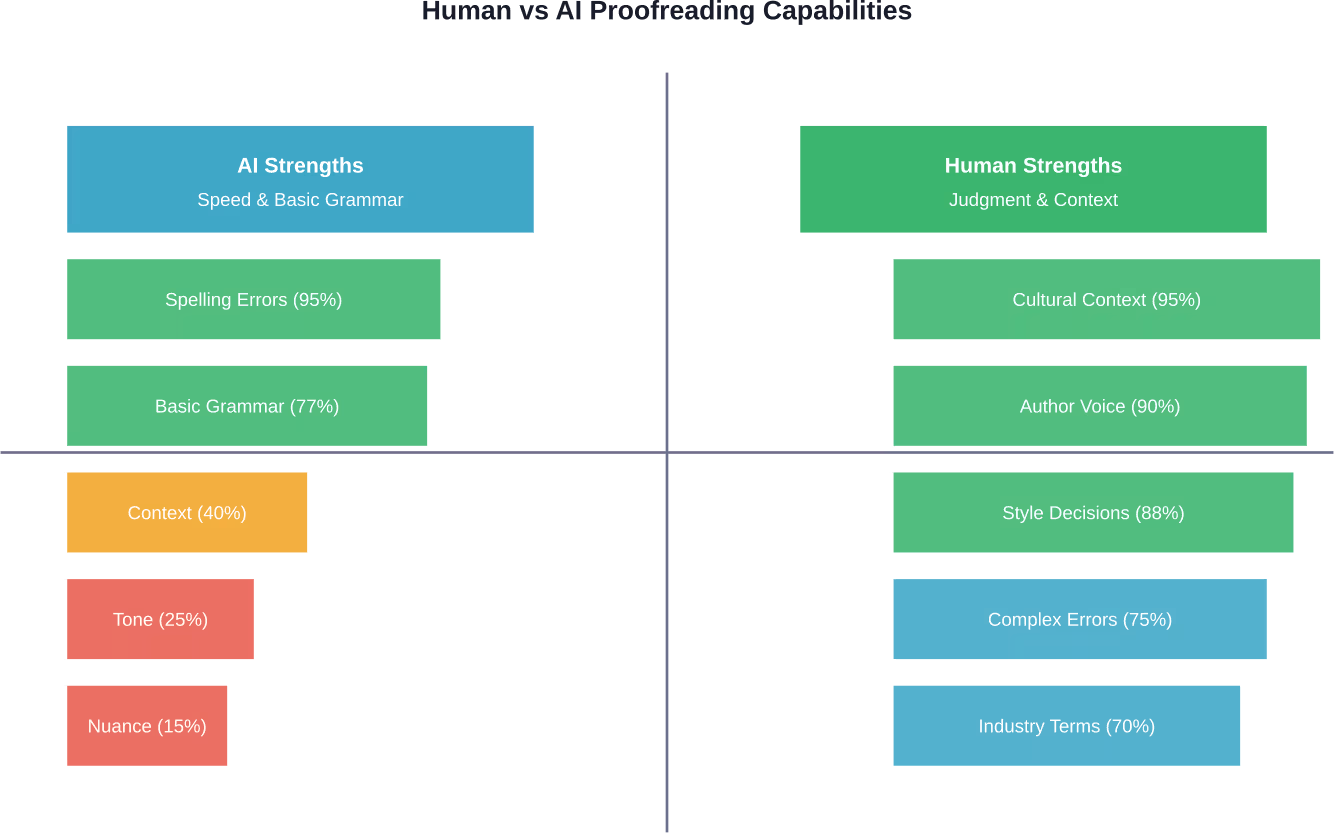
AI proofreading tools excel at mechanical tasks. They catch spelling errors, incorrect verb tenses, missing punctuation, and basic grammar violations faster than any human can.
Research comparing human and LLM proofreading found that Wordvice AI achieved near-human accuracy (77%) in correcting grammar and spelling errors in non-native English writing in non-native English writing. That’s impressive for straightforward error detection.
AI also scales effortlessly. It can process massive volumes of text without fatigue, making it useful for preliminary checks on large documents, website content, or high-volume publishing workflows.
For writers working on drafts, AI tools provide instant feedback. A cross-institutional survey of over 7,000 students (including more than 4,000 Monash students) found that 50% of students surveyed have used generative AI for feedback.
So AI has carved out a legitimate role in the editing process—as a first-pass tool.
Why Human Proofreaders Beat AI Every Time
Here’s where the limitations hit hard.
Context and Nuance Get Lost
AI doesn’t understand context the way humans do. It processes patterns, not meaning.
A human proofreader reads a sentence like “The board approved the proposal, finally” and recognizes whether “finally” conveys relief, sarcasm, or frustration based on the surrounding content. AI flags it as potentially needing a comma. That’s the difference.
Proofreading isn’t just about rules—it’s about knowing when to break them. Sentence fragments can add punch. Starting with “And” or “But” creates rhythm. AI tools often flag these as errors, even when they’re stylistic choices.
Tone and Voice Matter
Professional proofreading services preserve an author’s voice while polishing the text. AI tends to flatten everything into a generic, grammatically correct monotone.
Research on AI and LLM proofreading in second-language writing found that while AI tools made corrections, they often altered lexical and syntactic features in ways that changed the author’s intended tone or style.
Human editors ask: does this sound like the author? Is this the right register for the audience? Would a legal document use the same tone as a blog post?
AI doesn’t ask those questions. It just follows instructions.
Cultural and Industry Knowledge
A human proofreader working on medical content knows that “hypertension” and “high blood pressure” aren’t always interchangeable depending on the audience. Someone editing legal documents understands terms of art that AI might flag as errors.
Cultural references, idioms, regional language differences—these require human judgment. An AI tool editing British English might incorrectly flag “favour” as a misspelling if it’s trained primarily on American English datasets.
Errors AI Introduces
Real talk: AI doesn’t just miss errors. It creates them.
AI copyediting tools have been observed introducing new errors while attempting corrections—changing the meaning of sentences, creating awkward phrasing, or applying rules too rigidly without understanding exceptions.
Human proofreaders catch these AI-introduced errors. Who proofreads the AI? Humans do.
The Trust Problem with AI Disclosure
Even when AI does acceptable work, there’s a human perception issue.
Research from the University of Arizona involving over 5,000 participants across 13 experiments found consistent results: when people learned that AI was used, trust dropped significantly.
The numbers were stark. Trust from students dropped 16% when they learned a professor used AI for grading. Investors trusted firms 18% less when ads disclosed AI use. Clients placed 20% less trust in graphic designers after AI disclosure.
For professional proofreading services, this matters. Clients hiring editors want to know a human with expertise reviewed their work—not an algorithm that might introduce errors or miss critical context.

Own The Final Version, Even If AI Touched Every Line
AI can clean up grammar and suggest edits, but it doesn’t take responsibility for the final version of the text. AI Superior works with teams where that responsibility actually matters. Instead of treating AI as an auto-correction layer, they help define how content moves from draft to approved version – who validates changes, how edits are tracked, and how AI-generated suggestions are controlled before anything goes live.
That becomes critical in environments where even small wording changes can affect meaning, compliance, or brand positioning. At that point, proofreading stops being just error-checking and becomes part of a controlled process. If you’re using AI in content review but still need clear ownership over what gets published, reach out to AI Superior to see how it can fit into your setup.
How the Proofreading Profession Is Evolving
So what’s actually happening in the industry?
Proofreaders aren’t being replaced. They’re adapting.
AI as a First-Pass Tool
Many professional editors now use AI tools for preliminary checks. Run the document through Grammarly or ProWritingAid to catch obvious errors, then apply human judgment for everything else.
App State’s Institutional Review Board launched an AI proofreading tool in June 2025 to help researchers improve draft applications. The tool provides AI-generated feedback on major inconsistencies and clarity issues. But the IRB still requires human review—AI handles the preliminary scan.
That’s the pattern emerging: AI for speed, humans for judgment.
Increased Specialization
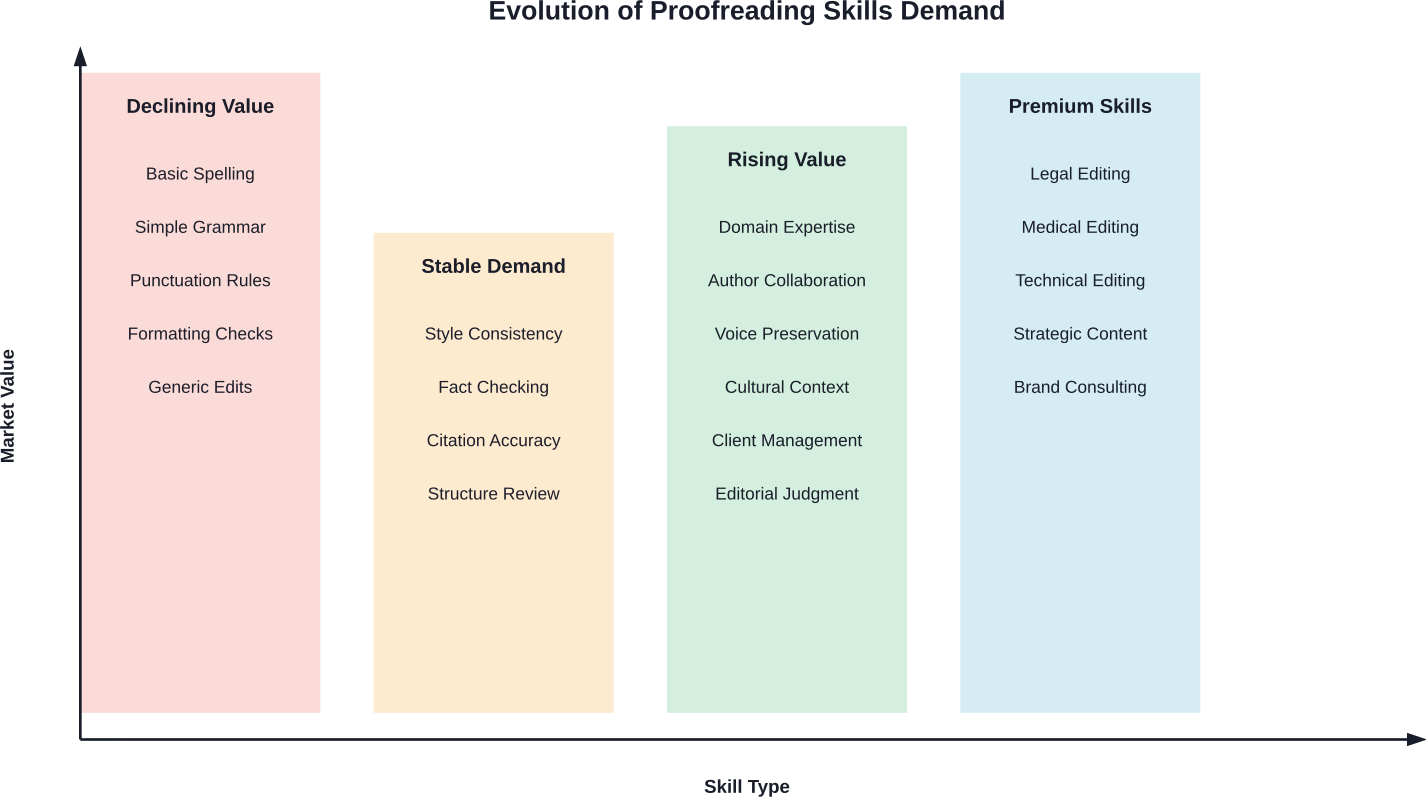
As AI handles basic proofreading, human editors are moving upmarket into more specialized, higher-value work.
Technical editing, medical editing, legal proofreading—these require domain expertise that AI doesn’t possess. An editor who understands clinical trial protocols or securities law brings value AI can’t replicate.
The World Economic Forum’s analysis of workforce skills found that human-centric skills—critical thinking, complex problem-solving, emotional intelligence—dropped between 2019 and 2021 and haven’t recovered. Organizations that underinvest in these skills see measurable performance declines as high as 6%.
For proofreaders, this means developing skills AI can’t match: client communication, project management, subject matter expertise, and editorial judgment.
Hybrid Workflows
The future isn’t “human or AI.” It’s both.
Publishers and content teams are building workflows where AI tools handle volume and speed while human editors handle quality and nuance. One editor can oversee more content when AI does the first pass, but the human component remains non-negotiable for quality control.
Which Proofreading Jobs Are Most At Risk
Not all proofreading roles face equal AI pressure.
Entry-level positions focused purely on mechanical error correction—fixing typos in web content, basic grammar checks on blog posts—are vulnerable. These tasks map directly onto what AI does well.
According to data-rich industries analysis from the World Economic Forum, sectors with abundant data could see AI adoption rates around 60-70%, while data-poor industries might stay below 25%. Content-heavy industries with standardized style guides are seeing higher AI integration.
But roles requiring judgment, client interaction, specialized knowledge, or creative decision-making remain largely human territory.
| Proofreading Role | AI Vulnerability | Reason |
|---|---|---|
| Entry-level blog proofreading | High | Repetitive, rule-based, mechanical tasks |
| Academic copy editing | Medium | Requires citation knowledge and field-specific terminology |
| Legal proofreading | Low | Demands legal expertise and understanding of terms of art |
| Medical/technical editing | Low | Requires specialized domain knowledge and regulatory awareness |
| Book manuscript editing | Very Low | Needs author collaboration, voice preservation, narrative judgment |
| Marketing copy editing | Low | Brand voice, audience awareness, persuasive writing decisions |
What This Means for Current and Aspiring Proofreaders
If you’re in the profession or considering it, here’s the practical outlook.
Don’t Panic, But Do Adapt
The sky isn’t falling. But the entry path is changing.
Breaking into proofreading purely on the ability to spot typos won’t work like it used to. AI already does that. New proofreaders need to offer something beyond basic error detection: client management skills, niche expertise, or the ability to handle complex editorial projects.
Learn the AI Tools
Resisting AI isn’t a viable strategy. Learning to use AI tools effectively is.
Editors who can efficiently combine AI speed with human judgment will outperform those who rely solely on one or the other. Understanding what AI can and can’t do helps you position your human skills more effectively.
Develop Specialized Knowledge
Generic proofreading gets commoditized. Specialized editing commands premium rates.
Pick an industry—healthcare, finance, technology, legal, academic—and build genuine expertise. Become the editor who understands not just grammar, but the subject matter.
Focus on Human-Centric Skills
The skills AI can’t replicate are exactly the ones becoming more valuable.
Client communication. Understanding author intent. Making judgment calls about tone and audience. These aren’t going away—they’re becoming the core differentiators for professional editors.
The Publishing Industry Perspective
What do publishers and content teams actually think about AI replacing editors?
Community discussions and professional perspectives consistently emphasize that AI isn’t a replacement—it’s a tool that still requires human oversight.
Publishers dealing with high-stakes content—academic journals, legal documents, medical publications, books—universally maintain human editorial oversight. The risk of AI-introduced errors or tone problems is too high.
According to professionals in the field, all writers need an editor at some point in the publishing process. Even editors need editors. The writing process leaves authors too close to their work to catch everything—brains auto-correct based on what was meant, not what was written.
And AI can’t replicate the author-editor relationship. It can’t have a conversation about whether a particular section works. It can’t understand the strategic goals behind a piece of content.
Data-Poor Industries and the AI Gap
Here’s an interesting wrinkle: not all industries can even use AI effectively for proofreading.
AI tools require training data. Industries with extensive text databases—tech companies with documentation, publishers with back catalogs, media organizations with archives—can train AI effectively on their style and terminology.
But data-poor industries face friction. Specialized fields without massive text datasets—emerging technologies, niche legal practices, new medical specialties—don’t have enough material to train AI effectively on their specific terminology and style requirements.
These sectors will rely on human editors longer because AI simply doesn’t have the reference material to learn from.
The Economics of AI vs Human Proofreading
Let’s talk money.
AI proofreading tools are cheap. Many offer free tiers, and premium versions cost $10-30 monthly. For basic tasks, the economics are compelling—why pay a human $50-100 to proofread a blog post when AI does it for pennies?
But that calculation changes for high-value content.
A legal brief that gets rejected because AI missed a critical term? Expensive. A medical journal article that introduces an error in dosage instructions? Potentially catastrophic. A book manuscript that loses the author’s distinctive voice? Unpublishable.
For content where errors carry real consequences—legal liability, medical risk, brand damage, publication rejection—the cost of human proofreading is insurance. And it’s cheap insurance compared to the cost of getting it wrong.
What AI Can’t Do in 2026
Despite rapid advancement, AI still has clear limitations in proofreading work.
AI can’t understand intent. It reads words, not meaning. A human editor asks “what is this document trying to accomplish?” and edits accordingly. AI applies rules.
AI doesn’t have genuine cultural awareness. It might have data about idioms, but it doesn’t understand why a phrase that works in one English-speaking country falls flat or offends in another.
AI can’t make strategic content decisions. Should this section come earlier? Does this argument need more support? Is this tone appropriate for the audience? These are human judgment calls.
And AI can’t collaborate. The back-and-forth between editor and author—discussing changes, explaining reasoning, offering alternatives—is fundamentally human work.
Community Perspectives on AI and Proofreading
User experiences and discussions in editing communities reveal practical realities.
Many editors report using AI tools for preliminary checks but catching significant errors AI introduced or missed during human review. The pattern repeats: AI saves time on obvious issues but creates new work fixing its mistakes or compensating for its limitations.
Writers describe mixed experiences with AI editing tools—helpful for catching typos, but frustrating when AI changes meaning or flattens the writing style. Professional writers still seek human editors for anything they care about.
Community consensus suggests AI works for low-stakes content where “good enough” suffices, but human editors remain essential for important work.
The Real Question: Will AI Replace Entry-Level Opportunities?
The harder question isn’t whether AI will replace experienced proofreaders—it won’t.
The real concern is whether AI eliminates the entry path into the profession.
Traditionally, aspiring editors started with basic proofreading work—catching typos, fixing obvious errors, learning on simple projects. These entry-level opportunities built skills and experience.
If AI handles basic proofreading, how do new editors gain experience?
This mirrors broader employment trends. The World Economic Forum notes that while overall job creation is positive, entry-level white-collar roles face disproportionate pressure from AI automation.
The profession may need new pathways for training editors—apprenticeships with experienced editors, specialized education programs, or hybrid roles where new editors work alongside AI tools from the start.
Frequently Asked Questions
Can AI completely replace human proofreaders?
No. While AI excels at mechanical tasks like catching spelling and basic grammar errors, it lacks the contextual understanding, judgment, cultural awareness, and ability to preserve author voice that professional human proofreaders provide. AI tools are best used as complementary first-pass tools, not replacements.
What proofreading tasks can AI handle effectively?
AI performs well on straightforward mechanical tasks: spelling errors, punctuation mistakes, basic grammar violations like subject-verb disagreement, and simple formatting inconsistencies. Research shows AI tools achieve around 77% accuracy on basic grammar and spelling corrections in non-native English writing.
Are proofreading jobs declining because of AI?
Entry-level proofreading positions focused purely on mechanical error correction face pressure from AI automation. However, experienced editors and specialized proofreading roles remain in demand. Brookings Institution research found only a 2% decline in contracts and 5% drop in earnings for AI-exposed freelancers—significant but not catastrophic.
Should professional proofreaders learn to use AI tools?
Absolutely. Editors who effectively combine AI speed for preliminary checks with human judgment for context, tone, and complex decisions will outperform those relying solely on either approach. AI literacy is becoming an essential professional skill for editors.
What types of content still require human proofreaders?
High-stakes content where errors carry serious consequences—legal documents, medical publications, academic journals, book manuscripts, technical documentation—requires human proofreading. Content needing brand voice consistency, cultural sensitivity, or strategic editorial decisions also needs human expertise.
How accurate is AI at proofreading compared to humans?
AI achieves near-human accuracy on basic mechanical errors (around 77-95% for spelling and simple grammar), but performs poorly on context-dependent tasks, tone preservation, and nuanced editorial decisions (often below 40%). AI also introduces new errors while making corrections, requiring human oversight.
Will AI replace copyeditors and proofreaders by 2030?
Unlikely. While AI will continue handling more mechanical tasks, the Bureau of Labor Statistics employment projections and World Economic Forum data suggest editing roles will evolve rather than disappear. The profession is shifting toward specialized, judgment-based work that complements AI capabilities rather than competes with them.
The Bottom Line on AI and Proofreading Jobs
So, will AI replace proofreaders?
The short answer: not entirely, but it’s definitely changing the job.
AI has already claimed territory in basic error detection. Entry-level proofreading work focused on mechanical tasks faces real pressure. That’s happening now, not in some distant future.
But professional proofreading involves far more than catching typos. Context, judgment, cultural awareness, voice preservation, client collaboration, specialized knowledge—these remain fundamentally human skills. And they’re becoming more valuable, not less, as AI handles the mechanical baseline.
The proofreaders thriving in 2026 aren’t the ones resisting AI. They’re the ones who learned to use AI tools for what they do well—preliminary checks and mechanical error detection—while doubling down on distinctly human editorial skills.
The profession is evolving, not dying. Entry paths are changing. The work is shifting upmarket toward specialized, higher-value tasks.
For anyone in the field or considering it: develop expertise AI can’t replicate. Learn the tools, but don’t rely on them exclusively. Build specialized knowledge in an industry or content type. Focus on the human elements—judgment, communication, context, collaboration.
AI is a powerful tool for proofreading. But tools need operators. And the best operators are skilled humans who understand not just how to catch errors, but why those errors matter and what the text is trying to accomplish.
That’s work AI won’t be doing anytime soon.
 English
  German
  Arabic
  French
  Dutch
Dutch  Spanish