
Quick Summary: AI will not fully replace stenographers in the foreseeable future. While artificial intelligence tools can assist with transcription and speed up certain processes, court reporting still requires human verification, critical thinking, and adaptability that AI cannot replicate. The future points toward a hybrid model where AI supports certified stenographers rather than replacing them entirely.
The question keeps surfacing in legal circles and court reporting communities: will artificial intelligence make stenographers obsolete? It’s a legitimate concern, especially as AI-powered transcription tools become more sophisticated and affordable.
But here’s the thing—the reality is more nuanced than simple replacement. The relationship between AI and stenography isn’t about one eliminating the other. It’s about transformation, adaptation, and finding the right balance between human expertise and technological efficiency.
Why This Question Is Being Asked More Often
Legal professionals see aggressive marketing for AI tools promising faster, cheaper transcription services. According to Rev, AI transcription models achieve up to 96% accuracy on high-quality audio. That sounds impressive on paper.
The stenographer shortage adds fuel to this conversation. Courts struggle to find qualified reporters, which creates pressure to explore alternative solutions. AI court reporting presents itself as an efficient tool to assist the justice system during this shortage.
Technology companies tout speed and cost savings. AI systems don’t need breaks, don’t call in sick, and can process hours of audio in minutes. For budget-conscious law firms and court systems, that’s tempting.
Sound familiar? It’s the same narrative that appears whenever automation threatens a skilled profession.
What AI Can Actually Do in Court Reporting Today
Real talk: AI has made genuine progress in legal transcription. Modern systems can handle straightforward depositions, convert audio to text with reasonable accuracy, and deliver transcripts faster than traditional turnaround times.
Rev’s specialized AI models for legal and technical content demonstrate accuracy rates exceeding 95% in optimal conditions. That’s solid performance for certain applications. AI transcription gets more accurate all the time as machine learning models improve.
The technology works particularly well for:
- Routine proceedings with clear audio
- Single speakers with minimal cross-talk
- Standard legal terminology
- Post-proceeding transcription (not real-time)
- Initial drafts that humans will review
One misheard number, one incorrect homophone, one missed negation—any of these could alter the meaning of testimony significantly in legal contexts.
Why AI Alone Cannot Replace Stenographers
The limitations of current AI technology become obvious once proceedings get complicated. Multiple speakers talking over each other? AI struggles. Heavy accents or technical jargon specific to a case? Accuracy drops significantly.
Human stenographers bring critical thinking to the job. They can identify speakers, clarify ambiguous statements, and flag inconsistencies in real-time. They understand context in ways that algorithms don’t.
Consider what happens during a contentious deposition when three attorneys start arguing simultaneously. A skilled stenographer tracks who’s saying what, maintains accuracy despite the chaos, and produces a coherent record. AI systems often fail spectacularly in these scenarios.
Court Rules Still Require Human Verification
Legal proceedings demand certified accuracy. Courts and legal bodies maintain standards that AI alone cannot currently meet. Professional standards for court reporting require human certification and accountability.
Many jurisdictions explicitly require certified court reporters for official proceedings. These regulations exist because the legal system needs someone accountable for the accuracy of the official record.
AI can’t be deposed. It can’t testify about what happened during a proceeding. It can’t explain why certain words were chosen or clarify ambiguities. A certified stenographer can.
The Human Elements That Machines Can’t Replicate
Stenographers do more than transcribe words. They maintain courtroom decorum, manage exhibits, provide real-time feeds to judges and attorneys, and adapt instantly to changing circumstances.
They catch errors as they happen. If an attorney misstates a date or number, an experienced reporter often notices and can clarify. That kind of quality control requires understanding the content, not just converting audio to text.
Real-time reporting remains a stronghold for human expertise. Attorneys need instantaneous, accurate feeds during proceedings to adjust their strategies. AI systems introduce latency and errors that can disrupt this critical function.
The Hybrid Model Is the Future of Court Reporting
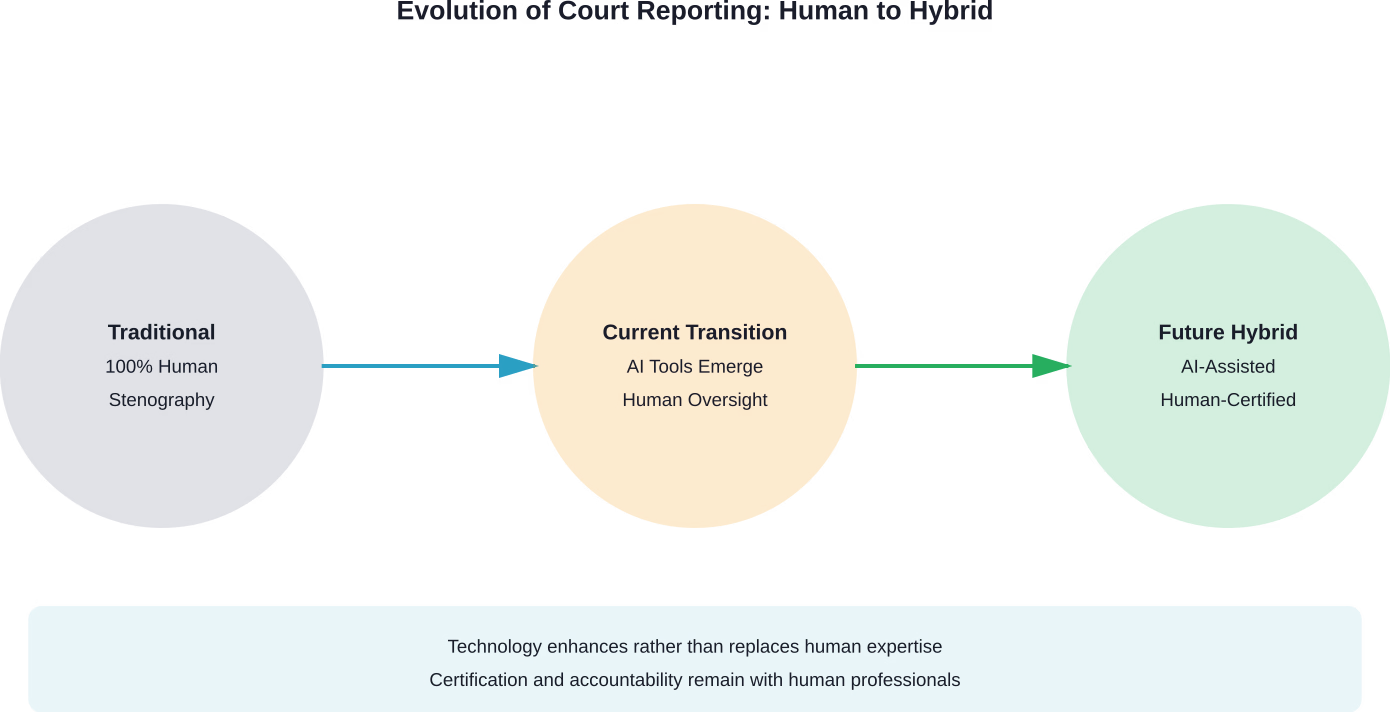
Here’s where it gets interesting. The future isn’t about choosing between AI or humans—it’s about intelligent integration.
Progressive court reporting services use AI as a support tool. The technology handles initial transcription, timestamps, and formatting. Human stenographers then review, correct, and certify the final product.
This approach combines speed with accuracy. AI reduces the grunt work, allowing certified reporters to focus on quality assurance and complex aspects that demand human judgment.
| Approach | Speed | Accuracy | Cost | Legal Compliance |
|---|---|---|---|---|
| AI Only | Very Fast | 90%+ | Low | Often Insufficient |
| Human Only | Standard | Higher accuracy | Higher | Fully Compliant |
| Hybrid Model | Fast | Higher accuracy | Moderate | Fully Compliant |
The hybrid model addresses the stenographer shortage without sacrificing quality. One certified reporter can oversee multiple AI-assisted proceedings, extending their capacity while maintaining professional standards.
Law firms benefit from faster turnaround and competitive pricing. Courts get reliable records. Stenographers evolve their role rather than losing it.

Use AI to Strengthen Transcription Workflows
AI can turn speech into text quickly, but in legal contexts a transcript isn’t just text – it’s something people rely on as an exact record of what happened. AI Superior works with organizations where that distinction matters.
Instead of focusing only on transcription accuracy, they help design how AI is used around sensitive data and critical records and how systems ensure consistency when multiple tools and sources are involved. That becomes important in environments where small errors don’t just look minor, they carry real consequences. The opportunity isn’t just speed – it’s building systems you can trust.
If you’re considering AI for transcription or record-keeping and want to improve reliability, not risk it, reach out to AI Superior to see how it can fit into your workflow.
What the Stenographer Shortage Really Means
The profession faces a demographic challenge. Experienced reporters retire faster than new ones enter the field. Training takes time to develop the skills needed for certification.
This shortage creates opportunities rather than obsolescence. Skilled stenographers remain in high demand, often commanding premium rates. The supply-demand imbalance favors those in the profession.
AI might fill gaps in lower-complexity proceedings, but it doesn’t eliminate the need for human expertise in complex litigation, criminal trials, and high-stakes depositions where accuracy is absolutely critical.
Real Concerns About AI in Legal Transcription
Legal professionals have expressed concerns about whether artificial intelligence threatens court reporting reliability. Their concerns are valid and worth examining.
Accuracy questions persist. That 96% figure sounds good until errors appear in critical testimony. Legal professionals deal with consequences—appeals, motions, professional liability—when transcripts contain mistakes.
AI systems lack transparency. When an error occurs, there’s no way to determine why the system made that particular mistake or what else it might have gotten wrong. Human reporters can explain their decisions and clarify ambiguities.
Data security poses another challenge. Cloud-based AI transcription means sensitive legal proceedings get transmitted and stored on third-party servers. That introduces confidentiality risks that don’t exist with traditional court reporting.
What This Means for Attorneys and Law Firms
Legal professionals should view AI court reporting as a tool, not a replacement. For routine matters with lower stakes, AI-assisted transcription can provide cost savings and faster turnaround.
But for complex litigation, expert witness depositions, criminal proceedings, and anything likely to be challenged—human expertise remains essential. The risk of relying on AI-only transcription exceeds any cost savings.
When evaluating court reporting services, ask about their process. Do they use AI as an assistant with human verification? Or do they rely solely on automated transcription? The difference matters.
Check whether the service provides certified stenographers who can testify about the accuracy of transcripts if needed. That certification carries legal weight that AI outputs lack.
The Skills That Will Keep Stenographers Relevant
Stenographers who adapt will thrive. That means developing expertise in areas where human judgment is irreplaceable: complex multi-party litigation, technical proceedings, real-time reporting, and quality assurance.
Understanding how to work alongside AI tools—using them for efficiency while applying human oversight—creates competitive advantages. The stenographer who can deliver the speed of AI with the accuracy of human verification offers the best of both worlds.
Specialization provides protection. Medical-legal reporting, intellectual property proceedings, and other specialized niches require terminology and context that general AI systems can’t handle well.
Professional certification and continuing education become more important, not less. These credentials differentiate skilled professionals from automated alternatives.
Will AI Ever Fully Replace Stenographers?
The short answer? Not in the foreseeable future. The long answer requires understanding what replacement actually means.
Will AI reduce the number of stenographer positions needed for routine proceedings? Probably. Will it handle straightforward transcription tasks that currently require human time? Yes, that’s already happening.
But will AI eliminate the need for certified court reporters in legal proceedings? The evidence suggests no. Legal standards, accountability requirements, and the complexity of human communication create enduring demand for human expertise.
Technology typically transforms professions rather than eliminating them. Bank tellers still exist despite ATMs. Pilots remain essential despite autopilot. Stenographers will likely follow similar patterns—fewer may be needed for basic tasks, but skilled professionals remain valuable for complex work.
Court reporting may face extinction through attrition if the profession doesn’t attract new talent, but that’s a recruitment and training issue, not an AI replacement issue.
Frequently Asked Questions
Can AI transcription replace court reporters in depositions?
AI can assist with routine depositions but cannot fully replace certified court reporters. While AI transcription may achieve 96%+ accuracy in ideal conditions, legal proceedings require higher reliability. Complex depositions with multiple speakers, technical terminology, or poor audio quality still demand human expertise and certification.
Do courts accept AI-generated transcripts as official records?
Many jurisdictions require certified court reporters for official proceedings and do not accept AI-only transcripts without human verification. Legal standards emphasize accountability and certification, which AI systems cannot provide. Regulations vary by jurisdiction, so checking local court rules is essential.
What advantages do human stenographers have over AI?
Human stenographers offer contextual understanding, real-time adaptability, speaker identification in complex scenarios, professional certification, and accountability. They can handle interruptions, clarify ambiguities, manage exhibits, and testify about transcript accuracy if needed—capabilities that current AI systems lack.
Will stenographers lose their jobs to artificial intelligence?
Rather than wholesale job loss, the profession is shifting toward a hybrid model where AI assists human experts. Demand for certified stenographers remains strong, particularly for complex proceedings. The stenographer shortage actually creates opportunities for skilled professionals who can work effectively with technology.
What is the hybrid model in court reporting?
The hybrid model combines AI transcription with human oversight and certification. AI handles initial transcription, timestamps, and formatting, while certified stenographers review, correct, and verify the final product. This approach delivers speed and cost efficiency while maintaining the accuracy and legal compliance that proceedings require.
Should law firms use AI for legal transcription?
Law firms can benefit from AI-assisted transcription for routine matters, internal meetings, or preliminary drafts. However, for depositions, trials, and proceedings that may face legal scrutiny, services that combine AI efficiency with human certification provide better risk management and reliability.
The Verdict on AI and Stenography
Technology will continue advancing. AI transcription will get better, faster, and cheaper. Those trends are certain.
But the legal system’s fundamental need for accuracy, accountability, and certified records creates a natural limit to AI replacement. Human expertise adapts to complexity in ways that algorithms struggle to replicate.
The smartest approach combines the strengths of both. AI handles speed and routine processing. Human stenographers provide oversight, certification, and expertise for complex scenarios. That partnership serves legal professionals better than either approach alone.
Stenographers who embrace this evolution—developing skills in oversight, specialization, and AI-assisted workflows—position themselves for sustained relevance and success. Those who view technology as a threat rather than a tool may struggle.
For attorneys and law firms, the message is clear: choose accuracy over automation when it matters. Use AI where it adds value, but maintain human expertise where reliability is non-negotiable.
The future of court reporting isn’t about AI replacing stenographers. It’s about creating better outcomes through intelligent collaboration between human skill and technological capability.
 English
  German
  Arabic
  French
  Dutch
Dutch  Spanish