
Quick Summary: Predictive analytics in telecom uses machine learning and AI to forecast network failures, identify churn-prone customers, optimize resource allocation, and improve service quality. Telecom operators leveraging predictive models can reduce operational costs, prevent downtime before it happens, and deliver personalized customer experiences that drive retention and revenue growth.
Telecom networks are drowning in data. Every call, text, browsing session, and IoT ping generates streams of information that most operators barely scratch the surface of.
But here’s the thing—buried in that data are patterns that predict exactly when a cell tower will fail, which customers are about to switch providers, and where network congestion will hit before it happens.
That’s predictive analytics. And it’s changing how telecom companies operate in 2026.
With 5G connections expanding globally, with operators investing heavily in 5G infrastructure according to GSMA—networks are more complex than ever. The old reactive approach of fixing problems after they occur doesn’t cut it anymore.
Real talk: enterprises will spend approximately 3-5% of their revenues on digital transformation through 2030 (totaling trillions of dollars), creating massive B2B opportunities in the 5G era. Telecom operators that master predictive analytics won’t just survive this shift—they’ll dominate it.
What Is Predictive Analytics in Telecommunications?
Predictive analytics applies statistical algorithms and machine learning techniques to historical telecom data to forecast future outcomes with measurable probability.
Unlike descriptive analytics that tells you what already happened, predictive models answer questions like: Which customers will churn next month? When will this network element fail? Where should we expand capacity next quarter?
The tech stack typically includes:
- Machine learning algorithms (Random Forest, Support Vector Machines, Neural Networks)
- Big data processing frameworks that handle petabytes of call detail records, network logs, and customer interactions
- Real-time analytics engines that score predictions as events happen
- Visualization dashboards that translate complex models into actionable business intelligence
IEEE research on customer churn predictive analysis demonstrates that Random Forest classifiers achieve particularly strong results in telecom applications. Separate IEEE studies on machine learning-based predictive analytics confirm that multiple algorithms—Logistic Regression, SVM, and Artificial Neural Networks—can identify customers likely to leave their service provider.
Research published in Frontiers in Artificial Intelligence examined telecom customer churn data and found approximately 26.5% of customers in typical datasets have churned, providing a baseline for model training. The study compared multiple approaches: Logistic Regression achieved 84% accuracy, while Support Vector Machines with RBF kernel reached 85% accuracy (or Random Forest reached 91% in comparable studies).
Why Telecom Companies Are Betting Big on Predictive Analytics
The business case is straightforward: retaining an existing customer costs far less than acquiring a new one.
Academic research from Harvard’s Astrophysics Data System notes that customer churn analysis has become critical in the telecom sector specifically because “retaining existing clients is cheaper than gaining a newer one.” When predictive models identify at-risk customers early, retention teams can intervene with targeted offers before the customer walks.
But churn prevention is just the start. Here’s what’s driving adoption:
Network Reliability at Scale
5G networks operate with dramatically tighter latency requirements than 4G. A single failed component can cascade across the network.
IEEE research on network elements failure prediction shows telecom operators are deploying predictive analytics techniques to forecast equipment failures before they impact service. Instead of scheduled maintenance on arbitrary timelines, operators now perform condition-based maintenance—fixing components when models predict imminent failure.
The ITU published research on machine learning for spatio-temporal beam-level traffic forecasting (published 18 December 2025), highlighting how accurate prediction of Downlink Throughput Volume is “essential for improving resource management in modern communications networks.” Forecasting traffic at the beam level enables operators to allocate resources precisely where and when they’re needed.
Operational Cost Reduction
Field truck rolls—sending technicians to investigate or repair network issues—represent massive operational expenses. Predictive analytics slashes these costs by identifying problems remotely and prioritizing interventions that prevent outages.
IEEE published work on AI-Driven DevOps in telecommunications demonstrates how predictive analytics integrates with continuous delivery pipelines to bridge forecasting with automated network agility. When a model predicts congestion, automated systems can reroute traffic or spin up additional capacity without human intervention.
5G Monetization Opportunities
According to GSMA, 5G Fixed Wireless Access (FWA) penetration varies by market, with some markets like Austria showing strong adoption according to GSMA. Predictive analytics helps operators identify which neighborhoods and customer segments show highest propensity to adopt FWA, optimizing rollout investments.
The rise of digital industries creates substantial B2B opportunities. Predictive models forecast which enterprise customers need low-latency network slicing, private 5G deployments, or edge computing services—enabling sales teams to approach prospects with data-driven recommendations.
Core Use Cases Transforming Telecom Operations
Let’s break down where predictive analytics delivers measurable impact in 2026.
Customer Churn Prediction and Prevention
Academic research from Rutgers and SUNY has focused extensively on telecom customer churn prediction using machine learning approaches. The pattern is consistent: models ingest customer data including usage patterns, payment history, service calls, contract details, and demographics.
Algorithms then score each customer’s churn probability. High-risk customers trigger automated retention workflows—personalized offers, proactive service outreach, or loyalty incentives calibrated to the predicted churn drivers.
The Harvard research notes that testing multiple algorithms against the same dataset reveals performance differences. Models trained on AT&T data showed that accuracy and Area Under Curve (AUC) metrics help identify which algorithms perform best for specific operator datasets.
Here’s what separates effective churn models from vanity projects: integration with CRM and retention systems. A model that scores churn probability but doesn’t trigger action is just an expensive science experiment.
Predictive Network Maintenance
Network elements—base stations, routers, switches, transmission equipment—generate continuous telemetry about temperature, power consumption, error rates, and performance metrics.
Predictive maintenance models ingest this telemetry and identify anomaly patterns that precede failures. When a router’s temperature fluctuations match historical patterns that led to failures within 72 hours, the system alerts field operations to schedule preventive replacement.
IEEE research specifically examines these techniques for predicting network element failures in telecom operators. The economic logic is compelling: planned maintenance during low-traffic windows costs a fraction of emergency repairs during peak hours, and prevents the revenue impact of unplanned outages.
Network Capacity Planning and Optimization
Where should operators deploy additional cell sites? Which links need capacity upgrades? When will current infrastructure hit saturation?
Predictive models answer these questions by forecasting traffic growth at granular geographic and temporal resolution. The ITU research on beam-level traffic forecasting shows that modern approaches predict throughput volume at individual beam level—enabling resource management decisions at unprecedented precision.
IEEE research on big data analytics in telecommunication demonstrates how state-of-the-art frameworks process distributed datasets to extract insights that inform network planning. As subscriber counts grow and per-user data consumption increases, these forecasts become critical for capital expenditure prioritization.
Revenue Optimization and Dynamic Pricing
Predictive models identify which customers show high propensity to upgrade to premium tiers, add lines, or adopt new services. Sales and marketing teams use these scores to target campaigns and personalize offers.
Some operators deploy dynamic pricing models that adjust data plan costs based on predicted demand elasticity for specific customer segments. When models forecast high willingness-to-pay, promotional discounts get smaller. When models predict price sensitivity, targeted discounts prevent churn.
Fraud Detection and Prevention
Telecom fraud—subscription fraud, SIM card fraud, premium rate service abuse—costs operators billions annually. Predictive analytics flags suspicious patterns in near-real-time.
Models learn normal behavior profiles for accounts and trigger alerts when deviations occur: sudden international calling from an account that never made international calls, rapid SIM swapping, usage spikes inconsistent with historical patterns.
The speed matters here. Detecting fraud hours after it occurs still results in losses. Models that score transactions in milliseconds enable blocking suspicious activity before charges accumulate.
The Technology Stack Behind Telecom Predictive Analytics
Building production-grade predictive analytics requires more than installing software. Here’s what the architecture looks like.
Data Infrastructure
Telecom data comes from dozens of sources: Call Detail Records (CDRs), network element management systems, customer databases, billing systems, social media, IoT devices, and third-party data providers.
Modern stacks use distributed storage (data lakes built on object storage) and processing frameworks that scale horizontally. IEEE research on big data analytics in telecommunication emphasizes the necessity of frameworks that operate in distributed computing environments given the sheer volume.
Data quality matters more than most operators initially realize. Models trained on incomplete, inconsistent, or incorrectly labeled data produce unreliable predictions. Data engineering—cleaning, validating, transforming, and enriching raw data—typically consumes more effort than model development.
Machine Learning Algorithms
No single algorithm dominates telecom predictive analytics. The choice depends on the specific use case, data characteristics, and accuracy requirements.
Common approaches include:
- Random Forest: Ensemble method that combines multiple decision trees. Performs well on churn prediction and handles missing data gracefully. IEEE research highlights its effectiveness in telecom customer churn analysis.
- Support Vector Machines: Particularly with RBF kernels, achieves high accuracy on classification problems.
- Logistic Regression: Simple, interpretable, computationally efficient. Often serves as a baseline model. Achieved 89% accuracy in the referenced churn study.
- Neural Networks and Deep Learning: Handle complex non-linear relationships and large feature sets. Required for image recognition (analyzing cell site photos for maintenance), natural language processing (analyzing customer service interactions), and sequential data (time series forecasting).
- Gradient Boosting (XGBoost, LightGBM): Frequently wins data science competitions and performs well on structured tabular data common in telecom.
Academic research comparing algorithms on telecom datasets consistently shows that model performance varies based on data characteristics. Testing multiple approaches and selecting based on validation metrics—not assumptions—produces better outcomes.
Real-Time Scoring Infrastructure
Batch predictions—scoring all customers once per month—work for some use cases. But fraud detection, network optimization, and dynamic customer interactions need real-time scoring.
This requires deploying trained models to production systems that score predictions in milliseconds as events occur. Modern architectures use containerized model serving, API gateways, and stream processing to achieve this latency.
Visualization and Decision Support
Data scientists understand ROC curves and confusion matrices. Business stakeholders don’t care. Effective implementations translate model outputs into dashboards that show: “Here are your 10,000 highest-risk churn customers this week” or “These five cell sites will likely fail in the next 30 days.”
The interface between predictive models and business action determines whether analytics drives value or collects dust.
Implementation Challenges and How to Overcome Them
Most telecom predictive analytics initiatives fail. Not because the technology doesn’t work—it does—but because organizations underestimate non-technical barriers.
Data Silos and Integration Complexity
Customer data lives in CRM. Network data lives in element management systems. Billing data lives in revenue assurance platforms. These systems often weren’t designed to share data.
Solution: Dedicate resources to data integration early. Building data pipelines that extract, transform, and load data from disparate sources into a unified analytics platform is unglamorous work—but it’s foundational. Skipping this step guarantees failure.
Organizational Resistance
Predictive models threaten existing workflows. Field technicians who’ve performed scheduled maintenance for 20 years resist condition-based maintenance. Marketing teams accustomed to mass campaigns resist personalized targeting.
Solution: Pilot projects that demonstrate value in narrow use cases build credibility. When a predictive maintenance trial prevents three major outages and saves measurable costs, skeptics become advocates. Start small, prove value, expand.
Skills Gap
Building and maintaining predictive analytics requires data scientists, machine learning engineers, data engineers, and analytics translators who bridge technical and business domains. Traditional telecom operators often lack these skills.
Solution: Three options exist—hire (expensive and slow), train existing staff (viable for motivated employees with quantitative backgrounds), or partner with specialists who bring both technical capabilities and telecom domain knowledge.
Model Drift and Maintenance
A model trained on 2024 data won’t perform well on 2026 data if customer behavior, network characteristics, or market conditions changed. Models degrade over time—a problem called drift.
Solution: Implement continuous monitoring that tracks prediction accuracy in production. When metrics decline below thresholds, trigger model retraining on recent data. Treat models as living systems requiring ongoing care, not one-time projects.
Overfitting and Generalization
It’s easy to build models that perform brilliantly on historical data but fail on new data. This happens when models learn noise and historical artifacts rather than genuine patterns.
Solution: Rigorous train-test splits, cross-validation, and holdout testing on data the model has never seen. When a model achieves suspiciously perfect accuracy, it’s probably overfit. Simpler models with slightly lower training accuracy often outperform complex models in production.
| Challenge | Impact | Solution Approach |
|---|---|---|
| Data silos across systems | Incomplete customer/network view limits model accuracy | Build unified data platform with integration pipelines |
| Organizational resistance | Models not adopted despite technical success | Start with pilots, demonstrate ROI, secure executive sponsorship |
| Insufficient skills | Poor model quality, slow development cycles | Hire specialists, upskill existing staff, or partner externally |
| Model drift over time | Prediction accuracy degrades silently in production | Continuous monitoring, automated retraining workflows |
| Overfitting to historical data | High training accuracy but poor real-world performance | Proper validation, simpler models, domain expertise in feature engineering |
Measuring Success: ROI and Performance Metrics
How do you know if predictive analytics is working?
Different use cases require different metrics, but here’s a framework:
Model Performance Metrics
These measure the statistical quality of predictions:
- Accuracy: Percentage of correct predictions. The research showed models ranging from 84% to 91% accuracy on churn prediction.
- Precision: Of customers predicted to churn, what percentage actually churned? High precision minimizes wasted retention spending.
- Recall: Of customers who churned, what percentage did the model identify? High recall ensures you don’t miss at-risk customers.
- F1-Score: Harmonic mean of precision and recall, balancing both concerns.
- ROC-AUC: Measures the model’s ability to distinguish between classes across all threshold settings. The SVM model in the referenced research achieved 0.98 ROC-AUC.
But wait. High model accuracy doesn’t guarantee business value. A model with 95% accuracy that identifies churn-prone customers is worthless if retention campaigns don’t actually retain them.
Business Impact Metrics
These measure outcomes that affect the P&L:
- Churn rate reduction: Did predicted churn decline after implementing predictive models and targeted retention?
- Mean time between failures (MTBF): Did predictive maintenance increase time between network element failures?
- Operational cost reduction: Did predictive analytics reduce truck rolls, emergency maintenance, or customer service contacts?
- Revenue per user (ARPU) lift: Did predictive targeting of upsell offers increase average customer revenue?
- Return on investment (ROI): Does the value generated exceed the cost of building and operating the analytics platform?
Calculate ROI by comparing the measurable business impact (reduced churn, lower maintenance costs, increased revenue) against total costs (technology, personnel, data infrastructure). Industry reports suggest telecom predictive analytics projects achieve positive ROI within 12-24 months when implemented effectively.
Leading vs. Lagging Indicators
Model accuracy is a leading indicator—you can measure it immediately. Churn rate reduction is a lagging indicator—it takes months to manifest.
Track both. Leading indicators help diagnose problems quickly. Lagging indicators confirm business value.
Common Myths About Predictive Analytics in Telecom
Let’s clear up some misconceptions that trip up operators.
Myth: Predictive Analytics Provides Perfect Certainty
No model predicts the future with 100% accuracy. Even state-of-the-art models make mistakes.
The goal isn’t perfection—it’s better decisions. A churn model with 85% accuracy that helps retain 40% of identified at-risk customers delivers massive value even though it misses 15% of predictions and can’t save every customer.
Myth: More Data Always Equals Better Models
Data quality trumps data quantity. Feeding models more incomplete, inaccurate, or irrelevant data doesn’t improve predictions.
Better approach: Start with clean, relevant data from core systems. Prove value. Then expand data sources incrementally, validating that each addition improves model performance.
Myth: Once Built, Models Run Forever Without Maintenance
Customer behavior changes. Networks evolve. Market conditions shift. Models trained on old patterns become obsolete.
Production deployments require monitoring, retraining, and updating. Budget ongoing maintenance, not just initial development.
Myth: AI Will Replace Human Decision-Making
Predictive analytics augments human judgment, not replaces it. Models identify patterns and flag risks. Humans decide what actions to take.
A model might identify that a customer has 80% churn probability. Retention specialists decide whether to offer a discount, upgrade, or service improvement—and how much to invest based on customer lifetime value.
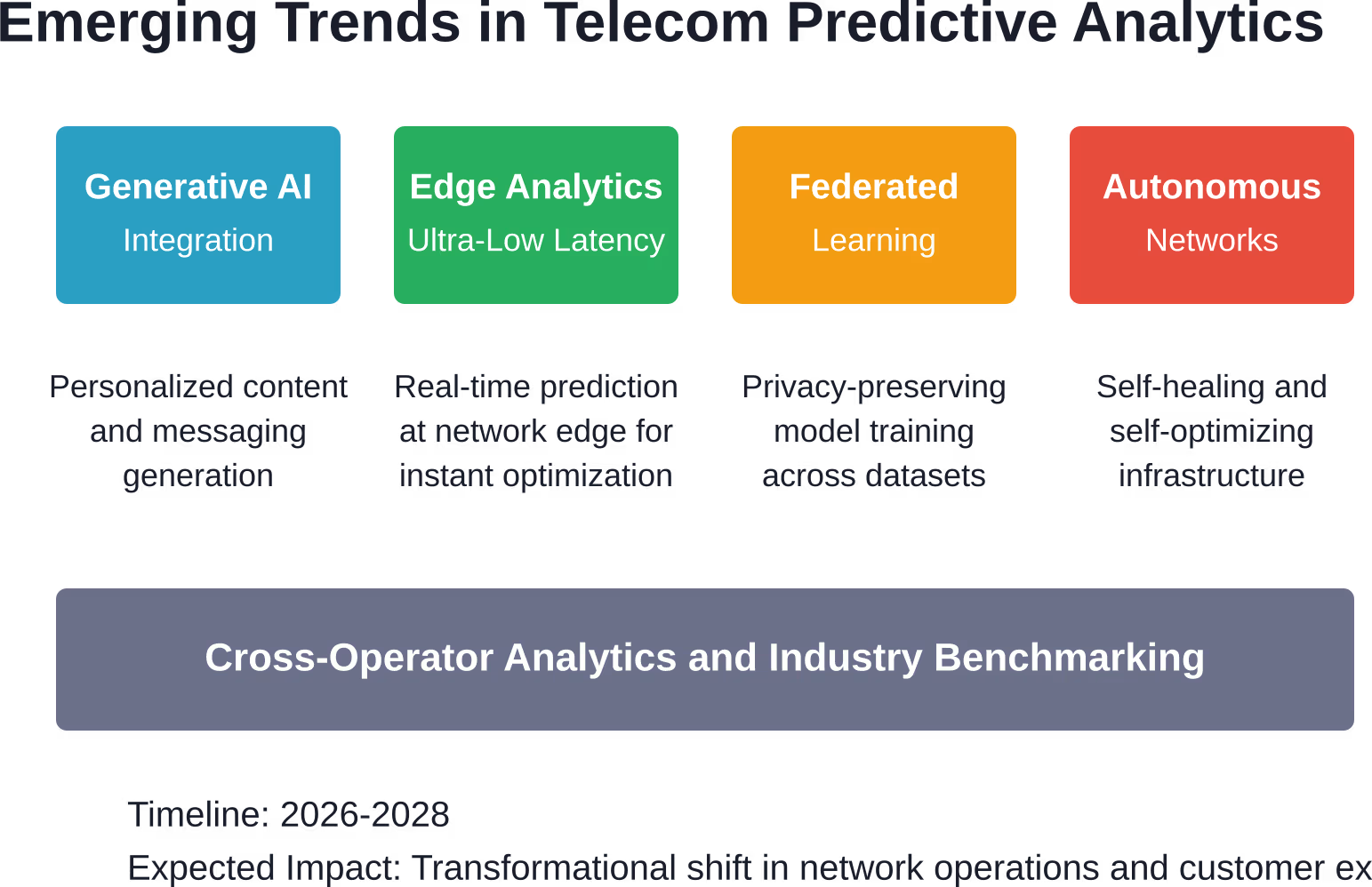
The Future of Predictive Analytics in Telecom
Where is this technology heading?
Integration with Generative AI
Generative AI models like large language models are beginning to complement predictive analytics. Instead of just predicting churn probability, systems generate personalized retention messages tailored to each customer’s specific situation.
Some operators experiment with AI agents that autonomously execute retention strategies—detecting churn risk, generating offers, and presenting them to customers through appropriate channels—with human oversight for escalations.
Edge Analytics for Ultra-Low Latency
As ITU research on network resource management demonstrates, modern networks require prediction and optimization at extremely granular levels. Edge computing enables deploying predictive models closer to network equipment and end users.
This architecture allows sub-millisecond prediction latency, enabling real-time network optimization that adjusts dynamically to changing conditions.
Federated Learning for Privacy-Preserving Analytics
Privacy regulations increasingly restrict how telecom operators collect and use customer data. Federated learning trains models across distributed datasets without centralizing raw data.
This approach allows operators to build predictive models that learn from customer behavior without directly accessing or storing sensitive personal information—balancing analytics capabilities with privacy requirements.
Autonomous Network Operations
IEEE research on AI-Driven DevOps in telecommunications explores bridging predictive analytics with continuous delivery for network agility. The end goal: self-optimizing networks that predict issues, automatically implement fixes, and continuously improve without human intervention.
We’re not there yet. But the trajectory is clear—networks that operate more like cloud infrastructure, scaling and healing automatically based on predicted demand and anticipated failures.
Cross-Operator Analytics and Benchmarking
Predictive models improve with more training data. Industry consortiums are emerging that allow operators to benchmark their analytics performance and—in some cases—collaboratively improve models while preserving competitive data confidentiality.
This approach accelerates capability development, especially for smaller operators that lack the data volumes larger players command.
Getting Started: A Practical Roadmap
So your organization wants to implement predictive analytics. Here’s a realistic path forward.
Step 1: Identify High-Value Use Cases
Don’t try to boil the ocean. Pick one or two use cases where predictive analytics addresses a significant business problem with measurable financial impact.
Best candidates for initial projects: customer churn prediction (clear ROI through retention), predictive maintenance (measurable cost reduction), or fraud detection (direct loss prevention).
Step 2: Assess Data Readiness
Do you have the data required to build models for your chosen use case? Is it accessible, clean, and sufficiently historical?
Most operators discover they need 3-6 months of data engineering before model development can begin. Factor this into timelines.
Step 3: Build or Buy Capability
Decide whether to develop analytics in-house, purchase packaged solutions from vendors, or partner with specialists.
In-house provides maximum customization but requires significant skills investment. Vendors offer faster deployment but less flexibility. Partnerships combine external expertise with knowledge transfer to internal teams.
There’s no universally correct answer—match the approach to organizational capabilities and strategic priorities.
Step 4: Start with a Pilot
Implement predictive analytics for a subset of customers, specific geographic region, or limited network scope. Prove value before scaling.
Pilots should run long enough to measure business impact—typically 3-6 months. Track both model performance metrics and business outcomes.
Step 5: Integrate with Operational Workflows
Models that generate predictions but don’t drive action waste resources. Build integration between analytics systems and operational platforms—CRM, workforce management, marketing automation, network management.
This integration often represents the hardest technical challenge and consumes more effort than model development.
Step 6: Establish Governance and Monitoring
Create processes for model approval, deployment, monitoring, and retraining. Define who owns model accuracy, who authorizes business actions based on predictions, and how to handle edge cases.
Set up dashboards that track model performance in production and alert when metrics drift outside acceptable ranges.
Step 7: Scale and Expand
Once initial use cases prove value, expand to additional applications. Leverage infrastructure and capabilities built for early projects to accelerate subsequent deployments.
Each new use case becomes easier as the organization develops analytics muscle and data infrastructure matures.

Predict Churn to Stop Revenue Loss Earlier
Customer churn and network issues don’t appear suddenly – they build up and hit revenue over time. AI Superior builds custom machine learning models that help teams detect early signals in network and customer data and act before performance drops or users leave.
Use Predictive Models To Improve Retention And Network Stability
AI Superior focuses on solutions that work inside operations:
- Models for churn prediction and customer behavior analysis
- Early detection of network performance risks
- Analysis of usage and operational data to find hidden patterns
- Integration into existing systems
- Validation through small, testable implementations
Talk to AI Superior and see how your data can reduce churn and protect revenue.
Frequently Asked Questions
What is predictive analytics in telecom?
Predictive analytics in telecom applies machine learning algorithms to historical network, customer, and operational data to forecast future outcomes—such as which customers will churn, when network equipment will fail, where capacity bottlenecks will emerge, and which fraud patterns are developing. These forecasts enable telecom operators to take proactive action rather than reacting to problems after they occur.
What machine learning algorithms work best for telecom predictive analytics?
No single algorithm dominates all use cases. Random Forest classifiers perform well on customer churn prediction according to IEEE research. Support Vector Machines achieve high accuracy on classification problems. Neural networks excel at complex pattern recognition in image, text, and time series data. Gradient boosting methods like XGBoost often deliver strong results on structured tabular data. Best practice involves testing multiple algorithms and selecting based on validation performance for specific datasets.
How much does it cost to implement predictive analytics in a telecom company?
Costs vary enormously based on scope, approach, and organizational maturity. Small pilots with external partners might run $100,000-$500,000. Enterprise-wide platforms with internal teams building custom models can exceed $5-10 million in first-year costs including technology, personnel, and data infrastructure. Most operators should expect 12-24 months to reach positive ROI when implementations are effective. Starting with narrow, high-value use cases minimizes upfront investment while proving business cases.
Can small telecom operators benefit from predictive analytics or is it only for large carriers?
Small operators absolutely can benefit, but approach matters. Building entirely custom solutions in-house requires data science teams and infrastructure that smaller operators can’t justify economically. Better options for smaller players include packaged vendor solutions, cloud-based analytics platforms, or partnerships with specialists who provide analytics-as-a-service. The key is choosing use cases where even modest improvements—reducing churn by 2-3 percentage points—deliver ROI that exceeds costs.
How long does it take to see results from predictive analytics initiatives?
Timeline depends on organizational readiness and use case. Organizations with clean, accessible data and clear processes can deploy initial models in 3-4 months. Most operators need 6-9 months for first deployment including data preparation, model development, integration, and testing. Business impact becomes measurable 3-6 months after models enter production—you need time for predicted events to occur and interventions to take effect. Plan for 12-18 months from project kickoff to quantifiable business results.
What are the biggest risks in predictive analytics projects?
Common failure modes include: starting with low-value use cases that don’t justify investment, underestimating data quality challenges, building models that don’t integrate with operational systems, lacking executive sponsorship when organizational resistance emerges, neglecting model monitoring leading to silent degradation, and overfitting models to historical data causing poor real-world performance. Mitigate risks through careful use case selection, realistic timelines, strong project governance, and treating analytics as ongoing capability development rather than one-time IT projects.
Final Thoughts
Predictive analytics has moved from experimental technology to operational necessity in telecommunications. Networks are too complex, competition too fierce, and customer expectations too high for reactive management approaches to suffice.
Operators that effectively deploy predictive models gain measurable advantages: lower churn, reduced operational costs, fewer outages, optimized investments, and better customer experiences. These advantages compound over time as analytics capabilities mature and expand to new use cases.
But technology alone doesn’t deliver results. Success requires clean data, appropriate algorithms, integration with business processes, organizational change management, and sustained executive commitment.
The good news? Telecom operators don’t need to become technology companies to compete. Partnerships, vendor solutions, and cloud platforms make sophisticated analytics accessible to organizations of all sizes.
What separates winners from laggards isn’t technical sophistication—it’s willingness to start, persistence through implementation challenges, and discipline to measure and optimize based on actual business outcomes.
The future of telecom belongs to operators who leverage data to predict, prevent, and personalize. That future is already here for early adopters. The question isn’t whether predictive analytics will transform your operations—it’s whether you’ll lead that transformation or react to competitors who do.
Ready to move from reactive to predictive? Start by identifying one high-value use case where better forecasting solves a real business problem. Build a pilot. Prove value. Scale from there.
The data is already flowing through your networks. The only question is whether you’ll use it.
 English
  German
  Arabic
  French
  Dutch
Dutch  Spanish