
Quick Summary: Predictive analytics in business intelligence transforms raw data into forward-looking insights by combining historical data with machine learning, statistical modeling, and data mining techniques. Organizations use these capabilities to forecast customer behavior, optimize operations, reduce risks, and make proactive decisions that improve competitive positioning and ROI.
Business intelligence used to answer one question: what happened? Reports showed sales figures from last quarter, customer counts from last month, or inventory levels from yesterday. Useful, sure. But reactive.
Predictive analytics changes the game completely. It shifts the focus from rearview mirrors to windshields, using historical data combined with statistical modeling, data mining techniques, and machine learning to forecast what’s coming next.
Here’s what predictive analytics actually does for business intelligence: it takes patterns buried in historical data and projects them forward, giving organizations the ability to anticipate customer churn, forecast demand spikes, identify fraud before it scales, and optimize resource allocation weeks or months in advance.
What Makes Predictive Analytics Different from Traditional Business Intelligence
Traditional business intelligence answers descriptive questions. What were our sales last quarter? Which products moved fastest? How many customers did we lose?
Predictive analytics tackles a fundamentally different question: what’s likely to happen next, and what should we do about it?
The distinction matters because it changes when organizations can act. Descriptive analytics lets teams react to problems after they’ve materialized. Predictive analytics creates the opportunity to intervene before outcomes solidify.
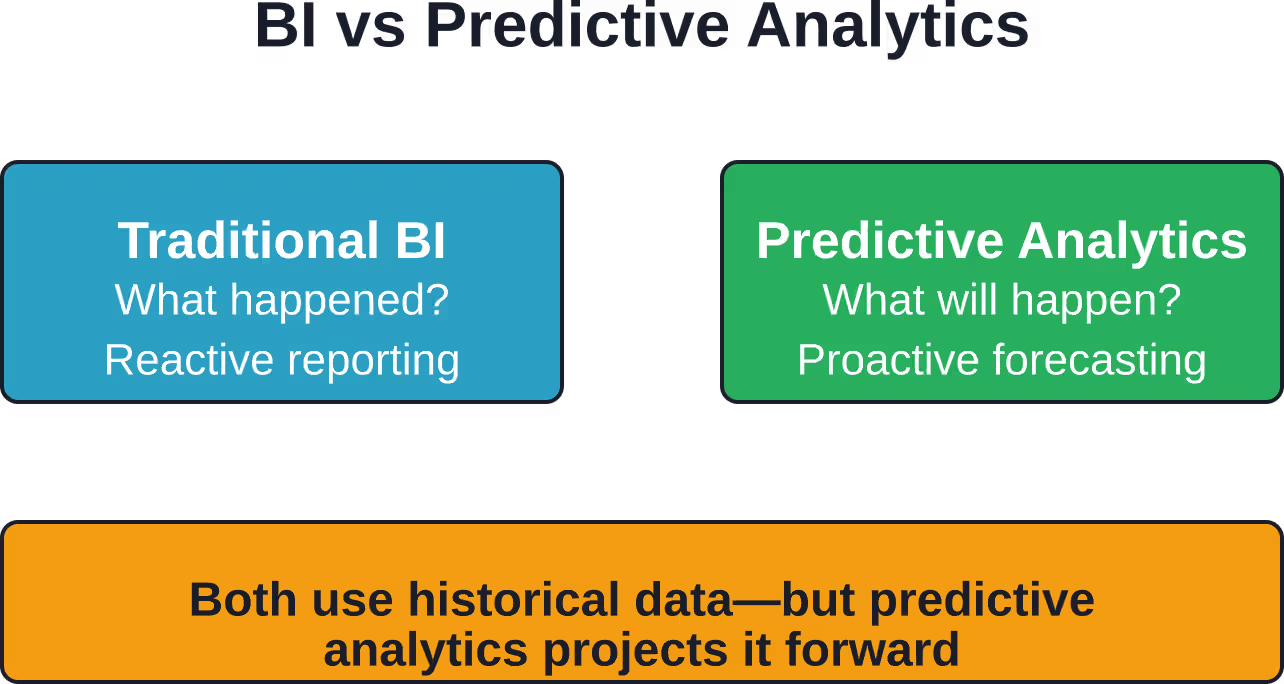
Consider customer retention. Descriptive BI tells teams that churn jumped from 10% to 12% last month. That’s valuable information, but those customers are already gone.
Predictive analytics identifies which current customers show early warning signs of churn—decreased engagement, reduced purchase frequency, support ticket patterns—while there’s still time to intervene with targeted retention offers.
The technical difference comes down to methodology. Business intelligence relies heavily on queries, reporting tools, and dashboards that slice historical data in various ways. Predictive analytics employs statistical algorithms, machine learning models, and data mining techniques that identify patterns and extrapolate them into probability forecasts.

Use Predictive Analytics in Business Intelligence with AI Superior
AI Superior works with business data to build predictive models that extend beyond reporting and support forward-looking analysis.
The focus is on integrating predictive outputs into BI workflows so insights can be used directly in decision-making.
Looking to Apply Predictive Analytics in BI?
AI Superior can help with:
- assessing business data
- building predictive models
- integrating models into BI systems
- refining results based on usage
👉 Contact AI Superior to discuss your project, data, and implementation approach
How Predictive Analytics Actually Works in Practice
The process isn’t mysterious. Predictive analytics follows a structured workflow that moves from raw data to actionable forecasts.
It starts with data collection. Organizations pull historical data from multiple sources: transaction databases, customer relationship management systems, web analytics platforms, operational logs, external market data, and any other relevant information repositories.
Data preparation comes next. Raw data is rarely analysis-ready. It contains duplicates, missing values, formatting inconsistencies, and outliers. Data scientists clean, normalize, and structure this information into formats suitable for modeling.
The modeling phase applies statistical algorithms and machine learning techniques to identify patterns in the prepared data. Regression models might predict sales volume based on seasonal patterns and promotional activities. Classification algorithms could flag transactions likely to be fraudulent. Time series models forecast inventory requirements based on historical demand fluctuations.
Model validation ensures predictions are reliable. Data scientists test models against held-back historical data to measure accuracy. A model that predicted the past accurately has a better chance of predicting the future reliably.
Deployment puts models into production systems where they generate real-time or batch predictions. A fraud detection model scores each transaction as it occurs. A demand forecasting model updates inventory recommendations nightly.
Monitoring completes the cycle. Model performance degrades over time as business conditions shift. Continuous monitoring catches accuracy drift and triggers retraining when needed.
Core Techniques That Power Predictions
Several statistical and machine learning approaches drive predictive analytics capabilities:
- Regression analysis models relationships between variables to predict continuous outcomes. Linear regression might forecast monthly revenue based on marketing spend, seasonality, and economic indicators. Logistic regression predicts binary outcomes like whether a customer will purchase or churn.
- Decision trees split data into branches based on feature values, creating rule-based prediction structures. Random forests combine multiple decision trees to improve accuracy and reduce overfitting.
- Neural networks process data through layers of interconnected nodes, learning complex non-linear patterns. Deep learning architectures handle unstructured data like text, images, and sensor readings.
- Time series models specialize in sequential data, capturing trends, seasonality, and cyclical patterns to forecast future values based on temporal dependencies.
- Clustering algorithms group similar records together, revealing customer segments, product affinities, or operational patterns that inform targeted strategies.
Business Applications Where Predictions Drive Value
Organizations across industries apply predictive analytics to solve specific business challenges. The use cases share common characteristics: they address high-impact decisions, leverage available historical data, and create measurable improvements in outcomes.
Customer Retention and Churn Prevention
Acquiring new customers costs significantly more than retaining existing ones. Predictive models identify customers at high risk of churning based on behavioral signals: declining engagement, decreased purchase frequency, support interactions, competitor research activity.
These predictions trigger targeted retention campaigns—personalized offers, proactive outreach, service improvements—while intervention can still change the outcome.
Demand Forecasting and Inventory Optimization
Retailers and manufacturers use predictive models to forecast product demand across locations, channels, and time periods. Accurate forecasts reduce stockouts that lose sales and excess inventory that ties up capital.
Time series models incorporate seasonality, promotions, weather patterns, economic indicators, and historical trends to generate forecasts that drive purchasing, production, and distribution decisions.
Fraud Detection and Risk Management
Financial institutions deploy predictive models that score transactions in real-time, flagging anomalies that suggest fraudulent activity. Machine learning models identify subtle patterns that rule-based systems miss—unusual transaction sequences, geographic inconsistencies, behavioral deviations.
The same approach extends to credit risk assessment, insurance underwriting, and compliance monitoring.
Targeted Marketing and Personalization
Marketing teams use predictive analytics to forecast which customers are most likely to respond to specific offers, which products to recommend, which channels drive highest conversion, and which messages resonate with different segments.
These predictions enable resource allocation that maximizes return on marketing investment by focusing effort where it generates measurable results.
Operational Efficiency and Maintenance
Predictive maintenance models analyze sensor data, usage patterns, and historical failure records to forecast when equipment will require service. This shifts maintenance from reactive (fixing breakdowns) or calendar-based (scheduled regardless of need) to condition-based (intervening when predictions indicate upcoming failure).
The approach reduces downtime, extends asset life, and optimizes maintenance resource allocation.
| Application Area | Key Predictions | Primary Benefit |
|---|---|---|
| Customer Retention | Churn probability, lifetime value | Reduced customer acquisition costs |
| Demand Forecasting | Product demand by location and time | Optimized inventory levels |
| Fraud Detection | Transaction risk scores | Reduced fraud losses |
| Marketing Optimization | Response probability, conversion likelihood | Improved marketing ROI |
| Predictive Maintenance | Equipment failure timing | Reduced downtime and maintenance costs |
| Sales Forecasting | Revenue projections by segment | Better resource planning |
Building Predictive Capabilities: What Organizations Need
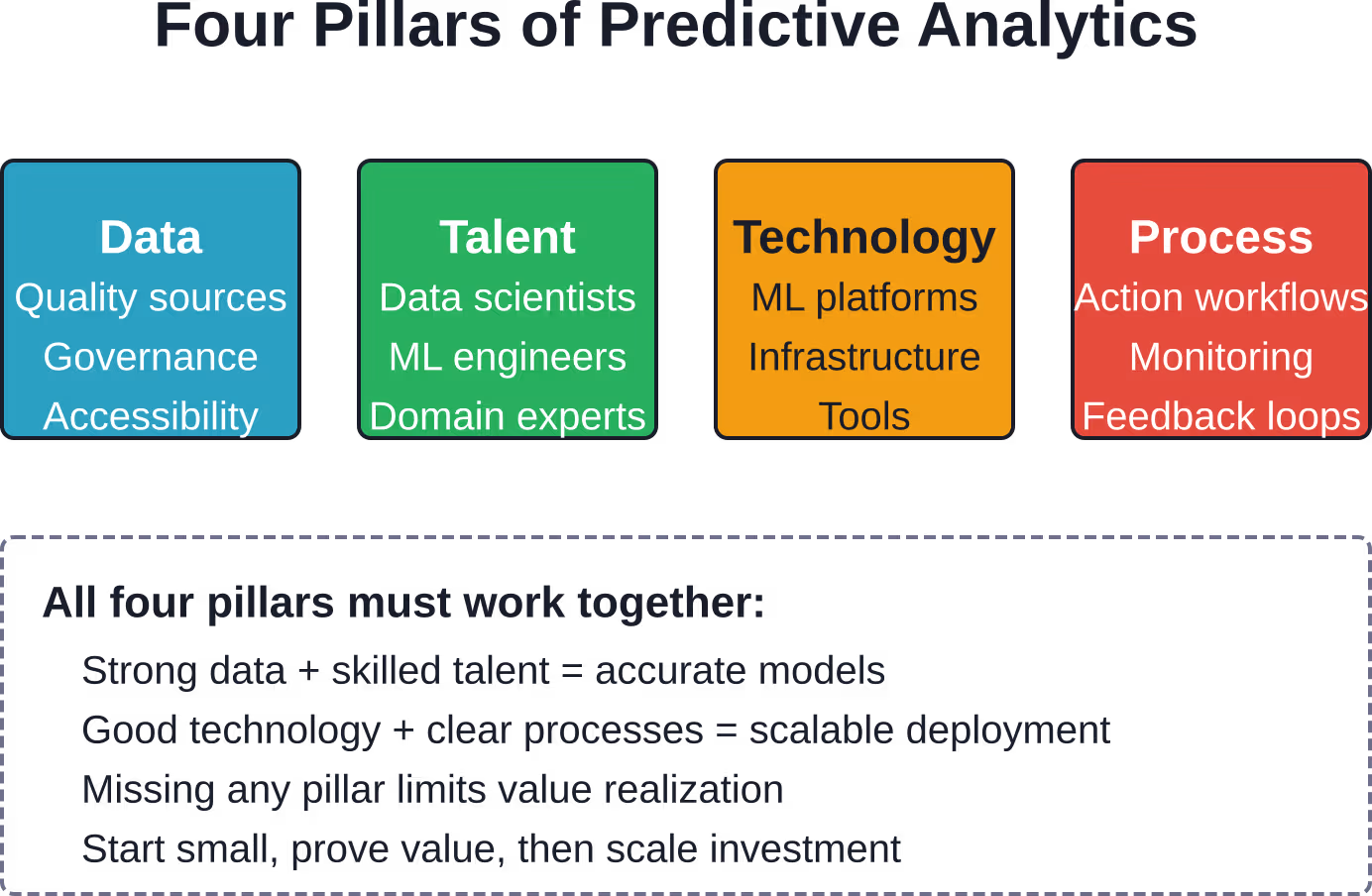
Implementing predictive analytics requires more than software licenses. Successful deployments combine technology infrastructure, skilled talent, quality data, and organizational processes that translate predictions into action.
Data Infrastructure and Quality
Predictive models are only as good as the data they train on. Organizations need systems that collect, store, and provide access to relevant historical data at the required granularity and completeness.
Data quality issues—missing values, duplicates, inconsistent formatting, measurement errors—directly degrade model accuracy. Investing in data governance, quality monitoring, and cleanup processes pays dividends in prediction reliability.
Analytical Talent and Expertise
Building and deploying predictive models requires specialized skills: statistical knowledge to select appropriate techniques, programming ability to implement and test models, domain expertise to identify relevant features and interpret results, and engineering capability to operationalize predictions in production systems.
Organizations address this through hiring data scientists and machine learning engineers, upskilling existing analytics teams, or partnering with external specialists.
Technology Platforms and Tools
Modern predictive analytics platforms provide integrated environments for data preparation, model development, validation, deployment, and monitoring. These tools range from open-source libraries like Python’s scikit-learn and TensorFlow to commercial platforms that offer end-to-end workflows with graphical interfaces.
The right choice depends on technical sophistication, use case complexity, scale requirements, and existing technology investments.
Organizational Processes for Action
Predictions create value only when organizations act on them. This requires processes that route predictions to decision-makers, workflows that trigger interventions, and feedback loops that measure whether actions based on predictions achieved desired outcomes.
A churn prediction model generates lists of at-risk customers. But without processes that deliver those lists to retention teams, trigger personalized outreach, and track whether interventions reduced churn, the predictions remain interesting data points rather than business value drivers.
Common Challenges and How to Navigate Them
Organizations implementing predictive analytics encounter predictable obstacles. Anticipating these challenges and planning mitigation strategies improves success rates.
Data Availability and Quality Gaps
Historical data often proves incomplete, inconsistent, or unavailable at the required granularity. Customer records lack purchase history before a certain date. System migrations lost old transaction data. Different departments store information in incompatible formats.
Solutions include investing in data integration platforms, establishing data quality standards, implementing governance processes, and starting with use cases where sufficient quality data already exists rather than waiting for perfect data across all domains.
Model Accuracy and Trust
Predictive models generate probabilistic forecasts, not certainties. A churn model with 80% accuracy still misidentifies one in five customers. Decision-makers accustomed to deterministic reports may struggle with probabilistic predictions.
Building trust requires transparency about model limitations, clear communication of confidence intervals, validation against historical outcomes, and starting with lower-risk use cases where prediction errors have manageable consequences.
Overfitting and Model Degradation
Models can become too specialized to training data, capturing noise rather than genuine patterns. This overfitting produces excellent results on historical data but poor predictions on new data.
Proper validation techniques—train/test splits, cross-validation, holdout datasets—catch overfitting during development. Monitoring production model performance catches degradation as business conditions shift, triggering retraining cycles.
Operationalizing Predictions
The gap between proof-of-concept models that run on data science workstations and production systems serving real-time predictions to thousands of users represents a major implementation hurdle.
Organizations need engineering resources to build deployment pipelines, integrate predictions with operational systems, ensure scalability and reliability, and establish monitoring that catches performance issues before they impact business outcomes.
ROI Considerations: When Does Predictive Analytics Pay Off?
Predictive analytics requires investment in data infrastructure, technology platforms, specialized talent, and organizational change. That investment needs to generate measurable returns.
Research on ROI-driven data analytics emphasizes that decisions about analytics depth should consider both cost and achievable benefit, identifying break-even points where further analysis stops adding value relative to invested effort.
High-ROI scenarios share characteristics: they address high-value decisions where improved accuracy generates significant financial impact, leverage existing quality data that minimizes preparation costs, and connect to operational processes ready to act on predictions.
A retailer using predictive demand forecasting to optimize inventory across thousands of SKUs and hundreds of locations creates value through reduced stockouts and excess inventory. The benefit scales with business size.
A small business with limited historical data, simple operations, and low decision complexity may find basic descriptive analytics sufficient for their needs. The predictive analytics investment wouldn’t pay off.
Starting with focused pilot projects on high-impact use cases proves value before committing to enterprise-wide deployments. Early wins build organizational confidence and fund expansion.
Future Directions: AI-Powered Intelligence
Predictive analytics continues evolving as machine learning techniques advance, computing power increases, and data availability expands.
According to IEEE research and publications on AI-powered business intelligence, organizations increasingly combine traditional predictive models with advanced AI capabilities including natural language processing for unstructured data, computer vision for image and video analysis, and deep learning for complex pattern recognition.
AutoML platforms now provide full-cycle autonomous governance and ‘Reasoning AI’ integration, moving beyond simple hyperparameter tuning to automated model ethics auditing and synthetic data generation.
Real-time prediction architectures process streaming data to generate forecasts at the moment decisions occur rather than batch-updating predictions overnight. This enables applications like dynamic pricing, instant fraud detection, and adaptive personalization.
Explainable AI techniques address the black-box problem in complex models, providing interpretable explanations for why models generate specific predictions. This builds trust and enables organizations to use predictions in regulated contexts requiring transparency.
Frequently Asked Questions
What’s the difference between predictive analytics and artificial intelligence?
Predictive analytics is a specific application of data analysis focused on forecasting future outcomes using statistical models and machine learning. Artificial intelligence is a broader field encompassing various techniques that enable computers to perform tasks requiring human-like intelligence. Many predictive analytics implementations use AI techniques, but not all AI applications involve prediction.
How much historical data do you need for predictive analytics?
Data requirements vary by use case complexity and prediction type. Simple regression models might work with hundreds of records, while deep learning approaches typically need thousands or millions of examples. Generally speaking, more data improves model accuracy, but quality matters more than quantity. Clean, relevant data from the past 1-3 years often suffices for many business applications.
Can small businesses benefit from predictive analytics?
Absolutely. While large enterprises may deploy sophisticated custom models, small businesses can leverage pre-built predictive capabilities in marketing platforms, CRM systems, and accounting software. Tools for email campaign optimization, customer segmentation, and cash flow forecasting incorporate predictive techniques without requiring data science expertise or massive datasets.
How accurate are predictive analytics models?
Accuracy depends on data quality, modeling approach, and inherent predictability of what’s being forecast. Well-built models for stable domains like demand forecasting might achieve 85-95% accuracy. Models predicting less deterministic outcomes like customer behavior might reach 70-80%. Predictions become less accurate further into the future and when conditions change significantly from historical patterns.
What happens when business conditions change and models stop working?
Model performance naturally degrades as market dynamics shift, customer behavior evolves, or external factors change. Continuous monitoring tracks prediction accuracy in production. When performance drops below acceptable thresholds, models need retraining on recent data that reflects current conditions. Organizations typically establish regular retraining schedules—monthly, quarterly, or when monitoring detects accuracy degradation.
How long does it take to implement predictive analytics?
Timelines vary widely based on use case complexity, data readiness, and organizational maturity. A focused pilot project leveraging existing clean data might deliver initial results in 2-3 months. Enterprise-wide implementations requiring data infrastructure upgrades, integration across multiple systems, and organizational change management can take 6-18 months. Starting with smaller scoped projects builds momentum and proves value faster.
Do you need a data science team to use predictive analytics?
Not necessarily. Organizations have several options: build internal data science teams for custom model development, use pre-built predictive features in commercial software platforms, partner with external analytics consultancies, or adopt AutoML tools that automate much of the technical complexity. The right approach depends on budget, use case sophistication, available talent, and strategic importance of analytics capabilities.
Taking the Next Step Forward
Predictive analytics transforms business intelligence from a rearview mirror into a forward-looking navigation system. Organizations that successfully implement these capabilities gain competitive advantages through earlier problem detection, proactive decision-making, and resource optimization that reactive analytics simply can’t match.
The path forward doesn’t require betting the company on massive analytics transformations. It starts with identifying high-value use cases where better predictions drive measurable outcomes, assessing data readiness for those applications, and running focused pilots that prove value before scaling investment.
Success depends on balancing four elements: quality data infrastructure, analytical talent and expertise, appropriate technology platforms, and operational processes that translate predictions into business actions. Organizations that neglect any pillar limit their ability to realize value from predictive capabilities.
The gap between what happened and what will happen represents the difference between reactive and proactive organizations. Predictive analytics bridges that gap, turning historical data into forward-looking insights that drive better decisions today based on likely outcomes tomorrow.
Ready to move beyond backward-looking reports? Start by identifying one high-impact decision where better forecasts would generate measurable value, assess whether sufficient historical data exists to support modeling, and build a focused pilot that proves predictive analytics can deliver results in your specific context.
 English
  German
  Arabic
  French
  Dutch
Dutch  Spanish