
Quick Summary: Predictive analytics transforms financial forecasting by using historical data, machine learning algorithms, and statistical models to anticipate future trends, risks, and opportunities. Organizations leverage these tools to improve forecast accuracy, manage cash flow, detect fraud, and make data-driven decisions in volatile markets. The Federal Reserve’s 2026 stress test scenarios demonstrate how predictive models now anticipate severe economic conditions with unprecedented precision, while portfolio forecasting models achieve R² values above 90% for key financial indicators.
Financial forecasting has shifted from spreadsheet guesswork to sophisticated predictive systems that process billions of data points in real time. Traditional methods couldn’t keep pace with market volatility, regulatory changes, or the explosion of available data sources.
Predictive analytics changes that equation entirely. Rather than relying on historical averages and linear projections, these systems identify patterns across economic cycles, detect emerging risks before they materialize, and model complex scenarios that account for hundreds of variables simultaneously.
The Federal Reserve’s 2026 stress test scenarios illustrate this evolution. Their models now predict a hypothetical severe global recession with precision metrics calibrated against unemployment rising from 4.1% in Q4 2024 to a peak of 10% by Q3 2027, along with substantial declines in risky asset prices and significant increases in financial market volatility.
That level of granularity wasn’t possible a decade ago. But here’s the thing—predictive analytics isn’t just for central banks and massive institutions anymore.
What Predictive Analytics Actually Means for Financial Forecasting
Predictive analytics in finance involves leveraging data analysis techniques to predict future financial trends, aiding in cash flow forecasting, risk management, and informed decision-making for finance teams. The technology combines historical data patterns with real-time inputs to generate probabilistic forecasts.
The core difference from traditional forecasting? Traditional methods extrapolate from past performance using relatively simple formulas. Predictive analytics builds probabilistic models that account for non-linear relationships, external shocks, and complex interdependencies.
Research from portfolio forecasting models demonstrates this capability. Unlagged predictive models achieve strong fit metrics across major financial indicators, with performance benchmarks representing a substantial improvement over traditional forecasting approaches.
The Three Core Components
Every predictive analytics system for financial forecasting relies on three foundational elements:
- Historical data infrastructure. The models need clean, comprehensive historical datasets covering the variables being forecast. One major US bank extended its forecast period from 3 months to 12 months after implementing robust data collection systems that captured granular transaction patterns.
- Machine learning algorithms. These algorithms identify patterns humans couldn’t spot manually. They detect correlations between seemingly unrelated variables, adjust for seasonal variations, and recalibrate as new data arrives.
- Real-time data integration. Static models decay quickly. The most effective systems continuously ingest market data, economic indicators, customer behavior metrics, and external signals to keep forecasts current.

Apply Predictive Analytics with AI Superior
AI Superior builds predictive models using financial and historical data to support forecasting and planning. They focus on models that integrate into existing systems and provide usable outputs for decision-making.
Looking to Use Predictive Analytics for Financial Forecasting?
AI Superior can help with:
- evaluating financial data
- building predictive models
- integrating models into existing systems
- refining forecasts based on results
👉 Contact AI Superior to discuss your project, data, and implementation approach
Critical Use Cases Transforming Corporate Finance
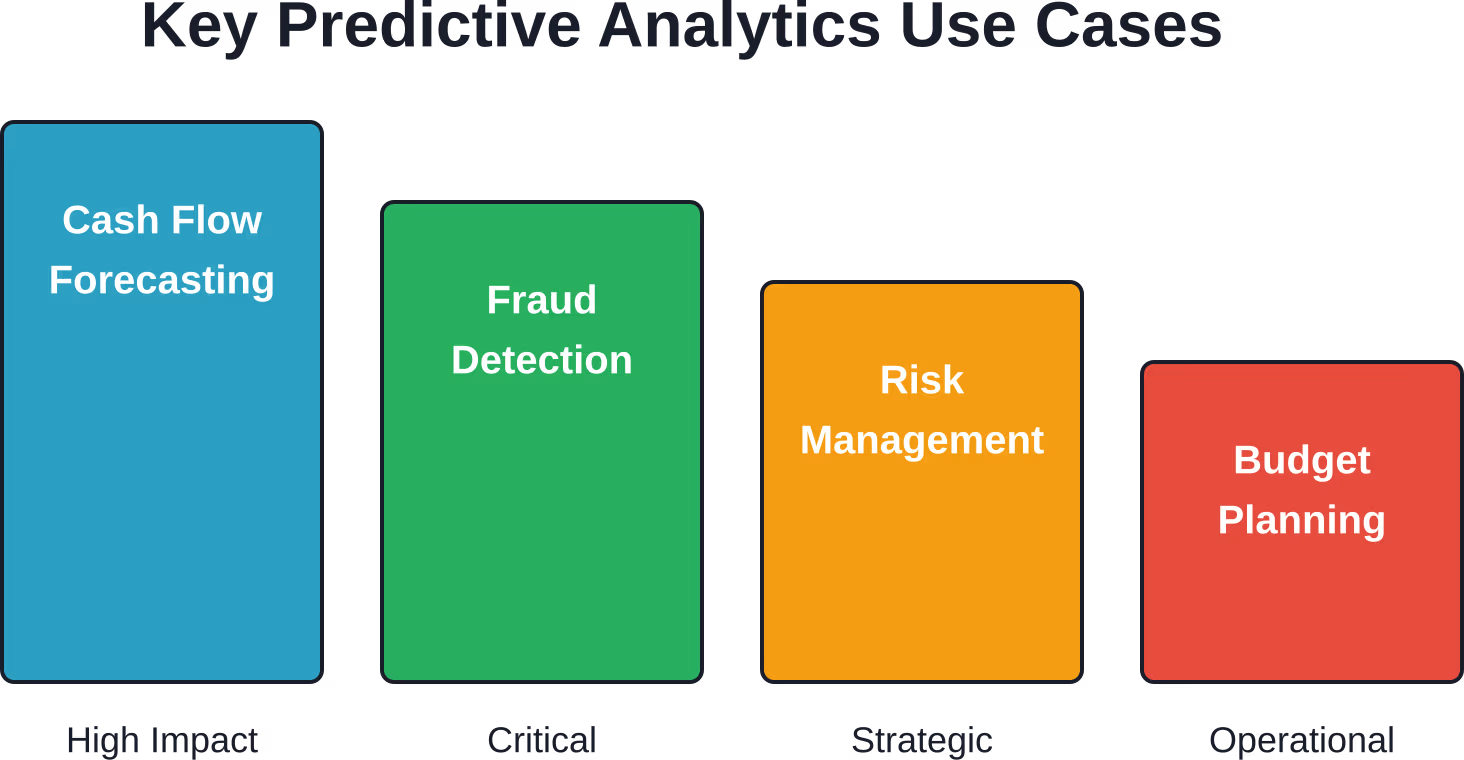
Predictive analytics applications in finance span multiple domains, but several use cases deliver particularly high impact for corporate finance teams.
Cash Flow Forecasting and Working Capital Management
Cash flow volatility creates operational risk. Predictive analytics in accounts receivable provides timely insights into risks and receivables that may constrain working capital.
Modern systems analyze payment patterns across customer segments, identify accounts likely to pay late, and forecast cash position with weekly or daily granularity. This allows finance teams to optimize working capital allocation rather than maintaining excessive cash buffers.
The analytics also reveal which invoices face higher default risk, enabling proactive collection strategies before accounts become overdue.
Fraud Detection and Prevention
One major U.S. financial institution implemented fraud detection systems with predictive capabilities. The system monitors transaction patterns in real time, flagging anomalies that deviate from established behavioral baselines.
Machine learning models continuously learn normal transaction profiles for individual accounts, merchant categories, geographic regions, and time periods. When activity falls outside those patterns—even if it doesn’t violate explicit rules—the system triggers alerts for review.
This probabilistic approach catches fraud schemes that rule-based systems miss entirely.
Risk Management and Scenario Planning
The Federal Reserve’s stress testing framework demonstrates how predictive analytics enables sophisticated scenario modeling. Their 2026 scenarios model severe recession conditions including house price declines of 33% and commercial real estate price drops of 30%.
Finance teams can run similar simulations tailored to their specific risk exposures. The models test how different adverse scenarios—supply chain disruptions, interest rate spikes, customer concentration risks—would impact financial performance.
Scenario planning isn’t about predicting the future. It’s about understanding the range of possible futures and preparing contingency plans for each.
Budget Accuracy and Strategic Planning
Traditional annual budgeting often produces plans that diverge from reality within weeks. Predictive analytics enables rolling forecasts that update continuously as conditions change.
One client extended its forecast accuracy period from 3 months to 12 months after implementing predictive models, freeing up employee time for value-added activities and enabling more accurate budget decisions.
The systems identify which budget line items show high variance, which cost drivers matter most, and where interventions will produce the greatest impact.
Predictive Models Used in Financial Forecasting
The choice of predictive model depends on the forecasting objective, data characteristics, and required accuracy levels. Financial institutions typically deploy multiple model types simultaneously.
Time Series Models
Time series analysis remains foundational for financial forecasting. These models identify trends, seasonal patterns, and cyclical components in historical data to project future values.
ARIMA (Autoregressive Integrated Moving Average) models work well for univariate forecasting—predicting a single variable based solely on its own history. They’re commonly applied to revenue forecasting, inventory planning, and demand prediction.
But time series models struggle with external shocks and structural breaks. They assume the future will resemble the past, which works until it doesn’t.
Regression Models
Regression analysis explores relationships between dependent variables (what you’re forecasting) and independent variables (the drivers). Multiple regression models can incorporate dozens of explanatory factors simultaneously.
For revenue forecasting, regression models might include variables like marketing spend, economic indicators, competitor pricing, customer acquisition metrics, and seasonal factors. The model quantifies how much each driver influences the outcome.
Regression-based portfolio forecasting models achieve strong fit metrics across major financial indicators using unlagged specifications.
Machine Learning Algorithms
Machine learning extends beyond traditional statistical methods by discovering non-linear patterns and complex interactions automatically.
Random forests build hundreds of decision trees, each trained on different data subsets, then aggregate their predictions. This ensemble approach reduces overfitting and handles missing data gracefully.
Neural networks excel at capturing intricate patterns in large datasets. Deep learning architectures can process alternative data sources—social media sentiment, satellite imagery, web traffic patterns—alongside traditional financial metrics.
Gradient boosting machines iteratively build models that correct previous models’ errors, often achieving superior accuracy for structured tabular data common in finance.
Ensemble Methods
The Ensemble Active Management (EAM) approach demonstrates the power of combining multiple models. Research in this area shows portfolio forecasting combining multiple methodologies can achieve strong performance metrics.
Ensemble approaches reduce model-specific risk by diversifying across different methodologies, each capturing different aspects of the data.
| Model Type | Best Use Cases | Key Strengths | Limitations |
|---|---|---|---|
| Time Series (ARIMA) | Revenue trends, demand forecasting | Simple, interpretable, minimal data needs | Struggles with structural breaks, external shocks |
| Regression | Driver-based forecasts, causal analysis | Quantifies variable relationships, explainable | Assumes linear relationships, requires clean data |
| Machine Learning | Complex patterns, alternative data | Handles non-linearity, discovers hidden patterns | Black box nature, requires large datasets |
| Ensemble | High-stakes decisions, portfolio management | Reduces individual model risk, robust performance | Complex implementation, resource intensive |
Navigating Volatile Markets With Predictive Analytics
Market volatility exposes the limitations of static forecasts. The Federal Reserve’s 2026 stress scenarios model exactly these conditions with substantial equity price declines and high levels of financial market volatility.
Predictive analytics systems handle volatility through continuous recalibration and probabilistic outputs. Rather than generating single-point forecasts, they produce probability distributions showing the range of likely outcomes.
This probabilistic framing supports better decision-making. Finance teams can evaluate strategies across multiple scenarios, understanding not just the most likely outcome but also tail risks and upside possibilities.
Real-Time Adjustment Capabilities
Traditional forecasting cycles—annual budgets updated quarterly—can’t respond to rapid market changes. Predictive systems process new data continuously, adjusting forecasts as conditions evolve.
When a major customer faces financial distress, the models immediately recalculate cash flow forecasts and payment probability. When commodity prices spike, budget projections update automatically to reflect the new cost structure.
This dynamic adjustment prevents the stale forecast problem that plagues traditional planning processes.
Stress Testing and Scenario Analysis
The Federal Reserve’s stress testing framework provides a template for corporate applications. Their 2026 scenarios include house prices declining 33% and commercial real estate dropping 30%—calibrated thresholds that test resilience under severe conditions.
Corporate finance teams can build similar frameworks testing company-specific risks. What happens if the largest customer defaults? How would a 20% currency swing impact margins? Can the balance sheet handle a six-month revenue disruption?
Predictive models quantify these scenarios, revealing vulnerabilities before they materialize into actual losses.
Implementation Challenges and Practical Guidelines
Deploying predictive analytics for financial forecasting presents several operational and technical challenges that organizations must address systematically.
Data Quality and Governance
Predictive models are only as good as the data feeding them. Incomplete records, inconsistent formats, duplicate entries, and missing values all degrade model performance.
Establishing data governance frameworks takes time but pays dividends. This includes standardizing data collection processes, implementing validation rules at entry points, maintaining audit trails, and creating master data management systems.
The bank that extended forecast periods from 3 to 12 months invested heavily in data infrastructure before deploying predictive models. That foundation enabled the analytical capabilities.
Model Selection and Validation
No single model works optimally for every forecasting task. Teams need frameworks for evaluating which approaches fit specific use cases.
Validation processes should test models on out-of-sample data—information the model hasn’t seen during training. This reveals whether the model genuinely learned predictive patterns or simply memorized historical data.
Backtesting against historical periods shows how the model would have performed in past conditions. But beware of overfitting to historical scenarios that may not repeat.
Integration With Existing Systems
Predictive analytics can’t operate in isolation. The systems need connections to general ledgers, ERP platforms, CRM databases, market data feeds, and reporting tools.
API-based integrations enable real-time data exchange. Cloud platforms simplify infrastructure management compared to on-premise deployments. But integration complexity shouldn’t be underestimated—it often consumes more project time than model development.
Regulatory and Compliance Considerations
The SEC proposed new requirements in July 2023 to address risks to investors from conflicts of interest associated with the use of predictive data analytics by broker-dealers and investment advisers. Firms must take certain steps to address conflicts of interest associated with these technologies.
Financial institutions using predictive analytics need to document model methodologies, maintain model inventories, conduct regular validation reviews, and demonstrate that models don’t introduce bias or unfair practices.
Model risk management frameworks should align with regulatory expectations around model governance, testing, and ongoing monitoring.
Benefits Driving Adoption Across Finance Teams
Organizations implementing predictive analytics for financial forecasting report measurable improvements across multiple dimensions.
Improved Forecast Accuracy
Better predictions translate directly to better decisions. One implementation case documented forecast accuracy improvements of 25%, enabling tighter inventory management, optimized cash positions, and more efficient capital allocation.
Portfolio forecasting research demonstrates this quantitatively with strong R² values across major financial indicators, representing near-excellent model fit for these complex financial variables.
Resource Efficiency Gains
Automating forecasting processes frees finance team capacity. The organization that extended forecast periods from 3 to 12 months also freed up employee time for value-added activities beyond manual data compilation and reconciliation.
Finance professionals spend less time building spreadsheets and more time interpreting results, developing strategy, and advising business leaders.
Enhanced Risk Visibility
Predictive models surface risks that might otherwise stay hidden until they materialize. Early warning indicators for customer default, liquidity constraints, or margin compression enable proactive mitigation.
The Federal Reserve stress testing demonstrates this principle at scale—identifying vulnerabilities before actual adverse conditions occur.
Faster Decision Cycles
Real-time forecasts support agile decision-making. Rather than waiting for month-end closes and quarterly reviews, leadership teams can access current projections whenever strategic questions arise.
This acceleration proves particularly valuable in volatile environments where conditions change rapidly.
Future Trends Reshaping Financial Forecasting
Predictive analytics capabilities continue evolving as data sources expand and algorithms advance.
Alternative Data Integration
Financial forecasts increasingly incorporate non-traditional data sources. Credit card transaction volumes, web traffic patterns, satellite imagery of retail parking lots, social media sentiment, and supply chain signals all provide leading indicators.
Machine learning models excel at extracting predictive signals from these unstructured data sources that traditional methods can’t process.
Explainable AI and Model Transparency
As regulatory scrutiny increases, demand grows for interpretable models. Techniques like SHAP (SHapley Additive exPlanations) values decompose predictions to show which variables contributed how much to each forecast.
This transparency helps finance teams understand model behavior, builds stakeholder confidence, and satisfies regulatory requirements for model documentation.
Automated Model Management
MLOps (Machine Learning Operations) platforms automate model deployment, monitoring, and retraining. These systems detect performance degradation, trigger retraining workflows, and manage model versioning—critical capabilities as organizations scale from a handful of models to hundreds.
Automated pipelines reduce the operational burden of maintaining production forecasting systems.
Frequently Asked Questions
What’s the difference between predictive analytics and traditional financial forecasting?
Traditional forecasting typically extrapolates from historical trends using relatively simple formulas like growth rates or moving averages. Predictive analytics uses machine learning algorithms and statistical models to identify complex patterns across multiple variables, generating probabilistic forecasts that account for non-linear relationships and external factors. The approach delivers substantially higher accuracy compared to much lower performance from traditional methods.
How accurate are predictive analytics models for financial forecasting?
Accuracy varies by application and implementation quality. Portfolio forecasting models achieve strong R² values across major financial indicators. Organizations implementing predictive cash flow systems report forecast accuracy improvements of 25% compared to previous methods. The Federal Reserve’s stress testing models demonstrate precision in modeling severe scenarios including substantial equity declines and unemployment reaching 10%.
What data do predictive analytics systems need for financial forecasting?
Effective systems require comprehensive historical data covering the variables being forecast—typically 3-5 years minimum, though more is better. This includes internal financial data (revenue, expenses, cash flows, customer payments), external economic indicators (interest rates, inflation, GDP growth), and increasingly alternative data sources (transaction volumes, web traffic, sentiment signals). Data quality matters more than volume—clean, consistent, complete records produce better results than massive datasets with gaps and errors.
How long does it take to implement predictive analytics for financial forecasting?
Implementation timelines range from 3-6 months for focused use cases (like cash flow forecasting) to 12-18 months for comprehensive enterprise deployments. Data infrastructure preparation often consumes 40-50% of project time. Organizations with mature data governance and clean historical records can move faster. Cloud-based platforms and pre-built models accelerate deployment compared to custom development, but integration with existing financial systems still requires significant effort.
What are the main challenges in implementing predictive analytics?
Data quality issues rank as the most common obstacle—incomplete historical records, inconsistent formats, and missing values all degrade performance. Integration complexity connecting predictive systems to ERPs, general ledgers, and other financial platforms often exceeds initial estimates. Model selection requires specialized expertise to match algorithms to specific forecasting objectives. Regulatory compliance adds documentation and validation requirements, particularly for financial institutions. Change management challenges arise when finance teams must adapt processes around new forecasting capabilities.
How does predictive analytics handle unexpected market events?
Models perform best when future conditions resemble historical patterns. Truly unprecedented events (black swans) challenge all forecasting approaches. However, predictive systems adapt faster than traditional methods because they continuously retrain on new data. Ensemble approaches combining multiple models reduce vulnerability to any single model’s blind spots. Scenario testing capabilities let finance teams model various adverse conditions—the Federal Reserve stress scenarios demonstrate this, testing banks against severe recession conditions. Probabilistic outputs showing ranges rather than single-point forecasts also help teams prepare for uncertainty.
Conclusion
Predictive analytics has fundamentally transformed financial forecasting from retrospective analysis to forward-looking intelligence. The technology delivers measurable improvements in forecast accuracy, risk visibility, and decision speed across cash flow management, fraud detection, scenario planning, and strategic budgeting.
Implementation success requires addressing data quality foundations, selecting appropriate models for specific use cases, integrating with existing systems, and maintaining regulatory compliance. Organizations that navigate these challenges gain substantial competitive advantages through better-informed decisions and faster adaptation to changing conditions.
The Federal Reserve’s stress testing framework and portfolio forecasting models achieving strong R² values demonstrate the maturity and precision now possible. These capabilities are no longer limited to major financial institutions—cloud platforms and specialized vendors have made sophisticated predictive analytics accessible to organizations of all sizes.
Start with focused applications in high-impact areas. Build data infrastructure systematically. Validate models rigorously. And iterate based on results.
Ready to transform your financial forecasting capabilities? Evaluate your current data readiness, identify the highest-priority use case for your organization, and explore platforms that align with your technical environment and resource constraints.
 English
  German
  Arabic
  French
  Dutch
Dutch  Spanish