
Quick Summary: Predictive analytics in smart farming leverages data from sensors, weather patterns, and historical records to forecast crop yields, optimize resource use, and detect threats before they escalate. By combining machine learning models with real-time agricultural data, farmers can make proactive decisions that boost productivity while reducing waste and environmental impact.
Agriculture is shifting from reactive guesswork to proactive precision. Weather patterns grow more erratic, resources tighten, and global food demand climbs—farmers can’t afford to rely on instinct alone. That’s where predictive analytics steps in, turning raw agricultural data into actionable forecasts that shape planting schedules, irrigation plans, and pest management strategies.
Smart farming technologies—IoT sensors, satellite imagery, machine learning—generate massive datasets every day. But data alone solves nothing. The real power emerges when predictive models analyze these inputs to forecast crop yields, detect nutrient deficiencies weeks before visible symptoms, or predict pest outbreaks with enough lead time to intervene.
Here’s the thing though—adoption isn’t universal. While large commercial operations increasingly deploy these tools, smaller farms face hurdles around cost, connectivity, and technical expertise. The gap between potential and practice remains wide, even as the technology matures.
What Predictive Analytics Brings to Modern Agriculture
Predictive analytics in agriculture employs statistical algorithms and machine learning to forecast outcomes based on historical and real-time data. Instead of reacting to drought after crops wilt, farmers receive advance warnings when soil moisture trends suggest trouble ahead.
The core inputs include weather forecasts, soil sensor readings (moisture, pH, nitrogen-phosphorus-potassium levels), crop health imagery, and historical yield records. Algorithms identify patterns—correlations between rainfall timing and grain quality, relationships between temperature swings and disease pressure, connections between planting dates and final tonnage.
Advanced models now incorporate IoT-based soil NPK sensing using machine learning, as explored in recent IEEE technical literature. These systems continuously monitor nutrient status and predict deficiency events before they impact growth.
Core Capabilities
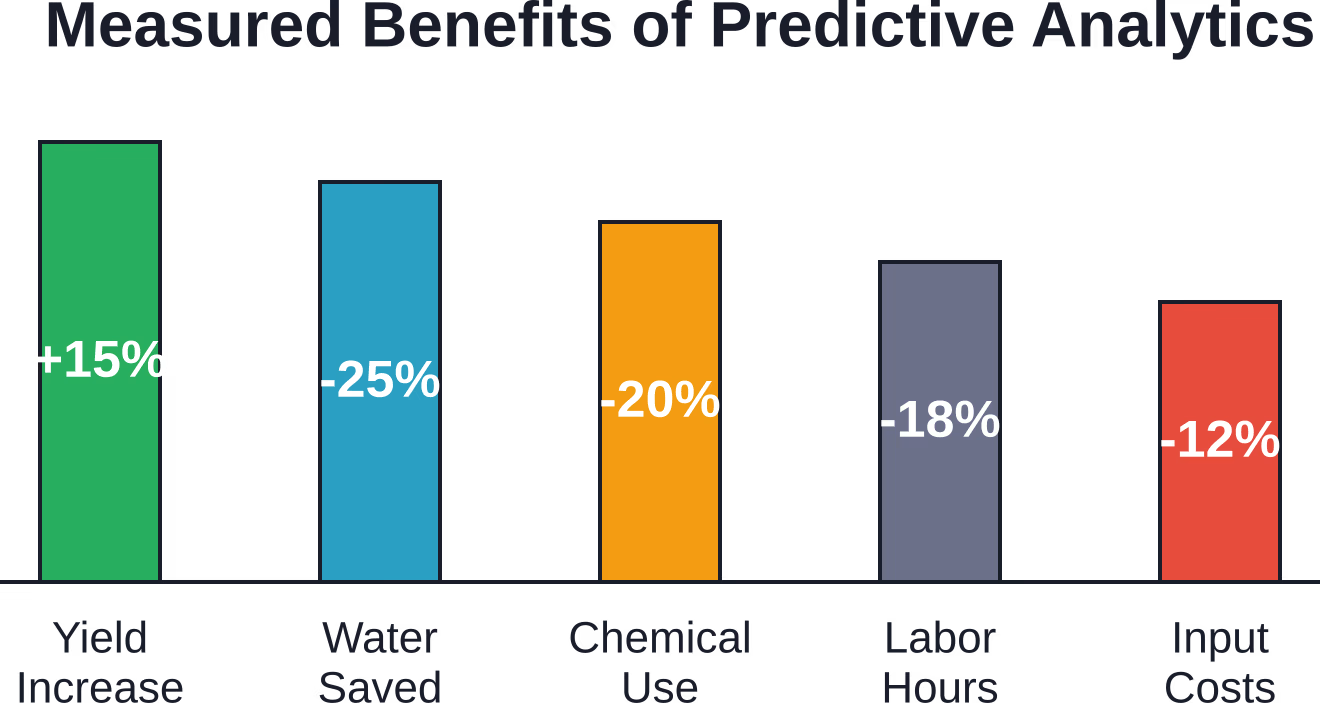
Yield forecasting stands out as the most visible application. Models trained on multi-year data can predict harvest volumes with improving accuracy, helping farmers negotiate contracts and manage storage capacity. Precision matters here—predictive analytics can forecast optimal planting times, with some operations reporting yield improvements of 15% or higher through optimized planting windows.
Resource optimization cuts waste while maintaining productivity. Predictive irrigation systems forecast soil moisture depletion rates based on weather patterns, crop stage, and evapotranspiration models. Water flows exactly when and where needed, not on a fixed schedule that ignores conditions.
Disease and pest forecasting analyzes temperature, humidity, crop density, and historical outbreak data to flag high-risk periods. Fungicide applications shift from calendar-based routines to threat-driven interventions, reducing chemical use and cost.

Use Predictive Analytics with AI Superior
AI Superior works with environmental and operational data to build predictive models for planning and monitoring in agriculture. The focus is on integrating models into existing systems so insights can be used in real-world conditions.
Looking to Apply Predictive Analytics in Smart Farming?
AI Superior can help with:
- evaluating environmental and sensor data
- building predictive models
- integrating models into existing systems
- refining outputs based on usage
👉 Contact AI Superior to discuss your project, data, and implementation approach.
Key Technologies Powering Predictive Smart Farming
The technology stack blends hardware and software. IoT sensors deployed across fields measure soil conditions, microclimate variables, and plant health indicators in real time. Satellite and drone imagery adds spatial context—vegetation indices, canopy temperature, moisture stress patterns visible from above.
Machine learning frameworks process these streams. Random forests, neural networks, and gradient boosting models each excel at different prediction tasks. Weather forecast APIs feed future conditions into models, while edge computing on farm equipment enables real-time decision support even when connectivity falters.
Recent developments emphasize energy-efficient models—so-called “Green AI” approaches that reduce computational overhead without sacrificing accuracy. This matters for resource-constrained farms and battery-powered sensor networks.
Data Integration Challenges
Farmers often juggle data from incompatible systems—one vendor’s soil sensors, another’s weather station, a third party’s satellite service. Integration requires standardized formats and APIs that many legacy systems lack.
Data quality presents another hurdle. Sensors drift out of calibration, connectivity gaps create missing records, and historical data may lack the granularity modern models need. Garbage in, garbage out—predictive accuracy depends entirely on input reliability.
Applications Across the Growing Season
Predictive analytics supports decisions from pre-planting through harvest. Soil analysis combined with weather forecasts guides variety selection and planting dates. During the season, growth models track development stages and predict maturity windows, coordinating logistics for harvest crews and storage.
| Application | Data Inputs | Predicted Outcome |
|---|---|---|
| Planting Optimization | Soil temp, moisture, 30-day forecast | Ideal planting window, variety selection |
| Irrigation Scheduling | Soil sensors, ET models, weather | Water needs by zone, timing |
| Nutrient Management | Soil NPK, crop stage, yield target | Fertilizer timing and rates |
| Pest/Disease Alerts | Humidity, temp, crop density, history | Outbreak probability, intervention window |
| Yield Forecasting | Multi-year data, current conditions | Expected harvest volume, quality |
Precision agriculture platforms tie these applications together. A single interface displays soil moisture maps, disease risk zones, and yield projections side by side, enabling holistic farm management rather than siloed decisions.
Benefits Beyond the Bottom Line
Economic gains grab headlines—reduced input costs, higher yields, better pricing through advance planning. But environmental and operational benefits matter too.
Water conservation ranks high in drought-prone regions. Predictive irrigation systems can significantly reduce water use by optimizing application timing and avoiding unnecessary percolation losses. Chemical reduction follows similar logic: targeted, threat-driven applications based on forecasted need minimize environmental load and reduce input costs.
Labor efficiency improves when predictive models coordinate tasks. Harvest crews arrive exactly when fruit reaches target ripeness, not too early or late. Equipment maintenance schedules align with predicted downtime windows, avoiding breakdowns during critical operations.
Risk mitigation extends to financial planning. Crop insurance premiums may drop when analytics demonstrate proactive management. Marketing strategies adapt to yield forecasts—locking in prices early when a bumper crop looms, holding for better terms when scarcity seems likely.
Barriers Slowing Adoption
Despite compelling benefits, many farms haven’t deployed predictive analytics. Cost tops the obstacle list—sensor networks, connectivity infrastructure, and software subscriptions add up quickly. Small operations struggle to justify expenses that scale-efficient megafarms absorb easily.
Technical complexity creates friction. Models require tuning, sensors need maintenance, and interpreting outputs demands statistical literacy many farmers lack. User interfaces have improved, but the learning curve remains steep.
Data privacy concerns linger. Who owns yield data? What happens when equipment manufacturers aggregate farm performance metrics? Trust deficits slow data-sharing arrangements that could improve model accuracy.
Connectivity gaps persist in rural areas. Predictive systems need reliable internet for weather updates, model execution, and remote monitoring. Cellular dead zones and satellite latency undermine real-time capabilities.
Making Analytics Accessible
Extension programs increasingly focus on predictive analytics training. The AgriProspects Workforce Development Network, supported by USDA’s National Institute of Food and Agriculture, awarded $1 million in the second round of grants to five selected projects to build capacity among agricultural professionals. These initiatives target the skill gap, helping advisors guide farmers through technology adoption.
Subscription models with tiered pricing lower entry barriers. Basic packages offer essential forecasting without requiring full sensor deployments, letting farms test value before committing capital.
Real-World Implementation Patterns
Successful deployments typically start small. Farmers pilot predictive irrigation on a single field or test disease forecasting for one high-value crop. Early wins build confidence and justify expansion.
Partnerships accelerate adoption. Cooperatives pool resources for shared sensor networks and analytics platforms, spreading costs across members. Equipment dealers increasingly bundle predictive tools with machinery sales, integrating analytics into familiar workflows.
Regional specificity matters. A predictive model trained on Iowa corn data won’t transfer directly to California almonds. Local calibration using regional soil types, climate patterns, and crop varieties improves accuracy dramatically.
| Do | Don’t |
|---|---|
| Start with pilot projects on high-value crops | Deploy farm-wide before proving value |
| Invest in sensor calibration and maintenance | Ignore data quality issues |
| Train staff on interpreting model outputs | Assume predictions are always correct |
| Validate forecasts against actual outcomes | Rely solely on historical data without current inputs |
| Integrate predictions with existing farm software | Overcomplicate models beyond practical utility |
The Road Ahead for Agricultural Forecasting
Predictive analytics will grow more sophisticated and accessible. Edge AI—running models directly on tractors and field equipment—reduces latency and connectivity dependence. Hyperspectral imaging from drones will detect stress invisible to human eyes days before symptoms appear.
Climate adaptation looms as a critical driver. As weather extremes intensify, the ability to forecast and respond to rapid condition changes becomes essential rather than optional. Predictive systems that integrate climate projections with operational data will guide long-term crop selection and infrastructure investment.
But wait. Technology alone won’t solve agriculture’s challenges. The best analytics in the world means nothing if farmers don’t trust it, can’t afford it, or lack the training to act on insights. The next phase of progress depends as much on education, policy support, and business model innovation as on algorithmic advances.
Cross-industry collaboration will shape outcomes. Tech companies, equipment manufacturers, agronomists, and farmers must co-develop solutions that address real needs rather than imagined ones. Open data standards, interoperable platforms, and shared research accelerate progress better than proprietary silos.
Frequently Asked Questions
How accurate are predictive analytics models for crop yield forecasting?
Accuracy varies by crop, region, and model sophistication. Well-calibrated systems using multi-year local data typically achieve 85-95% accuracy for seasonal yield predictions. Short-term forecasts (days to weeks) generally prove more reliable than full-season projections made months in advance. Continuous model refinement with actual harvest data improves performance over time.
What’s the typical ROI timeline for investing in predictive farming analytics?
Most commercial operations see positive returns within 2-3 growing seasons, though this depends on crop type, farm size, and initial investment scale. High-value crops and large acreage accelerate payback. Resource savings (water, fertilizer, chemicals) often generate immediate value, while yield improvements compound over multiple seasons as models learn field-specific patterns.
Can small farms benefit from predictive analytics or is it only for large operations?
Small farms absolutely benefit, though implementation approaches differ. Cooperative sensor networks, shared subscription platforms, and extension service partnerships make analytics accessible without massive capital outlays. Cloud-based services with tiered pricing offer entry points starting at minimal monthly costs. The key is matching tool complexity to operational needs rather than adopting enterprise-scale systems.
What data privacy protections exist for farm analytics information?
Data ownership and privacy policies vary significantly by platform provider. Farmers should review service agreements carefully, ensuring they retain ownership of their operational data and control over third-party access. Industry groups increasingly advocate for data transparency standards, but legal protections remain inconsistent. Selecting providers with clear privacy commitments and avoiding platforms that claim ownership of user data reduces risk.
How does predictive analytics handle unexpected weather events or climate extremes?
Modern systems integrate real-time weather feeds and continuously update forecasts as conditions evolve. However, truly unprecedented events outside historical training data can reduce accuracy. Ensemble models that combine multiple prediction approaches and include uncertainty ranges help quantify forecast confidence. The most robust systems flag low-confidence predictions and recommend increased monitoring during volatile periods.
What technical skills do farmers need to effectively use predictive analytics tools?
Entry-level platforms require minimal technical expertise beyond basic smartphone or tablet operation. More advanced systems benefit from understanding statistical concepts like confidence intervals and correlation, though user interfaces increasingly hide complexity behind visual dashboards. Most critical is the ability to interpret recommendations within local agronomic context—technology provides data, but farmers supply judgment.
Which crops see the greatest benefit from predictive analytics adoption?
High-value crops with tight quality windows—grapes, tree nuts, specialty vegetables—often show dramatic returns because harvest timing and input precision directly impact market value. Row crops like corn and soybeans benefit through large-scale efficiency gains. Perennial crops gain from multi-year planning support. Essentially, any crop with significant input costs, weather sensitivity, or quality premiums sees measurable advantages from predictive approaches.
Conclusion
Predictive analytics transforms smart farming from reactive management to proactive strategy. The convergence of IoT sensors, satellite data, machine learning, and cloud computing creates unprecedented visibility into agricultural systems. Farmers equipped with reliable forecasts make better decisions—planting at optimal moments, irrigating based on projected need, intervening against pests before populations explode.
Challenges remain. Cost, complexity, and connectivity barriers slow adoption, particularly among smaller operations. Data quality issues and integration headaches frustrate implementation. Real talk: the technology has outpaced the support infrastructure needed for broad deployment.
Yet momentum builds. Extension programs expand training, cooperative models spread costs, and vendors simplify interfaces. As climate volatility increases and resource constraints tighten, the farms that survive and thrive will be those leveraging every available advantage—and predictive analytics delivers measurable competitive edge.
The question isn’t whether agriculture will embrace data-driven forecasting. It’s how quickly farmers, technology providers, and support systems can align to make powerful analytics practical, affordable, and accessible across operations of all sizes. The tools exist. The benefits are proven. Now comes the hard work of translating potential into widespread practice.
 English
  German
  Arabic
  French
  Dutch
Dutch  Spanish