
Quick Summary: Predictive analytics uses statistical algorithms, machine learning, and historical data to forecast future outcomes and trends. In data science, it enables organizations to anticipate customer behavior, optimize operations, and make proactive decisions by identifying patterns in past data and extrapolating them forward.
The ability to see what’s coming next—even if it’s just a probability—transforms how organizations operate. That’s the fundamental promise of predictive analytics in data science.
Rather than reacting to events after they happen, businesses can anticipate trends, identify risks before they materialize, and position themselves strategically. This shift from reactive to proactive decision-making represents one of the most significant advantages modern data science offers.
At its core, predictive analytics combines statistical algorithms, machine learning techniques, and domain expertise to answer one question: What might happen next?
What Makes Predictive Analytics Different
Predictive analytics sits at the intersection of several disciplines. It pulls from statistics, computer science, and business intelligence to create models that forecast future outcomes based on historical data.
The practice isn’t about guarantees. Instead, it’s about probabilities and likelihoods—quantifying uncertainty in a way that supports better decisions.
Data science provides the framework and tools for this work. Algorithms scan through massive datasets, identify patterns that humans might miss, and extrapolate those patterns into future scenarios.
Here’s what sets predictive analytics apart from other types of analysis:
- Descriptive analytics tells what happened (sales dropped 15% last quarter)
- Diagnostic analytics explains why it happened (promotional campaign ended, competitor launched new product)
- Predictive analytics forecasts what will happen (sales will likely decline another 8% next quarter without intervention)
- Prescriptive analytics recommends actions (launch targeted promotion, adjust pricing strategy)
The transition from understanding the past to forecasting the future requires sophisticated modeling techniques and robust data infrastructure.

Apply Predictive Analytics in Data Science with AI Superior
AI Superior builds predictive models as part of broader data science workflows, focusing on practical application and integration. They start with feasibility analysis, build a working prototype, and scale the solution once validated.
Looking to Use Predictive Analytics in Data Science?
AI Superior can help with:
- evaluating data and use cases
- building predictive models
- integrating models into workflows
- improving results based on usage
👉 Contact AI Superior to discuss your project, data, and implementation approach.
Core Techniques That Power Predictions
Multiple statistical and machine learning approaches drive predictive analytics. Each technique serves different scenarios and data types.
Regression Models
Linear regression forms the foundation of many predictive models. It establishes relationships between variables—how changes in one factor correlate with changes in another.
When predicting continuous outcomes like sales revenue or temperature, regression algorithms excel. The model identifies the strength and direction of relationships in historical data, then applies those relationships to new inputs.
More complex variants handle non-linear relationships. Polynomial regression, for instance, captures curved patterns that straight-line models miss.
Classification Algorithms
When outcomes fall into distinct categories rather than continuous ranges, classification techniques take over. Will a customer churn or stay? Will a transaction prove fraudulent or legitimate?
Decision trees split data based on feature values, creating branching paths that lead to predictions. Random forests combine multiple decision trees to improve accuracy and reduce overfitting.
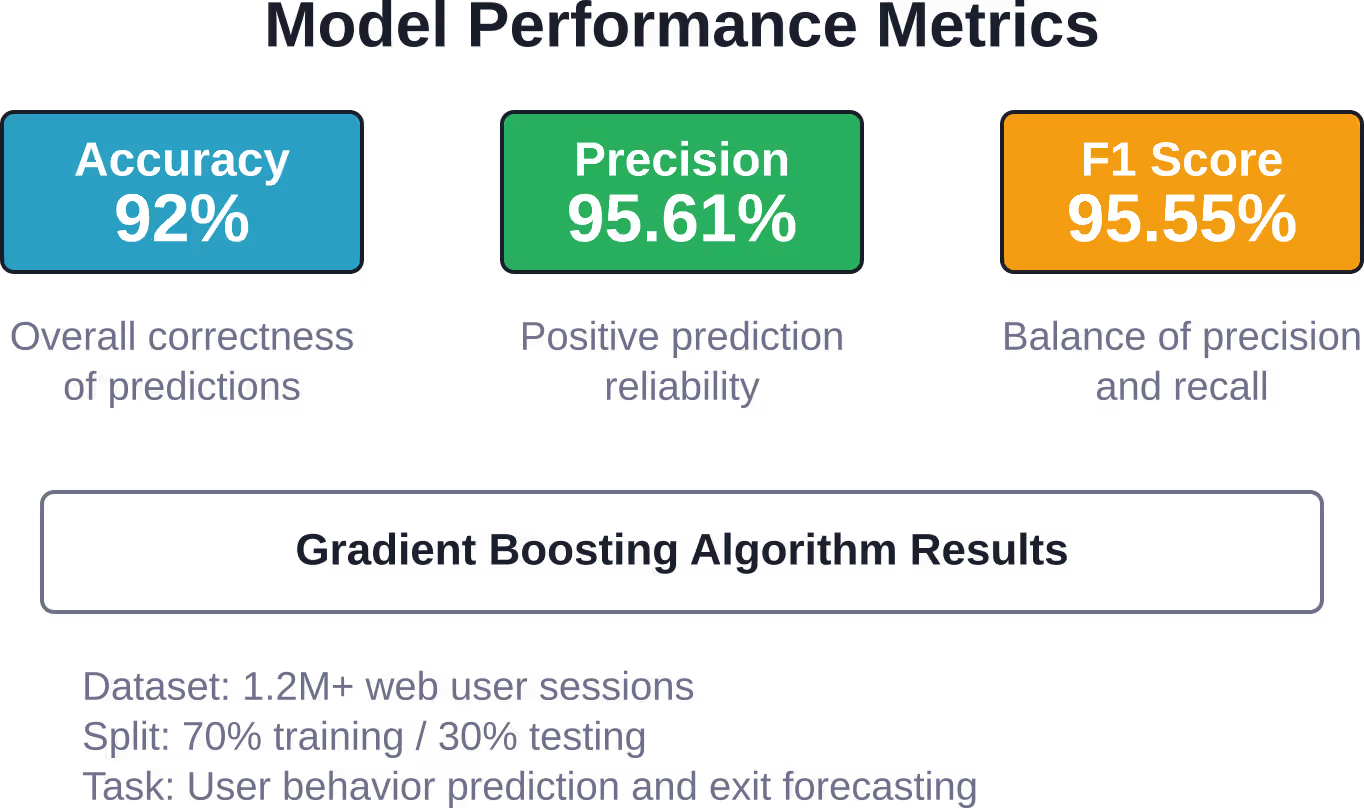
Gradient boosting builds models sequentially, with each new model correcting errors from previous ones. Research on web user behavior using gradient boosting algorithms demonstrated high performance metrics for user behavior prediction and exit forecasting.
Time Series Analysis
Data with temporal components demands specialized approaches. Time series models account for trends, seasonality, and cyclical patterns embedded in sequential data.
SARIMA (Seasonal Autoregressive Integrated Moving Average) captures both seasonal variations and longer-term trends. Methods like Holt-Winters Exponential Smoothing weight recent observations more heavily than older ones.
Modern approaches include Facebook Prophet and XGBoost, which handle multiple seasonal periods and external factors simultaneously. Recent research on AI forecasting introduced context parroting—a method that scans time-series data for similar historical patterns and uses what followed those patterns to predict future values, sometimes outperforming complex machine learning models.
Neural Networks and Deep Learning
For complex patterns in high-dimensional data, neural networks provide powerful modeling capabilities. These algorithms learn hierarchical representations, detecting subtle features humans might never explicitly define.
Deep learning excels with unstructured data—images, text, audio—but also handles structured tabular data when relationships are particularly intricate.
The tradeoff? Neural networks require substantial training data and computational resources. They also operate as “black boxes,” making interpretability challenging.
Building Predictive Models: The Process
Creating effective predictive models follows a structured sequence. Each phase builds on the previous one, and iteration happens frequently.
Data Collection and Preparation
Models are only as good as their training data. Garbage in, garbage out remains the iron law of predictive analytics.
Organizations gather historical data from multiple sources—transactional databases, web logs, sensor readings, customer interactions. Research on large-scale web portals utilized large-scale session datasets to build predictive models for user behavior.
Raw data rarely arrives ready for modeling. Preparation includes:
- Handling missing values through imputation or removal
- Detecting and addressing outliers that might skew results
- Normalizing scales across different variables
- Encoding categorical variables into numeric representations
- Creating derived features that capture domain knowledge
Standard practice splits prepared data into training and testing sets. The typical ratio allocates 70% for training and 30% for testing, ensuring models are evaluated on data they haven’t seen during development.
Feature Selection and Engineering
Not all variables contribute equally to predictions. Feature selection identifies which inputs actually matter, reducing noise and improving model performance.
Feature engineering creates new variables from existing ones. For time-based data, this might mean extracting day-of-week effects or calculating rolling averages. For text data, it could involve sentiment scores or topic classifications.
Domain expertise proves crucial here. A data scientist who understands the business context can engineer features that capture meaningful patterns algorithms might struggle to find independently.
Model Training and Tuning
With prepared data and selected features, training begins. Algorithms learn patterns by adjusting internal parameters to minimize prediction errors on the training set.
Hyperparameter tuning optimizes the model’s configuration settings—learning rates, regularization strengths, tree depths. Grid search and random search methods systematically test combinations to find optimal values.
Cross-validation provides more robust performance estimates. The training data gets split into multiple folds, with the model trained on some folds and validated on others, rotating through all combinations.
Validation and Evaluation
Performance metrics quantify how well models predict. The choice of metric depends on the problem type and business priorities.
For regression problems: Mean Absolute Error (MAE), Root Mean Squared Error (RMSE), and R-squared measure prediction accuracy.
For classification: Accuracy, precision, recall, F1 score, and area under the ROC curve assess different aspects of performance. Research demonstrated that enriched datasets enable machine learning models to achieve over 92% accuracy in prediction tasks.
The testing set—data completely held back from training—provides the final, unbiased evaluation. This simulates how the model will perform on future, unseen data.
Real-World Applications Across Industries
Predictive analytics touches virtually every sector. The specific applications vary, but the underlying goal remains consistent: better anticipation leads to better outcomes.
Financial Services
Banks and lenders use predictive models to assess credit risk, determining probability of default before extending loans. Recent comparative analysis examined machine learning algorithms for predicting default probabilities, focusing on model accuracy and interpretability tradeoffs.
Fraud detection systems flag suspicious transactions in real-time by comparing patterns against known fraudulent behavior. Insurance companies predict claim likelihood and cost to optimize pricing and reserves.
Healthcare and Life Sciences
Patient readmission predictions help hospitals allocate resources and implement preventive interventions. Disease progression models forecast how conditions will develop, informing treatment planning.
Drug discovery leverages predictive analytics to identify promising compound candidates earlier in the research process, reducing development costs and timelines.
Retail and E-Commerce
Demand forecasting optimizes inventory levels—reducing stockouts while minimizing excess inventory carrying costs. Customer lifetime value predictions identify which segments deserve increased acquisition spending.
Recommendation engines predict which products individual customers will likely purchase, personalizing the shopping experience and increasing conversion rates.
Manufacturing and Supply Chain
Predictive maintenance forecasts equipment failures before they occur, scheduling repairs during planned downtime rather than after costly breakdowns. Research from NIST explores domain-specific frameworks for predictive analytics in manufacturing environments.
Supply chain optimization predicts demand variability, transportation delays, and supplier reliability to improve planning and reduce costs.
Technology Infrastructure
Cloud resource optimization uses machine learning to predict demand patterns and scale resources accordingly, as explored in recent IEEE research on predictive resource scaling strategies. Network operations predict congestion and potential failures.
Web analytics predict user behavior patterns, session durations, and exit points. Research on cluster-specific predictive modeling addresses scalability challenges for resource-constrained Wi-Fi controllers.
Challenges and Limitations
Despite its power, predictive analytics faces real constraints. Understanding these limitations prevents overconfidence and misapplication.
Data Quality and Availability
Models trained on biased, incomplete, or inaccurate data produce flawed predictions. Historical data might not represent current conditions if business environments have shifted.
Some domains simply lack sufficient historical data for reliable modeling. New product launches or unprecedented market conditions leave algorithms without relevant training examples.
Data Drift and Model Decay
The patterns that exist today won’t necessarily persist tomorrow. IEEE research highlights data drift as a critical challenge—when underlying data distributions change, model accuracy degrades over time.
Continuous monitoring and retraining become necessary. Models aren’t “set it and forget it” solutions; they require ongoing maintenance as the world evolves.
Causation Versus Correlation
Predictive models identify correlations—variables that move together. But correlation doesn’t imply causation, and research specifically examines whether predictive models can reliably support causal inference.
A model might accurately predict an outcome without understanding the true causal mechanisms driving it. This limits the utility of predictions when interventions change the underlying system.
Interpretability and Trust
Complex models often operate as black boxes. Stakeholders may struggle to trust predictions they can’t understand or explain.
Regulatory environments increasingly demand model interpretability, particularly in high-stakes domains like healthcare and finance. Techniques like SHAP values and LIME help explain individual predictions, but tradeoffs between accuracy and interpretability persist.
Computational and Resource Requirements
Training sophisticated models demands significant computational power, specialized expertise, and time. Organizations without mature data infrastructure or skilled teams face steep implementation barriers.
Scalability challenges emerge as data volumes grow. Research on cluster-specific modeling explores solutions for resource-constrained environments, but deployment at scale remains complex.
The Evolution Toward Intelligent Systems
Predictive analytics continues evolving beyond static forecasting. The integration with artificial intelligence and autonomous systems represents the next frontier.
Agentic AI systems don’t just predict—they act on predictions autonomously. Organizations transition from “What will happen?” to “What should we do?” with automated decision-making processes.
MLOps practices standardize how models move from development to production, addressing deployment challenges and ensuring reliability at scale.
The boundary between predictive analytics and prescriptive analytics blurs as systems combine forecasts with optimization algorithms to recommend specific actions.
Getting Started With Predictive Analytics
Organizations new to predictive analytics should start focused rather than boiling the ocean.
Identify a specific, high-value use case with clear success metrics. Customer churn prediction, demand forecasting for key products, or equipment failure prediction often serve as strong initial projects.
Assess data readiness. Do historical records exist in accessible formats? Is the data sufficiently clean and complete? Can it be integrated across systems?
Start simple. Basic regression models or decision trees often deliver substantial value before investing in complex deep learning architectures. Build confidence and capability incrementally.
Invest in skills and tools. Whether through hiring, training, or partnerships, the combination of domain expertise, statistical knowledge, and programming capabilities proves essential.
Establish feedback loops. Track prediction accuracy against actual outcomes, creating mechanisms for continuous model improvement.
Frequently Asked Questions
What’s the difference between predictive analytics and machine learning?
Machine learning provides the algorithms and techniques—the “how”—while predictive analytics represents the broader practice and application—the “what” and “why.” Predictive analytics uses machine learning (along with statistics and domain knowledge) to forecast future outcomes. Think of machine learning as one critical toolset within the larger discipline of predictive analytics.
How much historical data is needed for predictive modeling?
The amount varies by problem complexity and technique. Simple linear regression might work with dozens of examples, while deep neural networks often require thousands or millions. As a general guideline, aim for at least 10 times as many observations as input variables for traditional statistical methods. More complex patterns demand more data. Data quality matters more than quantity—clean, relevant data beats vast amounts of noisy information.
Can predictive models guarantee future outcomes?
No. Predictive models estimate probabilities and likelihoods, not certainties. They quantify what’s probable based on historical patterns, but unexpected events, changing conditions, and inherent randomness mean predictions remain probabilistic. The goal is better-informed decisions, not perfect foresight. Models should include confidence intervals or probability distributions that acknowledge this uncertainty.
What causes predictive model accuracy to decline over time?
Data drift represents the primary culprit. When the relationships between variables change, or when the distribution of input data shifts, models trained on historical patterns lose relevance. Business conditions evolve, customer behavior changes, competitive dynamics shift, and external factors emerge. Regular monitoring, retraining on recent data, and updating features help maintain accuracy as the world changes.
How do I choose between different predictive modeling techniques?
Consider problem type (regression vs. classification), data characteristics (size, dimensionality, linearity), interpretability requirements, and computational constraints. Start simple—linear regression or decision trees—before progressing to complex methods. If simple models perform adequately, the added complexity of neural networks might not justify the cost. When accuracy matters more than interpretability and sufficient data exists, advanced techniques become worthwhile. Testing multiple approaches and comparing validation performance guides the best choice.
What industries benefit most from predictive analytics?
Any industry with historical data and decisions influenced by future uncertainty benefits. Finance, healthcare, retail, manufacturing, telecommunications, and energy sectors show particularly high adoption. The common thread is abundant data and high-value use cases where improved forecasting delivers measurable business impact. Small improvements in prediction accuracy can translate to millions in revenue or cost savings.
Is predictive analytics only for large organizations?
Not at all. While large enterprises often have more data and resources, smaller organizations can implement predictive analytics effectively. Cloud platforms and open-source tools have dramatically lowered barriers to entry. Starting with focused use cases, leveraging external data sources, and partnering with specialists makes predictive analytics accessible regardless of organization size. The key is aligning investment with realistic value potential.
Conclusion: From Insight to Foresight
Predictive analytics transforms how organizations operate by shifting focus from reactive responses to proactive strategies. The combination of statistical rigor, machine learning algorithms, and domain expertise creates forecasting capabilities that were unimaginable a generation ago.
But technology alone doesn’t deliver value. Successful implementation requires quality data, appropriate techniques matched to problems, continuous refinement as conditions change, and integration into decision-making processes where predictions actually influence actions.
The field continues advancing rapidly. New algorithms, increased computational power, richer data sources, and improved integration with autonomous systems expand what’s possible. Organizations that build predictive analytics capabilities position themselves to anticipate rather than just respond.
Ready to implement predictive analytics in your organization? Start by identifying one high-value use case, assessing your data readiness, and building the skills needed to turn historical patterns into future insights.
 English
  German
  Arabic
  French
  Dutch
Dutch  Spanish