
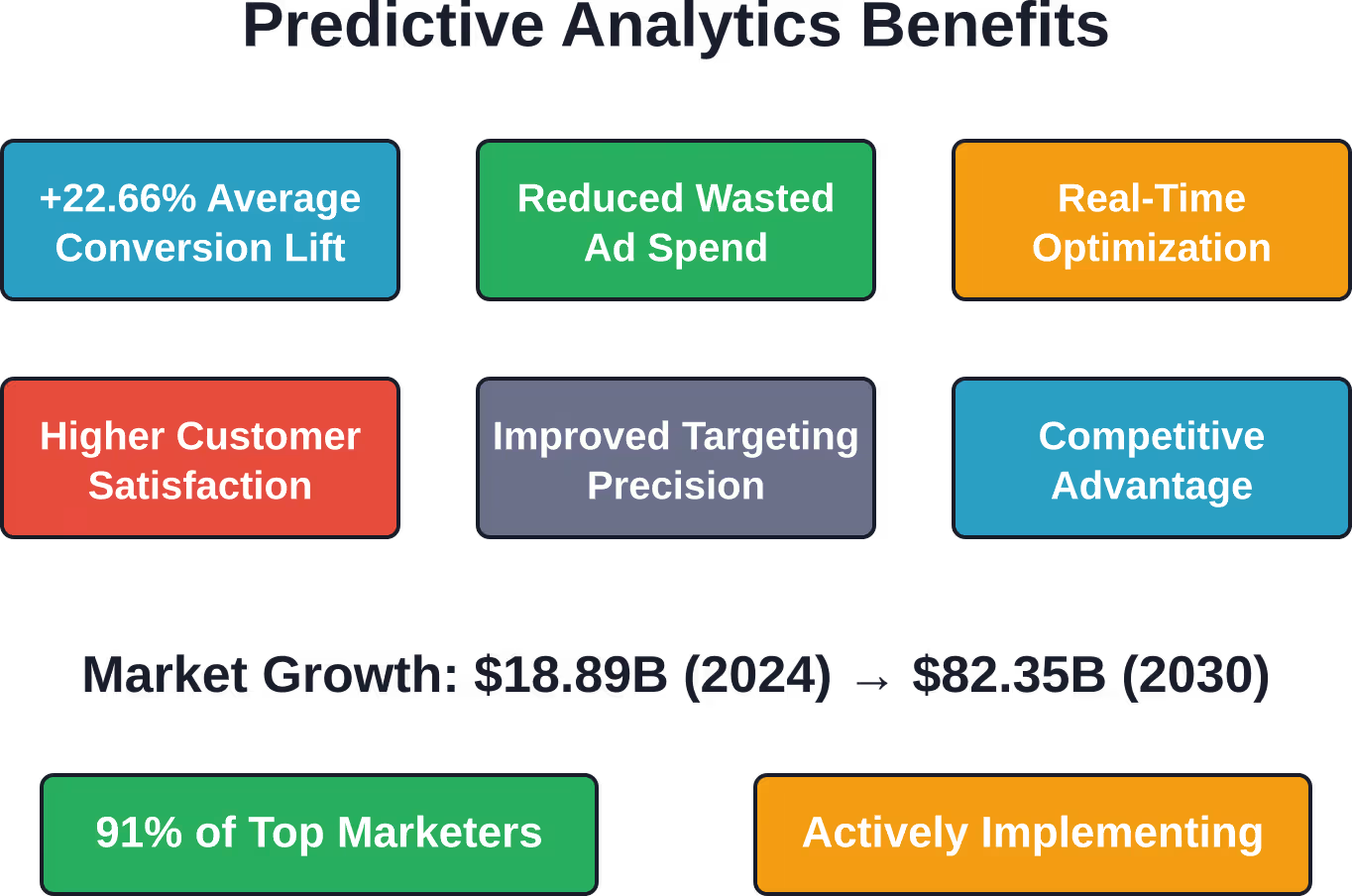
Quick Summary: Predictive analytics in advertising uses AI, machine learning, and statistical modeling to forecast customer behavior, campaign performance, and market trends before they happen. By analyzing historical data patterns, advertisers can optimize targeting, personalize content, reduce wasted spend, and achieve conversion lifts averaging 22.66% on influenced sessions. As of 2024, the global predictive analytics market reached $18.89 billion and is projected to grow to $82.35 billion by 2030, with 91% of top marketers already implementing predictive strategies.
Advertising used to be a rearview-mirror exercise. Run a campaign, wait weeks for results, then adjust. That approach doesn’t cut it anymore.
Between volatile consumer demand, stricter privacy regulations, and fragmented media journeys, advertisers need to make decisions with incomplete signals—and still defend every dollar spent. That’s where predictive analytics comes in.
Real talk: predictive analytics isn’t about crystal balls or guesswork. It’s about using confirmed relationships between data variables to forecast future outcomes with measurable accuracy. The technology combines data mining, artificial intelligence, and statistical modeling to identify patterns in historical behavior—then applies those patterns to predict what happens next.
And marketers are going all-in. According to industry data, 91% of top marketers are either fully committed to or already implementing predictive marketing strategies. The global predictive analytics market value reached $18.89 billion in 2024 and is expected to grow to $82.35 billion by 2030, driven largely by advertising and marketing applications.
The payoff is measurable. Sessions influenced by predictive intelligence show an average conversion rate lift of 22.66%. Online advertising already accounted for 64.4% of all total advertising in 2021 and continues to grow each year, with predictive capabilities becoming table stakes for competitive performance.
What Is Predictive Analytics in Advertising?
Predictive analytics in advertising—often called predictive marketing—uses historical data, machine learning algorithms, and statistical techniques to forecast customer behavior, campaign outcomes, and market trends before they materialize.
Here’s the thing though—data mining and predictive analytics are related but distinct. Data mining identifies and confirms relationships between variables: “customers who view three product pages are 40% more likely to purchase.” Predictive analytics takes those confirmed relationships and uses them to predict specific future events: “this visitor will likely convert within 48 hours.”
The predictions typically suggest the likelihood a particular behavior or event will occur. Will this prospect click? Convert? Churn? What price point maximizes both conversion and margin? Which creative variant will resonate with this segment?
According to academic research from Kennesaw State University, predictive analytics has become fundamental to knowledge creation in marketing. The technology helps convert raw information into actionable knowledge—and whether focused on product development, advertising, distribution, retailing, or marketing research, predictive methods are increasingly being applied.

Use Predictive Analytics in Advertising with AI Superior
AI Superior works with campaign and customer data to build predictive models for targeting, forecasting, and performance analysis. The focus is on integrating models into existing marketing systems so outputs can be used in day-to-day decisions.
Looking to Apply Predictive Analytics in Advertising?
AI Superior can help with:
- evaluating campaign and audience data
- building predictive models
- integrating models into existing systems
- refining performance based on results
👉 Contact AI Superior to discuss your project, data, and implementation approach.
How Predictive Analytics Works in Advertising Campaigns
The predictive process follows a consistent pattern across advertising use cases.
- First, data collection. Advertisers aggregate information from multiple sources: website behavior, CRM systems, transaction histories, ad engagement metrics, social media interactions, and third-party demographic data. The richer and cleaner the dataset, the more accurate the predictions.
- Next, pattern recognition. Machine learning algorithms analyze historical data to identify correlations and causal relationships. Which combinations of behaviors, attributes, and contexts historically led to conversions? To churn? To high lifetime value?
- Then, model building. Statistical models codify these relationships into predictive frameworks. Common techniques include regression analysis, decision trees, neural networks, and ensemble methods that combine multiple algorithms for stronger predictions.
- Finally, application. The models generate real-time predictions that feed directly into advertising systems—adjusting bids, personalizing creative, segmenting audiences, or triggering automated campaigns based on predicted likelihood of desired outcomes.
The site can collect data on a customer as soon as they click on something, gather data as it’s given, and make recommendations in real time, leading to measurably increased conversions.
Key Use Cases for Predictive Analytics in Advertising
Predictive analytics reshapes nearly every dimension of advertising strategy. Here are the applications delivering measurable impact.
Audience Targeting and Segmentation
Predictive models score prospects based on their likelihood to convert, engage, or deliver high lifetime value. Instead of broad demographic targeting, advertisers can focus budget on individuals the model identifies as high-probability converters.
This precision reduces wasted impressions and improves ROAS. Segmentation becomes dynamic—updating in real time as new behavioral signals arrive.
Campaign Performance Forecasting
Brands can’t afford to treat performance like a rearview-mirror exercise anymore. Predictive analytics forecasts campaign outcomes before launch, simulating different creative variants, budget allocations, and channel mixes to identify optimal configurations.
Between volatile demand, shifting privacy constraints, and fragmented media journeys, advertisers need to make decisions with incomplete signals and still defend every dollar. Forecasting helps mitigate risk and allocate resources where they’ll deliver the strongest return.
Personalized Content and Product Recommendations
Predictive engines power recommendation systems that serve personalized content, products, or offers based on predicted affinity. These aren’t generic “customers also bought” lists—they’re individualized predictions grounded in each user’s specific behavior patterns and context.
For example, Philips used AI-powered product recommendations to improve mobile conversion rates by 40.1% and generate over €20,000 of incremental revenue. Plus, these recommendations aren’t limited to e-commerce—they apply across email campaigns, landing pages, and dynamic ad creative.
Churn Prediction and Retention Campaigns
Predictive models identify customers at high risk of churning before they disengage. Early-warning signals—reduced login frequency, declining engagement, support tickets—trigger automated retention campaigns with personalized incentives.
It’s far cheaper to retain an existing customer than acquire a new one. Predictive churn models help brands intervene at the right moment with the right message.
Dynamic Pricing and Promotion Optimization
Predictive analytics determines optimal price points and discount levels by forecasting customer price sensitivity and purchase likelihood at different thresholds. The technology helps marketing specialists establish the optimal size of the price cut and promotion type and timing, thereby lowering marketing spend and improving sales.
Dynamic pricing adjusts in real time based on inventory levels, competitive positioning, and predicted demand elasticity.
Ad Budget Allocation and Bid Optimization
Predictive models guide budget distribution across channels, campaigns, and tactics based on forecasted ROI. In programmatic advertising, algorithms adjust bids in real time, paying more for impressions predicted to convert and reducing spend on low-probability inventory.
This continuous optimization maximizes efficiency and prevents budget from flowing to underperforming placements.
Benefits of Predictive Analytics for Advertisers
The advantages extend well beyond theoretical efficiency gains. Advertisers implementing predictive strategies report concrete performance improvements.
Higher Conversion Rates
By focusing efforts on high-probability prospects and personalizing messaging to predicted preferences, predictive analytics consistently drives conversion rate improvements. The average lift in conversion rate for sessions influenced by predictive intelligence is 22.66%—a meaningful gain that compounds across thousands or millions of sessions.
Improved Customer Satisfaction and Engagement
Personalization grounded in accurate predictions feels helpful rather than intrusive. Customers receive relevant recommendations, timely offers, and content that matches their actual interests. This relevance drives higher engagement metrics and strengthens brand perception.
Optimal Budget Allocation and Reduced Waste
Predictive models identify which channels, tactics, and segments deliver the strongest returns, enabling marketers to shift budget away from underperformers. This reduces wasted spend on low-converting audiences and maximizes efficiency of every advertising dollar.
Faster, Data-Driven Decision Making
Real-time predictions eliminate guesswork and reduce reliance on intuition. Marketers make decisions grounded in statistical forecasts rather than assumptions. Speed improves too—automated systems act on predictions instantly rather than waiting for manual analysis.
Competitive Advantage Through Knowledge Creation
According to research from Kennesaw State University, survival in a knowledge-based economy is derived from the ability to convert information to knowledge. Predictive analytics transforms raw data into actionable intelligence, giving organizations that master the discipline a durable competitive edge.
The Role of AI and Machine Learning in Predictive Advertising
Artificial intelligence isn’t just a buzzword in predictive analytics—it’s the engine driving the discipline forward. Machine learning algorithms identify non-linear relationships and interaction effects that traditional statistical methods might miss.
Academic research examining AI’s role in marketing transformation highlights AI’s ability to enhance decision-making and consumer engagement through extraction of valuable insights from complex data. These insights wouldn’t be accessible through manual analysis.
Deep learning models, a subset of machine learning, excel at processing unstructured data—images, video, text, audio. This allows predictive systems to analyze creative content itself, forecasting which visual elements, messaging, and formats will resonate with specific audiences.
Natural language processing (NLP) enables sentiment analysis and intent prediction from customer communications, social media posts, and reviews. These signals feed into broader predictive models that forecast behavior and guide campaign strategy.
But here’s the catch: correlation doesn’t equal causation. AI models can identify patterns that are merely coincidental rather than causal. That’s why rigorous testing—holdout groups, geo-split tests, public service announcement (PSA) controls—remains critical to validate that optimizations are driving true lift rather than just selecting likely converters.
Essential Data Sources for Predictive Analytics
Predictive accuracy depends on data quality and breadth. The strongest models integrate multiple sources:
First-Party Behavioral Data
Website interactions, app usage, purchase history, email engagement, CRM records. This proprietary data provides the foundation—it’s accurate, consented, and directly relevant to business outcomes.
Transaction and Conversion Data
Order values, product categories, purchase frequency, cart abandonment events. Transactional data reveals what customers actually do, not just what they say or browse.
Demographic and Firmographic Attributes
Age, location, income, company size, industry. These attributes help segment audiences and identify cohorts with similar predicted behaviors.
Third-Party Enrichment Data
Data providers offer additional context—intent signals, technographic data, competitive intelligence. Quality varies widely, and privacy regulations increasingly restrict use, but enrichment data can fill gaps in first-party datasets.
Social and Sentiment Data
Social media activity, reviews, community discussions, brand mentions. Sentiment analysis and social listening reveal attitudes and emerging trends that predict future behavior.
Look, more data doesn’t always mean better predictions. Noisy, inaccurate, or irrelevant data degrades model performance. Focus on high-quality, consented, and legally compliant data sources rather than maximizing volume.
Challenges in Implementing Predictive Analytics
Despite compelling benefits, organizations face real obstacles when deploying predictive capabilities.
Data Quality and Integration Issues
Predictive models are only as good as the data they’re trained on. Incomplete records, duplicate entries, inconsistent formatting, and siloed systems undermine accuracy. Data integration—combining CRM, web analytics, ad platforms, and transaction systems—requires significant technical effort.
Privacy Regulations and Consent Management
Regulations like GDPR, CCPA, and emerging state laws restrict what data can be collected, how it’s used, and how long it’s retained. Predictive models must respect user consent and deletion requests. As privacy constraints tighten, models need to deliver predictions with less granular data.
Correlation vs. Causation
Machine learning excels at finding patterns, but not all patterns are causal. A model might identify that high-intent users engage with certain content—but showing that content to low-intent users won’t necessarily convert them. Run incrementality tests like holdout groups, geo splits, or PSA controls to validate that optimizations drive true lift.
Model Accuracy and Ongoing Maintenance
Markets shift. Consumer preferences evolve. Models trained on historical data can degrade as conditions change. Continuous monitoring, retraining, and validation are essential to maintain accuracy. This requires dedicated data science resources and infrastructure.
Skills Gap and Resource Requirements
Many organizations lack the in-house expertise to build, deploy, and maintain predictive systems. Hiring qualified data scientists is competitive and expensive.
| Challenge | Impact | Solution Approach |
|---|---|---|
| Data quality issues | Inaccurate predictions, poor ROI | Implement data governance, validation rules, and cleansing processes |
| Privacy compliance | Legal risk, limited data availability | Build consent management, anonymization, and compliant data practices |
| Correlation vs. causation | Optimizing to wrong signals, wasted spend | Run incrementality tests (holdouts, geo splits, PSA controls) to validate lift |
| Model drift | Declining accuracy over time | Continuous monitoring, retraining schedules, and A/B testing |
| Skills shortage | Slow deployment, dependency on vendors | Invest in training, partner with specialists, or adopt managed platforms |
Overcoming Predictive Analytics Challenges
Smart organizations approach these obstacles systematically.
Start with data infrastructure. Invest in clean, integrated, well-governed data before building complex models. A simple model on high-quality data outperforms a sophisticated model on messy data.
Build privacy and compliance into the foundation. Design systems that respect user consent, enable deletion requests, and minimize data retention. Privacy-preserving techniques like differential privacy and federated learning allow predictive analytics within regulatory constraints.
Test rigorously. Don’t assume a correlation is causal. Use holdout groups, randomized controlled trials, and geo-split experiments to validate that optimizations drive incremental lift, not just select high-probability converters.
Monitor and retrain continuously. Set up automated alerts when model performance degrades. Establish retraining schedules and processes to keep predictions accurate as market conditions evolve.
Develop talent or partner strategically. If in-house expertise is limited, consider managed predictive platforms, consulting partnerships, or phased internal training programs. Future applications will be global and real time, so building capability is a long-term investment.
Real-World Examples and Case Studies
Predictive analytics delivers tangible results across industries.
- Philips deployed AI-powered product recommendations driven by predictive models. The system analyzed browsing behavior, purchase history, and contextual signals to forecast which products each visitor was most likely to buy. Mobile conversion rates improved by 40.1%, and the company generated over €20,000 of incremental revenue directly attributable to predictive recommendations.
- E-commerce platforms routinely use predictive segmentation to identify high-lifetime-value prospects. Instead of treating all visitors equally, ad budgets concentrate on users the model predicts will deliver strong long-term returns. This approach reduces customer acquisition cost while improving cohort quality.
- Email marketing campaigns leverage predictive send-time optimization, forecasting when each individual is most likely to open and engage. Rather than blasting messages at a fixed time, the system personalizes delivery based on predicted behavior patterns. Open rates and click-through rates improve measurably.
- Subscription services use churn prediction models to trigger retention campaigns before customers cancel. Early intervention—personalized offers, proactive support, feature recommendations—reduces churn rates and extends customer lifetime value.
The Future of Predictive Analytics in Advertising
Where is the field headed? Several trends are reshaping predictive capabilities.
Mixed-Data Models: Structured and Unstructured Analysis
According to Kennesaw State University research, data analysts will increasingly rely on mixed-data models that examine both structured data (numbers) and unstructured data (text and images). This integration allows predictive systems to analyze creative content, sentiment, visual elements, and contextual signals alongside traditional metrics.
Global and Real-Time Applications
Future applications will be global and real time. Predictive models will operate across regions, languages, and currencies, adjusting for local market conditions and cultural contexts. Real-time inference will enable split-second decisions at massive scale—billions of predictions per day across global ad inventory.
More Powerful, Easier-to-Use Tools
Statistical tools will be more powerful and easier to use. No-code and low-code platforms are democratizing access to predictive analytics, allowing marketers without data science backgrounds to build and deploy models. AutoML systems automate feature engineering, algorithm selection, and hyperparameter tuning.
Increased Focus on Incrementality and Causality
As the industry matures, distinguishing correlation from causation becomes critical. Expect greater emphasis on causal inference techniques, incrementality measurement, and experimental design to ensure predictive optimizations drive true lift rather than selection bias.
Privacy-Preserving Predictive Methods
Privacy regulations will continue tightening. Federated learning, differential privacy, and on-device machine learning allow predictive analytics without centralizing sensitive user data. These techniques will become standard practice as both regulation and consumer expectations demand stronger privacy protections.
Expert Concerns and Opportunities
A 2023 Pew Research Center survey asked experts to assess expected digital changes by 2035. According to the survey, 42% of experts indicated they are equally excited and concerned, 37% were more concerned than excited about digital technology trends.
Concerns center on algorithmic bias, manipulation, misinformation amplification, and erosion of privacy. But experts also expect great benefits in health care, scientific advances, and education as AI and predictive analytics mature.
The challenge for advertisers? Leverage predictive capabilities responsibly—maximizing performance while respecting privacy, avoiding manipulation, and maintaining consumer trust.
Getting Started With Predictive Analytics
Organizations ready to implement predictive capabilities should follow a phased approach.
- Phase 1: Assess data readiness. Audit existing data sources, quality, and integration. Identify gaps and prioritize improvements. Clean, integrated first-party data is the foundation.
- Phase 2: Define clear use cases. Start with high-impact, well-defined problems: churn prediction, conversion forecasting, audience segmentation, or recommendation engines. Avoid trying to predict everything at once.
- Phase 3: Choose appropriate tools. Evaluate whether to build custom models in-house, adopt managed platforms, or partner with specialists. Consider technical complexity, resource availability, and speed-to-value.
- Phase 4: Pilot and validate. Launch small-scale pilots with rigorous measurement. Use holdout groups and A/B tests to validate incremental impact. Prove ROI before scaling.
- Phase 5: Scale and optimize. Expand successful pilots across channels, campaigns, and markets. Establish monitoring, retraining, and governance processes for sustained performance.
- Phase 6: Build capability. Invest in training, hire specialists, and develop internal expertise. Predictive analytics is an ongoing capability, not a one-time project.
Predictive Analytics Platforms and Tools
The market offers diverse solutions across the spectrum from DIY to fully managed.
Enterprise marketing clouds from major vendors integrate predictive features into broader suites—audience scoring, send-time optimization, next-best-action recommendations. These platforms offer convenience but may lack flexibility for custom use cases.
Specialized predictive marketing platforms focus exclusively on forecasting and optimization. They typically offer more sophisticated algorithms and deeper customization than general-purpose marketing clouds.
Open-source frameworks like TensorFlow, PyTorch, and scikit-learn provide maximum flexibility for organizations with strong data science teams. Custom models can be tailored precisely to unique business logic and data structures—but require significant technical expertise.
Customer data platforms (CDPs) increasingly incorporate predictive capabilities, using unified customer profiles to generate scores, forecasts, and recommendations that flow to downstream activation channels.
Check official documentation and vendor websites for current feature availability and pricing—capabilities and plans evolve rapidly.
Measuring Success: KPIs for Predictive Analytics
Track metrics that directly connect predictions to business outcomes.
- Model accuracy: Precision, recall, F1 score, AUC-ROC. These technical metrics assess how well predictions match actual outcomes. But high accuracy alone doesn’t guarantee business value.
- Incremental lift: The performance gain attributable to predictive optimization versus a control group. This is the gold standard—did predictions drive measurably better results than baseline?
- Conversion rate improvement: Sessions influenced by predictive intelligence show an average conversion lift of 22.66%. Track this metric for your specific implementation.
- Return on ad spend (ROAS): Does predictive targeting and optimization improve advertising efficiency? Compare ROAS for predictive-optimized campaigns versus traditional approaches.
- Customer lifetime value (CLV): Predictive segmentation should improve cohort quality, attracting customers who deliver higher long-term value.
- Cost per acquisition (CPA): Precision targeting reduces wasted impressions and should lower the cost to acquire each customer or conversion.
- Churn rate reduction: For retention use cases, measure whether predictive interventions reduce churn among at-risk segments.
Frequently Asked Questions
What is predictive analytics in advertising?
Predictive analytics in advertising uses historical data, machine learning, and statistical modeling to forecast customer behavior, campaign performance, and market trends before they occur. It identifies patterns in past data and applies those patterns to predict future outcomes like conversions, engagement, or churn, enabling advertisers to optimize targeting, personalization, and budget allocation.
How accurate are predictive analytics models?
Accuracy varies based on data quality, model sophistication, and use case complexity. Well-built models on clean data typically achieve 70-90% accuracy for binary predictions like conversion likelihood. However, accuracy alone doesn’t guarantee value—models must drive incremental lift versus baseline performance. Rigorous testing through holdout groups and A/B experiments validates whether predictions translate to measurable business outcomes.
What’s the difference between predictive analytics and traditional analytics?
Traditional analytics looks backward, describing what happened: “conversion rate was 3.2% last month.” Predictive analytics looks forward, forecasting what will happen: “this visitor has a 68% probability of converting in the next 48 hours.” Traditional analytics informs understanding; predictive analytics drives proactive decisions and real-time optimizations based on forecasted outcomes.
Do I need a data science team to implement predictive analytics?
Not necessarily. Managed predictive platforms and no-code tools allow marketers without technical backgrounds to deploy predictive capabilities. However, custom implementations, advanced use cases, and ongoing optimization benefit significantly from data science expertise. Many organizations start with managed solutions and build internal capability over time as they scale predictive applications.
How does predictive analytics handle privacy regulations?
Compliant predictive systems respect user consent, honor deletion requests, minimize data retention, and implement privacy-preserving techniques like anonymization and aggregation. Advanced methods like federated learning and differential privacy enable predictions without centralizing sensitive user data. Organizations must design predictive workflows within regulatory frameworks like GDPR and CCPA from the outset—retrofitting compliance is far harder than building it in.
What ROI can I expect from predictive analytics?
ROI depends on use case, implementation quality, and baseline performance. Sessions influenced by predictive intelligence show an average conversion rate lift of 22.66%. Organizations report reduced customer acquisition costs, improved ROAS, higher customer lifetime value, and lower churn rates. Philips achieved a 40.1% mobile conversion rate improvement and over €20,000 in incremental revenue from predictive product recommendations. Start with pilot projects that prove incremental value before scaling investment.
What are the biggest challenges in predictive analytics?
The most common obstacles include data quality issues (incomplete, inconsistent, or siloed data), privacy compliance requirements, distinguishing correlation from causation, model drift as market conditions change, and skills shortages for building and maintaining predictive systems. Successful implementations address data infrastructure and governance first, test rigorously for incrementality, monitor continuously for accuracy degradation, and invest in talent development or strategic partnerships.
Conclusion
Predictive analytics has moved from experimental edge to competitive necessity in advertising. The global market reached $18.89 billion in 2024 and is projected to hit $82.35 billion by 2030. That growth reflects genuine business value—conversion lifts averaging 22.66%, reduced wasted spend, improved targeting precision, and measurable ROI gains.
But here’s the reality: predictive capabilities alone won’t guarantee success. Data quality, rigorous testing, privacy compliance, continuous monitoring, and skilled talent all matter just as much as the algorithms themselves. Organizations that treat predictive analytics as a holistic discipline—not just a technology purchase—will capture the strongest returns.
The future belongs to advertisers who can convert information to knowledge faster and more accurately than competitors. Mixed-data models analyzing both structured and unstructured information, real-time global applications, and privacy-preserving techniques will define the next generation of predictive advertising.
Start now. Assess data readiness, define clear use cases, pilot rigorously, prove incrementality, and scale what works. The competitive advantage goes to those who act while others wait.
Ready to implement predictive analytics in your advertising strategy? Begin with a data audit, identify your highest-impact use case, and choose the right platform or partner to get started. The market is moving fast—and 91% of top marketers are already implementing predictive approaches.
 English
  German
  Arabic
  French
  Dutch
Dutch  Spanish