
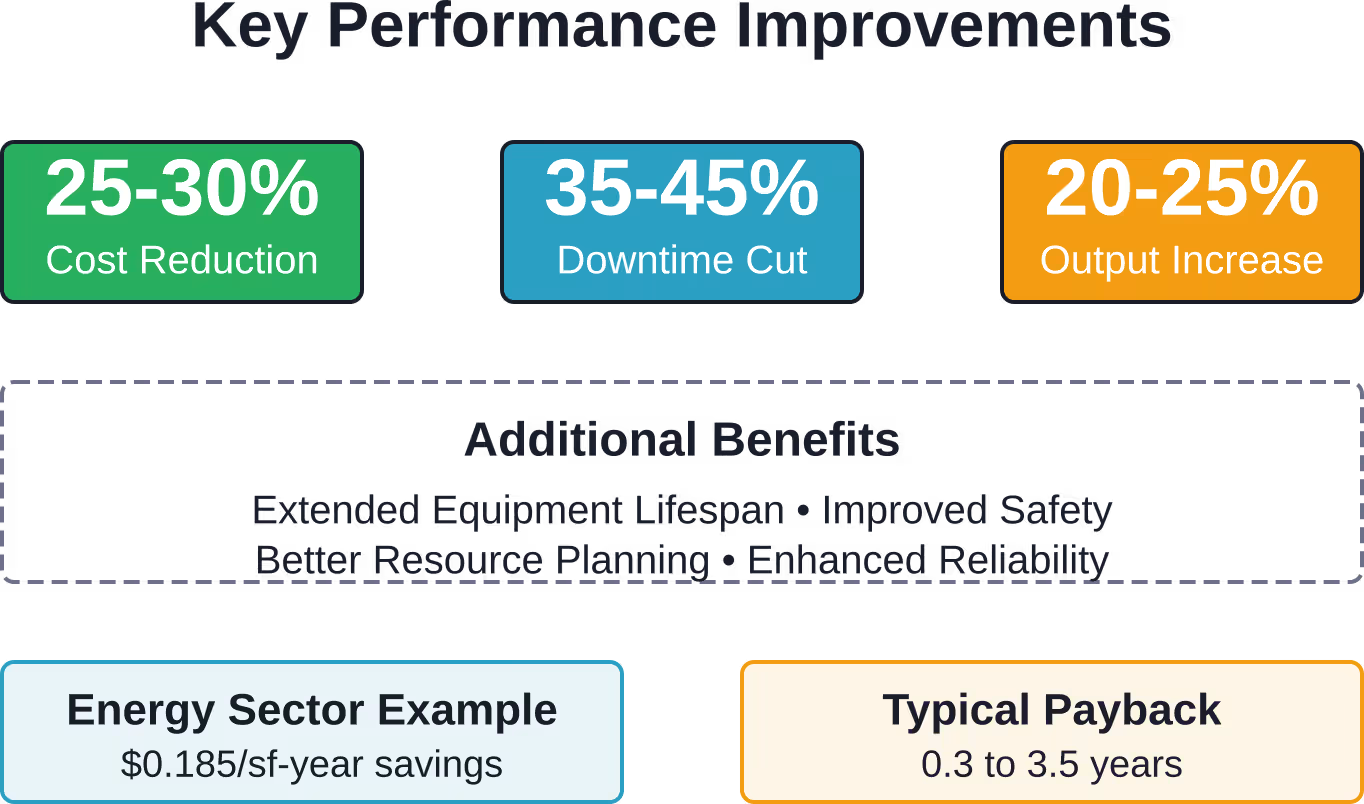
Quick Summary: Predictive analytics in maintenance uses real-time data, machine learning, and sensor technology to forecast equipment failures before they occur, enabling organizations to schedule maintenance proactively. This approach delivers measurable benefits including a 25% to 30% reduction in maintenance costs, 35% to 45% reduction in downtime, and 20% to 25% increase in production output compared to traditional reactive methods.
Equipment failure doesn’t announce itself politely. It shows up at the worst possible moment, halts production lines, and drains budgets faster than almost any other operational risk.
Traditional maintenance strategies—fix it when it breaks, or service everything on a rigid schedule—leave money on the table. Predictive analytics in maintenance changes that equation entirely.
By continuously monitoring asset health through sensors and applying advanced analytical techniques like machine learning, organizations can forecast failures weeks or months in advance. The results speak for themselves: maintenance costs drop by 25% to 30%, downtime decreases by 35% to 45%, and production increases by 20% to 25%.
This guide breaks down how predictive maintenance analytics actually works, where it delivers the strongest ROI, and what implementation really looks like in 2026.
What Is Predictive Analytics in Maintenance?
Predictive analytics in maintenance builds on condition-based monitoring to optimize equipment performance and lifespan by continually assessing asset health in real time. Instead of waiting for failure or adhering to fixed schedules, maintenance teams receive data-driven alerts that pinpoint exactly when intervention is needed.
The approach relies on three core components working together.
First, sensors collect continuous streams of data from equipment—vibration levels, temperature fluctuations, pressure readings, acoustic signatures, oil quality metrics, and dozens of other parameters depending on the asset type.
Second, machine learning algorithms analyze these data streams to establish baseline normal behavior patterns. The models detect deviations that signal degradation or impending failure, often identifying issues invisible to human operators or traditional monitoring systems.
Third, predictive models generate actionable maintenance recommendations with specific time windows. Rather than vague warnings, teams receive precise guidance: “Bearing replacement needed within 14-21 days” or “Gearbox oil change required before next 40 operating hours.”
This differs fundamentally from preventive maintenance, which services equipment at predetermined intervals regardless of actual condition. It also surpasses reactive maintenance, which only addresses problems after failure occurs.
The Evolution From Reactive to Predictive
Maintenance strategies have progressed through distinct phases over the past several decades.
Reactive maintenance dominated industrial operations for generations. Fix things when they break. Simple to understand, expensive to operate, and devastating when critical assets fail unexpectedly.
Preventive maintenance introduced scheduled servicing based on time intervals or usage metrics. Change the oil every 3,000 hours. Replace filters monthly. This reduced unexpected failures but led to over-maintenance—replacing components with plenty of useful life remaining.
Condition-based monitoring added sensors and periodic inspections to check asset health. Maintenance happens when measurements cross thresholds, not on arbitrary schedules. Better than preventive approaches, but still reactive in nature.
Predictive analytics represents the current frontier. Machine learning models don’t just monitor current conditions—they forecast future states. The system learns what degradation patterns precede specific failure modes and provides advance warning.
| Approach | Timing | Cost Efficiency | Downtime Risk |
|---|---|---|---|
| Reactive | After failure | Lowest efficiency | Highest risk |
| Preventive | Fixed schedules | Moderate efficiency | Moderate risk |
| Condition-Based | Threshold-triggered | Good efficiency | Low risk |
| Predictive Analytics | Forecast-driven | Highest efficiency | Lowest risk |

Apply Predictive Analytics in Maintenance with AI Superior
AI Superior builds predictive models using equipment and sensor data to support maintenance planning and failure prediction. They focus on models that connect to existing systems and support ongoing operations.
Looking to Use Predictive Analytics in Maintenance?
AI Superior can help with:
- evaluating equipment and sensor data
- building predictive models
- integrating models into existing systems
- improving results based on usage
👉 Contact AI Superior to discuss your project, data, and implementation approach.
How Predictive Maintenance Analytics Actually Works
The technical foundation of predictive analytics combines hardware, software, and data science in an integrated workflow.
Data Collection and Integration
Sensors installed on critical equipment continuously stream operational data to centralized systems. Industrial IoT (IIoT) technologies enable this massive data collection effort, with devices measuring everything from motor current draw to bearing vibration frequencies.
Data flows from sensors through edge computing devices that perform initial processing, then moves to cloud or on-premises analytics platforms. Modern systems integrate data from multiple sources: SCADA systems, enterprise asset management software, maintenance logs, environmental sensors, and production scheduling tools.
The volume can be substantial. A single manufacturing facility might collect millions of data points daily across hundreds of assets.
Machine Learning Model Development
Machine learning algorithms form the analytical core of predictive maintenance systems. Several approaches prove effective depending on the use case.
Supervised learning models train on historical data where failure events are labeled. The algorithm learns which parameter combinations and trends preceded past failures, then applies that knowledge to identify similar patterns in real-time data.
Unsupervised learning detects anomalies by establishing normal operational baselines. When current behavior deviates significantly from expected patterns, the system flags potential issues even for failure modes not seen in training data.
Deep learning neural networks excel at finding complex, non-linear relationships in high-dimensional sensor data. These models can identify subtle degradation patterns that simpler algorithms miss.
Time series forecasting predicts future equipment states based on historical trends. Instead of just detecting current problems, these models project how conditions will evolve over coming weeks or months.
Remaining Useful Life Estimation
One of the most valuable outputs from predictive analytics is remaining useful life (RUL) estimation. Rather than binary predictions—this will fail or won’t fail—RUL models provide time horizons.
An RUL model might indicate a pump bearing has 400-500 operating hours remaining before replacement becomes necessary. This enables maintenance teams to schedule interventions during planned downtime windows rather than scrambling for emergency repairs.
The accuracy of RUL predictions depends heavily on training data quality and quantity. Systems improve over time as they accumulate more failure examples and refine their understanding of degradation patterns.
Measurable Benefits of Predictive Maintenance Analytics
The financial and operational case for predictive analytics is compelling when implementation is done properly.
Cost Reduction
Organizations implementing predictive maintenance analytics typically achieve a 25% to 30% reduction in maintenance costs compared to preventive or reactive approaches. These savings come from multiple sources.
Unnecessary maintenance disappears. Instead of replacing components on fixed schedules, teams only service equipment when data indicates actual need. This extends component lifespan and reduces parts consumption.
Emergency repair costs plummet. Unplanned failures often require overtime labor, expedited parts shipping, and production interruption costs. Predictive systems identify issues early enough to handle them during normal working hours with standard parts procurement.
Labor productivity increases by 20% according to data corroborated across multiple industry sources. Technicians spend less time on routine inspections and more time on value-adding activities. Maintenance schedules optimize around production demands rather than arbitrary calendars.
Downtime Elimination
Downtime represents one of the largest hidden costs in industrial operations. For every machine that experiences unexpected failure, idle times can reach up to 800 non-productive hours per year based on field service data.
Predictive maintenance analytics delivers a 35% to 45% reduction in downtime. The advance warning enables maintenance teams to plan interventions during scheduled outages, coordinate with production schedules, and ensure parts and technicians are ready.
Beyond the direct production impact, reduced downtime improves customer satisfaction. Delayed shipments and missed deadlines damage relationships and reputation. Predictive approaches keep production lines running reliably.
Production and Efficiency Gains
Production increases by 20% to 25% when organizations successfully implement predictive maintenance programs. Equipment runs closer to design capacity when maintained optimally.
Real-world examples demonstrate the impact. In the oil and gas sector, monitoring oil temperature and gearbox speed in drilling equipment has greatly improved safety and operational efficiency. Drilling puts enormous wear on assets, and failures create risk and danger.
Energy sector implementations show substantial returns as well. According to Department of Energy data, building energy savings from optimization and re-tuning efforts range from 5% to 25%, with energy cost savings averaging $0.185 per square foot per year. Simple payback periods for these projects fall between 0.3 to 3.5 years.
Industry Applications and Use Cases
Predictive analytics proves valuable across virtually every sector that relies on physical equipment, though specific implementations vary by industry requirements.
Manufacturing and Industrial Operations
Manufacturing facilities face constant pressure to maximize equipment uptime. A single production line failure can halt an entire factory.
Predictive systems monitor critical assets like CNC machines, robotic assembly equipment, conveyors, and packaging lines. Vibration analysis detects bearing wear. Thermal imaging identifies electrical issues before they cause fires. Acoustic sensors recognize abnormal sounds that indicate mechanical problems.
Smart manufacturing processes are becoming more complex, with increased integration of IIoT technologies, greater process reconfigurability to support product customization, and demands for higher precision. According to NIST research, maintaining these smart manufacturing systems through prognostics and health management has become essential for reliable operations.
Energy and Utilities
Wind turbines, solar arrays, power generation equipment, and transmission infrastructure all benefit from predictive approaches.
Recent IEEE research focuses on developing predictive maintenance frameworks for wind turbine blade erosion, addressing one of the most challenging maintenance issues in renewable energy. Blade damage detection typically requires expensive inspections, but sensor-based monitoring combined with predictive analytics can identify degradation early.
The Department of Energy has funded multiple initiatives in this space. Arizona State University received a $750,000 award with an additional $380,000 in cost share for photovoltaic plant predictive maintenance optimization under uncertainties. Another $750,000 award supports AI development for renewable energy integration.
Data center cooling systems represent another critical application. Vigilent’s systems provide predictive maintenance, energy usage optimization, and real-time monitoring of cooling infrastructure. The technology was commercialized in 2008 and has been deployed at numerous customer sites worldwide.
Transportation and Fleet Management
Airlines, railways, and commercial fleets apply predictive analytics to reduce vehicle downtime and improve safety.
Aircraft engines generate massive amounts of sensor data during every flight. Predictive models analyze these data streams to identify developing issues—engine performance degradation, component wear, fuel system problems—allowing maintenance during scheduled ground time rather than mid-flight emergencies.
Commercial truck fleets monitor engine diagnostics, brake system health, tire pressure and wear, and transmission performance. Catching problems early prevents roadside breakdowns and extends vehicle lifespan.
Healthcare and Medical Equipment
Hospital equipment failures can have life-threatening consequences. MRI machines, CT scanners, ventilators, and other critical devices increasingly incorporate predictive monitoring.
These systems track usage patterns, performance metrics, and component condition to schedule maintenance during off-peak hours. This maximizes equipment availability while ensuring reliability when patients need it most.
Implementation Challenges and Solutions
Despite compelling benefits, organizations face real obstacles when deploying predictive maintenance analytics.
Data Quality and Availability
Machine learning models are only as good as their training data. Many industrial facilities lack historical failure data or have inconsistent data collection practices.
Legacy equipment often wasn’t designed with sensors for condition monitoring. Retrofitting sensors can be expensive and technically challenging, especially on older assets.
The solution requires a phased approach. Start with critical assets that have the highest failure costs and available data. Build the data foundation gradually rather than attempting facility-wide implementation immediately.
Data collection systems must capture not just sensor readings but contextual information: operating conditions, maintenance actions taken, environmental factors, production schedules. This context helps models distinguish normal variation from true degradation signals.
Integration Complexity
Predictive maintenance systems don’t operate in isolation. They need to integrate with enterprise asset management software, production scheduling systems, inventory management, and maintenance work order platforms.
These integrations often involve legacy systems with limited APIs or proprietary data formats. Building connections requires significant IT effort and ongoing maintenance as systems are upgraded.
Cloud-based platforms have simplified some integration challenges by providing pre-built connectors for common industrial systems. Edge computing capabilities allow local processing while syncing relevant data to centralized analytics platforms.
Skill Gaps and Organizational Change
Implementing predictive analytics requires skills that many maintenance organizations lack. Data science, machine learning, sensor technology, and industrial analytics represent specialties outside traditional maintenance expertise.
Organizations face a choice: hire new talent with these skills, train existing staff, or partner with vendors who provide managed analytics services.
Beyond technical skills, cultural change is necessary. Maintenance teams accustomed to reactive or preventive approaches must trust algorithmic recommendations. Management must commit to investing in systems whose benefits materialize over months or years, not immediately.
Change management programs that involve maintenance technicians early in the implementation process tend to succeed. When frontline teams understand how predictive systems help them work more effectively rather than replacing them, adoption improves dramatically.
| Challenge | Impact | Solution Approach |
|---|---|---|
| Limited historical data | Models can’t learn failure patterns | Start with critical assets; build data incrementally |
| Legacy equipment lacks sensors | Can’t collect condition data | Prioritize sensor retrofits by asset criticality and ROI |
| System integration complexity | Data silos prevent holistic analysis | Use cloud platforms with pre-built industrial connectors |
| Skills shortage | Can’t develop or maintain models | Combination of training, hiring, and managed services |
| Cultural resistance | Teams don’t trust or use predictions | Involve users early; demonstrate value with pilot projects |
Best Practices for Successful Implementation
Organizations that achieve strong results from predictive maintenance analytics follow common patterns.
Start With High-Impact Assets
Don’t attempt to monitor everything simultaneously. Identify critical assets where failures have the highest cost impact—whether through downtime, safety risk, or repair expense.
Run pilot programs on a limited number of these assets. Demonstrate value, refine approaches, and build organizational expertise before expanding scope.
The 80/20 rule applies here. A small percentage of assets typically account for the majority of maintenance costs and downtime. Focus there first.
Establish Clear Metrics and Goals
Define success metrics before implementation begins. What constitutes a successful outcome? Reduced maintenance costs by what percentage? Downtime reduction targets? Improved mean time between failures?
Track both leading and lagging indicators. Leading indicators include prediction accuracy, alert response time, and model confidence levels. Lagging indicators measure actual outcomes: cost savings, downtime avoided, failures prevented.
Build Cross-Functional Teams
Effective predictive maintenance programs require collaboration across maintenance, operations, IT, and data science teams.
Maintenance technicians provide domain expertise about how equipment fails and what symptoms matter. Operations teams understand production schedules and downtime windows. IT manages system infrastructure and integration. Data scientists develop and refine analytical models.
No single group can succeed alone. Regular cross-functional meetings ensure alignment and knowledge sharing.
Invest in Continuous Improvement
Predictive models aren’t static. They improve as they accumulate more data and learn from prediction outcomes.
Establish feedback loops where maintenance actions and actual failure events feed back into model training. When a prediction proves accurate, reinforce that pattern. When predictions miss failures or generate false alarms, investigate why and adjust accordingly.
Plan for ongoing model refinement rather than expecting perfect accuracy from day one. Early prediction accuracy might be 60-70%, improving to 85-90% or higher as the system matures.
The Role of Digital Twins in Predictive Maintenance
Digital twin technology represents an emerging enhancement to predictive maintenance capabilities. A digital twin creates a virtual replica of a physical asset, continuously updated with real-time sensor data.
IEEE research on levels of autonomy for predictive maintenance explores structured approaches with digital twin integration. Rather than just analyzing sensor data in isolation, digital twins enable simulation of different operational scenarios.
Engineers can test “what if” questions: How would this pump perform under higher flow rates? What happens if operating temperature increases by 10 degrees? How much life remains if we extend the maintenance interval by two weeks?
The digital twin simulates outcomes based on physics models combined with machine learning insights. This enables more sophisticated optimization of both maintenance schedules and operational parameters.
As digital twin platforms mature and computing costs decline, integration with predictive analytics will likely become standard practice for high-value assets.
Emerging Trends and Future Directions
Predictive maintenance continues evolving rapidly as new technologies emerge and analytical capabilities advance.
AI-Powered Autonomous Maintenance
Current predictive systems generate recommendations that humans review and act upon. The next phase involves increasing levels of autonomy where systems automatically schedule maintenance, order parts, and in some cases, trigger self-healing actions.
For example, a cooling system detecting degraded performance might automatically adjust operational parameters to compensate while scheduling technician intervention. A lubrication system could trigger additional oil flow to a bearing showing elevated friction.
Full autonomy remains years away for most applications, but incremental automation of specific maintenance actions is already appearing in advanced industrial facilities.
Edge Computing and Real-Time Analytics
Processing predictive analytics at the edge—directly on or near equipment rather than in centralized cloud systems—enables faster response times and reduced data transmission costs.
Edge devices can run lightweight models that detect immediate threats requiring instant action, while also sending summarized data to cloud platforms for more complex analysis and long-term trending.
This hybrid approach balances real-time responsiveness with comprehensive analytical capabilities.
Multi-Objective Optimization
Early predictive maintenance focused primarily on preventing failures. Advanced implementations now optimize across multiple competing objectives simultaneously.
IEEE research on multi-objective fuzzy deep learning frameworks addresses this challenge. Systems balance failure prevention against energy efficiency, production output, maintenance costs, and component lifespan extension.
Rather than simply minimizing failure risk, these frameworks find optimal operating points that maximize overall value across all relevant factors.
Federated Learning and Collaborative Models
Individual organizations often lack sufficient failure data to train highly accurate models, especially for rare failure modes. Federated learning enables multiple organizations to collaboratively improve predictive models without sharing proprietary operational data.
Equipment manufacturers can aggregate anonymized learnings from all their customers’ installations, creating more robust predictive models than any single customer could develop independently. The improved models then benefit all participants.
Frequently Asked Questions
What’s the difference between predictive and preventive maintenance?
Preventive maintenance services equipment on fixed time-based schedules regardless of actual condition—change oil every 3,000 hours, replace filters monthly. Predictive maintenance uses real-time data and analytics to forecast when specific maintenance is actually needed, typically extending intervals beyond preventive schedules while avoiding unexpected failures. Predictive approaches reduce maintenance costs by 25% to 30% compared to preventive methods by eliminating unnecessary servicing.
How much does predictive maintenance implementation cost?
Implementation costs vary widely based on facility size, asset complexity, and existing infrastructure. Sensor retrofits for a single critical asset might cost $5,000-$50,000 depending on equipment type. Enterprise software platforms range from $20,000-$200,000+ annually. However, typical payback periods fall between 0.3 to 3.5 years according to Department of Energy data, with cost savings of 25% to 30% in ongoing maintenance expenses. Starting with high-impact pilot projects on critical assets minimizes initial investment while demonstrating value.
What types of sensors are used in predictive maintenance?
Common sensor types include vibration sensors for detecting bearing wear and mechanical imbalances, thermal sensors for identifying overheating and electrical issues, acoustic sensors for abnormal sounds indicating problems, oil quality sensors measuring contamination and degradation, pressure sensors monitoring hydraulic and pneumatic systems, current sensors detecting motor and electrical issues, and ultrasonic sensors for leak detection. The specific sensor combination depends on equipment type and critical failure modes being monitored.
Can predictive maintenance work with older equipment?
Yes, though retrofitting sensors to legacy equipment requires more effort than monitoring assets designed with built-in condition monitoring. Wireless sensor technologies have made retrofits more practical by eliminating complex wiring requirements. The key consideration is whether the ROI justifies sensor installation costs—older equipment nearing end-of-life may not warrant investment, while critical legacy assets with years of remaining service life often represent excellent candidates. Many successful implementations focus exclusively on retrofitted older equipment where failure costs are highest.
How accurate are predictive maintenance forecasts?
Accuracy depends on data quality, model sophistication, and system maturity. Initial implementations often achieve 60-70% prediction accuracy, improving to 85-90%+ as models learn from more failure examples and false alarms are tuned out. Accuracy also varies by failure type—some degradation patterns are highly predictable while others remain challenging. The goal isn’t perfect prediction but sufficient accuracy to significantly reduce unexpected failures and optimize maintenance timing. Even 70% accuracy delivers substantial value compared to reactive or preventive approaches.
What skills does a predictive maintenance team need?
Successful teams combine domain expertise in maintenance and operations with data science and analytics capabilities. Maintenance technicians provide equipment knowledge and failure mode understanding. Data scientists develop and refine machine learning models. IT professionals manage system integration and infrastructure. Operations staff ensure predictions align with production schedules. Many organizations start by partnering with vendors who provide managed analytics services, gradually building internal capabilities through training and selective hiring rather than attempting to staff all roles immediately.
How does predictive maintenance improve safety?
Predicting failures before they occur prevents catastrophic equipment breakdowns that can cause injuries or fatalities. In oil and gas operations, monitoring drilling equipment has greatly improved safety by catching problems before they escalate to dangerous blowouts or structural failures. Early detection of pressure vessel degradation, electrical system faults, and mechanical failures reduces worker exposure to emergency repair situations. Planned maintenance during scheduled downtime is inherently safer than emergency repairs under time pressure with failed equipment.
Conclusion: Moving From Reactive to Predictive
Predictive analytics transforms maintenance from a cost center focused on fixing failures into a value driver that optimizes asset performance, extends equipment lifespan, and enables production reliability.
The benefits are measurable and substantial: 25% to 30% reduction in maintenance costs, 35% to 45% decrease in downtime, and 20% to 25% increase in production output. Organizations across manufacturing, energy, transportation, and other asset-intensive industries are achieving these results.
Implementation challenges around data quality, integration complexity, and skill gaps are real but manageable. Success comes from starting focused—high-impact assets first—building cross-functional teams, establishing clear metrics, and committing to continuous improvement as models learn and refine predictions.
The technology continues advancing. Digital twins, edge computing, multi-objective optimization, and increasing automation will further enhance capabilities over the coming years.
But the core insight remains constant: data-driven predictions beat fixed schedules and reactive firefighting. Equipment tells you what it needs when you listen properly.
Organizations still relying primarily on reactive or preventive maintenance are leaving significant value uncaptured. The question isn’t whether to adopt predictive approaches, but how quickly to implement them and which critical assets to prioritize first.
The competitive advantage goes to those who act now rather than waiting for perfect conditions that will never arrive.
 English
  German
  Arabic
  French
  Dutch
Dutch  Spanish