
Quick Summary: Machine learning in telecommunications is revolutionizing network management, customer experience, and operational efficiency through AI-powered automation. Telecom operators leverage ML for predictive maintenance, fraud detection, network optimization, and personalized services, driving measurable improvements in performance and cost reduction. Industry data shows ML implementations deliver up to 60% reduction in churn rates and 35% boost in network efficiency.
The telecommunications industry stands at an inflection point. Networks grow more complex every month. Customer expectations rise faster than infrastructure can scale. And guess what? Traditional reactive approaches don’t cut it anymore.
Machine learning has moved from experimental to essential. It’s not about futuristic promises—operators deploy ML algorithms right now to solve real problems. Network failures get predicted before customers notice. Fraud gets caught in milliseconds. Resources allocate themselves based on actual demand patterns.
But here’s the thing: not all ML implementations deliver equal value. Success depends on understanding where these algorithms create genuine impact versus where they add complexity without returns.
What Machine Learning Brings to Telecommunications
Machine learning algorithms analyze patterns in massive datasets that human operators could never process manually. Telecommunications networks generate petabytes of data daily—call records, network performance metrics, customer interactions, device telemetry.
ML models digest this information and extract actionable intelligence. The algorithms improve autonomously as they process more data, adapting to changing network conditions without manual reprogramming.
Three core capabilities define ML applications in telecom:
- Pattern recognition across billions of network events to identify anomalies, trends, and correlations invisible to conventional monitoring
- Predictive analytics that forecast equipment failures, traffic surges, and customer behavior before they materialize
- Automated optimization that continuously adjusts network parameters for performance, cost, and quality of service
These capabilities translate directly into operational advantages. According to 3GPP technical standards work, ML integration now spans multiple network layers from the physical air interface to core network management, with standardization efforts captured in Technical Report 38.843 for NR air interface studies in Release 18, continuing through Release 19 enhancements documented in Technical Report 38.743 for NG-RAN.
Core Machine Learning Applications in Modern Networks
Telecom operators deploy ML across a dozen distinct use cases. But six applications account for the majority of measurable business impact.
Predictive Network Maintenance
Equipment failures cost operators millions in downtime and emergency repairs. ML models analyze historical failure patterns, environmental conditions, and real-time performance metrics to predict which components will fail and when.
The algorithms process signals like temperature fluctuations, power consumption anomalies, and performance degradation curves. Maintenance teams receive alerts days or weeks before failures occur, enabling scheduled interventions during low-traffic windows.
Research published through IEEE shows ML-driven signal optimization systems improve 5G network reliability by identifying degradation patterns across radio access networks before service impacts materialize.
Intelligent Network Traffic Management
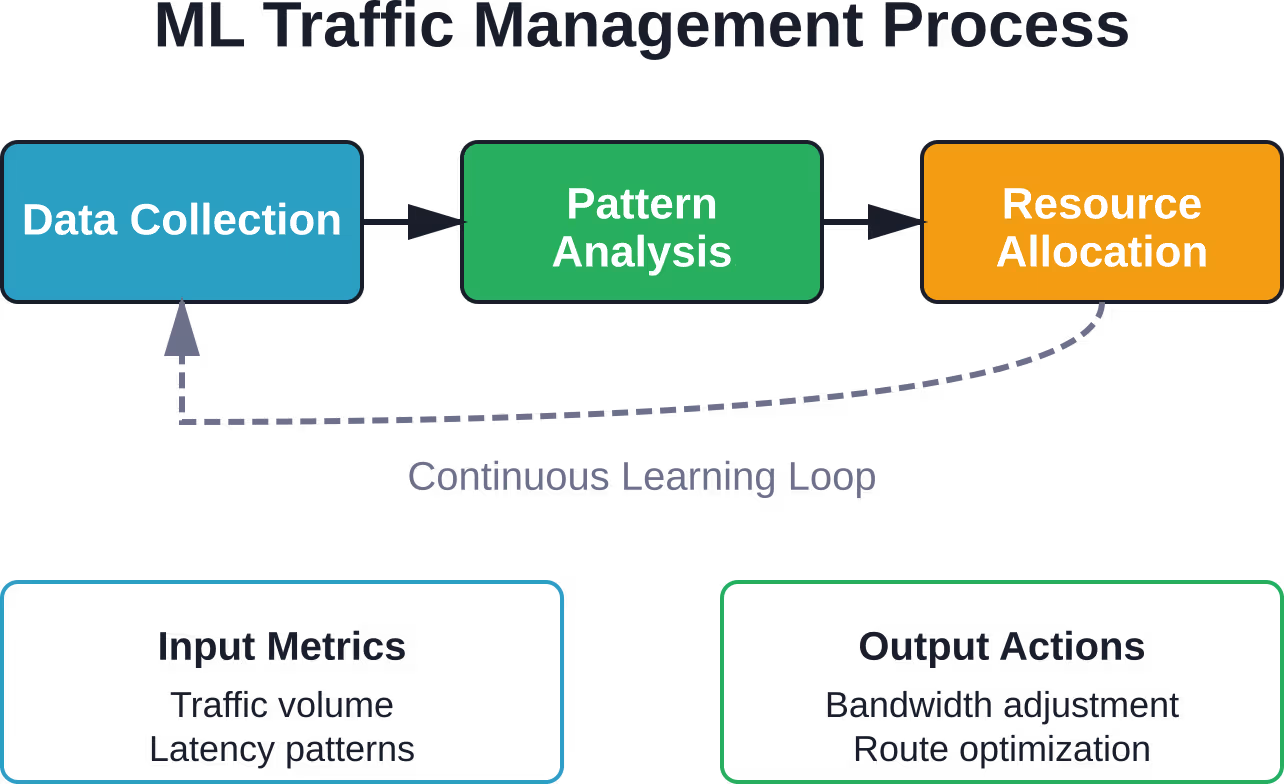
Network traffic follows complex patterns—rush hour surges, event-driven spikes, regional variations, seasonal trends. ML algorithms forecast traffic loads across different time scales and automatically adjust resource allocation.
Recent doctoral research from Boise State University focused specifically on traffic prediction in 5G networks demonstrated how LSTM networks combined with online learning frameworks can handle the bursty, event-driven nature of massive machine-type communication networks.
The models learn normal traffic patterns for each cell site and routing path. When demand spikes or shifts, resources redistribute dynamically without manual intervention. This automation becomes critical as 5G networks support millions of IoT devices with unpredictable traffic patterns.
Customer Churn Prediction
Acquiring new customers costs five to seven times more than retaining existing ones. ML models identify subscribers at high risk of cancellation based on usage patterns, customer service interactions, billing history, and competitive activity.
The algorithms detect subtle signals—declining data usage, increased customer service calls, plan downgrade inquiries, price sensitivity patterns. When a model flags a high-risk customer, retention teams intervene with targeted offers before the customer decides to leave.
Real-world deployments demonstrate significant impact. Industry data shows operators achieve up to 60% reduction in churn rates through ML-powered retention programs, with 25% increase in customer satisfaction scores.
Fraud Detection Systems
Telecommunications fraud—subscription fraud, call pumping, SIM box fraud, roaming fraud—costs the industry billions annually. ML algorithms monitor transaction patterns in real-time to flag suspicious activity.
The models learn normal behavior profiles for each account and detect deviations instantly. A subscriber who suddenly makes hundreds of international calls to high-risk destinations triggers immediate review. Stolen credentials generating anomalous traffic patterns get blocked before substantial damage occurs.
Response speed matters. Traditional rule-based systems take hours or days to catch fraud. ML models operate in milliseconds, analyzing millions of events per second to identify threats as they emerge.
Quality of Experience Optimization
Network performance metrics tell part of the story—bandwidth, latency, packet loss. But customer experience depends on application-level quality that varies by service type.
ML algorithms analyze how network conditions affect actual user experience for video streaming, voice calls, gaming, and web browsing. The models correlate technical metrics with customer satisfaction scores and complaint patterns to identify quality issues before they escalate.
This intelligence enables proactive interventions. Networks automatically prioritize traffic for customers experiencing degraded service. Engineering teams receive alerts about localized quality problems with specific root cause analysis.
5G and Beyond Network Intelligence
5G networks introduce massive complexity—network slicing, edge computing, ultra-low latency requirements, support for millions of IoT devices. Manual management becomes impossible at this scale.
Research published through the Astrophysics Data System examines how neural networks enable decision-making in 5G and beyond-5G architectures. The work explores convolutional neural networks, recurrent networks, and deep reinforcement learning for handling unstructured inputs and optimizing collective rewards across network elements.
According to 3GPP, AI and ML work for the NR air interface has progressed significantly, with standardization efforts now extending into Release 19 and planning for Release 20 management enhancements documented in Technical Report 28.882. Cell-free massive MIMO systems represent particularly promising applications for deep learning techniques in next-generation architectures.

Optimize Your Telecom Operations with Machine Learning
Telecom companies handle vast amounts of real-time data and face constant pressure to optimize services and network efficiency. AI Superior helps businesses harness machine learning to streamline network management, predict demand, and improve customer experiences.
Drive Smarter Telecom Solutions with AI
AI Superior offers:
- Predictive models for network performance and downtime prevention
- AI tools for customer behavior analysis and personalized services
- Automation of routine operations to improve efficiency
👉Contact AI Superior to discover how machine learning can enhance your telecom operations and service delivery.
Quantifiable Business Impact
ML implementations deliver measurable returns across multiple dimensions. Operators track these improvements rigorously because ML projects require significant investment in data infrastructure, computational resources, and specialized talent.
| Impact Area | Typical Improvement | Business Value |
|---|---|---|
| Network efficiency | 35% boost | Reduced infrastructure costs and energy consumption |
| Operational costs | 40% reduction | Lower maintenance expenses and optimized resource utilization |
| Customer churn | 60% decrease | Higher lifetime value and reduced acquisition spending |
| Customer satisfaction | 25% increase | Improved retention and positive brand perception |
These figures come from real operator deployments tracked across multiple implementations. Individual results vary based on network maturity, data quality, and implementation approach.
The operational cost reduction deserves particular attention. ML automation eliminates manual processes that consume thousands of engineering hours monthly. Network planning cycles shorten from weeks to days. Troubleshooting that required multiple teams and extended outages now happens automatically.
Implementation Challenges and Realities
ML projects fail frequently in telecommunications. Success requires navigating several common obstacles that trip up even experienced operators.
Data Quality and Accessibility
ML algorithms demand clean, consistent, labeled data at massive scale. Telecom networks generate enormous data volumes, but that data often exists in siloed systems with incompatible formats.
Historical records may contain gaps, errors, or inconsistencies. Labeling data for supervised learning requires domain expertise—knowing which network events preceded failures, which customer behaviors indicated churn risk, which traffic patterns represented fraud.
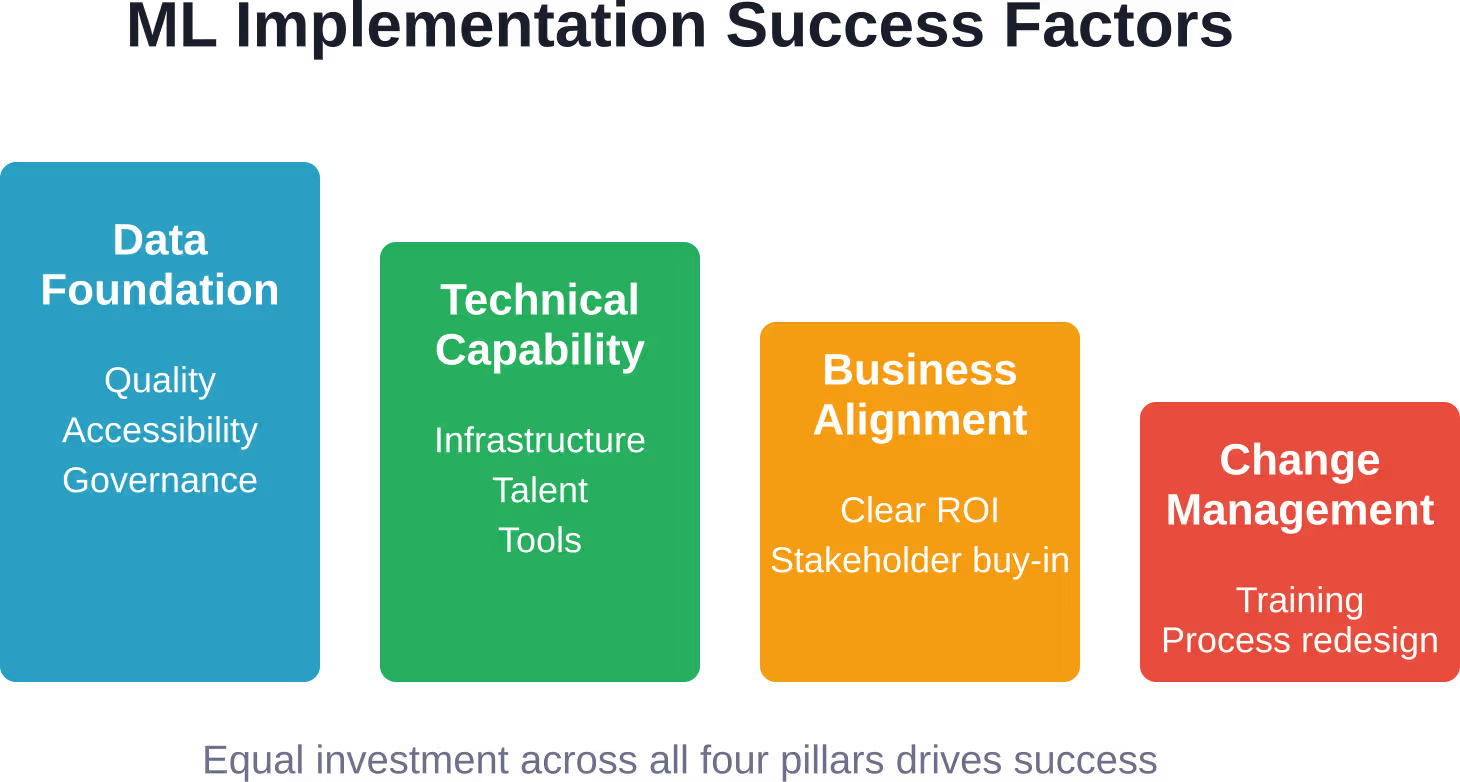
Organizations spend months or years building data pipelines before any ML model development begins. This foundational work doesn’t generate visible results but determines ultimate project success.
Model Complexity Versus Interpretability
Deep neural networks achieve impressive accuracy but operate as black boxes. When a model predicts equipment failure or flags a customer as high-risk, operators need to understand why.
Regulatory requirements compound this challenge. Automated decisions affecting customers or network operations may require auditable explanations. Simpler models with interpretable logic sometimes prove more practical than cutting-edge architectures with marginally better performance.
Real-Time Processing Requirements
Many telecom applications demand millisecond response times. Fraud detection can’t wait for batch processing. Traffic management must respond to demand shifts instantly. Quality optimization requires continuous adjustment.
Meeting these latency requirements forces tradeoffs. Complex models that run offline may need simplification for production deployment. Edge computing becomes necessary to avoid round-trip delays to centralized data centers.
Organizational Change Management
ML transforms how networks get managed. Engineers accustomed to manual troubleshooting must trust automated systems. Processes built around human decision-making need redesign for algorithm-driven operations.
Resistance emerges predictably. Teams worry about job displacement, loss of control, or accountability for algorithm mistakes. Successful implementations invest heavily in training, change management, and demonstrating value through pilot projects before full rollout.
Standards and Industry Collaboration
Machine learning in telecommunications can’t advance through isolated vendor efforts. Networks interconnect globally, requiring standardized approaches to ML integration.
The 3rd Generation Partnership Project leads this standardization work. According to 3GPP leadership speaking at the ETSI AI Conference in February 2025, AI models have become central to next-generation network development, with dedicated work items addressing the NR air interface specifically.
These standards define how ML models get trained, deployed, and updated across multi-vendor networks. They establish interfaces for sharing training data, performance metrics, and model parameters between network elements from different manufacturers.
Release 18 specifications reached Stage 3 functional freeze in 2024, with Release 19 work items ongoing as of mid-2024. Release 20 planning already addresses AI and ML management enhancements for deployments expected in the latter half of this decade.
IEEE publications complement 3GPP standards with research on specific ML applications. Systematic literature reviews examine ML for network reliability, signal optimization systems for 5G networks, and resource allocation algorithms. This academic foundation informs practical standardization efforts.
Security and Privacy Considerations
ML models in telecommunications access sensitive data—customer communications metadata, location information, usage patterns, payment details. This creates substantial security and privacy obligations.
According to NIST research published in May 2025, securing communications systems requires innovative approaches beyond traditional methods, particularly at the physical layer where ML algorithms increasingly operate.
Several security challenges deserve attention:
- Model poisoning attacks where adversaries manipulate training data to compromise algorithm behavior
- Adversarial inputs designed to fool ML classifiers and evade fraud detection
- Privacy leakage where models inadvertently expose information about training data
- Unauthorized access to model parameters that represent valuable intellectual property
Operators implement multiple defensive layers. Differential privacy techniques add noise to training data to prevent individual record identification. Federated learning trains models across distributed datasets without centralizing sensitive information. Robust model architectures detect and reject adversarial inputs.
Regulatory compliance adds complexity. GDPR in Europe, CCPA in California, and similar laws worldwide impose strict requirements on automated decision-making and data processing. ML systems must provide transparency, enable data deletion, and support individual rights even when algorithms operate autonomously.
Future Trajectories
Machine learning capabilities in telecommunications will expand significantly through the rest of this decade. Several trends show particular momentum.
Self-Optimizing Networks
Networks increasingly manage themselves with minimal human intervention. ML algorithms continuously tune parameters, redistribute resources, and reconfigure topology based on changing conditions.
This autonomy extends beyond optimization to self-healing. Networks detect failures, diagnose root causes, and implement corrections automatically. Human operators shift from reactive troubleshooting to strategic planning and oversight.
Intent-Based Networking
Rather than configuring networks through technical parameters, operators will specify business objectives—deliver 99.999% uptime for critical IoT applications, optimize cost for video traffic, guarantee latency below 10ms for autonomous vehicles.
ML systems translate these high-level intents into specific network configurations and continuously adjust implementation to maintain objectives as conditions change.
Energy Efficiency Optimization
Network power consumption represents a major operational expense and environmental concern. ML algorithms optimize energy usage by predicting traffic patterns and powering down unused capacity during low-demand periods.
These systems balance energy savings against performance requirements, learning optimal tradeoffs for different times, locations, and service types.
Open RAN and Disaggregation
Traditional networks use integrated equipment from single vendors. Open RAN architectures disaggregate hardware and software, enabling multi-vendor deployments with standardized interfaces.
This disaggregation creates new opportunities for ML integration. Specialized AI/ML functions can plug into open architectures, competing on capability rather than vendor lock-in. Innovation accelerates as software-focused companies enter markets previously dominated by infrastructure vendors.
Getting Started with ML in Telecommunications
Organizations beginning ML initiatives should follow a structured approach rather than pursuing multiple use cases simultaneously:
- Start with pilot projects targeting specific, measurable problems: Predictive maintenance for a subset of network equipment provides concrete value without requiring enterprise-wide transformation. Success builds momentum and organizational confidence.
- Invest in data infrastructure before algorithms: Clean, accessible, well-governed data determines outcomes more than model architecture choices. Organizations that rush to algorithm development with poor data foundations invariably fail.
- Build internal capability rather than relying entirely on vendors: While external expertise accelerates initial deployment, sustainable ML programs require internal talent who understand both telecommunications domain knowledge and machine learning techniques.
- Measure rigorously: Establish clear success metrics before projects begin and track results transparently. ML projects that promise vague benefits without specific targets rarely deliver meaningful value.
- Plan for iteration: Initial models won’t achieve optimal performance. Successful programs establish processes for continuous improvement—collecting feedback, retraining models, expanding to new use cases based on proven success.
Conclusion
Machine learning has moved from experimental curiosity to operational necessity in telecommunications. The complexity and scale of modern networks exceed human management capacity, making algorithmic intelligence essential rather than optional.
Real-world deployments demonstrate significant business impact—churn reduction up to 60%, network efficiency gains of 35%, operational cost cuts of 40%. These improvements translate directly to competitive advantage in markets where margins narrow and customer expectations rise continuously.
But success demands more than deploying algorithms. Organizations must build data foundations, develop talent, navigate standardization efforts, address security concerns, and manage organizational change. The technical challenges pale compared to these operational and cultural requirements.
Looking forward, ML capabilities will become deeply embedded in network architecture. Self-optimizing systems, intent-based management, and autonomous operations represent the inevitable evolution of telecommunications infrastructure.
Operators investing strategically today in ML capabilities position themselves for long-term competitiveness. Those who delay will find themselves managing increasingly complex networks with inadequate tools against competitors operating at fundamentally higher efficiency levels.
Ready to transform network operations through machine learning? Start with a focused pilot project, measure results rigorously, and scale systematically based on proven value. The technology works—success depends on disciplined implementation.
Frequently Asked Questions
What types of machine learning algorithms work best for telecommunications applications?
Telecommunications networks commonly deploy several ML algorithm types depending on the specific use case. Neural networks—including recurrent, convolutional, and deep learning variants—excel at pattern recognition in network data and customer behavior analysis. Reinforcement learning optimizes network parameters by learning from trial and error, particularly effective for resource allocation. Decision trees and random forests provide interpretable models for fraud detection and troubleshooting. Time series forecasting models like LSTM networks predict traffic patterns and equipment failures. The optimal choice depends on data characteristics, latency requirements, and interpretability needs.
How long does it take to implement machine learning in a telecom network?
Implementation timelines vary dramatically based on organizational readiness and project scope. Building foundational data infrastructure typically requires six to twelve months before any model development begins. Pilot projects for specific use cases like predictive maintenance can demonstrate value within three to six months after data pipelines are operational. Enterprise-wide deployments spanning multiple use cases generally take two to three years from initial planning to full production. Organizations with mature data governance and technical capabilities move faster than those starting from scratch.
What are the biggest obstacles to successful ML deployment in telecommunications?
Data quality and accessibility present the most common barriers. Network data often exists in incompatible systems with inconsistent formats, gaps, and errors. Organizations spend months building data pipelines before algorithm work begins. Organizational resistance follows closely—engineers accustomed to manual processes resist automated systems, requiring substantial change management investment. Real-time processing requirements force tradeoffs between model complexity and latency. Regulatory compliance around automated decision-making and data privacy adds complexity, particularly in heavily regulated markets.
How does machine learning improve 5G network performance specifically?
5G networks introduce massive complexity that exceeds manual management capabilities—network slicing, edge computing, ultra-low latency requirements, millions of IoT devices. ML algorithms optimize resource allocation across network slices with different performance requirements. Traffic prediction models forecast demand patterns for proactive capacity adjustment. Signal optimization systems maintain connection quality as devices move between cells. Interference management algorithms continuously adjust power and frequency parameters. Cell-free massive MIMO systems use deep learning for power distribution and channel estimation. According to 3GPP standards work, ML integration now spans multiple layers from the air interface to core network management.
What security risks does machine learning introduce to telecom networks?
ML systems create several security vulnerabilities requiring defensive measures. Model poisoning attacks manipulate training data to compromise algorithm behavior, potentially causing widespread network disruptions. Adversarial inputs are designed to fool classifiers and evade fraud detection systems. Privacy leakage occurs when models inadvertently expose information about training data, violating customer confidentiality. Unauthorized access to model parameters represents intellectual property theft. NIST research emphasizes the need for innovative security approaches as ML algorithms operate increasingly at the physical layer. Operators implement differential privacy, federated learning, robust architectures, and continuous monitoring to mitigate these risks.
Can small telecom operators benefit from machine learning or is it only for large carriers?
Small operators can implement ML effectively, though approaches differ from large carriers. Cloud-based ML platforms eliminate the need for massive on-premises infrastructure investment. Pre-trained models for common use cases like fraud detection and churn prediction reduce development costs. Focused pilot projects targeting specific high-value problems deliver ROI without enterprise-wide transformation. Partnerships with technology vendors provide access to expertise without building large internal teams. Open RAN architectures enable small operators to leverage ML capabilities through standardized interfaces. Success depends on starting with narrow, well-defined problems rather than attempting comprehensive network transformation.
How do 3GPP standards affect machine learning implementation in telecom networks?
3GPP standardization ensures ML implementations work across multi-vendor networks that interconnect globally. Technical Report 38.843 addresses AI and ML for the NR air interface in Release 18, with Release 19 enhancements documented in Technical Report 38.743 for NG-RAN. Release 20 planning includes management enhancements detailed in Technical Report 28.882. These standards define how ML models get trained, deployed, and updated across network elements from different manufacturers. They establish interfaces for sharing training data, performance metrics, and model parameters. Compliance with 3GPP standards allows operators to avoid vendor lock-in while ensuring interoperability as ML capabilities evolve through future releases.
 English
  German
  Arabic
  French
  Dutch
Dutch  Spanish