
Quick Summary: Machine learning is transforming the BPO industry by automating repetitive tasks, enhancing data accuracy, reducing operational costs, and enabling predictive analytics. AI-powered systems in BPO deliver faster customer service, intelligent routing, and real-time insights, allowing companies to scale operations efficiently while maintaining quality and compliance.
Business process outsourcing has entered a new era. Machine learning technologies are reshaping how BPO companies handle everything from customer service to data entry, fundamentally altering the competitive landscape.
The shift isn’t just theoretical. According to NASSCOM, the AI-powered tech services market represents a significant and growing segment of enterprise IT spending, with enterprise IT spend on AI and machine learning capabilities experiencing substantial growth relative to previous years. This expansion of investment signals something crucial: companies recognize that intelligent automation isn’t optional anymore.
Traditional BPO models relied heavily on manual labor and rigid scripting. Now? Machine learning enables systems that adapt, learn from patterns, and improve over time without constant human reprogramming.
Understanding Machine Learning’s Role in Modern BPO
Machine learning represents a fundamental departure from traditional automation. Where legacy systems follow predetermined rules, machine learning algorithms identify patterns in data and make decisions based on those patterns.
In BPO contexts, this translates to systems that can handle exceptions, recognize context, and continuously refine their performance. The technology excels at tasks involving classification, prediction, natural language processing, and pattern recognition—all core functions in outsourcing operations.
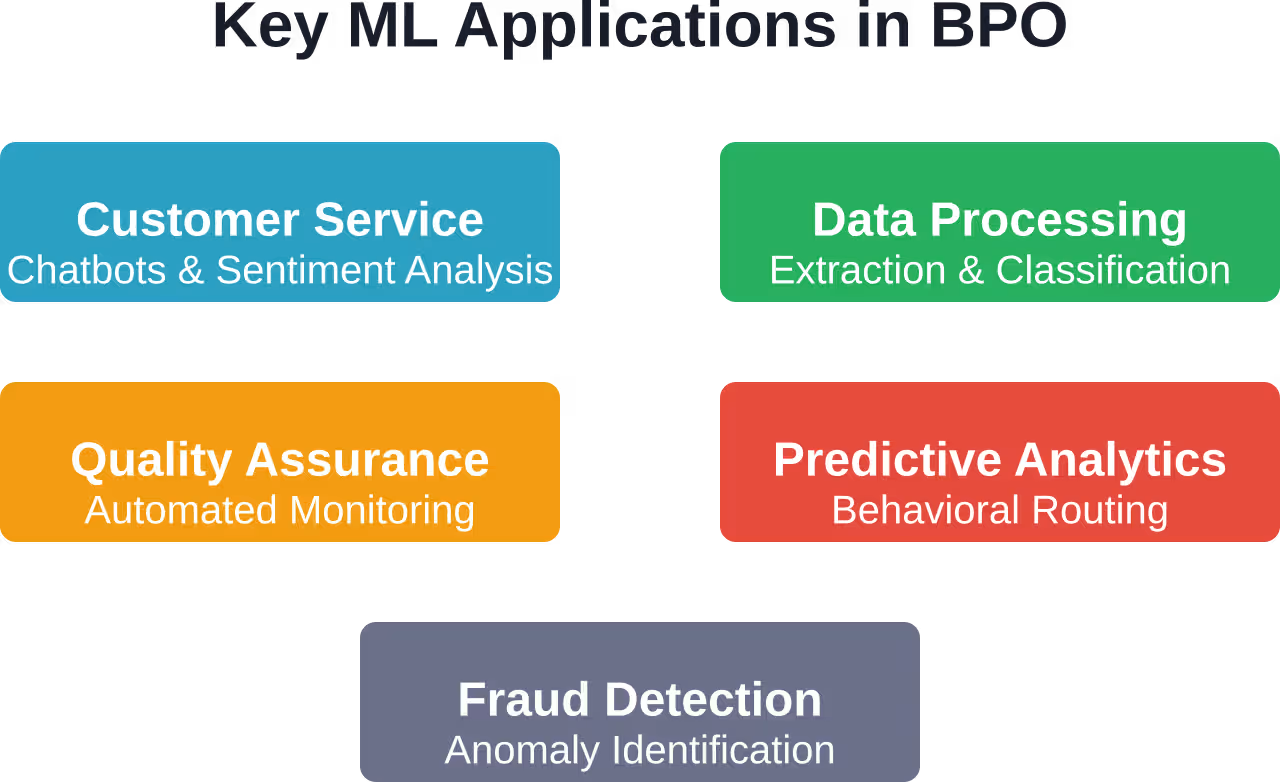
The practical applications span multiple domains: customer interaction analysis, document processing, quality assurance monitoring, workforce optimization, and fraud detection. Each of these areas benefits from machine learning’s ability to process vast datasets and extract actionable insights faster than any human team.

Create AI Tools for Business Process Data With AI Superior
AI Superior builds AI-based applications and custom software products using machine learning models and algorithms. Their work can include predictive analytics, NLP, BI solutions, big data analytics, and process-focused AI tools.
For BPO companies, this can help with workflow analysis, document processing, customer interaction data, performance forecasting, and automation of repetitive data-heavy tasks.
Need AI Connected to Your Operations?
AI Superior can help with:
- creating machine learning models
- building NLP and analytics tools
- testing automation ideas with PoC or MVP work
- connecting AI tools with existing platforms
👉 Contact AI Superior to discuss your project.
Automation and Efficiency Gains Through Machine Learning
Automation forms the most visible benefit of machine learning in BPO. Repetitive, rule-based tasks that once consumed thousands of employee hours now run with minimal oversight.
Data entry operations provide a clear example. Traditional data entry requires human operators to manually input information from documents, invoices, or forms. Machine learning-powered optical character recognition (OCR) combined with natural language processing can extract, classify, and validate this data automatically.
The efficiency multiplier is substantial. What previously required teams of dozens can often be handled by a fraction of that workforce, with remaining staff focusing on exception handling and quality verification rather than routine processing.
Process automation extends beyond data entry into workflow orchestration. Machine learning systems can prioritize incoming requests, route tasks to appropriate resources, and flag items requiring human intervention—all while learning which routing decisions produce the best outcomes.
Enhanced Accuracy and Error Reduction
Human error represents a persistent challenge in BPO operations. Fatigue, distraction, and simple mistakes inevitably creep into manual processes, no matter how well-trained the workforce.
Machine learning systems don’t tire. They apply the same logic consistently across millions of transactions. When trained on quality datasets, these systems achieve accuracy rates that typically exceed human performance on routine classification and extraction tasks.
The error reduction compounds over time. As machine learning models encounter edge cases and receive corrections, they incorporate that feedback into future predictions. The system becomes progressively more accurate with usage—a form of continuous improvement that traditional automation cannot match.
Cost Optimization and Resource Allocation
Cost reduction drives much of the interest in machine learning adoption within BPO. The economics are compelling: automated systems operate 24/7 without breaks, don’t require benefits, and scale horizontally with minimal marginal cost.
Research indicates organizations can achieve up to 25-60% cost savings by modernizing their sourcing strategies with advanced technologies. These savings stem from reduced labor requirements, decreased error correction costs, and improved resource utilization.
But here’s the thing—cost reduction doesn’t necessarily mean workforce reduction. Smart BPO operators redeploy human resources to higher-value activities: complex problem-solving, relationship management, strategic planning, and handling the nuanced customer interactions that still require human judgment.
The shift represents a fundamental rethinking of resource allocation. Rather than maximizing the number of transactions per employee, machine learning enables organizations to maximize value creation per employee by removing low-value work from their plates.
| Cost Factor | Traditional BPO | ML-Enhanced BPO | Impact |
|---|---|---|---|
| Labor Costs | High volume of FTEs | Reduced FTE requirements | 20-30% reduction |
| Error Correction | Manual review and rework | Automated validation | 40-60% reduction |
| Training Time | Weeks per employee | Zero-shot / Few-shot learning models | 95-99% reduction |
| Scalability | Linear cost increase | Marginal cost increase | Near-instant scaling |
| Quality Assurance | Sample-based monitoring | 100% automated review | Comprehensive coverage |
Transforming Customer Service With Predictive Analytics
Customer service represents one of the most transformative application areas for machine learning in BPO. Traditional call routing relied on skill-based matching—connecting customers with agents who possessed the technical knowledge to address their inquiry category.
AI-powered systems now use predictive behavioral routing, analyzing psychological aspects to match callers with operators based on personality patterns and communication styles. The newer approach leverages behavioral analysis and data analytics to pair customers with agents who can best handle their specific emotional state and interaction preferences.
Sentiment analysis tools monitor customer interactions in real-time, flagging conversations that show signs of escalation and suggesting intervention strategies. These systems analyze tone, word choice, and conversation patterns to assess customer satisfaction during the interaction—not just afterward through surveys.
The result? Faster resolution times, higher first-contact resolution rates, and improved customer satisfaction scores. Machine learning enables a level of personalization and responsiveness that manual processes simply cannot achieve at scale.
Natural Language Processing in Action
Natural language processing (NLP) serves as the foundation for many customer service innovations. Chatbots powered by NLP can handle routine inquiries, freeing human agents for complex issues. But the technology extends far beyond simple bots.
NLP systems analyze customer communication across channels—email, chat, social media, voice—to identify intent, extract key information, and route inquiries appropriately. They can summarize lengthy customer histories, highlight relevant previous interactions, and suggest responses based on similar past cases.
Voice analytics applies NLP to recorded calls, identifying compliance issues, training opportunities, and service gaps without requiring supervisors to manually review thousands of hours of recordings.
Data Processing and Intelligent Extraction
Data represents the lifeblood of modern business, and BPO operations handle massive volumes of it. Machine learning excels at extracting structure from unstructured data—turning emails, PDFs, scanned documents, and images into actionable, searchable information.
Intelligent document processing combines computer vision, NLP, and machine learning classification to understand document types, locate relevant fields, extract data with high accuracy, and validate the extracted information against business rules.
The technology handles variations that stump traditional template-based systems. Invoices that differ in layout, handwritten forms, documents with quality issues—machine learning models trained on diverse examples can process these with minimal configuration.
Real talk: this capability transforms industries where document processing forms a bottleneck. Healthcare claims processing, financial services onboarding, legal document review, insurance underwriting—all benefit dramatically from intelligent extraction.
Continuous Learning and Model Improvement
One of machine learning’s most powerful characteristics is its ability to improve through use. As systems process more data and receive feedback on their predictions, they refine their internal models to produce better results.
This continuous improvement happens automatically in well-designed implementations. Human reviewers correct extraction errors or misclassifications, and those corrections feed back into model training. Over weeks and months, accuracy climbs without requiring manual rule updates or system reconfiguration.
The learning extends to new patterns and exceptions. When business processes change or new document types appear, the system adapts by learning from examples rather than requiring extensive reprogramming.
Challenges and Implementation Considerations
Implementing machine learning in BPO operations isn’t without obstacles. Data quality issues top the list—machine learning models require substantial volumes of clean, labeled training data to achieve acceptable accuracy.
Organizations often discover their historical data is incomplete, inconsistent, or poorly structured. Cleaning and preparing datasets for machine learning can consume significant time and resources before any automation benefits materialize.
Integration with legacy systems presents another common challenge. Many BPO operations run on established platforms that weren’t designed with machine learning in mind. Creating data pipelines, managing model deployments, and maintaining system interoperability require careful planning and technical expertise.
Change management deserves attention as well. Employees may view automation as a threat rather than an opportunity. Successful implementations involve transparent communication, retraining programs, and a clear vision for how human roles will evolve rather than disappear.
| Challenge | Impact | Mitigation Strategy |
|---|---|---|
| Data Quality | Low model accuracy | Invest in data cleaning and validation pipelines |
| Legacy Integration | Implementation delays | Use API layers and middleware for system bridging |
| Skill Gaps | Poor model performance | Partner with ML specialists or upskill internal teams |
| Change Resistance | Low adoption rates | Communicate benefits clearly and retrain workforce |
| Compliance Requirements | Regulatory issues | Build explainability and audit trails into systems |
Future Trends Shaping ML in BPO
The trajectory of machine learning in BPO points toward greater autonomy and sophistication. Generative AI technologies are already beginning to impact content creation, report generation, and communication drafting within BPO operations.
Multimodal learning—systems that can process text, images, audio, and video simultaneously—will enable more comprehensive analysis of customer interactions and business documents. A single model might analyze a video call for visual cues, vocal tone, and spoken content to assess customer sentiment holistically.
Edge computing and on-device machine learning will bring intelligence closer to data sources, reducing latency and enabling real-time decision-making in scenarios where cloud connectivity is limited or impractical.
NASSCOM published its latest comprehensive framework ‘The Autonomous Enterprise: BPO Evolution 2026’ in January 2026, addressing AI maturity and organizational readiness for leveraging advanced AI capabilities. This work helps BPO providers assess their position and develop strategies for AI adoption.
Explainable AI will become increasingly critical as regulatory scrutiny intensifies. BPO providers must demonstrate not just that their machine learning systems work, but why they make specific decisions—particularly in sensitive domains like finance, healthcare, and legal services.
Frequently Asked Questions
How does machine learning differ from traditional BPO automation?
Traditional BPO automation follows fixed rules programmed in advance. Machine learning systems learn patterns from data and adapt their behavior based on experience. This means ML can handle variations, exceptions, and new scenarios without requiring manual reprogramming, whereas traditional automation breaks down when it encounters anything outside its predefined rules.
What BPO processes benefit most from machine learning implementation?
High-volume, repetitive processes with clear patterns benefit most: data entry and extraction, document classification, customer inquiry routing, fraud detection, quality assurance monitoring, and predictive analytics for workforce planning. Processes involving unstructured data—like emails, scanned documents, or voice calls—see particularly dramatic improvements through ML.
Does machine learning in BPO eliminate jobs?
Machine learning changes rather than eliminates most BPO roles. While it automates routine tasks, it creates demand for exception handling, model training and oversight, customer relationship management, and strategic analysis. Forward-thinking BPO providers retrain employees for higher-value work rather than simply reducing headcount. The focus shifts from transaction volume to problem-solving quality.
What data requirements exist for implementing ML in BPO operations?
Successful ML implementation requires substantial volumes of relevant, labeled training data—typically thousands to millions of examples depending on task complexity. Data must be representative of real-world scenarios the system will encounter. Quality matters more than quantity; clean, accurate, consistently formatted data produces better models than massive volumes of messy data. Organizations often need to invest months in data preparation before model training begins.
How long does it take to see ROI from machine learning in BPO?
ROI timelines vary widely based on implementation scope and data readiness. Simple use cases with standardized data now show positive ROI within 2-3 months due to standardized AI-as-a-Service (AIaaS) BPO templates. Complex implementations requiring extensive data preparation, system integration, and change management may take 18-24 months to reach breakeven. Ongoing benefits accumulate as models improve and organizations expand ML to additional processes.
What technical expertise does a BPO need to implement machine learning?
BPO providers need data scientists or ML engineers to develop and train models, data engineers to build pipelines and manage data infrastructure, and domain experts who understand business processes well enough to identify valuable use cases and validate model outputs. Smaller providers often partner with specialized ML vendors or consultancies rather than building full in-house capabilities. Cloud ML platforms from AWS and GCP have also lowered the technical barrier to entry significantly.
How do you ensure machine learning systems comply with data privacy regulations?
Compliance requires careful attention to data handling throughout the ML lifecycle. This includes obtaining proper consent for data usage, anonymizing or pseudonymizing personal information in training datasets, implementing access controls and audit trails, documenting model decision-making processes for regulatory review, and ensuring models don’t perpetuate bias or discrimination. Many organizations appoint dedicated AI ethics and compliance roles to oversee these requirements.
Conclusion
Machine learning has moved from experimental technology to core infrastructure within the BPO industry. The benefits—automation at scale, enhanced accuracy, cost optimization, and improved customer experiences—are no longer theoretical but demonstrated across thousands of implementations worldwide.
The technology continues advancing rapidly. What required teams of data scientists two years ago can now be accomplished with low-code platforms and pre-trained models. What was economically viable only for Fortune 500 companies is now accessible to mid-market BPO providers.
Organizations that embrace machine learning strategically—investing in data infrastructure, developing workforce capabilities, and thoughtfully selecting high-impact use cases—position themselves for sustainable competitive advantage. Those that delay risk falling behind competitors who deliver faster, more accurate, and more cost-effective services.
The question facing BPO providers isn’t whether to adopt machine learning, but how quickly and comprehensively they can integrate it into operations. The industry’s future belongs to organizations that view ML not as a replacement for human capability but as an amplifier of it—enabling people to focus on judgment, creativity, and relationship-building while intelligent systems handle repetitive execution.
Ready to transform your BPO operations with machine learning? Start by assessing your data readiness, identifying high-impact processes for automation, and building the technical capabilities needed to implement and maintain ML systems effectively.
 English
  German
  Arabic
  French
  Dutch
Dutch  Spanish