
Quick Summary: Machine learning has revolutionized weather forecasting by delivering predictions that match or exceed traditional physics-based models while using a fraction of the computational resources. AI-driven models from NOAA, ECMWF, and other organizations now provide faster, more accurate forecasts—particularly for medium-range predictions—though challenges remain in forecasting extreme events and understanding how neural networks learn atmospheric physics.
Weather forecasting has always been a numbers game. For decades, meteorologists relied on massive supercomputers running physics-based simulations to predict tomorrow’s weather. These numerical weather prediction systems consumed enormous computational resources and still struggled with accuracy beyond a few days out.
That’s changing fast. Machine learning models trained on historical atmospheric data are now producing forecasts that rival—and sometimes beat—the world’s best traditional systems. And here’s the kicker: they’re doing it with dramatically less computing power.
According to NOAA, the new AI-driven global forecast system uses a fraction of the computational resources required by traditional systems, with drastically reduced computational expenses. The speed gains are equally impressive, with forecasters receiving guidance faster while maintaining or improving accuracy.
The Traditional Approach: Physics-Based Numerical Weather Prediction
Traditional numerical weather prediction relies on solving complex physical equations that describe atmospheric behavior. These models divide the atmosphere into a three-dimensional grid and calculate how temperature, pressure, wind, and moisture evolve over time based on fundamental physics.
The Weather Research and Forecasting model with High-Resolution Rapid Refresh currently generates around 148 weather parameter values per hour over large geo-grids at 3 km × 3 km spatial resolution. That’s an enormous amount of data crunching.
But these systems face inherent limitations. Running high-resolution models with large ensemble sizes—necessary for probabilistic forecasts—requires supercomputer infrastructure that many national weather services can’t afford. Forecast updates are slow because each simulation takes hours to complete.
How Machine Learning Models Actually Work
Machine learning weather models flip the script entirely. Instead of solving physics equations in real time, they learn patterns from decades of historical weather data—typically high-quality reanalysis datasets that combine observations with physics-based models to create comprehensive atmospheric records.
The training process involves feeding these neural networks millions of examples of how weather patterns evolved from one time step to the next. The model learns to recognize relationships between atmospheric variables: how jet stream configurations influence surface weather, how sea surface temperatures correlate with rainfall patterns, and countless other connections.
Once trained, the model can generate forecasts through simple inference—running input data through the neural network to produce output predictions. This takes minutes rather than hours because the computationally expensive work happened during training, not forecasting.
Key Architectural Approaches
Different research teams have experimented with various neural network architectures. Some models use convolutional neural networks that process weather data like images, recognizing spatial patterns in temperature and pressure fields.
Others employ transformer architectures—the same technology behind large language models—to capture long-range dependencies in atmospheric data. Some transformer-based models produce global forecasts at varying temporal resolutions.
Emerging transformer-based architectures explore extended-range forecasting at various temporal resolutions.

Build Forecasting Models With AI Superior
AI Superior develops AI-based applications and custom software products using machine learning models and algorithms. Their work can include predictive analytics, big data analytics, BI tools, and custom AI systems.
For weather forecasting, this can support data analysis, pattern detection, forecasting models, or tools that combine large datasets into more usable outputs.
Need Forecasting Built Around Your Data?
AI Superior can help with:
- building machine learning forecasting models
- analyzing large and complex datasets
- testing ideas through PoC or MVP work
- integrating AI tools into existing systems
👉 Contact AI Superior to discuss your project.
NOAA’s Operational AI Weather Models
In December 2025, NOAA made headlines by launching operational AI-driven global weather prediction models. This wasn’t a research experiment—these models are now part of NOAA’s official forecast production pipeline.
The AI Global Forecast System delivers improved accuracy for large-scale weather patterns and tropical storm tracks while drastically reducing computational expenses. Forecasters receive products faster, which is critical during rapidly evolving weather situations.
NOAA’s AI weather models provide improved accuracy while extending forecast capability compared to traditional systems. That extra guidance makes a real difference for emergency managers, agricultural planners, and logistics operations.
At key NOAA presentations in March 2026, presentations highlighted frameworks supporting machine learning model development. Project EAGLE—the Experimental AI Global and Limited-area Ensemble forecast system—provides infrastructure for building, testing, and deploying next-generation forecasting systems with greater efficiency and reliability.
GenCast: Probabilistic Forecasting Breakthrough
Weather forecasts are fundamentally uncertain. A single prediction telling you it’ll rain tomorrow doesn’t capture the range of possible outcomes. Probabilistic forecasts that show multiple scenarios—maybe a 60% chance of rain—are far more useful for decision-making.
Traditional ensemble forecasting handles this by running dozens or hundreds of slightly different simulations. But that multiplies the already-high computational cost.
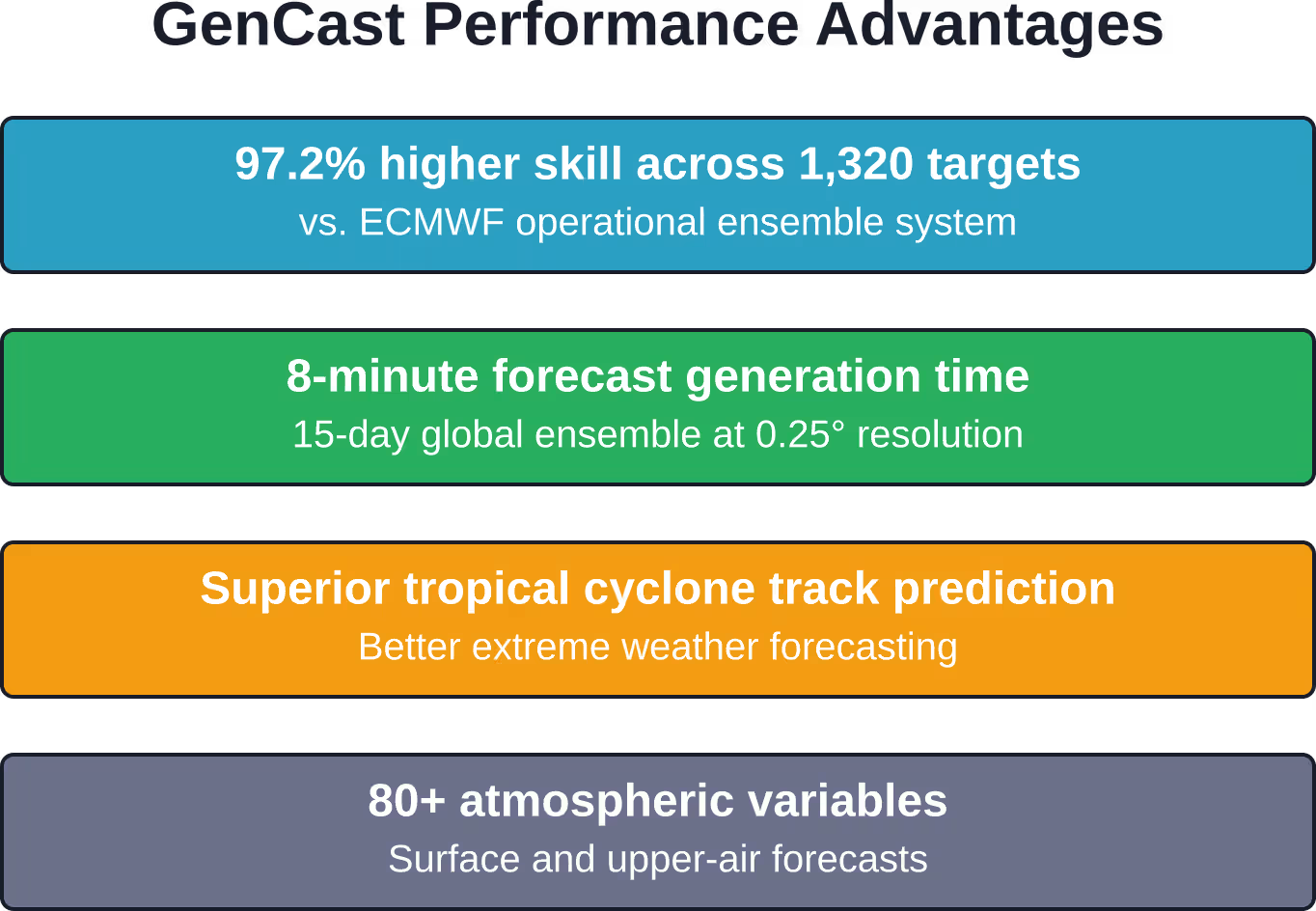
GenCast, a probabilistic machine learning model, changed the equation. It generates ensemble forecasts of stochastic 15-day global predictions at 12-hour steps and 0.25° latitude-longitude resolution for more than 80 surface and atmospheric variables. Total runtime? Eight minutes.
The results are striking. GenCast demonstrates greater skill than the European Centre for Medium-Range Weather Forecasts ensemble system on 97.2% of 1,320 variable, lead time and vertical level combinations evaluated. At lead times greater than 36 hours, that figure jumps to 99.8%.
Extreme Weather: The Remaining Challenge
Machine learning models excel at medium-range forecasts of typical weather patterns. But extreme events—the hurricanes, flash floods, and heat waves that cause the most damage—present a tougher challenge.
The issue is partly mathematical. Extreme events are rare by definition, so training datasets contain relatively few examples. Neural networks learn from patterns in data, and sparse data means weaker pattern recognition.
There’s also a theoretical question: are these models truly learning atmospheric physics, or just statistical correlations? Researchers at the Center for Western Weather and Water Extremes examined this through a sensitivity analysis of Cyclone Xynthia, an extreme weather event in February 2010 that caused significant casualties and damages in Western Europe.
The study analyzed gradients of kinetic energy at 36 hours lead time with respect to atmospheric features at the initial time. Results suggest AI models do capture some physical relationships, but questions remain about their reliability during unprecedented weather scenarios—so-called “gray swan” events that fall outside historical patterns.
According to research from the University of California, Santa Cruz, neural networks predict based on patterns from the past. When weather does something genuinely novel, model performance becomes uncertain.
Nowcasting: Where AI Shines Brightest
The World Meteorological Organization identifies AI-powered nowcasting—forecasts from minutes to hours ahead—as offering potential to improve accuracy and enable timely warnings.
Many localized extreme weather events like thunderstorms and heavy rainfall develop suddenly and intensify rapidly. They’re limited in spatial extent and often escape detection by coarser traditional models that require hours to complete.
Machine learning models can ingest real-time radar and satellite data, recognize developing patterns, and issue warnings within minutes. That speed advantage saves lives during flash flood events and severe storms.
Operational Integration and the Path Forward
The European Centre for Medium-Range Weather Forecasts went live with a fully operational weather forecast system powered by artificial intelligence in February 2025. Other national weather services are following suit.
But this doesn’t mean physics-based models are obsolete. The emerging consensus points toward hybrid systems that harness the best of both methods. Traditional models handle extreme events and novel situations better. Machine learning models deliver speed, efficiency, and excellent performance for typical forecasting scenarios.
The World Meteorological Organization established a Task Team on Artificial Intelligence for Weather to coordinate research and identify opportunities across member organizations. The goal is helping national services integrate AI tools while maintaining forecast quality and reliability.
Computational Democratization
Here’s something that gets overlooked in technical discussions: the computational efficiency of machine learning models could democratize weather forecasting.
Many national meteorological services lack resources for in-house numerical weather prediction systems. Supercomputer infrastructure is expensive to build and maintain. Staff expertise in atmospheric physics modeling takes years to develop.
Machine learning models trained on publicly available reanalysis datasets can run on modest hardware. A weather service that previously relied entirely on products from larger agencies could potentially operate its own forecasting system.
The World Meteorological Organization notes this could revolutionize operational systems, resulting in democratized access to forecast information and insights. That benefits services that previously lacked resources for comprehensive weather prediction capabilities.
But there’s a flip side. The private sector—including big tech companies and weather startups—can now enter the forecasting market with lower barriers to entry. This raises questions about the role of official meteorological services and the quality control of weather information reaching the public.
Technical Limitations and Research Frontiers
Machine learning weather models aren’t perfect. Several technical challenges need addressing before they can fully replace traditional approaches.
Forecasts can become overly smooth, losing the fine-scale detail that matters for local weather. Bias tends to increase with forecast lead time as small errors compound. Tropical cyclone intensity prediction remains weaker than track prediction.
Training requirements are substantial. Building these models demands massive datasets and significant computational resources for the training phase itself. Models need frequent updates to account for climate variability and improved physical understanding.
The verification frameworks are still evolving. Traditional forecast verification tools were designed for physics-based models. Researchers are developing new approaches like SAFE—Stratified Assessments of Forecasts over Earth—that better evaluate machine learning model performance across different regions and weather regimes.
| Aspect | Traditional NWP | Machine Learning |
|---|---|---|
| Computational cost (inference) | Very high | Very low (0.3% of traditional) |
| Forecast generation time | Hours | Minutes |
| Medium-range accuracy | High | Equal or better |
| Extreme event forecasting | Better established | Still developing |
| Physical consistency | Guaranteed by equations | Learned from data |
| Training requirements | None (physics-based) | Massive data and compute |
Real-World Applications Already Deployed
Machine learning weather forecasting isn’t just academic research. Practical applications are operating right now.
Colorado State University’s Machine Learning Probabilities system uses Random Forest models to predict extreme weather hazards associated with deep convection—flash flooding, tornadoes, hail, and damaging winds. These statistical postprocessing techniques convert raw forecast data into actionable probability guidance.
Wind energy operators use machine learning models for power production forecasting. GenCast has demonstrated better prediction of wind power availability compared to traditional ensemble systems, helping grid operators balance supply and demand more effectively.
Agricultural planning benefits from extended-range forecasts. Knowing temperature and precipitation patterns two to three weeks out—even with increased uncertainty—allows farmers to time planting, irrigation, and harvesting decisions better.
Emergency management agencies leverage faster forecast updates during evolving situations. When a hurricane is approaching or a severe weather outbreak is developing, receiving updated guidance every few minutes instead of every few hours changes response capabilities.
The Hybrid Future
The future of weather forecasting isn’t physics-based or machine learning—it’s both.
Research teams are exploring ways to integrate machine learning components into traditional modeling frameworks. Physics-based models could provide boundary conditions for machine learning regional forecasts. Machine learning postprocessing could refine physics-based outputs.
Some approaches use machine learning to accelerate specific computationally expensive components of traditional models—parameterizations of clouds, radiation, or precipitation—while keeping the overall physics-based structure.
General circulation models that combine physics equations with machine learning for medium-range forecasting from 1 to 14 days are showing promise. The physics provides constraints and physical consistency, while machine learning adds speed and pattern recognition.
NOAA’s presentations at recent conferences highlighted scalable infrastructure and research-to-operations pipelines that enable the community to build, test, and deploy next-generation forecasting systems. The framework supports both purely machine learning models and hybrid approaches.
Frequently Asked Questions
How accurate are machine learning weather forecasts compared to traditional models?
Machine learning models now match or exceed traditional physics-based forecasts for medium-range predictions (1-14 days). GenCast outperforms the ECMWF ensemble system on 97.2% of evaluated targets. However, traditional models still have advantages for extreme events and situations outside historical patterns. The accuracy gap is closing rapidly as researchers develop better training methods and architectures.
Why do AI weather models use so much less computing power?
The computational work happens during training, not forecasting. Training a machine learning model requires massive resources and can take weeks on supercomputers. But once trained, generating a forecast is simple inference—running input data through the neural network. NOAA’s AI Global Forecast System uses just 0.3% of the computing resources required by traditional models for a 16-day forecast because it’s not solving complex physics equations in real time.
Can machine learning models predict hurricanes and extreme weather?
Results are mixed. Machine learning models show superior tropical cyclone track prediction compared to traditional ensembles. GenCast demonstrates better extreme weather forecasting overall. But intensity prediction remains weaker, and questions exist about how well these models handle unprecedented events. The World Meteorological Organization identifies AI-powered nowcasting for rapidly developing storms as particularly promising, while longer-range extreme event prediction needs further development.
Do AI weather models understand atmospheric physics or just recognize patterns?
This is an active research question. Studies analyzing sensitivity gradients in AI models suggest they do capture some physical relationships between atmospheric variables. But whether they truly understand causality versus statistical correlation remains debated. The models learn from data that itself comes from physics-based simulations and observations, so they implicitly encode physical constraints. However, they may fail when confronted with weather scenarios sufficiently different from their training data.
Will machine learning replace traditional weather forecasting?
Complete replacement is unlikely in the near term. The consensus points toward hybrid systems combining both approaches. Traditional physics-based models provide physical consistency and handle novel situations better. Machine learning delivers speed, efficiency, and excellent typical-case performance. Integration strategies—using machine learning for postprocessing, regional refinement, or accelerating specific model components—appear most promising. National weather services are deploying both systems operationally.
What’s the biggest advantage of AI weather forecasting?
Speed and computational efficiency. Forecast generation takes minutes instead of hours, using a tiny fraction of computing resources. This enables faster updates during evolving situations, larger ensembles for better probabilistic guidance, and democratized access for weather services that lack supercomputer infrastructure. NOAA’s AI models extended forecast skill by 18 to 24 hours while reducing computational costs by 99.7%.
What are the main limitations of machine learning weather models?
Several challenges remain. Forecasts can become overly smooth, losing local detail. Bias increases with lead time. Training requires massive datasets and computational resources. Models need frequent updates as climate changes. Performance on rare extreme events is uncertain because training data contains few examples. Physical consistency isn’t guaranteed by fundamental equations like in traditional models—it’s learned from data and may break down in novel scenarios.
Looking Ahead
Machine learning has already transformed weather forecasting. The next chapter involves operational integration, hybrid model development, and extending AI capabilities to subseasonal and seasonal prediction.
Climate change is making this work more urgent. As extreme weather events become more frequent and intense, the need for accurate, fast, affordable forecasting grows. Machine learning models that can run on modest hardware and deliver competitive accuracy could extend advanced forecasting capabilities to regions that currently lack them.
Research continues on making these models more interpretable—understanding what they’ve learned and why they make specific predictions. Better verification frameworks tailored to machine learning characteristics will help meteorologists know when to trust AI guidance and when to rely on traditional approaches.
The computational efficiency alone represents a paradigm shift. Weather services can now run hundreds of ensemble members exploring different scenarios without breaking their computational budget. That translates to better uncertainty quantification and more informed decision-making.
For forecasters, this means faster access to more diverse guidance. For researchers, it opens new possibilities in understanding atmospheric dynamics. For the public, it promises more accurate warnings and better information for planning everything from daily activities to long-term agricultural and infrastructure decisions.
The revolution in weather forecasting powered by machine learning isn’t coming—it’s already here. And it’s just getting started.
 English
  German
  Arabic
  French
  Dutch
Dutch  Spanish