
Quick Summary: Machine learning in predictive maintenance uses AI algorithms to analyze sensor data and predict equipment failures before they occur. By identifying patterns in historical and real-time data, ML models enable organizations to schedule maintenance proactively, reducing downtime by up to 60% in select cases and cutting spare parts consumption by 10–20%. This approach transforms reactive maintenance into a data-driven strategy that extends asset lifespan and optimizes operational efficiency.
Equipment failure doesn’t announce itself with a courtesy call. One minute everything’s running fine, the next minute production stops cold while maintenance teams scramble to diagnose the problem.
That’s the old way. Machine learning has changed the game entirely.
By analyzing patterns in sensor data from motors, pumps, turbines, and other industrial equipment, ML algorithms can spot the early warning signs of impending failure—sometimes weeks before a breakdown occurs. This isn’t science fiction. It’s happening right now across manufacturing plants, energy facilities, and transportation networks worldwide.
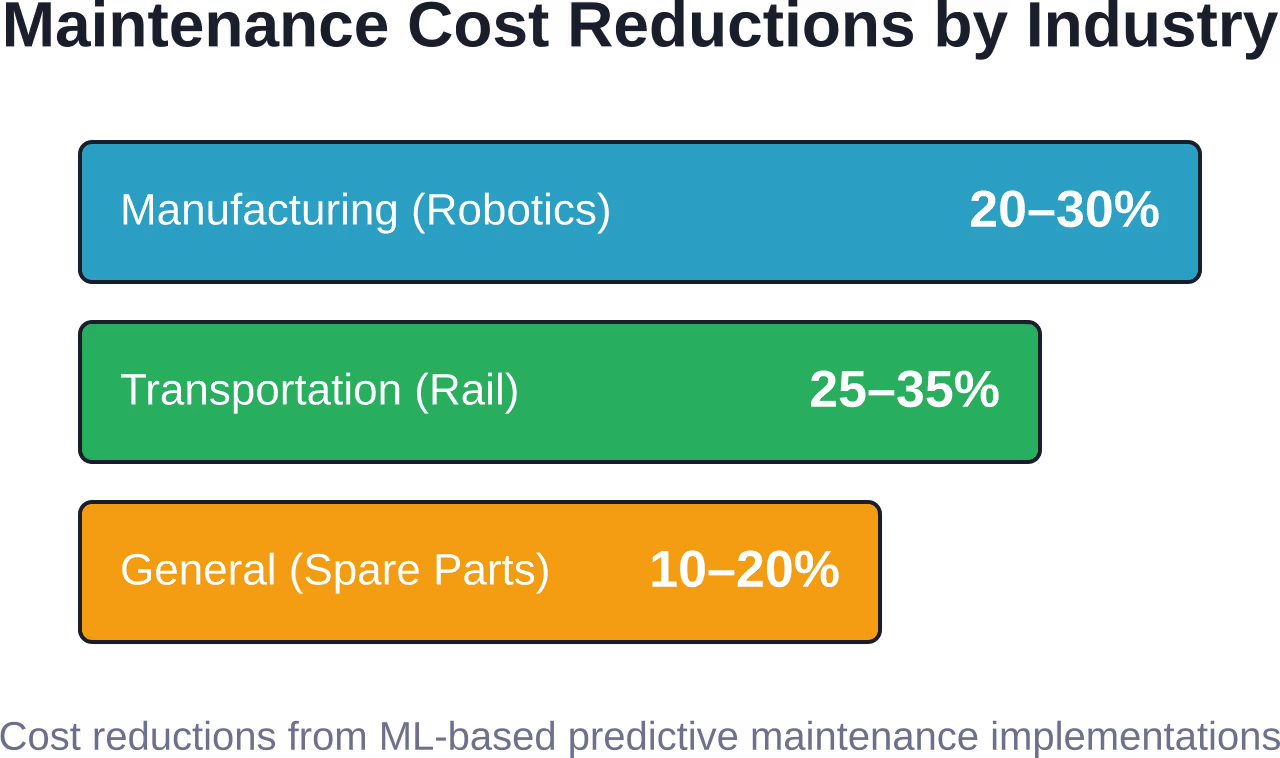
The technology doesn’t just predict failures. It enables organizations to plan maintenance during scheduled downtime, reduce spare parts inventory, extend equipment lifespan, and slash operational costs. Some organizations have seen maintenance cost reductions of 20–30% by implementing ML-based predictive systems.
Here’s the thing though—deploying machine learning for predictive maintenance isn’t as simple as plugging in an algorithm and watching magic happen. The approach requires careful data collection, model selection, feature engineering, and continuous refinement.
This guide examines how machine learning enables predictive maintenance, which algorithms work best for different scenarios, and what it takes to implement these systems successfully. Real talk: this technology represents one of the most practical applications of AI in industrial settings, delivering measurable ROI within months rather than years.
What Is Predictive Maintenance?
Predictive maintenance monitors equipment health in real time to determine the optimal moment for servicing. Rather than following fixed schedules or reacting to breakdowns, this approach uses data analytics to predict when maintenance should occur.
The strategy sits between two traditional methods: preventive maintenance (scheduled at fixed intervals) and reactive maintenance (fixing things after they break). Predictive maintenance combines the proactive nature of preventive strategies with the cost efficiency of doing maintenance only when needed.
Sensors installed on equipment continuously collect data about temperature, vibration, pressure, acoustic signatures, and other operational parameters. This stream of information flows into analytical systems that establish baseline performance and detect anomalies that signal deteriorating conditions.
When patterns indicate an approaching failure, the system triggers alerts so maintenance teams can schedule interventions during planned downtime. This prevents unexpected breakdowns while avoiding unnecessary servicing of equipment that’s still functioning optimally.
The approach delivers measurable benefits. Predictive maintenance typically reduces spare parts consumption and labor hours by 10–20%, as service is triggered by actual equipment condition rather than arbitrary time intervals. Organizations implementing predictive strategies often see the time required to run maintenance analyses decrease from one week to as little as 20 minutes.
The Evolution From Reactive to Predictive Strategies
Maintenance strategies have evolved through distinct phases. Reactive maintenance—the “run it until it breaks” approach—minimizes upfront costs but creates unpredictable downtime and emergency repair expenses that often exceed planned maintenance costs by 300% or more.
Preventive maintenance emerged as the first proactive strategy, scheduling service based on manufacturer recommendations or historical averages. This reduces unexpected failures but performs unnecessary maintenance on equipment still in good condition, wasting labor and parts.
Condition-based maintenance introduced sensors and monitoring, allowing teams to check equipment status and perform maintenance when indicators crossed predefined thresholds. This improved efficiency but remained somewhat reactive, responding to conditions rather than predicting them.
Predictive maintenance represents the current frontier. By applying advanced analytics and machine learning to sensor data, these systems forecast failures before condition indicators reach critical levels. This extended prediction window enables optimal maintenance scheduling that balances equipment health, operational demands, and resource availability.
How Machine Learning Transforms Predictive Maintenance
Machine learning algorithms excel at finding patterns in massive datasets that humans would never spot manually. When applied to equipment sensor data, these algorithms learn the normal operational signature of each asset and detect subtle deviations that precede failures.
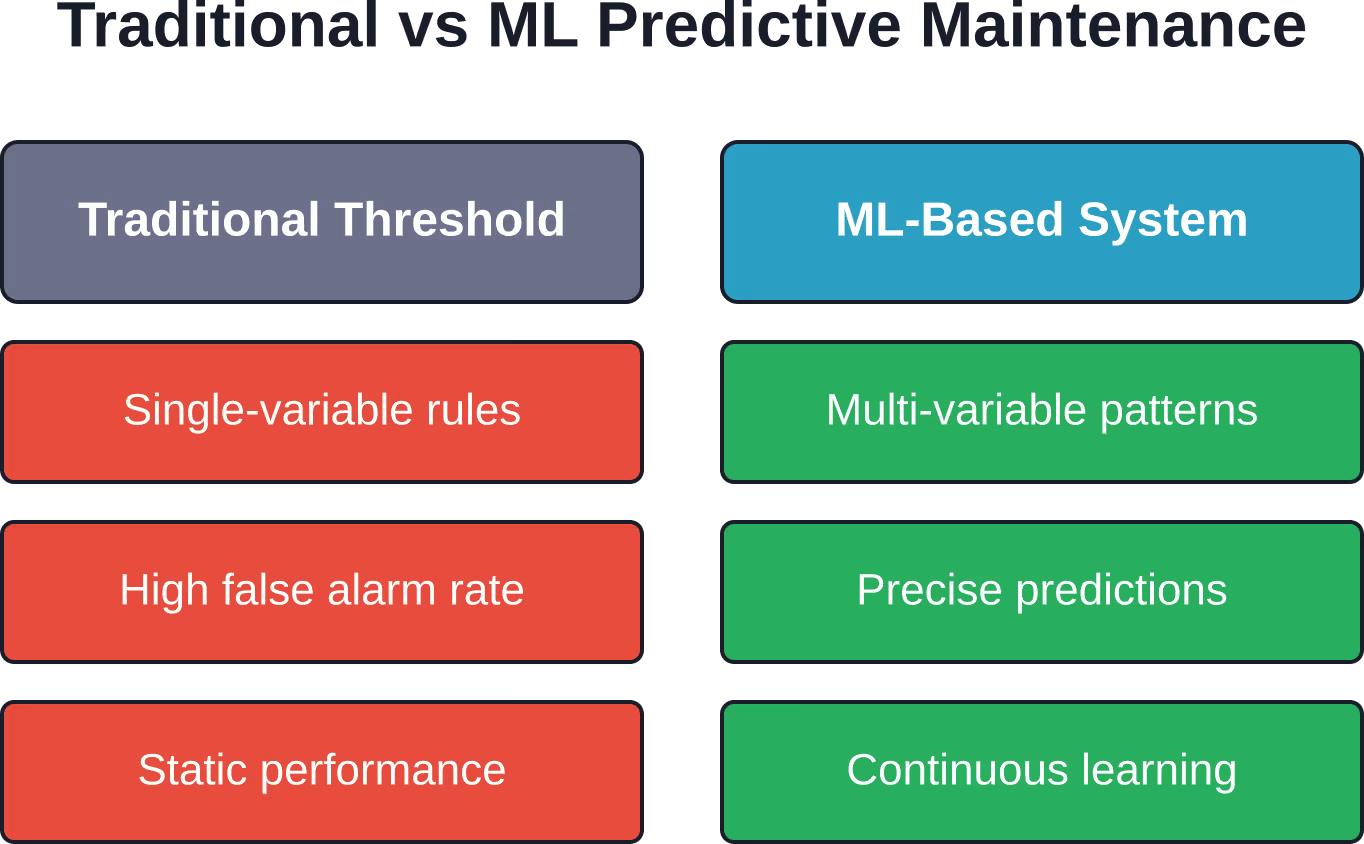
Traditional predictive methods rely on threshold-based rules: if vibration exceeds X or temperature rises above Y, trigger an alert. This works for obvious problems but misses the complex interactions between variables that signal many failure modes.
ML models analyze dozens or hundreds of sensor readings simultaneously, identifying multivariate patterns that indicate specific failure types. A bearing failure might show a particular combination of vibration frequency changes, temperature drift, and acoustic signature shifts days or weeks before catastrophic failure occurs.
The models improve continuously as they process more data. Each maintenance event and failure becomes a learning opportunity that refines prediction accuracy. This self-improving capability distinguishes ML-based systems from static rule-based approaches.
Machine learning also handles the variability inherent in industrial operations. Equipment operates under different loads, environmental conditions, and usage patterns. ML algorithms adapt to these variations, learning what’s normal for each specific context rather than applying universal thresholds that generate false alarms.
The Data Foundation
Machine learning models are only as good as the data they receive. Predictive maintenance requires comprehensive data collection from multiple sources:
- Sensor data forms the primary input stream. Accelerometers measure vibration, thermocouples track temperature, pressure transducers monitor hydraulic systems, and acoustic sensors detect unusual sounds. The sampling frequency matters—some applications require readings every millisecond, while others work with minute-interval data.
- Operational context provides essential variables. Load levels, production rates, environmental conditions, and operating modes all influence equipment behavior. ML models need this context to distinguish between normal variations and genuine anomalies.
- Maintenance history creates the training labels that teach models what failure looks like. Historical records of breakdowns, repairs, and part replacements establish the ground truth that supervised learning algorithms require.
- Equipment specifications add valuable features. Age, manufacturer, model, previous modifications, and design parameters help models understand each asset’s unique characteristics.
The challenge isn’t collecting data—industrial IoT sensors have become affordable and ubiquitous. The challenge is collecting the right data at appropriate frequencies and ensuring data quality through proper sensor calibration, network reliability, and storage infrastructure.

Create Predictive Maintenance Tools With AI Superior
AI Superior develops AI solutions for prediction, data analysis, BI, big data analytics, and custom software development. Their predictive analytics work can use current and historical data to support forecasting and better operational decisions.
For predictive maintenance, this can support equipment failure prediction, maintenance planning, anomaly detection, sensor data analysis, or internal alerts.
Need AI Built Around Operational Data?
AI Superior can help with:
- building machine learning models
- developing predictive analytics systems
- analyzing equipment and sensor data
- integrating AI into existing workflows
👉 Contact AI Superior to discuss your project.
Machine Learning Algorithms for Predictive Maintenance
Different ML algorithms suit different predictive maintenance scenarios. The choice depends on data characteristics, failure modes, computational resources, and required prediction accuracy.
Supervised Learning Approaches
Supervised learning trains models on labeled historical data where failures and normal operation are already identified. These methods work well when organizations have sufficient historical failure data to train on.
- Random Forests build multiple decision trees and aggregate their predictions. This ensemble method handles non-linear relationships, works with mixed data types, and provides feature importance rankings that reveal which sensors contribute most to predictions. Random forests resist overfitting and perform reliably across various industrial applications.
- Gradient Boosting Machines (including XGBoost and LightGBM) sequentially build trees that correct the errors of previous trees. These algorithms often achieve the highest accuracy in predictive maintenance competitions and real-world deployments. The trade-off: they require more careful tuning than random forests.
- Support Vector Machines find optimal boundaries between normal and faulty states in high-dimensional feature spaces. SVMs excel with limited training data and work particularly well for binary classification (will fail / won’t fail in the next X days).
- Neural Networks and deep learning models can automatically extract features from raw sensor signals without manual feature engineering. Convolutional neural networks process vibration spectrograms, while recurrent networks (LSTMs) capture temporal dependencies in time-series sensor data. The downside: these models require large training datasets and substantial computational resources.
Unsupervised Learning Methods
Unsupervised approaches work without labeled failure data, making them valuable for new equipment or rare failure modes where historical examples don’t exist.
- Anomaly detection algorithms learn normal operating patterns and flag deviations. Isolation forests, autoencoders, and one-class SVMs establish baselines from healthy equipment data, then identify unusual sensor readings that might indicate developing problems.
- Clustering techniques like k-means or DBSCAN group similar operating states together. Operational data that doesn’t fit established clusters might represent abnormal conditions worth investigating.
- Dimensionality reduction methods (PCA, t-SNE) compress hundreds of sensor readings into a few key dimensions. Changes in these compressed representations can signal equipment degradation before individual sensor thresholds are crossed.
Advanced Approaches
Gaussian Process models provide probabilistic predictions with confidence intervals, helping maintenance planners understand prediction uncertainty. This transparency proves valuable when balancing the risk of unnecessary maintenance against the cost of unexpected failures.
Survival analysis and remaining useful life (RUL) estimation predict not just whether equipment will fail, but when. These methods estimate the time until failure, enabling precise maintenance scheduling that maximizes equipment utilization while maintaining safety margins.
Transfer learning allows models trained on one piece of equipment to be adapted for similar assets with limited data. This accelerates deployment when installing predictive systems on new production lines or facility expansions.
Implementation Process and Best Practices
Deploying machine learning for predictive maintenance follows a structured process. Organizations that rush implementation without proper planning often struggle with data quality issues, model accuracy problems, and poor user adoption.
Phase 1: Assessment and Planning
Start by identifying high-value equipment where predictive maintenance delivers the strongest ROI. Critical assets with expensive failures, safety implications, or production bottlenecks make ideal candidates for initial deployment.
Assess existing data infrastructure. What sensors are already installed? What’s the data sampling rate? Where is data stored, and how accessible is it? Many organizations discover their sensor data isn’t properly timestamped, contains gaps, or isn’t correlated with maintenance records.
Define clear success metrics before implementation begins. Reduced downtime? Lower maintenance costs? Extended equipment life? Specific, measurable goals guide model development and provide objective evaluation criteria.
Assemble a cross-functional team. Data scientists build models, but maintenance technicians understand failure modes, operations staff know production constraints, and IT teams manage infrastructure. Successful implementations require collaboration across these domains.
Phase 2: Data Collection and Preparation
Install additional sensors if needed to capture relevant failure indicators. Ensure proper sensor placement, calibration, and data transmission reliability. Poor sensor installation undermines even the best ML algorithms.
Establish data pipelines that collect, transmit, and store sensor readings reliably. Industrial environments present challenges: electromagnetic interference, temperature extremes, and vibration can disrupt data collection. Build redundancy and error handling into data infrastructure.
Clean and preprocess historical data. Remove sensor drift, interpolate missing values, and synchronize timestamps across different data sources. This unglamorous work consumes 60–80% of project time but determines model quality.
Label historical data with failure events and maintenance actions. This requires combing through maintenance logs, correlating them with sensor timestamps, and sometimes interviewing technicians about past incidents. The quality of these labels directly impacts supervised learning performance.
Phase 3: Feature Engineering and Model Development
Raw sensor readings rarely feed directly into ML models. Feature engineering transforms time-series sensor data into meaningful predictive variables:
- Statistical features: mean, standard deviation, skewness, kurtosis over time windows
- Frequency domain features: FFT coefficients, spectral power in specific bands
- Trend features: linear regression slopes, moving average crossovers
- Comparison features: deviations from baseline, ratios between related sensors
Domain expertise proves invaluable here. Maintenance technicians know that bearing failures show characteristic vibration frequencies, or that certain temperature-pressure combinations indicate specific problems. Incorporating this knowledge into engineered features improves model performance dramatically.
Split data into training, validation, and test sets with careful attention to temporal ordering. Using future data to predict past failures creates artificially inflated accuracy estimates that don’t reflect real-world performance.
Train multiple algorithms and compare performance using appropriate metrics. Classification accuracy alone misleads—class imbalance (normal operation vastly outnumbers failures) makes precision, recall, and F1 scores more informative. For RUL prediction, mean absolute error and root mean squared error quantify prediction accuracy.
Phase 4: Deployment and Integration
Deploy models where they can process real-time sensor data and generate timely predictions. Edge computing approaches run models on local hardware near the equipment, reducing latency and network dependencies. Cloud-based deployment centralizes model management but requires reliable connectivity.
Integrate predictions with existing maintenance management systems. Maintenance teams already use CMMS (Computerized Maintenance Management Systems) or EAM (Enterprise Asset Management) platforms. Predictions should flow into these familiar workflows rather than requiring separate interfaces.
Design alerting mechanisms that balance sensitivity and specificity. Too many false alarms train technicians to ignore predictions. Too few alerts miss genuine failures. Start with conservative thresholds, then adjust based on operational feedback.
Provide context with predictions. Don’t just tell maintenance teams “motor 7 will fail”—specify the likely failure mode, confidence level, estimated time until failure, and recommended actions. Actionable predictions get used; cryptic alerts get ignored.
Phase 5: Monitoring and Refinement
Track model performance continuously in production. Prediction accuracy, false positive rates, false negative rates, and lead time distribution reveal how well models perform on live data versus historical testing.
Watch for concept drift. Equipment behavior changes as assets age, operating conditions shift, or maintenance practices evolve. Models trained on old data gradually lose accuracy. Regular retraining with recent data keeps predictions current.
Collect feedback from maintenance technicians. When they investigate a predicted failure, did they find the anticipated problem? If they performed maintenance based on a prediction, was it necessary? This ground truth refines future model iterations.
Expand gradually to additional equipment and failure modes. Learn from initial deployments before scaling across the entire facility. Each equipment type may require model customization even when using the same underlying algorithms.
| Implementation Phase | Typical Duration | Key Activities | Common Challenges
|
|---|---|---|---|
| Assessment and Planning | 2–4 weeks | Equipment selection, team formation, goal setting | Securing stakeholder buy-in, defining clear metrics |
| Data Collection | 3–6 months | Sensor installation, pipeline setup, data cleaning | Data quality issues, incomplete maintenance logs |
| Model Development | 6–12 weeks | Feature engineering, algorithm testing, validation | Class imbalance, limited failure examples |
| Deployment | 4–8 weeks | System integration, alert configuration, training | Legacy system compatibility, user adoption |
| Refinement | Ongoing | Performance monitoring, retraining, expansion | Concept drift, maintaining accuracy over time |
Real-World Applications Across Industries
Machine learning-based predictive maintenance has moved beyond pilots to production deployment across diverse sectors. The specific applications vary, but the core principle remains consistent: predict failures, optimize maintenance, reduce costs.
Manufacturing
Production lines represent ideal predictive maintenance candidates. Equipment failures stop production, creating expensive downtime that cascades through supply chains.
Robotic arms in automotive assembly benefit significantly from ML-based monitoring. Organizations implementing predictive maintenance on robotic arms report maintenance cost reductions of 20–30% by replacing joints only when sensor patterns indicate wear rather than on fixed schedules.
CNC machines, injection molding equipment, and packaging lines all generate rich sensor data suitable for ML analysis. Vibration signatures reveal spindle bearing degradation, thermal patterns indicate cooling system problems, and hydraulic pressure fluctuations signal valve wear.
The manufacturing sector has seen maintenance analysis time decrease dramatically with ML implementation. Organizations report reducing the time required to run analyses from one week to as little as 20 minutes, enabling faster response to emerging equipment issues.
Energy and Utilities
Power generation equipment operates under extreme conditions where failures have severe consequences. Turbines in power plants benefit from continuous monitoring that predicts bearing failures, blade erosion, and seal degradation before catastrophic breakdowns occur.
Wind farms deploy ML models that analyze vibration, temperature, and acoustic data from turbines. Predicting gearbox failures enables maintenance during low-wind periods rather than peak generation times, maximizing energy production while extending component life.
Electrical grid infrastructure uses ML-based predictive maintenance to monitor transformers, circuit breakers, and transmission lines. Early detection of insulation degradation or connection problems prevents outages that affect thousands of customers.
Transportation
Aircraft maintenance has adopted predictive approaches extensively. Engine sensors generate continuous data during flights. ML models analyze this data to predict component failures and optimize maintenance scheduling during routine service intervals rather than causing unscheduled groundings.
Railway systems monitor wheel bearings, brake systems, and track conditions. Predictive maintenance prevents derailments, reduces maintenance costs, and improves schedule reliability. Some rail operators have reduced maintenance costs by 25–35% while improving safety metrics.
Commercial vehicle fleets track engine performance, transmission health, and brake wear. Predicting maintenance needs enables scheduling service during planned downtime rather than experiencing roadside breakdowns that disrupt delivery schedules.
Oil and Gas
Offshore platforms and remote drilling operations face extreme maintenance challenges. Equipment failures in these locations require expensive emergency responses and cause significant production losses.
Pumps, compressors, and drilling equipment generate extensive sensor data. ML models predict seal failures, bearing wear, and valve degradation, enabling preventive intervention before costly breakdowns occur.
Pipeline monitoring uses ML to analyze pressure, flow rate, and acoustic data. Predicting corrosion, crack propagation, and valve failures prevents leaks and environmental incidents while optimizing inspection schedules.
Data Centers
Cooling systems in data centers represent critical infrastructure where failures cause server overheating and potential data loss. ML-based monitoring predicts compressor failures, refrigerant leaks, and fan motor degradation.
Server hardware monitoring analyzes temperature patterns, fan speeds, and power consumption. Predicting disk failures, memory errors, and power supply problems enables proactive replacement before data loss occurs.
Backup generator systems undergo predictive monitoring to ensure reliability during power outages. ML models analyze battery health, fuel system condition, and engine parameters to guarantee availability when needed.
Key Benefits of Machine Learning Predictive Maintenance
The value proposition extends beyond preventing breakdowns. ML-based predictive maintenance delivers multiple interconnected benefits that compound to significantly improve operational performance.
Reduced Unplanned Downtime
Unexpected equipment failures bring production to a sudden halt. Organizations wait for diagnosis, source replacement parts, and coordinate repair resources—all while production stands idle.
Predictive maintenance transforms unplanned downtime into scheduled maintenance windows. In select cases, organizations have seen downtime decrease by as much as 60% through ML-based prediction systems that enable proactive intervention before failures occur.
Scheduling maintenance during planned low-production periods or shift changes eliminates the chaos of emergency repairs. Production teams receive advance notice, supply chains adjust accordingly, and the financial impact of stopped production diminishes dramatically.
Lower Maintenance Costs
Emergency repairs cost substantially more than planned maintenance. Premium pricing for expedited parts, overtime labor, and emergency service calls multiplies repair expenses.
Predictive approaches optimize parts inventory. Rather than stocking expensive spares for every possible failure, organizations can maintain leaner inventories and order parts when predictions indicate upcoming need. This reduces spare parts consumption and carrying costs by 10–20% according to documented implementations.
Condition-based servicing eliminates unnecessary maintenance on equipment still operating optimally. Fixed-interval preventive maintenance replaces components that have substantial remaining life, wasting both parts and labor.
Extended Equipment Lifespan
Running equipment until catastrophic failure often causes collateral damage to adjacent components. A failed bearing might damage shafts, seals, or housings, turning a simple repair into a major overhaul.
Early intervention prevents cascading failures. Replacing a degrading component before complete failure protects surrounding equipment and extends overall asset life. Organizations report 20–40% longer equipment lifespan with consistent predictive maintenance versus reactive approaches.
Optimal operating conditions detected through continuous monitoring also contribute to longevity. ML models identify operational patterns that accelerate wear, enabling process adjustments that reduce stress on equipment.
Improved Safety
Equipment failures can injure workers or create environmental hazards. Pressure vessel ruptures, mechanical ejections from rotating equipment, and electrical faults present serious safety risks.
Predicting and preventing failures before they occur eliminates these hazards. Safety improvements prove particularly valuable in industries like oil and gas, chemical processing, and power generation where equipment failures carry severe consequences.
Reduced emergency repair work also improves safety. Rushed troubleshooting under production pressure increases the likelihood of accidents. Scheduled maintenance proceeds with proper planning, safety protocols, and adequate time for careful work.
Enhanced Operational Efficiency
Maintenance teams work more efficiently when focusing on genuine equipment needs rather than responding to fixed schedules or emergencies. Prioritization becomes data-driven rather than reactive.
Workforce planning improves with advance notice of maintenance requirements. Organizations staff appropriately, schedule training for complex repairs, and coordinate with operations to minimize production impact.
Data-driven insights from ML systems help refine operational practices. If models reveal that certain operating conditions accelerate equipment degradation, operators adjust processes to extend equipment life while maintaining production targets.
| Benefit Category | Predictive Maintenance | Preventive Maintenance | Reactive Maintenance |
|---|---|---|---|
| Downtime | Minimized (up to 60% reduction) | Moderate (scheduled) | High (unplanned) |
| Cost Efficiency | Optimized (20–30% savings) | Moderate waste | Highest (emergency pricing) |
| Equipment Life | Extended significantly | Moderately extended | Shortened |
| Labor Planning | Proactive scheduling | Fixed schedule | Chaotic response |
| Parts Inventory | 10–20% reduction | High stock requirements | Emergency procurement |
| Safety Risk | Minimized | Moderate | Elevated |
Challenges and Considerations
Machine learning predictive maintenance delivers substantial benefits, but implementation comes with real challenges that organizations must address.
Data Quality and Availability
ML models require substantial high-quality data. Many organizations discover their existing sensor data contains gaps, calibration drift, or synchronization problems that undermine model training.
Historical failure data often proves scarce. Reliable equipment fails infrequently, leaving few examples for supervised learning algorithms. Class imbalance—thousands of normal operation records versus dozens of failure examples—complicates model training.
Labeling historical data accurately requires domain expertise and careful record analysis. Maintenance logs might not precisely correlate with sensor timestamps, or technicians might have documented symptoms rather than root causes.
Initial Investment and ROI Timeline
Sensor installation, data infrastructure, and model development require upfront investment. Organizations must justify these costs against uncertain future savings.
ROI timelines vary by industry and application. Some implementations deliver measurable savings within 6–12 months, while others require 18–24 months before benefits exceed costs. Executive patience during the initial implementation period proves essential.
Starting with high-value equipment where failure costs are clear helps build business cases. Demonstrating success on critical assets creates momentum for broader deployment.
Integration with Existing Systems
ML predictions must flow into existing maintenance workflows to drive action. Integration with legacy CMMS, ERP, and SCADA systems presents technical challenges, particularly in facilities with older infrastructure.
Maintenance teams accustomed to traditional approaches may resist data-driven recommendations. Change management, training, and demonstrating prediction accuracy build trust and encourage adoption.
IT and OT convergence creates security considerations. Connecting operational technology to data analytics platforms requires careful network architecture to prevent cyber vulnerabilities.
Model Maintenance and Drift
ML models aren’t set-it-and-forget-it solutions. Equipment behavior changes over time due to aging, process modifications, and evolving operating conditions. Models require periodic retraining to maintain accuracy.
Monitoring model performance in production demands ongoing resources. Organizations need processes to detect degrading prediction quality and trigger model updates.
Expanding from pilot projects to facility-wide deployment multiplies the model management burden. Each equipment type or failure mode may require customized models, creating a portfolio that needs systematic oversight.
Skill Gap and Expertise
Effective predictive maintenance requires collaboration between data scientists who understand ML algorithms and maintenance engineers who know equipment failure modes. Finding or developing this hybrid expertise proves challenging.
Domain knowledge remains critical throughout the ML lifecycle. Feature engineering, model interpretation, and prediction validation all benefit from maintenance expertise that understands what equipment behavior patterns mean.
Training maintenance technicians to work with ML predictions—understanding confidence levels, interpreting model outputs, and providing feedback—requires investment in education and cultural change.
The Role of Data Scientists and Domain Experts
Successful machine learning predictive maintenance depends on effective collaboration between technical roles with different expertise.
Data scientists bring ML algorithm knowledge, statistical analysis skills, and programming capability. They design experiments, implement models, and optimize prediction accuracy. But they typically lack deep understanding of equipment failure mechanisms and maintenance practices.
Maintenance engineers understand how equipment fails. They know the characteristic sounds of failing bearings, the vibration patterns of misaligned shafts, and the thermal signatures of overloaded motors. This domain knowledge guides feature engineering and model interpretation.
Operations personnel provide context about production demands, operating conditions, and practical constraints. Their input ensures maintenance recommendations align with business realities.
The sweet spot lies at the intersection of these disciplines. Data scientists who learn equipment fundamentals build better models. Maintenance engineers who understand ML principles provide more valuable feedback. Organizations that foster this cross-functional collaboration achieve superior results compared to siloed approaches.
Some organizations hire or develop “data engineering” roles that bridge domains—professionals with both technical ML skills and industrial equipment knowledge. These hybrid specialists accelerate implementation by translating between disciplines and making decisions that balance technical and operational considerations.
Future Trends in ML-Based Predictive Maintenance
The field continues evolving rapidly as technology advances and implementations mature.
Edge Computing and Real-Time Analysis
Running ML models directly on edge devices near equipment eliminates latency and network dependencies. Real-time analysis enables immediate response to rapidly developing problems rather than waiting for cloud processing.
Edge deployment reduces data transmission costs and addresses connectivity challenges in remote locations. Only predictions and relevant alerts need transmission rather than continuous raw sensor streams.
Automated Machine Learning (AutoML)
AutoML platforms automate model selection, hyperparameter tuning, and feature engineering. This democratizes ML deployment by reducing the specialized data science expertise required for implementation.
While AutoML won’t replace domain experts, it lowers barriers for organizations with limited data science resources and accelerates development cycles for experienced practitioners.
Digital Twins and Simulation
Digital twin technology creates virtual replicas of physical equipment that simulate behavior under various conditions. Combining digital twins with ML predictive models enables testing maintenance scenarios and optimizing intervention timing.
Simulation helps address the scarcity of failure data by generating synthetic examples of rare failure modes. This augments limited historical data and improves model training for infrequent events.
Federated Learning
Federated learning enables training models across multiple facilities or organizations without sharing raw data. This preserves data privacy while leveraging broader datasets to improve prediction accuracy.
Equipment manufacturers could provide pre-trained base models refined with federated learning from their entire customer base, then customized locally with facility-specific data.
Integration with Augmented Reality
AR interfaces overlay ML predictions and maintenance guidance directly onto equipment during inspection and repair. Technicians see predicted failure locations, recommended procedures, and real-time sensor data without consulting separate systems.
This contextual information delivery improves repair efficiency and accuracy, particularly for complex equipment or less experienced technicians.
Prescriptive Maintenance
Beyond predicting failures, next-generation systems recommend optimal maintenance actions and timing. Prescriptive approaches balance failure risk, production schedules, parts availability, and labor resources to determine the best intervention strategy.
Reinforcement learning algorithms learn optimal maintenance policies by simulating different strategies and evaluating long-term outcomes. This shifts from “equipment will fail in 30 days” to “perform maintenance in 21 days for optimal cost-benefit balance.”
Frequently Asked Questions
What’s the difference between predictive maintenance and preventive maintenance?
Preventive maintenance follows fixed schedules based on time intervals or usage metrics, performing service whether equipment needs it or not. Predictive maintenance monitors actual equipment condition through sensors and data analytics, triggering maintenance only when data indicates developing problems. This condition-based approach reduces unnecessary maintenance while catching issues before failure occurs. Organizations typically see 10–20% cost savings switching from preventive to predictive strategies.
How much data do you need to implement machine learning predictive maintenance?
Requirements vary by approach. Supervised learning typically needs several failure examples per equipment type—ideally 20–50 labeled failure events for robust training, though transfer learning can work with fewer. Unsupervised anomaly detection requires only normal operation data but may generate more false positives initially. Most implementations collect 6–12 months of baseline data before deploying production models. The key factor isn’t just volume but data quality: properly labeled failures, calibrated sensors, and complete operational context.
Can small and medium-sized manufacturers benefit from ML predictive maintenance?
Absolutely. While enterprise-scale implementations receive more publicity, cloud-based platforms and affordable IoT sensors have made predictive maintenance accessible to smaller operations. Start with critical equipment where failures cause significant production disruption. Many vendors offer SaaS solutions that eliminate large infrastructure investments. The key success factor isn’t company size but having equipment where failure costs justify the implementation effort. A small manufacturer with one critical production line can see substantial ROI from predictive monitoring.
What types of sensors are most important for predictive maintenance?
The optimal sensor suite depends on equipment type and failure modes. Vibration sensors (accelerometers) detect mechanical problems in rotating equipment like motors, pumps, and gearboxes. Temperature sensors identify thermal issues in electrical systems, bearings, and process equipment. Acoustic sensors catch bearing failures and gas leaks. Pressure transducers monitor hydraulic and pneumatic systems. Current sensors detect electrical motor problems. Most implementations use 3–6 sensor types per asset, with sampling rates from once per minute to thousands of samples per second depending on the failure mechanism.
How accurate are machine learning models at predicting equipment failures?
Accuracy varies significantly based on equipment type, sensor quality, and failure mode. Well-implemented systems typically achieve 80–95% accuracy for predicting failures within a specified time window. Precision (avoiding false alarms) and recall (catching genuine failures) both matter—most organizations tune models to catch 90%+ of real failures while keeping false positive rates below 10–15%. The prediction horizon also affects accuracy: predicting failure within the next week proves more accurate than predicting failure in the next month. Performance improves over time as models train on more real-world data.
What happens if the machine learning model makes a wrong prediction?
False positives (predicting failure when equipment is fine) waste maintenance resources but avoid catastrophic breakdowns. Most organizations prefer conservative models that occasionally trigger unnecessary maintenance over aggressive models that miss genuine failures. False negatives (missing actual failures) are more serious, but organizations maintain backup safety protocols and don’t eliminate all traditional monitoring. Continuous model refinement based on prediction outcomes gradually reduces both error types. The goal isn’t perfect prediction but substantially better performance than reactive or fixed-schedule approaches.
How long does it take to implement machine learning predictive maintenance?
Timeline depends on starting conditions and scope. Organizations with existing sensor infrastructure and clean historical data can deploy pilot systems in 4–6 months. Starting from scratch—installing sensors, building data infrastructure, collecting baseline data, and training models—typically requires 9–15 months for initial production deployment. Enterprise-wide rollout across multiple facilities takes 2–3 years. Quick wins come from targeting one or two critical assets first, demonstrating value, then expanding systematically. The implementation is iterative: basic models deploy relatively quickly, then improve continuously through refinement.
Conclusion
Machine learning has transformed predictive maintenance from a promising concept into a practical reality delivering measurable operational improvements. By analyzing sensor data patterns that precede equipment failures, ML algorithms enable organizations to shift from reactive firefighting to proactive maintenance strategies.
The benefits extend across multiple dimensions. Reduced unplanned downtime—in some cases by up to 60%—keeps production running smoothly. Maintenance cost savings of 20–30% come from optimized scheduling, reduced spare parts inventory, and eliminated emergency repair premiums. Extended equipment lifespan results from catching problems before cascading damage occurs. Improved safety follows from preventing catastrophic failures.
But implementation requires more than purchasing ML software. Success demands quality sensor data, careful model development, integration with existing maintenance workflows, and collaboration between data scientists and maintenance professionals. Organizations must address data quality challenges, manage initial investment costs, and evolve maintenance culture to embrace data-driven decision making.
The field continues advancing rapidly. Edge computing enables real-time analysis, AutoML democratizes implementation, and digital twins enhance simulation capabilities. These developments make predictive maintenance increasingly accessible and effective across industries and organization sizes.
For organizations still relying on fixed maintenance schedules or reactive approaches, the competitive gap widens. ML-based predictive maintenance isn’t experimental anymore—it’s becoming table stakes in industries where equipment reliability drives operational success.
The question isn’t whether to implement predictive maintenance, but how quickly to begin and where to focus initial efforts. Start with critical assets where failure costs are clear, build foundational data infrastructure, and expand systematically based on demonstrated results.
 English
  German
  Arabic
  French
  Dutch
Dutch  Spanish