
Quick Summary: Machine learning in HR analytics transforms workforce management by enabling predictive insights, automating repetitive tasks, and surfacing data-driven recommendations for hiring, retention, engagement, and strategic planning. Organizations using ML-powered HR analytics report better talent decisions, reduced bias, and measurable improvements in employee experience and business outcomes.
HR teams are sitting on a goldmine of workforce data—performance reviews, engagement surveys, turnover patterns, hiring metrics. But without the right analytical tools, that data just sits there, unused.
Machine learning changes that equation completely.
Instead of waiting for problems to emerge, ML algorithms spot patterns humans miss, predict which employees might leave, identify skills gaps before they become critical, and automate decisions that used to take days. According to SHRM, just over half of organizations (51%) use AI to support recruiting efforts, with 44% using it to screen resumes.
The shift from reactive to predictive HR isn’t just a tech upgrade—it’s a fundamental change in how workforce strategy gets built. And the organizations making this leap early are pulling ahead fast.
What Machine Learning Actually Means for HR Analytics
Machine learning is a subset of artificial intelligence that uses algorithms to find patterns in data, make predictions, and improve over time without explicit programming for every scenario. Unlike traditional HR software that follows static rules, ML systems learn from historical data and adapt.
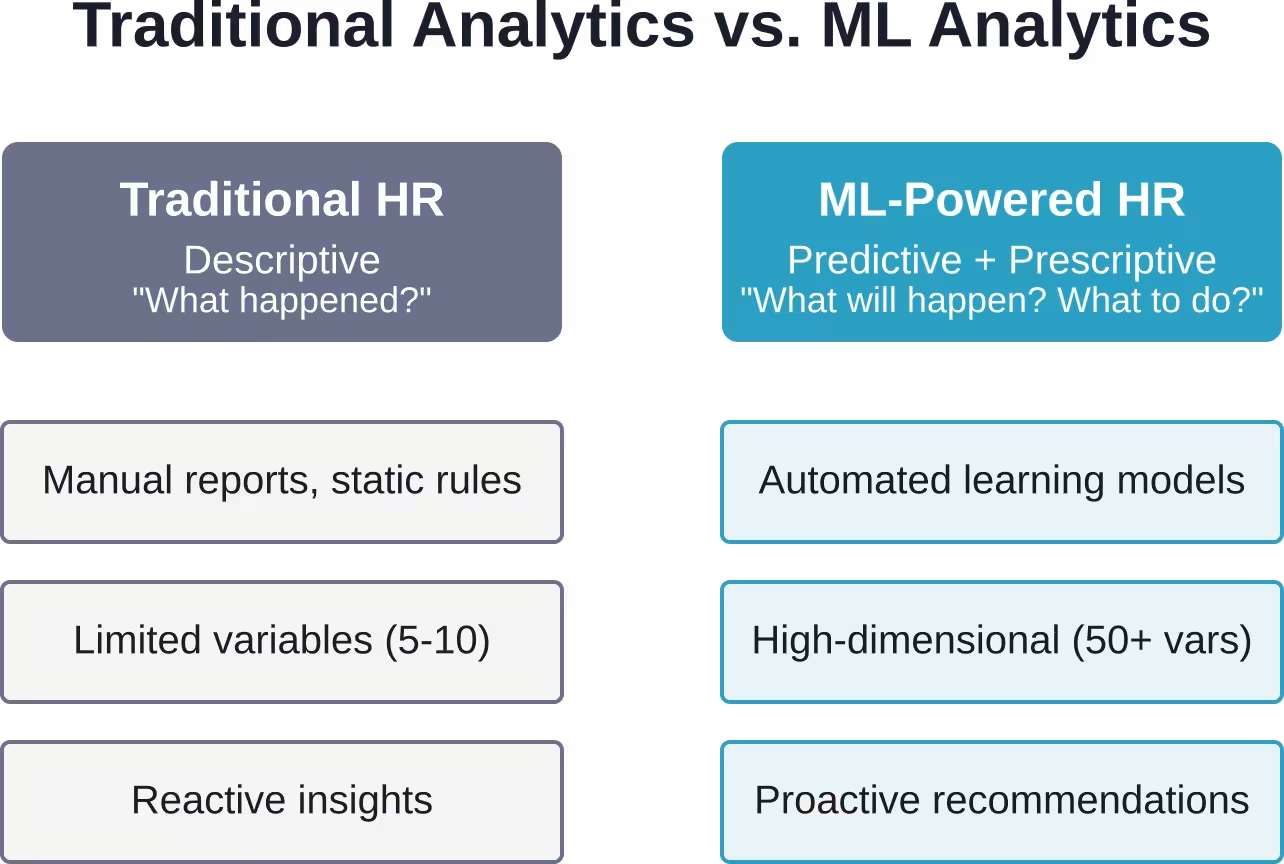
Here’s the practical difference: A traditional system flags employees with low engagement scores. An ML system predicts which employees are likely to disengage in the next 90 days based on dozens of variables—workload changes, manager transitions, peer departures, communication patterns—and recommends specific interventions.
Three types of machine learning show up most often in HR contexts:
- Supervised learning: Algorithms trained on labeled historical data (employees who left vs. stayed) to predict outcomes for new cases. Used for turnover prediction, performance forecasting, hiring success models.
- Unsupervised learning: Algorithms that find hidden patterns without predefined labels. Used for segmenting employees into engagement clusters, identifying unusual compensation patterns, discovering skill gaps.
- Reinforcement learning: Systems that learn optimal actions through trial and feedback. Less common in HR, but emerging in learning path recommendations and career pathing.
The key insight: ML doesn’t replace human judgment. It surfaces insights that would take analysts months to find manually, then hands decisions back to HR professionals who understand context, culture, and individual circumstances.

Create ML Tools for HR Data With AI Superior
AI Superior helps companies assess AI use cases and turn them into working software. Their services cover AI consulting, AI software development, R&D, training, and integration into existing workflows.
For HR analytics, this can support workforce planning, retention prediction, skill analysis, hiring insights, employee engagement data, or internal reporting tools.
Need Machine Learning for HR Workflows?
AI Superior can help with:
- assessing machine learning use cases
- building custom AI and ML tools
- developing analytics and prediction models
- integrating AI into HR systems
👉 Contact AI Superior to discuss your project.
Why Traditional HR Analytics Falls Short
Most HR departments run reports. They track headcount, turnover rates, time-to-hire, cost-per-hire. These metrics matter, but they’re backward-looking.
You learn that 15% of employees left last quarter. Okay—but which 15% are at risk next quarter? Traditional analytics can’t answer that.
SHRM research shows that 58% of HR executives cite data literacy and infrastructure barriers. The data exists, but the tools to extract predictive value don’t. Spreadsheets and basic BI dashboards hit a ceiling fast when dealing with hundreds of variables across thousands of employees.
Machine learning breaks through that ceiling by processing complexity humans can’t. It handles:
- High-dimensional data (50+ variables per employee)
- Non-linear relationships (engagement doesn’t decline steadily—it often drops suddenly)
- Time-series patterns (seasonal hiring cycles, tenure-based turnover curves)
- Hidden interactions (remote work + new manager + team restructuring = 3x attrition risk)
The result? Instead of descriptive reports, HR gets prescriptive recommendations. Not “what happened,” but “what’s likely to happen and what to do about it.”
7 High-Impact Use Cases of Machine Learning in HR
Theory is one thing. Real-world application is another. Here are the seven areas where machine learning delivers measurable value for HR teams.
1. Predictive Turnover Modeling
Employee attrition costs organizations 1.5-2× an employee’s annual salary when factoring in recruiting, onboarding, lost productivity, and knowledge drain. ML models predict flight risk 6-12 months in advance.
How it works: Algorithms analyze tenure, promotion history, manager changes, compensation relative to market, peer departures, engagement scores, workload patterns, and even communication frequency. The model assigns each employee a risk score and flags high-value individuals for retention interventions.
Real talk: This isn’t about surveilling employees. It’s about spotting systemic patterns—like “high performers in Department X leave within 18 months because they don’t see clear career paths”—and fixing the underlying issue.
2. Resume Screening and Candidate Ranking
Recruiters spend 23 hours on average screening resumes for a single hire. ML cuts that to minutes by learning what “good fit” looks like from past successful hires.
According to SHRM data, 44% of organizations now use AI for resume screening. The algorithms parse skills, experience, education, and even writing patterns to rank candidates by likelihood of success and culture fit.
The catch? Bias. If historical hiring data reflects past discrimination, the model learns that bias. Responsible implementation requires bias audits, diverse training data, and human oversight of final decisions.
3. Skills Gap Analysis and Workforce Planning
Business needs shift faster than HR can map manually. ML algorithms compare current workforce skills against strategic requirements, identify gaps, and recommend upskilling priorities or external hiring needs.
Unsupervised learning clusters employees by skill profiles, revealing hidden patterns—like “we have 12 people with dormant Python skills who could transition to data roles with 40 hours of training.” That insight changes hiring strategy overnight.
4. Performance Prediction and High-Potential Identification
Who will become a top performer? Who has leadership potential? ML models trained on performance history, peer feedback, project outcomes, and behavioral data spot patterns that predict future success.
This shifts talent development from gut instinct to evidence. Instead of betting on the loudest voices in the room, organizations invest in people the data shows are likely to excel.
5. Personalized Learning Paths
Generic training programs waste time and money. ML personalizes learning by analyzing skill levels, career goals, learning styles, and knowledge retention patterns.
Employees get customized course recommendations. The system tracks completion, assesses knowledge gaps, and adjusts in real-time. Engagement goes up because training feels relevant instead of mandatory.
6. Compensation Equity Analysis
Pay equity isn’t just ethical—it’s legally required in many jurisdictions. ML algorithms analyze compensation across demographics, roles, performance levels, and tenure to flag unexplained pay gaps.
The models control for legitimate variables (experience, role, location) and surface disparities that need investigation. This proactive approach prevents lawsuits and builds trust.
7. Employee Engagement Prediction
Engagement surveys are snapshots. ML tracks engagement continuously by analyzing communication patterns, collaboration networks, time-off usage, recognition frequency, and survey sentiment over time.
Organizations that deliver top employee experiences typically outperform on revenue growth by 31% compared to other firms, and research indicates strong workplace cultures correlate with higher employee engagement and motivation. ML helps organizations move the needle by identifying which teams, managers, or departments need intervention before disengagement spreads.
Building a Data-Driven HR Function with Machine Learning
Moving from traditional HR to ML-powered analytics isn’t a software purchase. It’s a capability build that requires infrastructure, skills, and culture change.
Step 1: Audit Your Data Foundation
Machine learning is only as good as the data feeding it. Start with an honest assessment:
- Do you have consistent data on hiring, performance, turnover, engagement, compensation across all departments?
- Is data stored in a single system or scattered across spreadsheets, legacy HRIS, and disconnected tools?
- Are data definitions standardized? (One team’s “high performer” can’t mean something different than another’s.)
- What’s the data quality? Missing values, duplicates, and errors poison ML models.
SHRM reports that 58% of HR executives cite data literacy and infrastructure as barriers to people analytics. Fix the foundation before building models on top.
Step 2: Start with High-Impact, Low-Complexity Pilots
Don’t try to predict everything at once. Pick one use case with clear business value and clean data. Turnover prediction is popular because the ROI is obvious—saving one senior engineer from leaving can pay for the entire initiative.
Build a pilot, test accuracy against a holdout set, measure business impact, and iterate. Early wins build organizational buy-in for larger investments.
Step 3: Invest in HR Data Literacy
HR professionals don’t need to become data scientists, but they need enough fluency to ask the right questions, interpret model outputs, and spot when results don’t pass the smell test.
Training should cover:
- Basic statistics (correlation vs. causation, confidence intervals, sample bias)
- How to read ML model outputs (predicted probabilities, feature importance, confidence scores)
- Ethical considerations (bias, fairness, transparency)
- When to trust the model and when to override it
Forrester research found that 66% of technology decision-makers said they’ll increase investment in EX or human resource technologies in 2024, but without data-literate users, those tools sit unused.
Step 4: Establish Governance and Ethics Guardrails
ML in HR touches sensitive employee data and high-stakes decisions. Governance isn’t optional.
Key policies include:
- Bias audits: Regularly test models for disparate impact across protected demographics
- Transparency: Employees should know when algorithms influence decisions about them
- Human oversight: No model should make final decisions on hiring, firing, or promotion without human review
- Data privacy: Comply with GDPR, CCPA, and other regulations governing employee data
- Model documentation: Maintain records of training data, features, performance metrics, and decision logic
The U.S. Equal Employment Opportunity Commission has warned that algorithmic hiring tools can perpetuate discrimination if not carefully designed and monitored. The Federal Trade Commission similarly cautioned about bias and accuracy issues in AI systems. Compliance isn’t just ethical—it’s legally required.
Overcoming Common Challenges in ML for HR Analytics
Implementing machine learning in HR isn’t plug-and-play. Organizations hit predictable roadblocks.
Challenge 1: Insufficient Historical Data
ML models need hundreds or thousands of examples to learn patterns. A startup with 50 employees doesn’t have enough turnover history to train a reliable attrition model.
Workarounds: Start with simpler statistical models, use external benchmark data, focus on descriptive analytics until sample size grows, or partner with vendors who aggregate anonymized data across clients.
Challenge 2: Bias in Training Data
If past hiring favored certain demographics, ML learns that preference. If promotions historically went to one group, the model predicts more of the same.
Solution: Audit training data for imbalances, use fairness-aware algorithms, remove sensitive attributes (gender, race) from feature sets, and test model outputs for disparate impact. But remember—removing demographic variables doesn’t eliminate bias if proxies like zip code or college name remain.
Challenge 3: Resistance from HR and Employees
People fear being reduced to a number or having algorithms make career-defining decisions. HR professionals worry about losing autonomy.
The fix: Position ML as decision support, not decision replacement. Emphasize that algorithms surface insights humans can validate, question, or override. Share success stories where ML caught problems humans missed. Build trust through transparency about how models work and what data they use.
Challenge 4: Tool Overload and Vendor Hype
Every HR tech vendor now claims “AI-powered” features. Many are glorified rules engines or basic statistical models, not true machine learning.
Gartner research found that 60% of HR leaders believe current technologies hinder rather than improve employee experience. The market is noisy.
Vet vendors carefully: Ask what algorithms they use, how models are trained, what data is required, how accuracy is measured, and whether outputs are explainable. Request case studies with measurable outcomes, not just testimonials.
| Challenge | Impact | Mitigation Strategy |
|---|---|---|
| Insufficient historical data | Models can’t learn reliable patterns | Start with simpler models; use benchmarks; focus on data collection |
| Bias in training data | Perpetuates discrimination | Audit data; use fairness algorithms; remove proxies; test outputs |
| Employee/HR resistance | Low adoption; workarounds; mistrust | Position as decision support; transparency; early wins; training |
| Vendor hype and tool overload | Wasted investment; poor results | Demand proof of algorithms; case studies; explainability; pilot first |
| Data privacy and compliance | Legal risk; regulatory penalties | Governance policies; legal review; GDPR/CCPA compliance; transparency |
The Shift Toward Agentic AI in HR
Machine learning has focused on prediction—flagging risks, scoring candidates, identifying patterns. The next wave goes further: agentic AI that takes action.
Agentic systems don’t just predict which employees might leave. They draft personalized retention offers, schedule one-on-ones with managers, and automatically adjust compensation bands based on market data. They don’t just rank candidates—they schedule interviews, send follow-ups, and update hiring managers in real-time.
This isn’t science fiction. Early implementations are live. The shift raises new questions about autonomy, accountability, and the role of HR professionals when algorithms handle execution, not just recommendation.
But here’s the thing: Even agentic AI requires human judgment for high-stakes decisions. The goal isn’t to automate HR out of existence—it’s to free HR from repetitive operational tasks so they can focus on strategy, culture, and the messy human problems that algorithms can’t solve.
Measuring ROI of Machine Learning in HR
CFOs want proof that ML investments pay off. HR needs to speak the language of business impact.
Track these metrics:
- Turnover cost savings: Compare predicted vs. actual attrition and calculate saved replacement costs for retained employees
- Time-to-hire reduction: Measure days from job posting to offer acceptance before and after ML-powered screening
- Quality of hire: Track performance ratings and tenure of ML-recommended candidates vs. traditional hires
- Engagement improvement: Correlate ML-driven interventions with engagement survey scores and productivity metrics
- Compliance risk reduction: Document pay equity improvements and bias audit results
Real talk: Not every outcome is measurable in quarter one. Some benefits—better culture, stronger employer brand, reduced bias—compound over years. Balance short-term ROI with long-term strategic value.
Real-World Examples: Machine Learning in Action
Abstract theory is fine, but what does this look like in practice?
A global tech company implemented ML-powered turnover prediction and identified that software engineers with 18-24 months tenure and no promotion had an 80% chance of leaving within six months. HR launched targeted career development conversations, resulting in a 35% reduction in early-career attrition and estimated savings of $4.2M annually.
A retail chain used unsupervised learning to cluster store managers by performance patterns. The analysis revealed that high performers shared specific scheduling practices and team communication habits. Those insights became training content, lifting average store performance by 12% over two years.
A financial services firm deployed ML for resume screening and cut time-to-hire from 45 days to 28 days while increasing the diversity of interview pipelines by 20%. The key? Training the model on diverse successful hires rather than historical averages.
These aren’t hypothetical. Organizations using people analytics report measurable improvements in talent outcomes. According to SHRM data from 2024, 56% of HR professionals rated their organization’s recruiting efforts as effective or very effective, suggesting room for improvement in recruiting outcomes.
The Ethical Dimension: Bias, Transparency, and Fairness
Machine learning amplifies the patterns found in its training data. If historical hiring data reflects bias, the model can learn and repeat that discrimination.
The U.S. Equal Employment Opportunity Commission has warned that algorithms can contribute to employment discrimination, while the Federal Trade Commission has raised concerns about inaccuracy, bias, and commercial surveillance in AI systems.
Responsible ML in HR starts with better data and careful oversight. Training datasets should include varied demographics, career paths, and employment histories so the model does not learn from a narrow or distorted view of the workforce. Fairness testing is also important, especially to check whether models perform consistently across protected groups.
Explainability matters as well. HR teams should understand which factors influence model predictions, whether through interpretable models or tools that show the main drivers behind a decision. Human review should remain part of the process, especially for hiring, firing, promotion, and compensation decisions.
Bias can also appear over time as the workforce, labor market, or business needs change. Continuous monitoring helps catch those shifts before they turn into serious problems.
Transparency is just as important. Employees should know when machine learning plays a role in decisions that may affect their careers, and some jurisdictions legally require that disclosure.
The ethical path is not avoiding ML completely. It is using it with safeguards, accountability, and a clear understanding that algorithms are not neutral by default.
What Skills HR Teams Need for ML-Driven Analytics
HR professionals won’t become data scientists overnight. But the skill gap is real.
Core competencies for ML-literate HR include:
- Data fluency: Understand data types, quality issues, and how to spot bad data
- Statistical basics: Know correlation vs. causation, sample bias, confidence intervals
- Model interpretation: Read outputs, understand feature importance, recognize overfitting
- Business translation: Convert model insights into actionable recommendations
- Ethics awareness: Identify bias risks, advocate for fairness, challenge outputs that don’t pass scrutiny
Upskilling can happen through workshops, certifications, partnerships with data teams, or hiring people analytics specialists who bridge HR and data science.
The goal isn’t to turn every HR generalist into a coder. It’s to create enough fluency that HR can ask the right questions, evaluate vendor claims, and collaborate effectively with technical teams.
Selecting the Right Tools and Platforms
The HR tech market is crowded with vendors claiming AI and ML capabilities. Not all deliver.
Evaluation criteria should include:
- Algorithm transparency: Does the vendor explain what models they use and how they’re trained?
- Data requirements: What inputs does the system need? Can it integrate with existing HRIS?
- Accuracy metrics: What’s the model’s performance on test data? Are validation results shared?
- Explainability: Can the system show why it made a prediction?
- Bias testing: Has the vendor audited for disparate impact?
- Implementation support: What training, onboarding, and ongoing support is included?
- Scalability: Will it work as headcount grows?
Pilot before committing. Test tools on real data, measure outcomes, and involve end users in evaluation. A tool that looks impressive in a demo can flop in production if it doesn’t fit workflow or requires data quality HR doesn’t have.
Future Trends: Where ML in HR Is Headed
The field is moving fast. Three trends stand out.
Agentic AI: Systems that don’t just predict but act—drafting emails, scheduling meetings, adjusting policies. The shift from recommendation to execution.
Real-time analytics: Moving beyond quarterly reports to continuous monitoring. Algorithms that track engagement, collaboration, and performance in near real-time and alert HR when intervention is needed.
Privacy-preserving ML: Techniques like federated learning and differential privacy that allow model training without exposing individual employee data. Regulatory pressure and employee expectations are driving adoption.
The organizations investing now in data infrastructure, skills, and governance will be positioned to capitalize as these technologies mature. Those waiting will face a steeper climb.
Frequently Asked Questions
What is machine learning in HR analytics?
Machine learning in HR analytics uses algorithms to analyze workforce data, identify patterns, and predict employee behaviors like turnover, performance, or engagement. Unlike traditional analytics that describe what happened, ML predicts what will happen and recommends actions to take. Common applications include turnover prediction, resume screening, skills gap analysis, and compensation equity audits.
How accurate are machine learning models for predicting employee turnover?
Accuracy varies based on data quality and sample size, but well-trained models typically achieve 70-85% accuracy in identifying flight-risk employees 6-12 months in advance. The models work best when historical data includes diverse variables—tenure, compensation, manager changes, engagement scores, peer departures, and workload patterns. Organizations with limited historical data should expect lower accuracy until sufficient examples accumulate.
Does machine learning in HR perpetuate bias?
ML models can perpetuate bias if trained on historical data that reflects past discrimination. For example, if promotions historically favored one demographic, the model learns that pattern. Responsible implementation requires bias audits, diverse training data, removal of sensitive attributes and proxies, fairness-aware algorithms, and continuous monitoring. The U.S. EEOC and FTC have both warned about algorithmic discrimination, making compliance legally required.
What data does HR need to implement machine learning?
Effective ML requires consistent, clean data on hiring, performance, turnover, engagement, compensation, tenure, skills, manager relationships, and ideally external factors like market benchmarks. Data must be standardized across departments and stored in accessible systems. According to SHRM, 58% of HR executives cite data literacy and infrastructure as barriers, highlighting that data foundation often needs work before ML can succeed.
Can small organizations benefit from machine learning in HR?
Small organizations face challenges due to limited historical data—ML models need hundreds or thousands of examples to learn reliable patterns. However, small teams can start with simpler statistical models, use external benchmark data, focus on descriptive analytics, or partner with vendors who aggregate anonymized data across clients. As the organization grows and data accumulates, more sophisticated ML becomes feasible.
How much does machine learning HR software cost?
Pricing varies widely depending on vendor, features, organization size, and implementation complexity. Enterprise platforms can range from tens of thousands to hundreds of thousands annually, while smaller tools or modules within existing HRIS may cost less. Many vendors use per-employee pricing. For current pricing, check vendor websites directly, as costs and tier structures change frequently.
What skills do HR professionals need to work with machine learning?
HR teams don’t need to become data scientists, but should develop data fluency (understanding data quality and types), basic statistics (correlation vs. causation, sample bias), model interpretation (reading outputs and feature importance), business translation (converting insights to actions), and ethics awareness (identifying bias and advocating for fairness). Upskilling can happen through workshops, certifications, or hiring people analytics specialists.
Conclusion: From Insight to Impact
Machine learning in HR analytics isn’t about replacing human judgment with algorithms. It’s about augmenting HR teams with tools that surface insights faster, predict problems earlier, and recommend interventions backed by data rather than intuition.
The shift is already underway. SHRM data shows 51% of organizations use AI in recruiting, and research indicates that employee experience and strong workplace cultures correlate with higher performance and revenue growth—outcomes ML helps drive by connecting workforce metrics to business results.
But technology alone won’t deliver value. Success requires clean data, skilled teams, ethical governance, and a culture that treats analytics as decision support, not decision replacement.
The organizations pulling ahead aren’t the ones with the fanciest tools. They’re the ones building data-driven HR functions where ML is embedded in strategy, talent decisions are evidence-based, and bias is actively monitored rather than ignored.
Start small. Pick one high-impact use case, prove value, upskill the team, and scale from there. The competitive advantage isn’t in having perfect models—it’s in making better decisions faster than competitors still relying on spreadsheets and gut instinct.
The future of HR is predictive, proactive, and powered by machine learning. The question isn’t whether to adopt these tools—it’s how fast to move.
 English
  German
  Arabic
  French
  Dutch
Dutch  Spanish