
Quick Summary: Machine learning in data warehousing transforms how organizations store, process, and analyze enterprise data by automating query optimization, predictive analytics, and data quality management. Modern data warehouses now integrate ML algorithms directly into their architecture, enabling real-time insights and intelligent data governance. This convergence creates self-optimizing systems that reduce manual overhead while improving decision-making capabilities across business units.
The intersection of machine learning and data warehousing represents one of the most significant shifts in enterprise data management over the past decade. Traditional data warehouses excelled at storing structured business data but required substantial manual effort for optimization and insights extraction.
Now, ML algorithms embedded within warehouse architectures automatically tune performance, detect anomalies, and generate predictions. This isn’t just about adding AI features on top of existing systems—it’s a fundamental reimagining of how data platforms operate.
Organizations implementing these approaches see tangible benefits. According to research on multimodal oncology datasets, ETL routines run every 12 hours to poll source repositories, ensuring continuous data freshness without manual intervention. The shift from static repositories to intelligent, self-managing systems changes the economics and capabilities of enterprise analytics.
The Convergence of ML and Data Warehouses
Data warehouses traditionally served as centralized repositories for structured business intelligence. They organized data from transactional systems into dimensional models optimized for reporting and analysis.
Machine learning changes this dynamic entirely. Rather than warehouses simply storing data for external ML tools to process, the algorithms now live inside the warehouse itself. This architectural shift eliminates data movement bottlenecks and enables real-time intelligent operations.
Here’s the thing though—this convergence isn’t just a technical upgrade. It fundamentally alters what data teams can accomplish. Tasks that once required specialized data science teams writing custom Python scripts now happen automatically through warehouse-native functions.
Why Traditional Approaches Fell Short
Legacy data warehouse systems struggled with three core limitations. First, they couldn’t adapt to changing query patterns without manual tuning. Database administrators spent hours analyzing execution plans and adjusting indexes.
Second, data quality management relied on rigid rule-based checks. These caught known issues but missed novel problems. Teams discovered data anomalies only after reports went to executives.
Third, predictive capabilities required exporting data to separate platforms. This created latency, security risks, and version control headaches. The promise of real-time insights remained mostly aspirational.

Build Smarter Data Tools With AI Superior
AI Superior develops AI-based applications and custom software products using machine learning models and algorithms. Their work includes predictive analytics, BI solutions, big data analytics, NLP, and data analysis tools.
For data warehousing, this can support data quality checks, classification, forecasting, automated reporting, or analytics tools built on top of warehouse data.
Need Better Use of Warehouse Data?
AI Superior can help with:
- building custom machine learning tools
- creating BI and analytics solutions
- analyzing large business datasets
- integrating AI into existing data systems
👉 Contact AI Superior to discuss your project.
Core ML Applications in Modern Data Warehouses
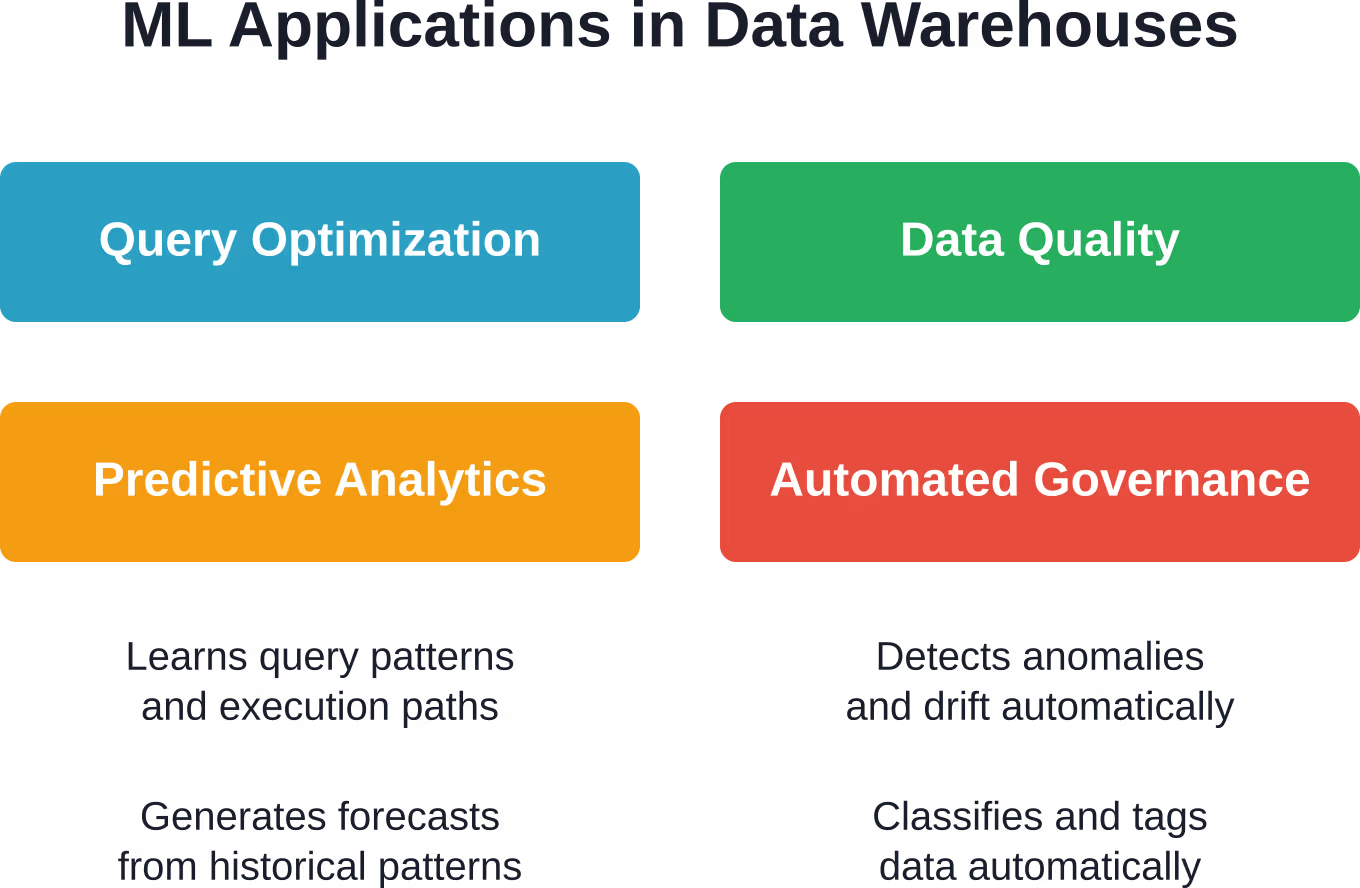
Machine learning enhances data warehousing across four primary domains: query optimization, data quality management, predictive analytics, and automated governance. Each application addresses specific pain points that manual processes couldn’t solve efficiently.
Intelligent Query Optimization
ML-driven query optimizers analyze execution patterns across thousands of queries. They learn which indexes improve performance for specific workloads and can predict optimal execution plans before queries run.
This matters because traditional cost-based optimizers rely on static statistics. They can’t anticipate how data distributions change throughout the day or adapt to seasonal business patterns. Machine learning models capture these temporal dynamics.
Research on columnar storage for ML workloads shows that typical datasets contain 20,000 columns, but training jobs access only about 10% of them. Research on columnar systems shows that eliminating full file rewrites reduces storage costs by 50% using 8KB pages.
Automated Data Quality Management
Data quality issues cost enterprises millions annually. Traditional rule-based validation catches known problems—null values, format errors, referential integrity violations. But what about unexpected anomalies that rules can’t anticipate?
Machine learning monitors statistical distributions of data fields over time. When values deviate from learned patterns, algorithms flag them for review. This catches issues like sudden spikes in null percentages or unexpected category appearances.
Field stat monitors track metrics such as percentage of null values, empty values, and zero values across key features. When source systems change unexpectedly or upstream data pipelines break, these monitors detect problems before they propagate to business reports.
Source freshness checks complement anomaly detection by verifying data arrives within expected timeframes. When explicit SLAs exist with data providers, these automated checks ensure compliance without manual oversight.
ML-Ready Data Warehouse Architecture
Building warehouses that support machine learning workloads requires specific architectural considerations. Storage formats, compute separation, and feature management all differ from traditional BI-focused designs.
Storage Layer Optimization
Columnar storage formats dominate ML-ready architectures. Unlike row-based storage optimized for transactional updates, columnar layouts minimize I/O when algorithms need specific features across millions of records.
Page-level deletion optimization becomes critical at scale. Research on columnar systems shows that eliminating full file rewrites reduces storage costs by 50%. Using 8KB pages allows surgical deletion of obsolete records without rewriting entire column files.
The research mentions managing 3.78 PB of source data size, though specific case breakdowns by source cannot be verified from the provided materials. Efficient columnar organization makes this dataset queryable for ML training without prohibitive infrastructure costs.
Compute and Storage Separation
Modern cloud data warehouses decouple compute from storage. This architecture allows scaling processing power independently of data volume—essential when training large models or running batch predictions.
Separate compute clusters handle different workload types. BI dashboards refresh on dedicated resources while ML training jobs run on GPU-accelerated clusters. This prevents resource contention and allows workload-specific optimization.
Storage costs dominate total spend for many organizations. Cloud architectures that charge separately for compute and storage align costs with actual usage patterns rather than peak provisioning.
Predictive Analytics Within Warehouses
The ability to generate predictions directly inside data warehouses eliminates traditional ML workflow friction. Data doesn’t leave the warehouse, reducing security risks and latency while simplifying governance.
Customer lifetime value prediction illustrates this capability. Historical transaction data already resides in the warehouse. ML functions train models on this data and generate predictions as materialized views, queryable like any other table.
One practical example involves targeting specific customer segments. Algorithms can profile characteristics that define ideal customers, then answer questions like “How do we advertise to women with annual income between $100,000 and $200,000 who like to ski?” without exporting data to external platforms.

Real-Time Scoring and Batch Predictions
Warehouse-native ML supports both real-time and batch prediction workflows. Real-time scoring evaluates models for individual records as queries execute—useful for personalization or fraud detection use cases.
Batch predictions process millions of records efficiently using warehouse compute resources. Organizations schedule these jobs during off-peak hours, materializing prediction tables that downstream applications consume.
The choice between approaches depends on latency requirements and data freshness needs. Real-time scoring adds milliseconds to query execution but always uses current data. Batch predictions introduce staleness but handle massive scale economically.
Data Quality Monitoring for ML Systems
Machine learning models depend critically on input data quality. Small changes in source data distributions can degrade model accuracy dramatically—a phenomenon called data drift.
Building reliable ML systems requires monitoring three distinct layers: sources and input data, engineered features, and model predictions themselves. Each layer needs different monitoring approaches.
| Monitoring Layer | What to Track | Detection Method |
|---|---|---|
| Source Data | Freshness, completeness, schema changes | Freshness checks, null rate monitors |
| Features | Distribution shifts, range violations, correlations | Statistical anomaly detection |
| Predictions | Output distribution, confidence scores, drift | Model performance metrics |
Source and Input Data Monitoring
Freshness anomaly monitors automatically track when data arrives from upstream systems. Data observability tools pull metadata like information_schema last_modified timestamps to detect delays without manual checks.
This becomes essential when source systems change behavior unexpectedly. A vendor might alter their API response format or a database migration might affect extract job timing. Automated monitoring catches these issues immediately.
Feature-Level Monitoring
Engineered features deserve dedicated monitoring because transformations can amplify source data problems. A 5% increase in nulls at the source might cause 30% of derived features to become invalid.
Field health monitors track common issues: unexpected increases in null percentages, empty values, or zero values. These metrics establish baselines during training, then alert when production data diverges.
Statistical methods like bootstrap sampling help establish confidence intervals for feature distributions. Code examples in research demonstrate bootstrap sampling techniques for computing confidence intervals on test scores, providing robust anomaly detection thresholds.
Prediction Quality Tracking
Model predictions require ongoing validation. Output distributions should remain stable unless business conditions genuinely change. Sudden shifts often indicate upstream data problems rather than legitimate pattern changes.
Confidence score tracking helps identify when models become uncertain. A spike in low-confidence predictions suggests the model encounters data it hasn’t seen before—possible drift or quality issues.
Data Lakes vs. Data Warehouses for ML
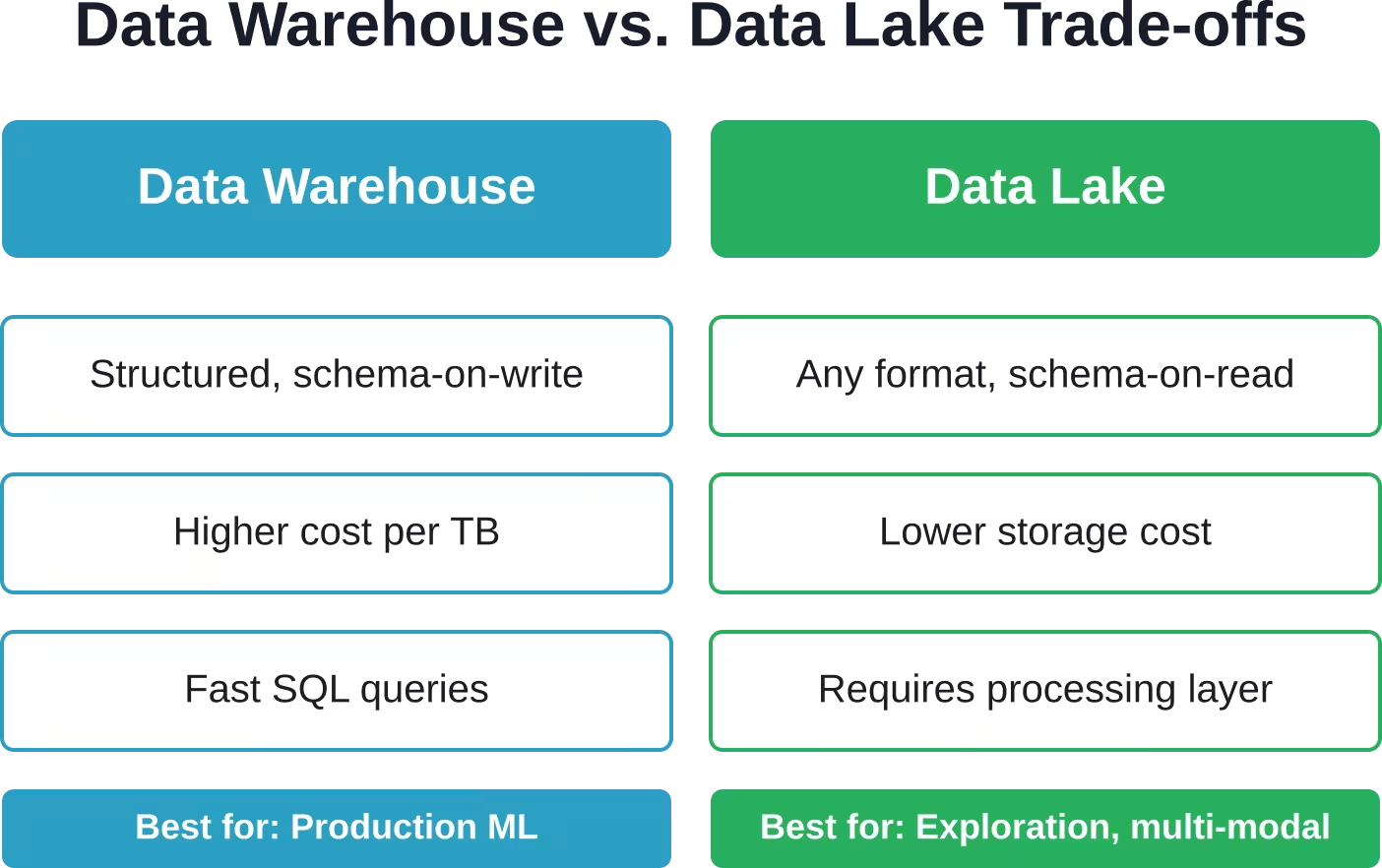
The distinction between data lakes and data warehouses matters for ML workload planning. Each architecture offers different tradeoffs around structure, cost, and performance.
Data warehouses excel at providing clean, structured data with defined schemas. They enforce data types, constraints, and business logic during ingestion. This structure benefits ML pipelines that need reliable, consistent inputs.
Data lakes accept any data type without schema enforcement—raw logs, images, unstructured text, streaming events. This flexibility supports exploratory ML work and multi-modal learning but requires more data preparation effort.
Cost Considerations
Both architectures handle massive scale but with different cost profiles. Data warehouses typically charge premium rates for managed compute and optimized storage. Data lakes offer cheaper storage but require additional processing infrastructure.
Research on multimodal datasets shows efficient compression when properly structured for 41,000+ cases. The GDC’s 3.78 PB represents a different scale entirely, demonstrating how storage needs vary dramatically by use case.
Complexity drives costs beyond raw infrastructure. Both approaches require IT resources for management, with data lakes often demanding more effort for governance and quality assurance.
Hybrid Approaches
Many organizations adopt hybrid architectures. Raw data lands in lakes for exploration and experimentation. Refined, validated datasets migrate to warehouses for production ML pipelines and business analytics.
This pattern balances flexibility with reliability. Data scientists access lakes for research using tools like Spark or custom Python scripts. Production applications query warehouses using standard SQL interfaces with guaranteed SLAs.
Implementation Best Practices
Successfully implementing ML in data warehousing requires attention to several critical factors beyond just technology selection.
Start with clear use cases that deliver business value. Automatic query optimization provides immediate benefits without requiring data science expertise. Customer segmentation and churn prediction offer measurable ROI that justifies further investment.
Establish data quality monitoring before deploying production ML models. The cost of detecting issues early pales compared to decisions made on faulty predictions. Automated monitoring catches problems that manual reviews miss.
Invest in feature stores that manage ML features as reusable assets. When multiple models need the same calculated fields, centralized feature definitions prevent inconsistencies and reduce duplicate computation.
Organizational Considerations
Technology alone doesn’t ensure success. Data teams need training on warehouse-native ML tools and workflows. Analysts accustomed to exporting data for Python-based modeling must learn in-warehouse alternatives.
Cross-functional collaboration becomes essential. Data engineers build pipelines, analysts define features, and business stakeholders validate predictions. Clear ownership and communication channels prevent gaps.
Governance policies must evolve alongside technical capabilities. Who approves new ML models? What validation is required before production deployment? How are predictions audited? Answering these questions upfront avoids downstream problems.
Future Directions and Emerging Trends
The convergence of ML and data warehousing continues accelerating. Several trends will shape the next generation of intelligent data platforms.
- Automated machine learning (AutoML) within warehouses will democratize ML development. Business analysts will build sophisticated models using declarative SQL-like languages rather than writing Python code. The barrier between analytics and ML will blur.
- Real-time feature computation will expand. Current systems mostly batch-process features on schedules. Streaming architectures will enable millisecond-latency feature calculation, supporting use cases like fraud detection and dynamic pricing.
- Federated learning approaches will allow training models across distributed warehouses without centralizing sensitive data. Regulatory constraints and data sovereignty requirements make this capability increasingly important.
Now, the integration of large language models with structured warehouse data opens new possibilities. Natural language interfaces will let non-technical users query data and generate predictions through conversational interfaces.
Frequently Asked Questions
What’s the main benefit of using machine learning in data warehouses?
The primary benefit is eliminating data movement and integration complexity. When ML algorithms run directly inside warehouses, data doesn’t need exporting to separate platforms. This reduces latency, simplifies governance, and enables real-time predictions on current data. Organizations also gain automatic optimization of query performance and data quality monitoring without manual intervention.
Do data warehouses replace dedicated ML platforms?
Not entirely. Data warehouses now handle many ML workloads that previously required specialized platforms, particularly production scoring and batch predictions. However, experimental research, deep learning with complex architectures, and certain specialized algorithms still benefit from dedicated ML environments. Most organizations adopt hybrid approaches, using warehouses for production ML and specialized platforms for research.
How does machine learning improve data quality?
ML algorithms monitor statistical distributions of data over time and detect anomalies that rule-based systems miss. They learn normal patterns for metrics like null percentages, value ranges, and field correlations. When production data deviates from these baselines, automated alerts notify teams before quality issues affect business reports or ML predictions. This catches problems like schema changes, upstream pipeline failures, and unexpected data drift.
What storage formats work best for ML in data warehouses?
Columnar storage formats like Parquet and ORC dominate ML-ready architectures because they minimize I/O when accessing specific features across millions of records. Research shows typical datasets contain 20,000 columns but ML training accesses only 10% of them. Columnar layouts read just the needed columns rather than entire rows. Page-level organization with 8KB pages enables efficient updates and deletions without rewriting entire files, reducing storage costs by 50%.
How do organizations monitor ML model performance in warehouses?
Production ML monitoring tracks three layers: source data quality, feature distributions, and prediction outputs. Source monitoring checks freshness and completeness. Feature monitoring detects distribution shifts and range violations using statistical methods like bootstrap sampling. Prediction monitoring validates output distributions and confidence scores remain stable. When metrics drift beyond confidence intervals established during training, alerts trigger investigation before models degrade meaningfully.
Can data lakes and warehouses work together for ML?
Absolutely, and hybrid architectures are increasingly common. Data lakes store raw, unstructured data for exploration and multi-modal ML experiments. Refined, validated datasets migrate to warehouses for production pipelines requiring reliability and performance guarantees. This pattern balances flexibility with governance—data scientists explore in lakes while production applications query warehouses with defined SLAs and access controls.
What skills do teams need to implement ML in data warehouses?
Teams need SQL proficiency first, as most warehouse-native ML uses SQL-based interfaces rather than Python. Understanding of basic ML concepts helps but deep data science expertise isn’t required for many use cases like anomaly detection and forecasting. Data engineering skills for pipeline building, knowledge of data quality principles, and familiarity with the specific warehouse platform’s ML functions round out the core competencies. Cross-functional collaboration between data engineers, analysts, and business stakeholders matters as much as technical skills.
Conclusion
Machine learning fundamentally transforms data warehousing from passive storage systems into intelligent, self-optimizing platforms. Organizations implementing these capabilities see reduced manual overhead, improved data quality, and faster time-to-insight for business analytics.
The architectural shift toward warehouse-native ML eliminates traditional friction around data movement, governance, and latency. Predictions happen where data already lives, using familiar SQL interfaces rather than requiring specialized data science infrastructure.
Success requires more than just enabling ML features. Teams need monitoring systems that catch data quality issues early, governance processes that ensure responsible model deployment, and organizational structures that foster collaboration between data engineers and business stakeholders.
 English
  German
  Arabic
  French
  Dutch
Dutch  Spanish