
Quick Summary: Machine learning has transformed speech recognition from rule-based systems to adaptive models that learn from massive voice datasets. Modern ASR systems leverage deep neural networks, transformers, and end-to-end architectures to convert spoken words into text with accuracy exceeding 95% in ideal conditions, with some systems achieving accuracy of 99.8% in optimal laboratory settings. These technologies power everything from virtual assistants to medical transcription, though challenges like accents, background noise, and domain-specific vocabulary still require ongoing innovation.
Speech recognition—or Automatic Speech Recognition (ASR)—converts spoken words into written text. What used to require carefully scripted phrases and slow, deliberate speech now handles natural conversation with remarkable accuracy.
The breakthrough? Machine learning. Instead of programming every phonetic rule manually, modern systems learn patterns from thousands of hours of recorded speech. The result is technology that adapts, improves, and handles the messy reality of human communication.
Let’s explore how machine learning makes this possible, which models dominate the field, and where the technology still struggles.
What Makes Speech Recognition Different
Speech recognition isn’t just pattern matching. Human speech carries enormous variability—accents, speaking speeds, background noise, emotional tone, and context all affect how words sound.
According to IBM, speech recognition focuses on translating speech from a verbal format into written text, distinguishing it from voice recognition which identifies who is speaking. The core challenge remains converting continuous audio signals into discrete text units.
Traditional rule-based systems couldn’t handle this complexity. They required perfect pronunciation and quiet environments. Machine learning changed the game by letting systems discover patterns in data rather than following rigid rules.
Core Components of ASR Systems
Modern speech recognition systems typically consist of several interconnected parts:
- Acoustic model: Maps audio features to phonetic units
- Language model: Predicts likely word sequences based on context
- Feature extraction: Converts raw audio into processable numerical representations
- Decoder: Combines acoustic and language information to produce final text
Machine learning has revolutionized each component, but the acoustic model saw the most dramatic transformation.
Machine Learning Models That Power Speech Recognition
Several model architectures compete in the speech recognition space. Each has strengths for different use cases.
Hidden Markov Models: The Foundation
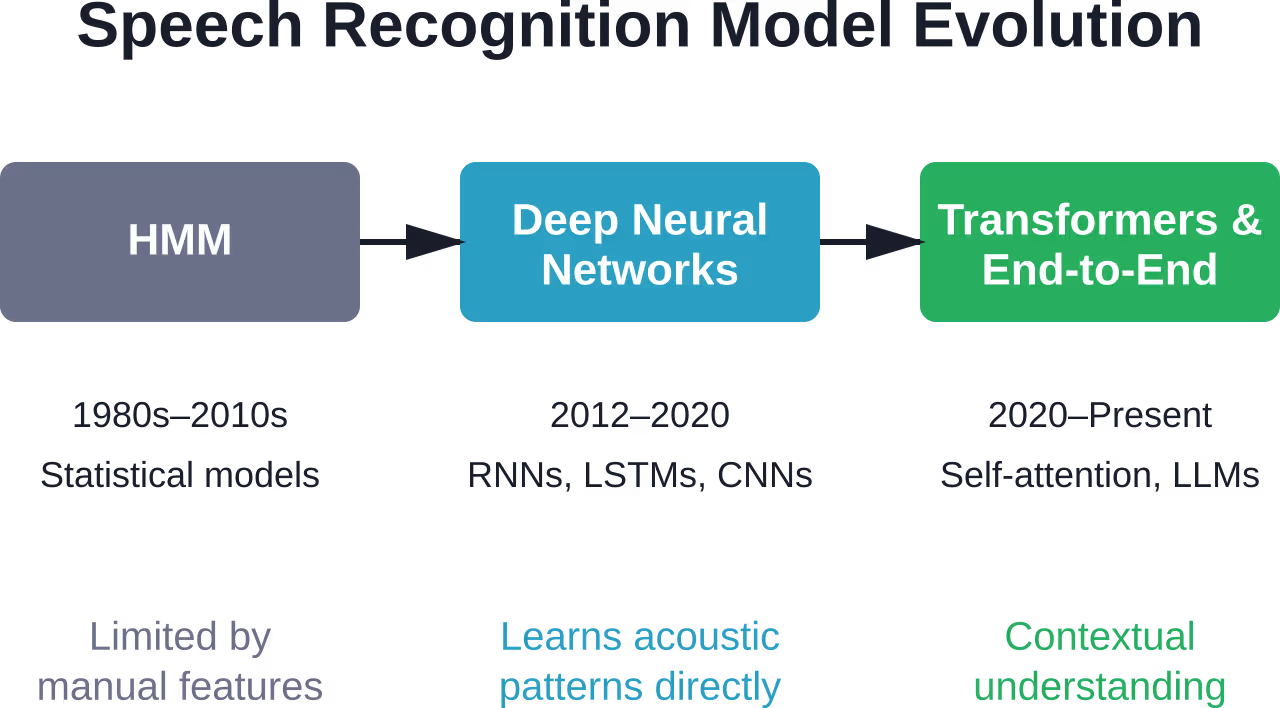
Hidden Markov Models (HMMs) dominated ASR for decades before deep learning arrived. These statistical models calculate the most likely sequence of hidden states—words—from observable data like sound waves.
HMMs work by breaking speech into small time frames and estimating probabilities for phoneme sequences. They’re computationally efficient and perform well with limited training data, making them useful for low-resource languages.
IEEE research on acoustic modeling shows HMMs still find applications in resource-constrained environments where deep learning models would be impractical. But they struggle with long-range dependencies and complex acoustic patterns.
Deep Neural Networks Enter the Scene
Deep learning dramatically improved speech recognition accuracy starting around 2012. Neural networks with multiple hidden layers could learn hierarchical acoustic features automatically—no manual feature engineering required.
Recurrent Neural Networks (RNNs) and their more advanced variant, Long Short-Term Memory (LSTM) networks, became popular because they handle sequential data naturally. Speech unfolds over time, and these architectures maintain memory of previous inputs.
IEEE surveys on deep learning techniques highlight how Convolutional Neural Networks (CNNs) also found success in speech recognition. Originally designed for image processing, CNNs excel at detecting local patterns in spectrograms—visual representations of audio.
The combination proved powerful: CNNs for feature extraction paired with RNNs for temporal modeling.
Transformers and End-to-End Models
The latest breakthrough came from transformer architectures. Originally developed for natural language processing, transformers use self-attention mechanisms to weigh the importance of different input segments.
Research published on arXiv on end-to-end speech recognition notes that deep learning enabled the shift from traditional multi-component systems to streamlined end-to-end models. Instead of separate acoustic and language models, these systems map audio directly to text in one integrated neural network.
End-to-end models simplify training and often achieve better accuracy because they optimize the entire pipeline together. They’ve become the dominant approach for high-resource languages with abundant training data.
Recent work on integrating pre-trained speech and language models shows promising results. By combining specialized speech encoders with large language models, researchers achieve superior contextualization—the system understands not just what was said, but what was likely meant.
| Model Type | Core Strength | Best Use Case | Limitation |
|---|---|---|---|
| Hidden Markov Models | Computationally efficient | Low-resource languages | Struggles with context |
| RNN/LSTM | Sequential processing | Moderate-length speech | Long-range dependencies |
| CNN | Local pattern detection | Feature extraction | Less effective for temporal modeling |
| Transformers | Self-attention mechanism | Long-form transcription | Requires large datasets |
| End-to-End | Integrated optimization | General-purpose ASR | Data-hungry |

Develop Speech Recognition Models With AI Superior
Speech recognition systems depend heavily on data quality, model training, and real-world testing. AI Superior can help teams build machine learning solutions for speech analysis, transcription, voice processing, or language-related automation tasks. Their work covers AI consulting, machine learning, NLP, deep learning, AI software development, proof of concept development, and model evaluation.
AI Superior can help with:
- Reviewing speech, audio, or language datasets
- Defining the speech recognition use case
- Building proof of concept models
- Developing speech-to-text or voice analysis systems
- Testing recognition accuracy and reliability
- Planning integration into software platforms or workflows
- Supporting deployment and AI model optimization
For speech recognition, this may include voice transcription, speaker identification, call analysis, voice command systems, multilingual speech processing, and conversational AI support.
Contact AI Superior to discuss the implementation approach.
How Speech Recognition Systems Learn
Training a speech recognition system requires massive datasets—thousands of hours of recorded speech paired with accurate transcripts. The model learns by comparing its predictions to the correct text and adjusting internal parameters to reduce errors.
The Training Process
Here’s what typically happens during training:
- Data preparation: Audio files get segmented and aligned with transcripts. Features like Mel-frequency cepstral coefficients (MFCCs) or spectrograms are extracted from raw waveforms.
- Model initialization: Neural network weights start with random values or are pre-trained on related tasks.
- Forward pass: Audio features flow through the network, producing predicted text or phoneme sequences.
- Loss calculation: The system measures how far predictions deviate from correct transcripts using metrics like Cross-Entropy or Connectionist Temporal Classification (CTC) loss.
- Backpropagation: Gradients flow backward through the network, updating weights to minimize loss.
This process repeats millions of times across the entire dataset. Models gradually learn which acoustic patterns correspond to which phonemes, words, and phrases.
Data Challenges and Solutions
Quality training data remains scarce for most languages. English, Mandarin, and a few others have extensive resources, but thousands of languages lack sufficient recorded speech.
IEEE research on low-resource speech recognition explores techniques like transfer learning—training on high-resource languages, then fine-tuning on the target language with limited data. Data augmentation also helps by artificially creating variations through speed changes, noise injection, or pitch shifts.
Another approach involves continual learning, where models update incrementally as new data becomes available. ArXiv research on online continual learning demonstrates how end-to-end models can adapt without catastrophic forgetting—losing previously learned information.
Measuring Speech Recognition Performance
How do we know if a speech recognition system works well? The most common metric is Word Error Rate (WER).
Understanding Word Error Rate
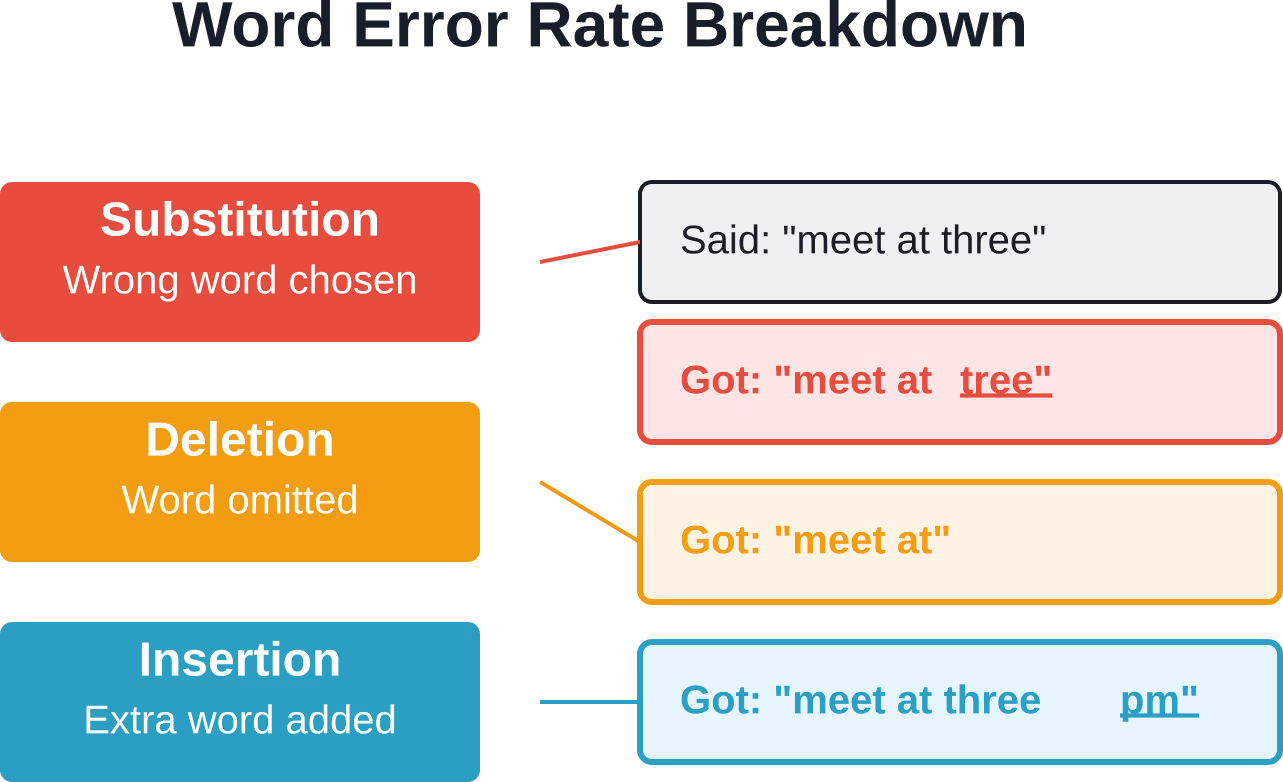
WER measures the percentage of words the system gets wrong. It counts three error types:
- Substitutions: Wrong word transcribed (e.g., “I’m good” becomes “I am good”)
- Deletions: Missing words the system skipped
- Insertions: Extra words the system hallucinated
The formula is straightforward: add all errors (substitutions + deletions + insertions) and divide by the total number of words in the correct transcript. Lower is better—0% represents perfect transcription.
Research from Lippmann estimates human transcription WER around 4%. That became the target benchmark for ASR systems. Modern commercial systems now approach or exceed human parity in controlled conditions, though real-world performance varies significantly.
Beyond WER: Other Metrics
WER doesn’t tell the whole story. A system might have low WER but still produce unusable transcripts if errors occur in critical words.
Additional metrics include:
- Character Error Rate (CER): Finer-grained than WER, useful for languages without clear word boundaries
- Real-Time Factor (RTF): Processing speed—RTF under 1.0 means faster than real-time
- Latency: Time delay between speech and transcription, critical for live applications
Context matters too. Medical transcription demands near-perfect accuracy on terminology. Voice commands for smart speakers tolerate higher error rates if the system understands intent.
Real-World Challenges That Still Exist
Despite impressive progress, speech recognition hasn’t solved every problem.
Accents and Dialects
Models trained predominantly on one accent struggle with others. A system trained on American English often fails with Scottish or Indian accents. The same language can sound radically different across regions.
This isn’t just inconvenient—it creates equity issues. Communities with underrepresented accents get worse service from voice-activated technologies.
Background Noise and Overlapping Speech
Controlled environments produce clean audio. Real life doesn’t. Background conversations, traffic, music, and mechanical noise all degrade performance.
Overlapping speech—multiple people talking simultaneously—remains particularly challenging. Most ASR systems assume one speaker at a time.
Domain-Specific Vocabulary
General-purpose models train on everyday conversation and common text. Domain-specific medical terminology remains challenging for general-purpose ASR systems without specialized training. Domain adaptation through fine-tuning helps, but requires specialized datasets.
Rare Words and Names
Language models predict likely word sequences based on training data. Rare words, proper nouns, and newly coined terms appear infrequently or not at all. Rare words and proper names may be misrecognized by systems with limited exposure to those terms. ArXiv research on contextualization with large language models shows promise—systems can incorporate external knowledge to handle uncommon terms.
Practical Applications Transforming Industries
Speech recognition powered by machine learning enables capabilities that seemed like science fiction a decade ago.
Virtual Assistants and Voice Control
Siri, Alexa, Google Assistant, and similar systems rely entirely on ASR. They process millions of voice queries daily, learning from interactions to improve accuracy.
Voice control extends beyond smartphones to cars, home automation, and accessibility devices. For people with mobility impairments, voice interfaces provide independence.
Medical Transcription
Doctors spend enormous time on documentation. Speech recognition allows them to dictate notes directly into electronic health records.
The challenge? Medical terminology is vast and pronunciation varies. Specialized medical ASR systems fine-tuned on clinical speech can achieve accuracy high enough for practical use, though human review remains standard.
Customer Service Automation
Call centers use speech recognition to route calls, transcribe conversations, and analyze sentiment. The technology identifies customer issues, monitors agent performance, and flags compliance problems.
Automated phone systems now understand natural speech rather than requiring keypad navigation. When they work well, they improve efficiency. When they fail, they are frustrated.
Accessibility and Inclusion
Real-time captioning makes video content accessible to deaf and hard-of-hearing individuals. YouTube’s automatic captions, while imperfect, provide value where manual transcription would be prohibitively expensive.
Speech recognition also assists language learners by providing pronunciation feedback and enabling conversation practice with AI tutors.
The Future: Where Speech Recognition Is Heading
Current research pushes several frontiers simultaneously.
Multimodal Integration
Combining audio with visual information—lip movements, facial expressions, gestures—improves accuracy and robustness. In noisy environments, seeing the speaker helps disambiguate sounds.
Research on wearable sensing systems demonstrates devices that capture vocal organ vibrations directly from the skin, enabling speech recognition even in silent articulation or extreme noise.
Personalization and Adaptation
Systems that learn individual speaking patterns, vocabulary preferences, and context achieve better performance. On-device learning enables this without sending private speech data to cloud servers.
ArXiv work on confidence-based ensembles explores combining multiple specialized models, selecting predictions based on confidence scores to improve overall accuracy.
Low-Resource Language Support
Most of the world’s 7,000+ languages lack speech recognition support. Self-supervised learning—training on unlabeled audio—and cross-lingual transfer learning make progress possible with minimal data.
The goal is universal speech recognition that works for everyone, regardless of which language they speak.
Emotional and Paralinguistic Understanding
IEEE research on speech emotion recognition shows systems moving beyond words to understand tone, stress, and emotional state. This matters for applications like mental health monitoring, customer satisfaction analysis, and more natural human-computer interaction.
But it also raises privacy concerns. Should systems constantly analyze our emotional state?
Getting Started with Speech Recognition
For developers interested in implementing ASR, several options exist depending on requirements.
Cloud-Based APIs
Services from Google, Amazon, Microsoft, and others provide production-ready speech recognition through simple API calls. They handle the complexity—models, infrastructure, updates—so developers can focus on applications.
The tradeoff? Cost, latency, and privacy. Audio gets sent to remote servers for processing.
Open-Source Frameworks
Tools like Mozilla’s DeepSpeech, Facebook’s wav2vec, and OpenAI’s Whisper offer free alternatives. They require more setup and computational resources but provide full control.
These models can run locally, keeping audio private and eliminating network dependencies.
Custom Model Training
Organizations with specialized needs and sufficient data can train custom models. This requires machine learning expertise, labeled training data, and significant compute resources.
Transfer learning reduces requirements by starting from pre-trained models and fine-tuning on specific domains.
Frequently Asked Questions
How accurate is machine learning-based speech recognition?
Modern systems achieve Word Error Rates below 5% in ideal conditions with clear audio and standard accents—comparable to human transcribers. However, accuracy drops significantly with background noise, unfamiliar accents, or specialized vocabulary. Real-world performance typically ranges from 80-95% accuracy depending on conditions.
What’s the difference between speech recognition and voice recognition?
According to IBM, speech recognition converts spoken words into text, focusing on what was said. Voice recognition identifies who is speaking based on unique vocal characteristics. Speech recognition powers transcription and voice commands, while voice recognition enables speaker identification and authentication.
Can speech recognition work offline?
Yes. While many commercial systems use cloud processing for better accuracy and lower device resource requirements, on-device speech recognition is possible. Smartphones increasingly include local ASR capabilities for privacy, reduced latency, and functionality without internet connectivity. Performance is typically lower than cloud-based alternatives but continues improving.
Why do speech recognition systems struggle with accents?
Models learn patterns from training data. If training data predominantly features one accent or dialect, the system becomes biased toward those speech patterns. Unfamiliar pronunciations, intonations, and phonetic variations cause errors. Solving this requires diverse, representative training datasets covering various accents—something many systems still lack.
How much training data does a speech recognition system need?
Requirements vary by approach. Traditional methods might need hundreds of hours of transcribed speech. Modern deep learning models typically require thousands of hours for high accuracy. However, transfer learning and pre-training techniques reduce requirements—fine-tuning a pre-trained model on a specific domain might need only 10-50 hours of specialized data.
What machine learning techniques are most common in modern ASR?
Deep neural networks dominate current systems. Recurrent networks (RNNs/LSTMs) and convolutional networks (CNNs) remain widely used, but transformer-based architectures increasingly lead in performance. End-to-end models that integrate acoustic and language modeling in one neural network represent the current state-of-the-art, according to arXiv surveys on speech recognition.
Can speech recognition understand multiple languages simultaneously?
Multilingual models that recognize multiple languages exist, but most systems work best when the language is specified beforehand. Code-switching—alternating between languages mid-conversation—remains challenging. Some recent models show promise in handling multiple languages and automatic language detection, but accuracy typically decreases compared to single-language specialized models.
Conclusion: Speech Recognition’s Ongoing Evolution
Machine learning transformed speech recognition from a constrained laboratory curiosity into technology billions use daily. Deep neural networks, transformers, and end-to-end architectures pushed accuracy to levels that seemed impossible just a decade ago.
But the journey isn’t finished. Challenges around accents, noise robustness, rare words, and low-resource languages require continued innovation. The field moves toward more inclusive, personalized, and contextually aware systems that understand not just words but meaning and emotion.
For developers, researchers, and businesses, speech recognition offers enormous opportunities. The technology enables new interfaces, improves accessibility, and automates tedious transcription tasks.
The machines learned to listen. Now they’re learning to truly understand.
 English
  German
  Arabic
  French
  Dutch
Dutch  Spanish