
Quick Summary: Machine learning has revolutionized sports betting by enabling more accurate predictions, dynamic odds adjustment, and sophisticated risk management. Calibration-optimized models generate 69.86% higher average returns compared to accuracy-optimized models, based on Walsh and Joshi study, while advanced algorithms process over 250 performance features to identify mispriced betting opportunities. Despite impressive gains, challenges around data quality, real-time decision-making, and ethical transparency remain critical for both bookmakers and bettors.
Sports betting isn’t what it used to be. Gone are the days when gut feelings and basic stats determined who placed winning bets. The industry has transformed into a data-driven battleground where machine learning algorithms analyze thousands of variables in milliseconds.
The numbers tell the story. The market for AI-driven betting analytics is projected to expand significantly, with projections ranging from approximately $1.7 billion in 2025 to $8.5 billion by 2033. That’s not just hype—it’s a reflection of how deeply machine learning has embedded itself into every corner of sports betting.
But here’s the thing: not all machine learning approaches are created equal. Recent academic research shows that optimizing for the right metrics can make the difference between profit and loss.
How Machine Learning Transformed Sports Betting
Machine learning represents a fundamental shift in how both bookmakers and bettors approach wagering. Traditional methods relied on historical trends and expert intuition. Modern approaches leverage algorithms that process vast datasets to uncover patterns invisible to human analysis.
The sports betting industry has experienced rapid growth, driven largely by technological advancements and the proliferation of online platforms. Machine learning hasn’t just improved predictions—it’s reshaped risk management, odds-setting, and fraud detection.
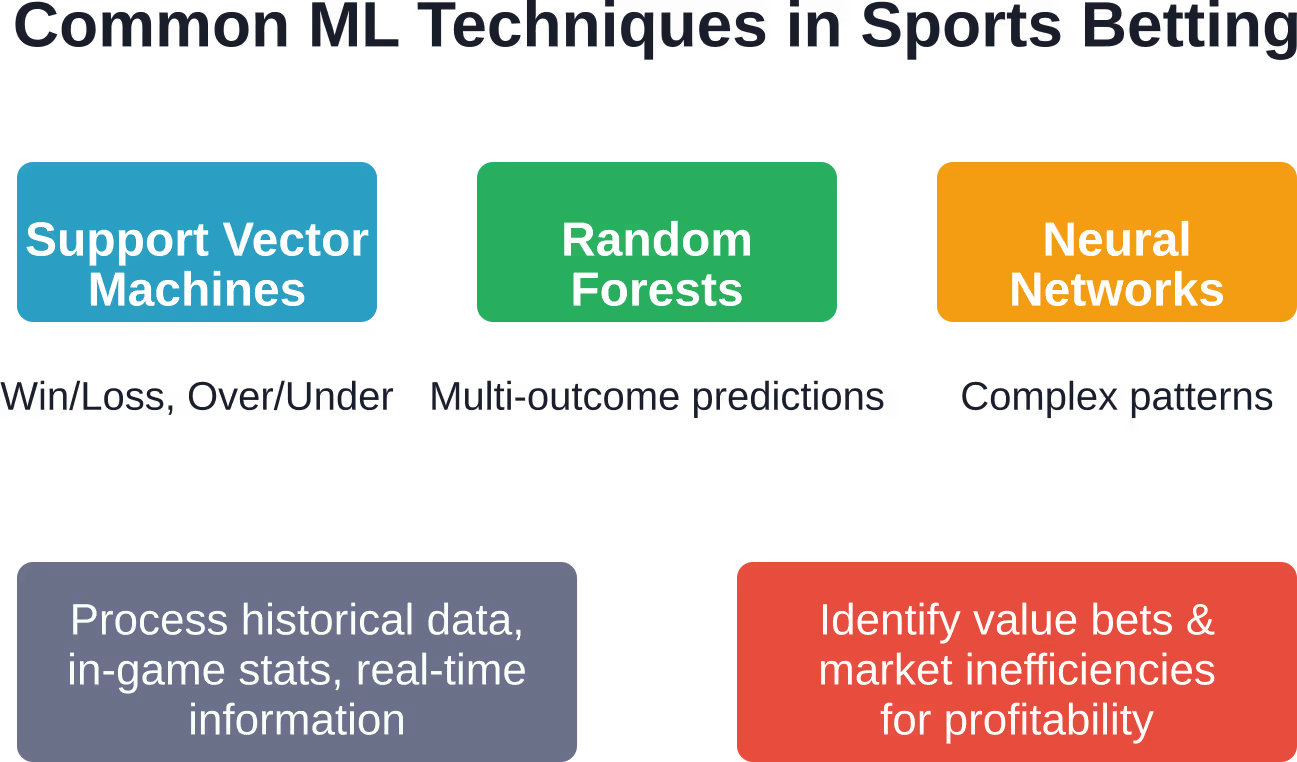
For bookmakers, algorithms facilitate dynamic odds adjustment in real-time. For bettors, data-driven insights help identify value bets where the actual probability of an outcome exceeds what the odds suggest. This creates a competitive environment where information asymmetry matters less than analytical sophistication.
The Core Techniques Powering Predictions
Several machine learning techniques have proven particularly effective across different sports. Support vector machines excel at binary classification problems—win or lose, over or under. Random forests handle complex feature interactions well, making them popular for multi-outcome predictions.
Neural networks have gained traction for their ability to model non-linear relationships in player performance and team dynamics. These deep learning models can process everything from rolling window statistics to game variables and advanced metrics.
Research from Vanderbilt University’s Data Science Institute explored models that created over 250 features to quantify player performance for NHL anytime goalscorer markets. That level of granularity—tracking everything from ice time to shooting percentages under specific game conditions—illustrates how far beyond basic stats modern approaches have evolved.

Explore Sports Betting ML Solutions With AI Superior
Sports betting workflows often depend on statistical modeling, probability analysis, historical data evaluation, and predictive systems. AI Superior can support organizations and research teams using machine learning for sports-related forecasting and analytical workflows.
AI Superior can help sports betting analytics projects with:
- Organizing historical and operational sports datasets
- Developing predictive and probability-based models
- Building proof of concept analytical systems
- Detecting trends and statistical patterns
- Testing model performance against historical outcomes
- Supporting integration into analytical environments
👉Talk with AI Superior about the analytical workflow and technical setup.
Calibration vs. Accuracy: The Metric That Actually Matters
Here’s where most approaches get it wrong. Many researchers and bettors optimize machine learning models for accuracy—the percentage of correct predictions. Sounds logical, right?
Turns out that’s backwards for sports betting. Academic research published in 2024 demonstrated something remarkable: calibration-optimized models generate 69.86% higher average returns compared to accuracy-optimized models, based on Walsh and Joshi study.
The difference is crucial. Accuracy measures how often a model correctly predicts outcomes. Calibration measures how well predicted probabilities match actual frequencies. When a calibrated model says an event has a 35% chance of happening, that event actually occurs about 35% of the time across many predictions.
Why Calibration Drives Profitability
Sports betting is fundamentally about recognizing when bookmaker odds are misaligned with true probabilities. A model that’s 80% accurate but poorly calibrated might confidently assign 90% probability to outcomes that actually occur 70% of the time. That overconfidence leads to poor bet selection.
Researchers Walsh and Joshi tested this hypothesis using NBA data over several seasons. In NBA betting experiments, the calibration-optimized model achieved a return on investment of +34.69% versus -35.17% for the accuracy-focused approach. In the best case scenario, calibration delivered +36.93% compared to +5.56% for accuracy.
These findings suggest that for sports betting—or any probabilistic decision-making problem—calibration matters more than raw predictive accuracy. Bettors who select models based on calibration rather than accuracy stand a better chance of long-term profitability.
| Model Selection Criterion | Average ROI | Best Case ROI | Key Advantage |
|---|---|---|---|
| Accuracy-Optimized | -35.17% | +5.56% | High prediction rate |
| Calibration-Optimized | +34.69% | +36.93% | Accurate probability estimates |
| Performance Gap | 69.86% higher | 31.37% higher | Better bet selection |
Sport-Specific Applications and Results
Machine learning performance varies significantly across sports. The nature of the game, data availability, and event frequency all influence model effectiveness.
Soccer presents unique challenges with low-scoring outcomes and frequent draws. Research covering 13 seasons of Dutch Eredivisie matches (2000-2013) explored various prediction approaches for match outcomes. The continuous game flow and tactical variability make soccer particularly complex for algorithmic modeling.
Basketball offers richer data streams. High-scoring games, detailed player tracking, and possession-by-possession statistics create favorable conditions for machine learning. In basketball, machine learning models have demonstrated higher accuracy rates compared to older statistical approaches, though exact performance varies by model and season.
Tennis, Cricket, and Individual Sports
Tennis benefits from head-to-head matchups with extensive historical data. Player form, surface preferences, and serving statistics feed into models predicting match outcomes and set scores. The individual nature eliminates team chemistry variables that complicate team sports modeling.
Cricket applications leverage ball-by-ball data, player performance metrics, and match conditions. Limited-overs formats like Twenty20 provide structured scenarios that machine learning handles well. Test cricket’s longer format introduces complexity through changing pitch conditions and weather factors.
Hockey presents interesting opportunities, particularly for player proposition bets. The NHL anytime goalscorer market research from Vanderbilt’s Data Science Institute focused on identifying positive expected value bets by finding mispriced opportunities in sportsbook odds.
How Bookmakers Use Machine Learning
Bookmakers face different challenges than bettors. Their goal isn’t picking winners—it’s setting odds that balance their books and manage risk exposure.
Machine learning enables dynamic odds adjustment based on betting volume, injury news, and real-time game developments. When sharp money floods in on one side, algorithms recalibrate lines to attract offsetting action.
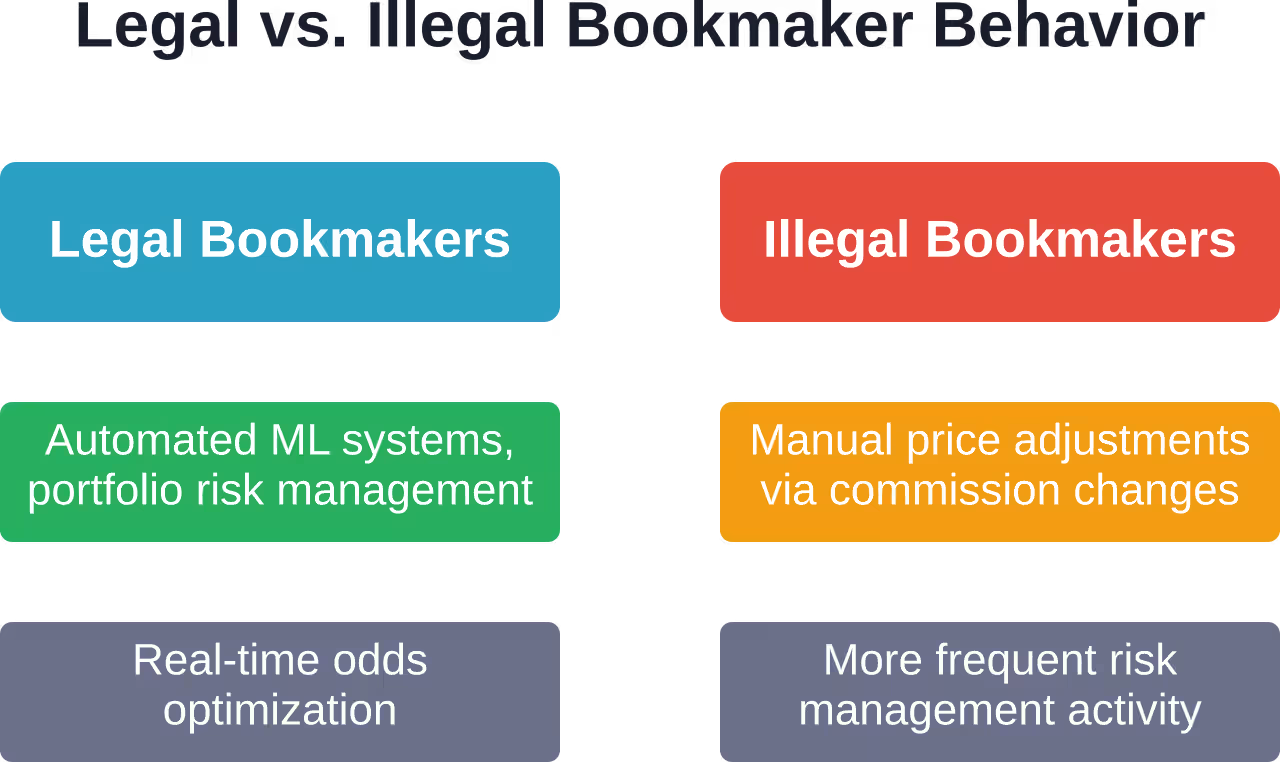
Research comparing legal and illegal bookmakers found differences in risk management approaches, with illegal operators engaging in more frequent price adjustments through commission changes compared to legal operators.
Legal operators rely more heavily on automated systems and sophisticated modeling. They leverage machine learning for portfolio-style risk management across thousands of simultaneous markets, optimizing overall exposure rather than individual bet outcomes.
Fraud Detection and Market Integrity
As sports betting expands, fraud threatens market integrity. Match-fixing, syndicate betting, and insider trading require sophisticated detection mechanisms.
Machine learning excels at identifying anomalous patterns. According to Onfido’s Identity Fraud Report, fraud rates in the sports betting industry rose from 4.2% in 2022 to 7.6% in 2023. That surge makes prevention more critical than ever.
Anomaly detection models flag suspicious betting patterns—large wagers from new accounts, coordinated activity across multiple bettors, or unusual odds movements without corresponding news. AI-powered systems analyze real-time data to detect unusual patterns, stopping fraud early and minimizing monetary damage.
Protecting All Stakeholders
Fraud detection protects multiple parties. Legitimate bettors deserve fair markets free from manipulation. Bookmakers need to prevent losses from coordinated attacks. Sports leagues must maintain competitive integrity to preserve fan trust.
Machine learning models process betting volume, timing patterns, geographic distribution, and account behavior. When clusters of indicators align, automated systems can pause markets, flag accounts for review, or trigger manual investigation.
The technology isn’t perfect. False positives can frustrate legitimate customers. But the alternative—undetected fraud—poses existential risks to the industry’s credibility and financial stability.
Data Requirements and Feature Engineering
Machine learning models are only as good as the data feeding them. Sports betting applications require diverse, high-quality inputs.
Historical performance data forms the foundation—win-loss records, scoring statistics, head-to-head results. Player-level metrics add granularity: shooting percentages, passing accuracy, defensive ratings, injury history.
Contextual factors matter enormously. Home-field advantage, rest days, weather conditions, referee assignments, and playoff implications all influence outcomes. Advanced models incorporate these variables through careful feature engineering.
Real-Time Data Integration
In-play betting demands real-time data processing. Models must update probabilities as games unfold, reacting to scores, injuries, momentum shifts, and strategic adjustments.
That creates technical challenges. Latency matters—odds must update faster than bettors can exploit stale information. Data quality varies across sources. Missing values, reporting errors, and inconsistent formats require robust preprocessing pipelines.
The most sophisticated approaches use rolling window statistics that capture recent form while retaining historical context. A player’s performance over the last 10 games might matter more than their career average, but both inform the complete picture.
Challenges and Limitations
Despite impressive advances, machine learning in sports betting faces fundamental constraints. Sports are inherently unpredictable. Injuries, weather, officiating decisions, and plain luck introduce irreducible randomness.
Data quality issues persist across the industry. Inconsistent record-keeping, missing historical data, and biased samples (survivorship bias, selection bias) undermine model reliability. Cleaning and validating sports data demands significant effort.
Real-time decision-making remains technically challenging. Processing streams of live data, updating complex models, and delivering predictions with minimal latency requires substantial infrastructure investment.
The Overfitting Trap
Overfitting poses particular risks in sports betting. Models trained on historical data may capture noise rather than signal, performing well on past games but failing to generalize to future matchups.
Cross-validation helps, but sports evolve. Rule changes, tactical innovations, and player development mean that relationships observed in past data may not hold going forward. The 2015-2016 Golden State Warriors revolutionized basketball offense—models trained before that era wouldn’t capture modern three-point shooting dynamics.
Ethical concerns deserve attention too. Transparency in algorithmic odds-setting, responsible gaming protections, and fairness in market access all matter. Sophisticated bettors with better data and models gain advantages over casual players, raising questions about market equity.
| Challenge | Impact on Models | Mitigation Strategy |
|---|---|---|
| Data quality issues | Unreliable predictions | Robust preprocessing, validation |
| Real-time processing | Latency in odds updates | Streaming architectures, edge computing |
| Inherent randomness | Prediction ceiling | Probabilistic approaches, calibration focus |
| Overfitting | Poor generalization | Cross-validation, regularization techniques |
| Market evolution | Model drift | Continuous retraining, adaptive algorithms |
Future Directions and Emerging Trends
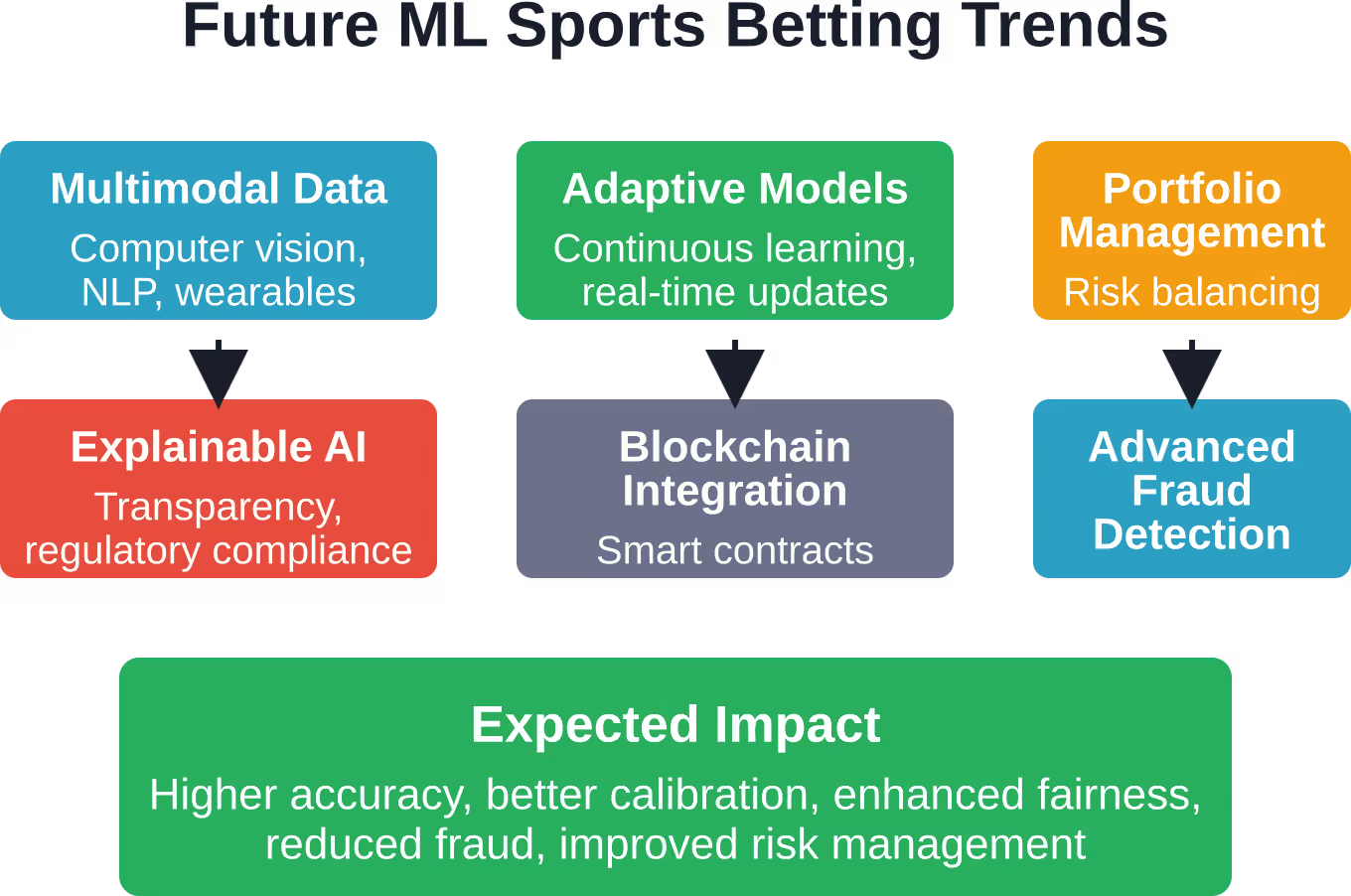
The next generation of sports betting machine learning will integrate multimodal data sources. Computer vision analyzing player positioning and movement patterns, natural language processing extracting insights from news and social media, and biomechanical data from wearables all promise richer feature sets.
Adaptive models that continuously learn from new data will replace static approaches trained once on historical datasets. Online learning techniques allow algorithms to update predictions as games unfold and seasons progress, capturing evolving dynamics.
Portfolio-style risk management is already emerging. Rather than optimizing individual bets, sophisticated bettors and bookmakers manage collections of wagers to balance risk and return across correlated markets. This mirrors financial portfolio theory, treating bets as assets with expected returns and covariance structures.
Explainable AI and Transparency
As regulations tighten, explainable AI becomes more important. Bookmakers may need to justify odds to regulators. Bettors want to understand why models recommend specific wagers. Black-box neural networks that deliver accurate predictions without interpretability face adoption barriers.
Techniques like SHAP values and attention mechanisms help illuminate model decision-making. Showing that a basketball total prediction heavily weights pace of play, offensive efficiency, and defensive rating builds trust compared to opaque recommendations.
Blockchain integration could enhance transparency and fairness. Smart contracts might automate payouts based on verifiable outcomes, while distributed ledgers create tamper-proof records of odds and wager history.
Practical Considerations for Bettors
What does all this mean for someone looking to apply machine learning to sports betting? First, understand that building competitive models requires substantial expertise and resources.
Data acquisition alone poses challenges. Quality historical data costs money. Maintaining clean, up-to-date datasets demands ongoing effort. Real-time data feeds for in-play betting require subscriptions and technical infrastructure.
Model development isn’t trivial either. Feature engineering—deciding which variables to include and how to transform them—requires domain knowledge about the sport. Algorithm selection, hyperparameter tuning, and validation all demand technical skills.
Start Small and Focus on Niches
Community discussions suggest starting with narrow markets where information advantages exist. Major sports and high-profile games attract sophisticated bettors and efficient odds. Smaller leagues, prop bets, and niche markets may offer more opportunities for those willing to specialize.
Bankroll management remains critical regardless of model sophistication. Even well-calibrated models face variance. Betting too aggressively on individual wagers risks ruin even with positive expected value over the long term.
Testing strategies through paper trading or minimal stakes before scaling up helps validate models without risking significant capital. Tracking detailed records of predictions, actual outcomes, and profitability enables continuous improvement.
Frequently Asked Questions
How accurate are machine learning sports betting predictions?
In basketball, machine learning models have demonstrated higher accuracy rates compared to older statistical approaches, though exact performance varies by model and season. However, raw accuracy matters less than calibration—how well predicted probabilities match actual outcome frequencies. Well-calibrated models that optimize for probability estimation rather than just correct picks generate substantially higher returns.
What’s the difference between calibration and accuracy in betting models?
Accuracy measures how often a model correctly predicts outcomes (win/loss, over/under). Calibration measures whether predicted probabilities align with actual frequencies. A calibrated model that predicts 35% probability will be correct about 35% of the time across many predictions. Research shows calibration-optimized models generate 69.86% higher average returns compared to accuracy-optimized models, based on Walsh and Joshi study, because they better identify mispriced odds.
Can machine learning guarantee profits in sports betting?
No. Sports contain inherent randomness that no model can eliminate. Injuries, weather, officiating, and luck create unpredictability. Machine learning can identify positive expected value opportunities where probabilities favor the bettor, but variance means losing streaks occur even with sound strategies. Proper bankroll management and realistic expectations are essential—machine learning improves edge but doesn’t eliminate risk.
What data do machine learning betting models need?
Effective models require historical performance data (scores, win-loss records), player-level statistics (shooting percentages, defensive metrics, injury history), contextual factors (home/away, rest days, weather, referee assignments), and for in-play betting, real-time game data. Advanced approaches use over 250 features including rolling window statistics and advanced metrics. Data quality and consistency matter more than sheer volume.
How do bookmakers use machine learning?
Bookmakers leverage machine learning for dynamic odds adjustment, risk management across thousands of simultaneous markets, and fraud detection. Algorithms respond to betting volume patterns, injury news, and real-time game developments to maintain balanced books and manage exposure. Legal operators rely heavily on automated systems and portfolio-style risk management rather than manual adjustments.
What are the biggest challenges in applying machine learning to sports betting?
Key challenges include data quality issues (missing values, inconsistencies, biases), real-time processing requirements for in-play betting, inherent sports unpredictability, overfitting risks where models capture noise rather than signal, and market evolution that causes model drift. Fraud rates increased from 4.2% to 7.6% in one year, making detection critical. Ethical concerns around transparency and fairness also require attention.
Should beginners try to build their own machine learning betting models?
Building competitive models demands substantial expertise in data science, sports domain knowledge, and technical infrastructure. Beginners face steep learning curves and established competition. Starting with narrow niche markets, paper trading to validate approaches, minimal stakes before scaling, and thorough record-keeping helps manage risk. Many find more success leveraging existing analytical tools and focusing on disciplined bankroll management rather than building models from scratch.
Conclusion
Machine learning has fundamentally transformed sports betting, enabling more sophisticated predictions, dynamic odds-setting, and advanced risk management. The technology offers clear advantages—calibration-optimized models demonstrate 69.86% higher average returns compared to accuracy-focused approaches, based on Walsh and Joshi study, while algorithms processing over 250 features can identify mispriced opportunities in real-time.
But challenges remain. Data quality, inherent sports randomness, overfitting risks, and ethical concerns around transparency all constrain what machine learning can achieve. According to Onfido’s Identity Fraud Report, fraud rates in the sports betting industry rose from 4.2% in 2022 to 7.6% in 2023, underscoring the need for sophisticated detection mechanisms.
Looking ahead, multimodal data integration, adaptive learning algorithms, portfolio-style risk management, and explainable AI will shape the next generation of sports betting applications. The market for AI-driven betting analytics is projected to expand significantly, with projections ranging from approximately $1.7 billion in 2025 to $8.5 billion by 2033, reflecting both the technology’s promise and the industry’s commitment to data-driven approaches.
For bettors, the message is clear: calibration matters more than accuracy, niche markets may offer better opportunities than major leagues, and bankroll management remains critical regardless of model sophistication. Machine learning is a powerful tool, not a guarantee—those who understand its capabilities and limitations stand the best chance of long-term success.
Ready to explore how data-driven strategies can improve betting outcomes? Start by understanding the fundamentals of calibration, invest in quality data sources, and test approaches rigorously before committing significant capital. The intersection of sports and machine learning continues to evolve—staying informed about emerging techniques and market dynamics provides competitive advantages in this rapidly growing industry.
 English
  German
  Arabic
  French
  Dutch
Dutch  Spanish