
Quick Summary: Machine learning is transforming market research by enabling rapid data analysis, predictive consumer insights, and automated personalization at scale. Organizations are increasingly adopting synthetic personas and AI-driven analytics to reduce research costs while uncovering patterns in consumer behavior that traditional methods miss. As of 2026, the integration of ML tools enables researchers to process millions of data points significantly faster than traditional methods, fundamentally shifting how businesses understand and respond to market demands.
Market research has always been a slow dance. Companies spend months collecting data, analyzing surveys, and interpreting focus groups—only to discover the market has shifted by the time they publish findings.
Machine learning changes that equation entirely.
Today’s ML algorithms process vast datasets in hours, identify patterns human analysts would miss, and predict consumer behavior with remarkable accuracy. Harvard Business Review reports that generative AI and synthetic personas are now enabling organizations to simulate consumer responses, dramatically cutting both time and cost of traditional research methods.
But here’s the thing: this isn’t just about speed. Machine learning is fundamentally reshaping what’s possible in market research—from how we collect data to how we interpret human behavior at scale.
How Machine Learning Revolutionizes Data Collection and Analysis
Traditional market research relied on surveys, focus groups, and manual data entry. The process was labor-intensive and prone to human error. Machine learning flips this model.
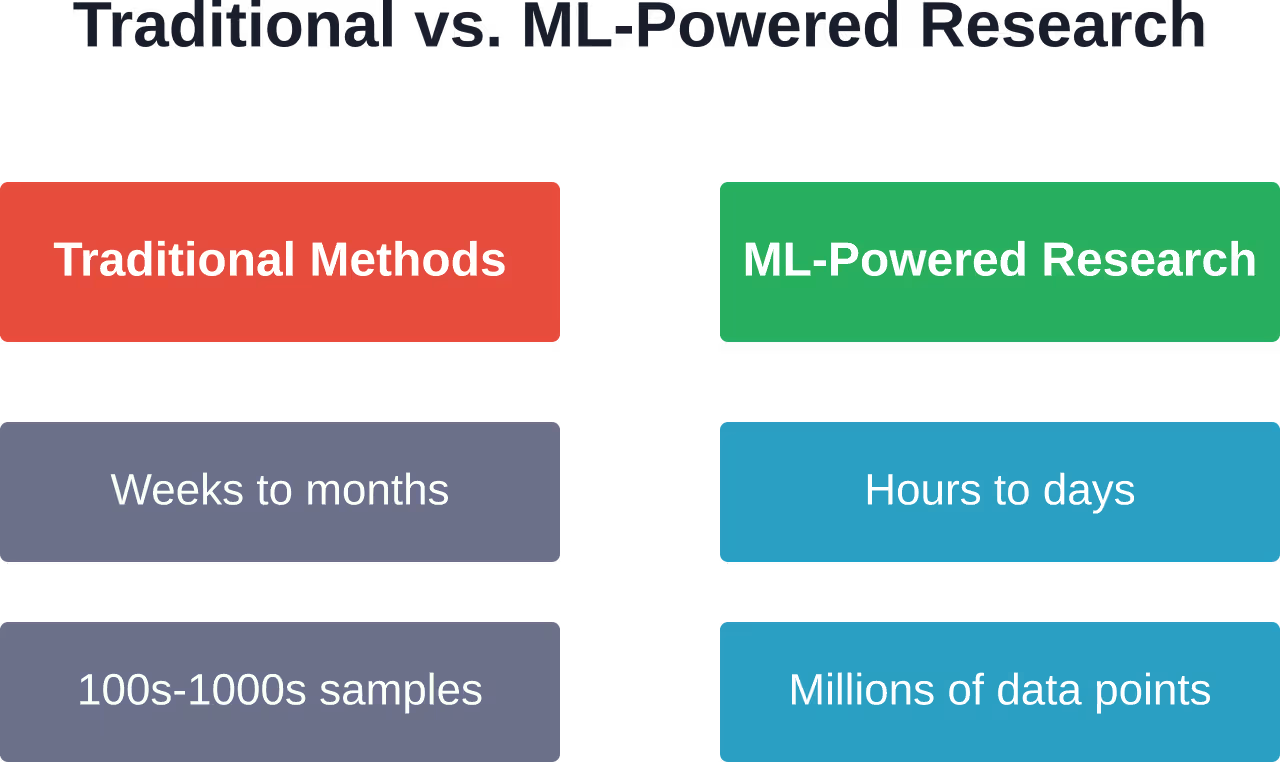
ML algorithms now ingest data from dozens of sources simultaneously: social media sentiment, purchase histories, web behavior, customer service interactions, and more. Rather than sampling a few hundred people, researchers analyze millions of data points in real time.
Real-Time Data Processing at Scale
The scale difference is staggering. Where traditional methods might survey 1,000 respondents over several weeks, machine learning systems process behavioral data from millions of users continuously.
This shift enables researchers to spot emerging trends as they happen rather than discovering them months later in quarterly reports. Consumer preferences shift quickly—ML tools track those shifts in real time.
Handling Unstructured Data
Most consumer data is unstructured: social media posts, customer reviews, support tickets, forum discussions. Traditional analysis struggled with this messiness.
Natural language processing—a subset of machine learning—excels here. Sentiment analysis algorithms read thousands of product reviews per minute, categorizing emotional tone, identifying common complaints, and flagging emerging issues before they become crises.
Research in natural language processing literature shows that sentiment analysis has become significant across sectors including healthcare, finance, and customer relationship management. The ability to quantify qualitative data transforms how researchers understand consumer attitudes.
Predictive Analytics: Understanding Tomorrow’s Consumer
Machine learning doesn’t just describe what happened—it predicts what’s coming next.
Predictive models analyze historical patterns to forecast future behavior: which customers are likely to churn, which products will trend next quarter, which market segments are poised for growth.
Consumer Behavior Forecasting
ML algorithms identify subtle correlations humans miss. A sudden spike in searches for a specific ingredient might predict demand for related products weeks before traditional research spots the trend.
These models continuously learn and refine their predictions. As new data arrives, the algorithm adjusts its understanding, becoming more accurate over time without manual recalibration.
Harvard Business Review’s research on synthetic personas demonstrates how digital twins—AI-generated proxies of real consumers—can simulate responses to hypothetical products or campaigns before companies invest in full production.
Market Segmentation at Scale
Traditional segmentation divided markets into broad categories: age groups, income brackets, geographic regions. Machine learning creates micro-segments based on behavioral patterns.
Rather than targeting “women aged 25-35,” ML models identify “frequent evening browsers who abandon carts but respond to next-day email offers with free shipping.” This granularity drives dramatically higher conversion rates.
| Segmentation Approach | Granularity | Update Frequency | Actionability |
|---|---|---|---|
| Traditional Demographics | Broad categories | Quarterly/Annual | General campaigns |
| Behavioral ML Segmentation | Micro-segments | Real-time | Personalized 1:1 messaging |
| Psychographic Analysis | Attitude-based groups | Semi-annual | Brand positioning |
| ML Predictive Segments | Intent-based clusters | Continuous | Proactive targeting |
Personalization and Hyper-Targeting: The New Standard
Generic marketing messages are dying. Consumers expect brands to understand their preferences and deliver relevant content.
Machine learning makes personalization possible at scale—something that would be impossible manually with millions of customers.
Dynamic Content Optimization
ML algorithms test thousands of content variations simultaneously, learning which headlines, images, and calls-to-action resonate with specific user segments.
This goes beyond simple A/B testing. Multi-armed bandit algorithms continuously optimize in real time, allocating more traffic to better-performing variants while still exploring new options.
Real-world results are compelling. According to a Salesforce case study, Turtle Bay Resort achieved a 40% increase in customer engagement using ML-powered personalization by personalizing content based on booking behavior—offering snorkeling promotions to guests who booked water activities, and excursions to those interested in exploration.
Recommendation Engines
Recommendation systems are machine learning’s most visible consumer-facing application. These engines analyze purchase history, browsing patterns, and similar user behaviors to suggest products customers are likely to want.
The algorithms behind these systems use collaborative filtering, content-based filtering, or hybrid approaches—constantly learning from user interactions to improve suggestions.
Synthetic Personas and Digital Twins: The Frontier of Research
Here’s where things get really interesting.
Generative AI now creates synthetic personas—AI-generated representations of market segments that can simulate consumer responses without recruiting actual participants. Harvard Business Review identifies this as one of the most transformative developments in market research.
How Synthetic Personas Work
These tools aggregate demographic and psychographic data to build representative models of target segments. Researchers can then “interview” these synthetic consumers, testing messaging, product concepts, or pricing strategies.
Digital twins take this further by replicating individual consumers with granular data, enabling more nuanced testing of how specific customer types might respond to new offerings.
Early validation studies suggest these synthetic methods closely mirror human responses in certain domains, though researchers emphasize the need for periodic validation against real-world benchmarks to catch biases and limitations.
Cost and Speed Advantages
Traditional custom research required months and significant investment. Synthetic personas deliver preliminary insights in days at a fraction of the cost.
This speed enables iterative testing. Companies can refine concepts through multiple rounds of synthetic testing before committing to expensive human studies for final validation.
That said, the technology isn’t perfect. Harvard Business Review notes challenges in capturing the full diversity of human opinion and potential biases in training data. Smart organizations use synthetic personas for rapid exploration, then validate key findings with traditional methods.
Automation and Efficiency Gains Across Research Operations
Machine learning automates countless tedious research tasks that previously consumed hours of analyst time.
Survey coding, data cleaning, transcript analysis, anomaly detection—ML handles these at scale, freeing researchers to focus on strategic interpretation rather than mechanical processing.
Automated Survey Analysis
Open-ended survey responses once required manual coding by trained analysts. ML-powered text classification now categorizes thousands of responses in minutes, identifying themes and sentiment patterns automatically.
Continuous Monitoring Systems
Rather than periodic research waves, ML enables always-on monitoring. Algorithms track brand sentiment, competitive positioning, and market trends continuously, alerting researchers when significant shifts occur.
This shift from snapshot research to continuous intelligence fundamentally changes how organizations understand their markets. Decisions are based on current data rather than months-old findings.
Key Applications of Machine Learning in Market Research
Let’s get specific about where ML delivers the most value.
Sentiment Analysis and Social Listening
ML algorithms monitor social media, review sites, and forums to gauge public sentiment about brands, products, or topics. Natural language processing identifies not just positive/negative sentiment but nuanced emotions: frustration, excitement, confusion, delight.
This real-time pulse on consumer attitudes helps companies respond quickly to emerging issues or capitalize on positive momentum.
Price Optimization
Dynamic pricing algorithms analyze demand patterns, competitor pricing, inventory levels, and dozens of other variables to recommend optimal pricing strategies.
These systems learn which customer segments are price-sensitive and which prioritize other factors, enabling sophisticated price discrimination that maximizes revenue without alienating customers.
Churn Prediction
ML models identify customers at risk of leaving before they actually churn. By analyzing behavioral signals—declining usage, support tickets, reduced engagement—algorithms flag at-risk accounts for proactive retention efforts.
Research shows these models can predict churn with remarkable accuracy, enabling targeted interventions that retain valuable customers.
Content Performance Prediction
Before launching campaigns, ML models can predict which creative approaches are likely to resonate with target audiences based on historical performance data and current trends.
This reduces waste on underperforming content and accelerates identification of winning concepts.
| ML Application | Primary Benefit | Typical Use Case | Data Requirements |
|---|---|---|---|
| Sentiment Analysis | Real-time brand monitoring | Crisis detection and response | Social media, reviews, forums |
| Predictive Segmentation | Precise targeting | Personalized campaign delivery | Behavioral data, demographics |
| Churn Prediction | Proactive retention | At-risk customer outreach | Usage patterns, engagement metrics |
| Price Optimization | Revenue maximization | Dynamic pricing strategies | Purchase history, demand signals |
| Recommendation Engines | Cross-sell/upsell | Product suggestions | Purchase/browsing history |

Apply Machine Learning to Market Research With AI Superior
Market research projects often combine customer feedback, survey responses, behavioral information, and statistical analysis. AI Superior supports organizations using machine learning to process and analyze research-related datasets more efficiently. Their work includes AI consulting, NLP, machine learning, data science, and AI software implementation.
AI Superior can contribute to market research projects through:
- Processing structured and unstructured research data
- Developing classification and segmentation models
- Applying NLP methods to feedback and survey analysis
- Building proof of concept analytical workflows
👉Reach out to AI Superior to discuss the research goals and implementation plan.
Challenges and Considerations in ML Adoption
Machine learning isn’t a magic solution. Implementation comes with real challenges.
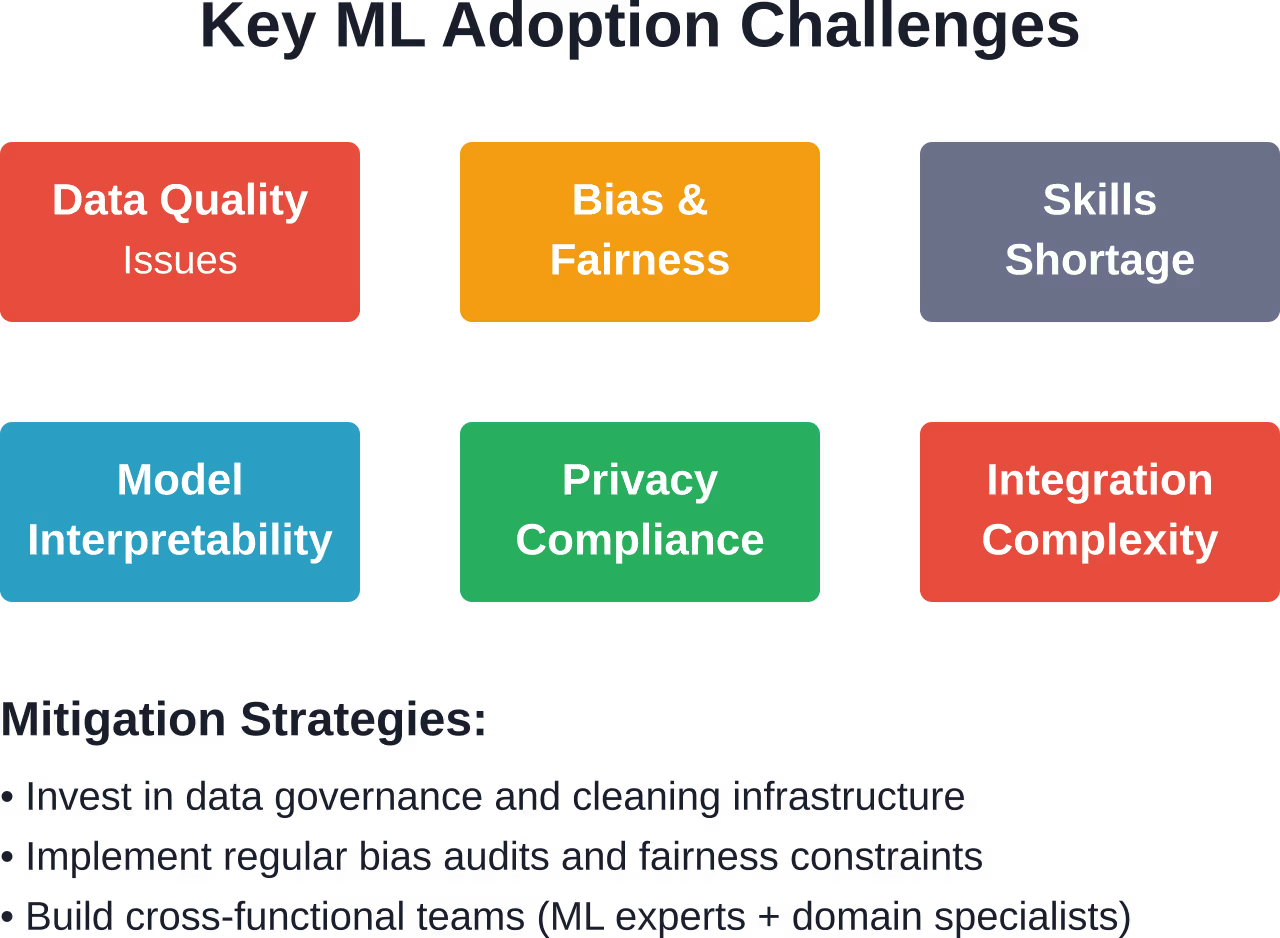
Data Quality and Availability
ML models are only as good as their training data. Garbage in, garbage out remains the fundamental rule.
Many organizations discover their data is fragmented across systems, inconsistently formatted, or riddled with gaps. Cleaning and integrating this data often represents the bulk of an ML project’s effort.
Bias and Fairness Concerns
ML models can perpetuate and amplify biases present in training data. Research indicates that predictive credit-scoring tools may be between 5 and 10 percent less accurate for lower-income families and minority borrowers compared to other populations.
Researchers must actively audit models for bias and implement fairness constraints to prevent discriminatory outcomes. This requires ongoing vigilance, not one-time checks.
Interpretability and Explainability
Complex ML models—particularly deep learning systems—often function as “black boxes.” They make accurate predictions but can’t explain why in terms humans easily understand.
For market research, where stakeholders need to understand the “why” behind insights, this opacity creates challenges. Explainable AI techniques help but add complexity.
Skills Gap and Talent Shortage
According to the Bureau of Labor Statistics cited in Coursera, ML employment is projected to grow by 20 percent from 2024 to 2034—much faster than the average for all occupations.
This rapid growth reflects surging demand, but it also highlights a talent shortage. Organizations struggle to find professionals who combine ML expertise with market research domain knowledge.
Salaries reflect this scarcity. Median yearly compensation ranges from approximately $125,000 for ML data analysts to higher amounts for principal data scientists in finance, with salaries varying significantly by role and experience.
Privacy and Regulatory Compliance
ML models often require detailed personal data to deliver personalization. This creates tension with privacy regulations like GDPR and CCPA.
Research on privacy policy analysis from arXiv notes that users would need to spend at least 181 hours per year to read applicable privacy policies—an impossible burden. The incomprehension of policies affects both users and service providers.
Organizations must balance ML capabilities with privacy obligations, implementing robust consent management and data governance frameworks.
The Market Landscape: Growth and Investment Trends
The machine learning market is experiencing explosive growth. Industry analyses show the global ML market is projected to increase from $91.31 billion in 2025 to $1.88 trillion by 2035, according to market research firms.
The machine learning-as-a-service segment is expanding even faster, rising from $45.76 billion in 2025 to approximately $209.63 billion by 2030. This growth reflects increasing enterprise adoption as cloud-based ML platforms lower barriers to entry.
Investment Priorities
A May 2024 Forrester survey revealed that 67% of AI decision-makers plan to increase investment in generative AI within the next year.
This investment surge isn’t speculative. Organizations are seeing measurable returns: research suggests AI can improve business efficiency significantly, with improvements projected through 2035, with potential cost reductions across operations.
Industry-Specific Adoption
Financial services led early ML adoption, using algorithms for fraud detection, risk assessment, and trading decisions. Retail followed quickly with recommendation engines and demand forecasting.
Now adoption is spreading broadly. Healthcare uses ML for patient outcome prediction, manufacturing for quality control, and media companies for content optimization. Market research benefits accumulate across all sectors.
Practical Steps for Implementing ML in Market Research
So how should organizations actually get started?
Start with Clearly Defined Use Cases
Don’t implement ML for its own sake. Identify specific research challenges where ML offers clear advantages: perhaps automating survey coding, improving segmentation precision, or predicting campaign performance.
Define success metrics upfront. What accuracy level makes the model useful? How much time savings justifies the implementation cost?
Build on Existing Data Infrastructure
Audit current data sources and quality. Successful ML requires clean, accessible data—often from multiple systems that need integration.
Invest in data pipelines and governance before rushing into model development. The infrastructure work isn’t glamorous but determines project success.
Experiment and Validate Iteratively
Harvard Business Review recommends organizations experiment with emerging tools like synthetic personas while carefully validating synthetic data against real-world benchmarks.
Start with pilot projects in low-risk areas. Learn what works, refine approaches, then scale successful applications.
Combine ML with Human Expertise
The most effective research operations blend ML capabilities with human judgment. Algorithms excel at pattern recognition and processing scale; humans provide context, strategic thinking, and ethical oversight.
Design workflows where ML handles data-intensive tasks while researchers focus on interpretation, strategic recommendations, and stakeholder communication.
Address Skills Gaps Proactively
Build cross-functional teams that combine ML technical skills with market research domain expertise. Neither skill set alone is sufficient.
Many data scientists hold four-year degrees in computer science or related fields, though professionals come from diverse academic backgrounds including statistics, economics, and social sciences.
The Future: What’s Next for ML in Market Research
The trajectory is clear: machine learning will become the default approach for market research, not an experimental add-on.
Multimodal AI Integration
Next-generation models will analyze text, images, video, and audio simultaneously. Imagine algorithms that watch focus group recordings, analyzing not just words but facial expressions, tone of voice, and group dynamics to extract deeper insights.
Real-Time Adaptive Research
Research will shift from discrete projects to continuous intelligence streams. ML systems will constantly monitor markets, automatically triggering deep-dive analyses when anomalies or opportunities emerge.
Democratization of Advanced Analytics
As ML tools become more accessible through no-code platforms and pre-built models, smaller organizations will access capabilities previously reserved for enterprises with dedicated data science teams.
Enhanced Synthetic Research Validation
Synthetic persona technology will mature, with better validation frameworks that clearly define when synthetic methods are reliable versus when human participation remains essential.
The key is thoughtful adoption. Organizations that experiment early, validate carefully, and build strong data foundations will gain lasting competitive advantages in understanding their markets.
Frequently Asked Questions
What is machine learning in market research?
Machine learning in market research refers to the application of algorithms that automatically learn from data to identify patterns, make predictions, and generate insights about consumer behavior, market trends, and business opportunities. Unlike traditional statistical methods, ML models improve their accuracy over time as they process more data, enabling researchers to analyze vast datasets, predict future trends, and personalize research at scale without manual programming for each new scenario.
How does machine learning improve market segmentation?
ML improves segmentation by identifying micro-segments based on behavioral patterns rather than broad demographic categories. Traditional segmentation might divide markets by age or income; ML algorithms analyze hundreds of variables simultaneously—browsing behavior, purchase timing, content engagement, response to promotions—to create highly specific segments. These segments update continuously as new data arrives, ensuring targeting remains current. The granularity enables personalized messaging that converts at significantly higher rates than generic campaigns.
What are synthetic personas and how do they work?
Synthetic personas are AI-generated representations of market segments created by aggregating demographic and psychographic data. According to Harvard Business Review, these tools enable researchers to simulate consumer responses to products, messaging, or pricing strategies without recruiting actual participants. Digital twins take this further by replicating individual consumers with granular data for more nuanced testing. While early studies show these methods can closely mirror human responses in certain domains, periodic validation against real-world benchmarks is essential to catch biases and limitations.
What are the main challenges of implementing ML in market research?
The primary challenges include data quality issues (fragmented, inconsistent, or incomplete datasets), bias and fairness concerns (ML models can perpetuate biases in training data), skills shortages (finding professionals who combine ML expertise with research domain knowledge), model interpretability (understanding why black-box models make certain predictions), and privacy compliance (balancing personalization capabilities with regulations like GDPR). Successful implementation requires addressing data infrastructure, building cross-functional teams, and establishing ongoing bias audits before rushing into model development.
How much does it cost to hire machine learning professionals for market research?
Salaries vary significantly based on role and experience. According to coursera.org data, median yearly compensation ranges from $125,000 for machine learning data analysts to $140,000 for data scientists, $157,000 for machine learning engineers, and $187,000 for machine learning scientists. Market research roles command similar premiums. The talent shortage drives these high salaries—ML employment is projected to grow 20 percent from 2024 to 2034, much faster than average occupations. Many organizations address costs through training existing staff or using MLaaS platforms.
Can machine learning completely replace traditional market research methods?
No, ML complements rather than replaces traditional research methods. While algorithms excel at processing scale, identifying patterns, and generating predictions from quantitative data, human researchers provide strategic context, ethical oversight, and interpretation of nuanced qualitative insights. Harvard Business Review emphasizes that organizations should use synthetic personas and ML tools for rapid exploration and hypothesis testing, then validate key findings with traditional methods. The most effective research operations blend ML capabilities for data-intensive tasks with human expertise for strategic thinking and stakeholder communication.
What data privacy concerns arise with ML-powered market research?
ML models often require detailed personal data to deliver personalization, creating tension with privacy regulations like GDPR and CCPA. Research from arXiv notes that users would need at least 181 hours annually to read applicable privacy policies—an impossible burden that leads to incomprehension affecting both consumers and companies. Organizations must implement robust consent management, data governance frameworks, and anonymization techniques. The challenge is balancing ML capabilities with privacy obligations: delivering personalized insights without violating regulatory requirements or consumer trust.
Conclusion: Embracing the ML Revolution in Market Research
Machine learning has fundamentally transformed what’s possible in market research. The shift from slow, expensive traditional methods to rapid, scalable ML-powered insights isn’t just an incremental improvement—it’s a paradigm change.
Organizations that embrace this technology thoughtfully—starting with clear use cases, investing in data infrastructure, validating carefully, and combining ML capabilities with human expertise—will understand their markets with unprecedented depth and speed.
But success requires more than just adopting tools. It demands cultural shifts toward continuous intelligence, cross-functional collaboration between technical and research teams, and ongoing commitment to data quality and ethical AI practices.
The market research function of 2026 looks dramatically different from 2020. The next five years will bring even more profound changes as multimodal AI, real-time adaptive research, and mature synthetic methods become standard practice.
The question isn’t whether to adopt machine learning in market research. It’s how quickly organizations can build the capabilities to compete in an ML-driven landscape.
Ready to transform your market research with machine learning? Start by auditing your data infrastructure, identifying high-value use cases, and building the cross-functional teams that bridge technical ML skills with deep research domain expertise. The competitive advantage goes to those who act now.
 English
  German
  Arabic
  French
  Dutch
Dutch  Spanish