
Quick Summary: Data science as a service (DSaaS) allows organizations to access advanced analytics, machine learning, and AI capabilities without building in-house teams or infrastructure. Companies leverage external expertise and cloud-based platforms to extract insights from their data, reduce costs, and accelerate time-to-value while avoiding the complexity of hiring specialized talent.
According to IBM, 82% of enterprises struggle with data silos that disrupt workflows, and 68% of data goes unanalyzed. That’s an astonishing waste of potential insights.
Data science as a service emerged as the practical answer to this challenge. Instead of investing years building internal capabilities, companies can now tap into specialized expertise and proven analytics infrastructure on demand.
The model has matured considerably. What started as basic reporting has evolved into sophisticated platforms offering deep learning, predictive modeling, and real-time analytics—all without requiring permanent staff or capital expenditure on infrastructure.
What Is Data Science as a Service?
Data science as a service is an outsourced model where external providers deliver analytics capabilities to client organizations. Rather than hiring data scientists, building infrastructure, and maintaining specialized tools internally, companies access these resources through service agreements.
The service typically includes several components working together. Cloud-based platforms host the computational infrastructure. Experienced data scientists and analysts handle modeling and interpretation. Pre-built algorithms and frameworks accelerate deployment. And integration services connect everything to existing business systems.
Think of it as renting expertise rather than buying it outright. The provider maintains the talent pipeline, keeps up with emerging techniques, and spreads infrastructure costs across multiple clients.
How DSaaS Differs from Traditional Analytics
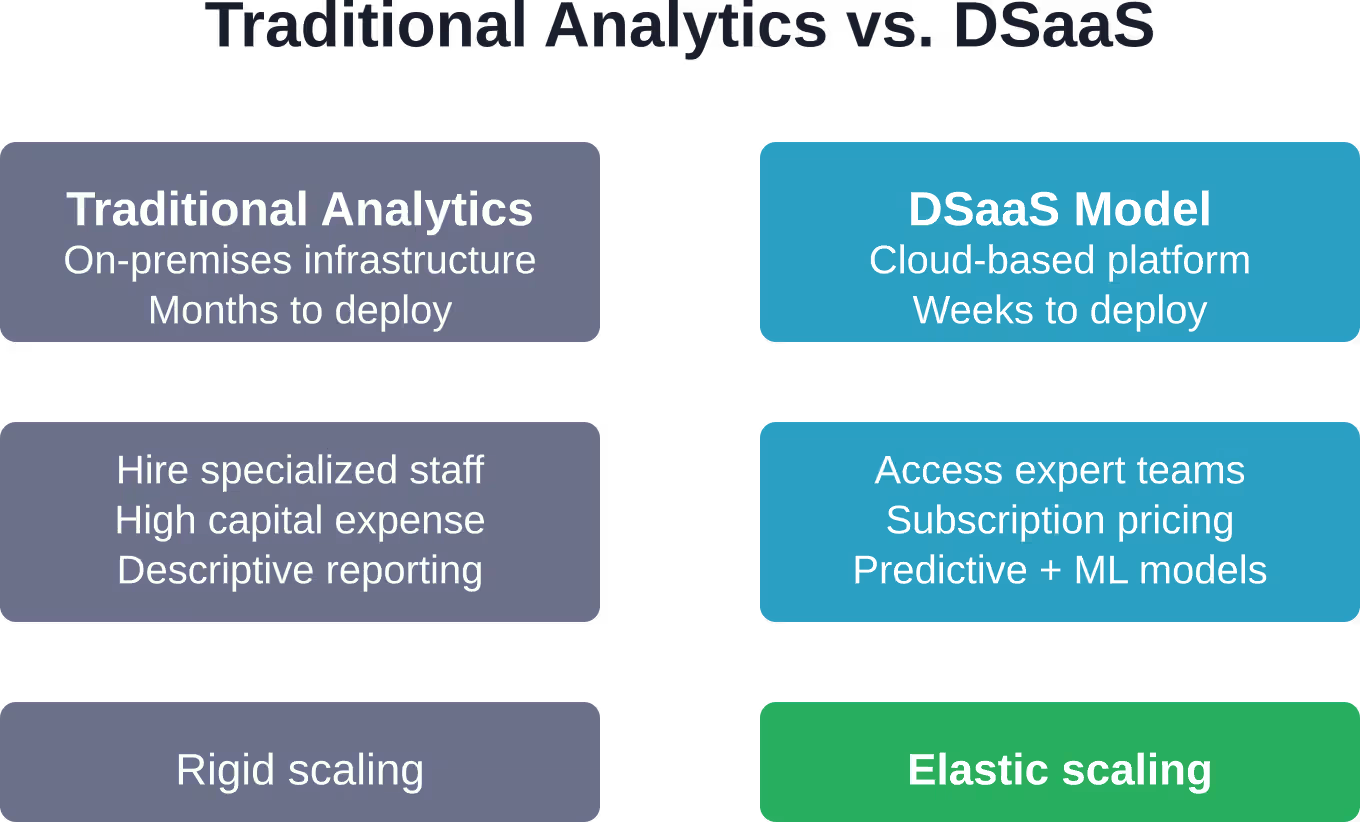
Traditional business intelligence tools generate reports from historical data. DSaaS goes further by applying machine learning, statistical modeling, and predictive algorithms to uncover patterns humans might miss.
The delivery model matters too. Legacy analytics required on-premises installation, lengthy implementation cycles, and dedicated IT resources. DSaaS operates in the cloud with faster deployment and subscription-based pricing that converts capital expenses into operational ones.

Build Data Science Tools With AI Superior
AI Superior develops custom AI software, including machine learning models, predictive analytics, BI tools, big data analytics, NLP, and computer vision solutions. Their team can support projects from early discovery and data review to MVP development, integration, and result evaluation.
For Data Science as a Service, this can help companies turn raw data into working tools for forecasting, reporting, automation, and decision support.
Need Data Science Built Around Your Data?
AI Superior can help with:
- building custom data science solutions
- developing machine learning and analytics models
- testing ideas through PoC or MVP development
- integrating AI tools into existing systems
👉 Contact AI Superior to discuss your project.
Key Benefits of Data Science as a Service
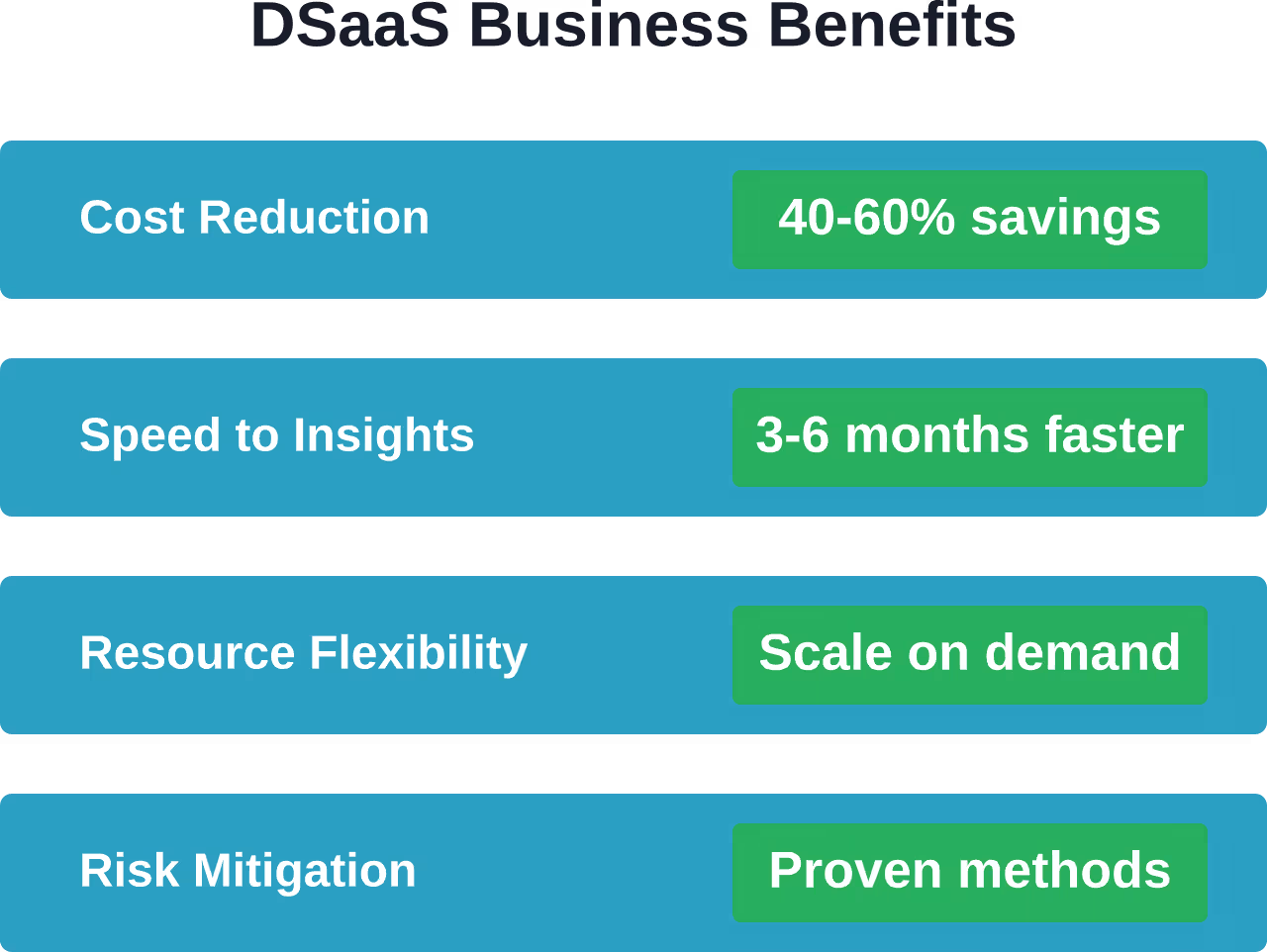
The DSaaS model addresses several critical business challenges simultaneously. Organizations gain capabilities that would otherwise require substantial investment and time.
Rapid Access to Specialized Expertise
Hiring qualified data scientists takes months and costs significantly. Competition for talent is fierce, and building a full team requires recruiting specialists across multiple disciplines—statisticians, machine learning engineers, data engineers, and domain experts.
DSaaS providers maintain these teams already. They’ve assembled the talent, worked through the learning curves, and established proven methodologies. Clients access this collective expertise immediately through service agreements.
Cost Efficiency and Predictable Spending
Building internal data science capabilities involves substantial upfront investment. Salaries for experienced practitioners run high. Infrastructure costs include compute resources, storage, specialized software licenses, and development tools.
The subscription model converts these expenses into predictable monthly costs. Organizations pay for what they use rather than maintaining capacity for peak demand. There’s no depreciation, no idle resources during slow periods, and no surprise expenses when scaling up.
Faster Time to Value
Internal projects often stall during the setup phase. Teams spend months configuring environments, establishing data pipelines, and learning tools before producing any business value.
DSaaS providers bring pre-configured platforms and established processes. They’ve solved the common technical challenges already. Projects move directly to analysis and insights rather than spending months on infrastructure.
Reduced Technical Risk
Data science projects carry significant risk.
Experienced providers have navigated these challenges across multiple clients. They understand what works, what doesn’t, and how to avoid common pitfalls. Their track record reduces the probability of project failure.
Common Use Cases Across Industries
DSaaS applications span virtually every sector. The flexibility of the model allows providers to tailor solutions to industry-specific challenges.
Retail and E-commerce
Customer behavior prediction drives personalization engines. Recommendation systems analyze purchase history, browsing patterns, and similar customer profiles to suggest relevant products. Demand forecasting optimizes inventory levels across distribution networks.
Price optimization algorithms adjust pricing dynamically based on competition, demand signals, and margin requirements. Churn prediction identifies at-risk customers before they leave, enabling targeted retention campaigns.
Financial Services
Fraud detection systems process transactions in real-time, flagging suspicious patterns for review. Credit risk modeling assesses borrower likelihood of default using broader data sources than traditional scoring.
Algorithmic trading strategies analyze market conditions and execute trades automatically. Customer lifetime value calculations guide acquisition spending and relationship investment.
Healthcare and Life Sciences
Predictive models identify patients at high risk for readmission or disease progression. Clinical trial optimization improves patient matching and endpoint selection. Drug discovery platforms accelerate compound screening and molecular modeling.
Operational analytics optimize staffing levels, equipment utilization, and patient flow through facilities.
Manufacturing and Supply Chain
Predictive maintenance algorithms monitor equipment sensor data to schedule repairs before failures occur. Quality control systems detect defects automatically using computer vision. Supply chain optimization balances inventory, transportation costs, and service levels across complex networks.
Demand sensing incorporates real-time signals to improve short-term forecasts beyond traditional time-series methods.
Choosing the Right DSaaS Provider
Not all providers offer equivalent capabilities. Several factors distinguish effective partnerships from disappointing ones.
Domain Expertise and Track Record
Industry-specific knowledge matters significantly. Providers familiar with particular sectors understand the data types, regulatory constraints, and business metrics that matter. They’ve encountered similar problems before and developed relevant solution patterns.
Request case studies from comparable organizations. Ask about specific challenges they’ve solved and measurable outcomes achieved. Generic claims matter less than concrete examples.
Technical Capabilities and Tools
Evaluate the provider’s technical stack. Do they support modern machine learning frameworks? Can they handle the data volumes and velocity your organization generates? What about integration with existing systems?
Cloud platform choices affect scalability and cost. Providers working across multiple clouds offer more flexibility than those locked to a single vendor.
Data Security and Compliance
Security is critical when handling sensitive organizational data. Data breaches carry substantial costs and reputational risks.
Verify the provider’s security certifications and compliance frameworks. How do they handle data encryption, access controls, and audit trails? What happens to client data after project completion?
Regulatory requirements vary by industry. Healthcare organizations need HIPAA compliance. Financial services require adherence to various regulations. European operations must satisfy GDPR requirements.
| Evaluation Criteria | Why It Matters | Questions to Ask |
|---|---|---|
| Industry Experience | Domain knowledge accelerates results | How many similar clients? Specific outcomes? |
| Technical Platform | Determines scalability and capability | What ML frameworks? Cloud platforms? Integration options? |
| Security Posture | Protects sensitive data and reputation | Certifications? Encryption? Access controls? |
| Service Model | Defines engagement flexibility | Project-based? Ongoing? Hybrid teams? |
| Pricing Structure | Impacts budget predictability | Fixed fee? Usage-based? Hidden costs? |
Service Models and Engagement Types
Providers offer various engagement structures. Some operate purely as consultancies, delivering specific projects with defined endpoints. Others provide ongoing managed services with continuous optimization and monitoring.
Platform-based providers emphasize self-service tools with expert support available when needed. This model works well for organizations with some internal capabilities who need occasional specialized help.
Hybrid models combine elements of each approach. Initial projects might be heavily provider-led, with gradual knowledge transfer enabling internal teams to handle routine work independently.
Implementation Considerations
Successful DSaaS adoption requires planning beyond simply selecting a provider. Several factors influence outcomes significantly.
Data Readiness and Quality
Poor data quality undermines even the most sophisticated analytics. Data preparation typically consumes more time than modeling itself.
Before engaging providers, assess current data quality. Are key fields populated consistently? Do definitions remain stable over time? Can data from different sources be matched reliably?
Organizations with clean, well-organized data see faster results and better accuracy.
Organizational Readiness
Analytics insights only create value when organizations act on them. The best predictive model accomplishes nothing if recommendations never reach decision-makers or operational processes don’t change.
Consider how insights will be consumed. Who needs access? In what format? How frequently? What authority do they have to act on recommendations?
Change management matters as much as technical implementation. Stakeholders must understand what models do, trust their outputs, and integrate them into workflows.
Starting with Pilot Projects
Ambitious initial scopes often lead to disappointment. Complex projects increase risk and delay value realization. Starting small allows organizations to learn the engagement model and demonstrate value before scaling up.
Select pilot projects with clear business value, measurable outcomes, and manageable data requirements. Success builds momentum and organizational buy-in for broader initiatives.
Pricing Models for DSaaS
DSaaS providers structure pricing in several common ways. Understanding these models helps organizations budget appropriately and compare alternatives fairly.
Project-Based Pricing
Fixed-price projects define scope upfront and charge a single fee for delivery. This model provides budget certainty but requires detailed specification of requirements. Changes mid-project typically trigger additional charges.
Time-and-materials billing charges for actual hours worked. It offers more flexibility for evolving requirements but less cost predictability. This works well for exploratory projects where scope can’t be fully defined initially.
Subscription and Retainer Models
Monthly subscriptions provide ongoing access to analytics capabilities. Organizations might purchase a certain number of support hours, platform access, or specific service tiers. Costs remain consistent month-to-month, simplifying budgeting.
Retainer arrangements guarantee availability of provider resources. Organizations pay for priority access even if they don’t use full capacity every period.
Usage-Based Pricing
Consumption-based models charge for actual resource usage—compute time, data processed, API calls, or model executions. Costs scale directly with usage, minimizing waste during low-activity periods.
Hybrid approaches combine fixed base fees with variable usage charges. The base fee covers platform access and support; usage charges apply to computational resources consumed.
| Pricing Model | Best For | Advantages | Considerations |
|---|---|---|---|
| Fixed Project | Well-defined initiatives | Budget certainty | Scope changes costly |
| Time & Materials | Exploratory work | Maximum flexibility | Cost uncertainty |
| Subscription | Ongoing needs | Predictable costs | Pay even during low usage |
| Usage-Based | Variable workloads | Pay only for use | Budgeting complexity |
Challenges and Limitations
DSaaS solves many problems but introduces some challenges worth acknowledging upfront.
Vendor Dependency
Heavy reliance on external providers creates risks. If the provider relationship ends, organizations may struggle to maintain models or access historical work. Intellectual property ownership matters—ensure contracts clearly define who owns developed models and derived insights.
Mitigate dependency through knowledge transfer. Documentation, training, and gradual capability building reduce reliance over time.
Integration Complexity
Connecting provider platforms to existing systems sometimes proves harder than expected. Legacy infrastructure, security restrictions, and data format incompatibilities create friction.
Successful integrations require collaboration between provider teams and internal IT staff. Allocate sufficient time and resources for integration work—it’s rarely as simple as flipping a switch.
Communication and Alignment
External teams need clear guidance about business objectives and constraints. Misalignment between provider activities and organizational priorities wastes resources and delays value.
Establish regular communication cadences. Define success metrics explicitly. Ensure both sides understand what constitutes a good outcome.
The Future of Data Science as a Service
The DSaaS market continues maturing rapidly. Several trends are shaping how services evolve.
Automation and AI-assisted analytics reduce the manual effort required for common tasks. AutoML platforms can now handle model selection, hyperparameter tuning, and feature engineering with minimal human intervention. This democratizes analytics capabilities, making sophisticated techniques accessible to less technical users.
Industry-specific solutions are proliferating. Rather than generic platforms, providers increasingly offer pre-built models and workflows tailored to particular sectors. These accelerate deployment and improve accuracy by incorporating domain knowledge into the platform itself.
Real-time analytics capabilities are expanding. Stream processing and edge analytics enable insights from data in motion, not just historical analysis. Applications like fraud detection and dynamic pricing benefit significantly from reduced latency.
Ethical AI and explainability receive growing attention. Regulators and customers demand transparency about how models make decisions. Providers increasingly emphasize interpretable models and tools that explain individual predictions.
Frequently Asked Questions
What’s the difference between DSaaS and DaaS?
DaaS (Data-as-a-Service) provides access to curated datasets—essentially data subscription services. DSaaS (Data Science as a Service) provides analytics capabilities applied to your organization’s data. One delivers data itself, the other delivers insights from data through advanced analytics and machine learning.
How long does typical DSaaS implementation take?
Pilot projects often deliver initial results within 6-12 weeks. Production deployments typically require 3-6 months depending on data readiness, integration complexity, and organizational approval processes. Ongoing engagements evolve continuously with regular model updates and capability expansions.
Do we need internal data scientists to use DSaaS effectively?
Not necessarily. Many organizations successfully leverage DSaaS without internal data science teams. However, having technical staff who understand analytics concepts improves communication with providers and helps translate insights into action. Business analysts familiar with data often bridge this gap effectively.
Can DSaaS handle sensitive or regulated data?
Yes, but verify provider compliance certifications match requirements. Reputable providers offer secure environments with appropriate controls for healthcare, financial, and personally identifiable information. Some support on-premises or private cloud deployment for organizations with strict data residency requirements.
How do we measure ROI from DSaaS initiatives?
Define success metrics before starting projects. Common measures include revenue lift from improved targeting, cost savings from operational optimization, reduced fraud losses, or improved customer retention rates. Compare costs against measurable business outcomes rather than trying to value analytics abstractly.
What happens if we want to bring capabilities in-house later?
Negotiate knowledge transfer provisions upfront. Good providers document methodologies, provide model access, and offer training to internal teams. Some organizations start with DSaaS, build understanding, then gradually transition to hybrid models combining internal and external capabilities.
How much data do we need for DSaaS to be effective?
Requirements vary by use case. Some machine learning applications need thousands or millions of examples. Others work with smaller datasets when combined with appropriate techniques. Providers can assess data sufficiency during initial consultations and recommend approaches that match available data volumes.
Conclusion
Data science as a service represents a practical path for organizations seeking advanced analytics capabilities without the overhead of building teams and infrastructure from scratch.
The model addresses real challenges—talent scarcity, high costs, long implementation cycles, and technical complexity. By accessing specialized expertise through flexible service agreements, companies accelerate time to value and reduce risk.
Success requires more than selecting a provider, though. Data quality, organizational readiness, and clear business objectives all influence outcomes significantly. Starting with focused pilot projects builds experience and demonstrates value before scaling to enterprise-wide initiatives.
The market continues evolving rapidly. Automation, industry specialization, and real-time capabilities expand what’s possible. Organizations that embrace these capabilities position themselves to compete more effectively in increasingly data-driven markets.
 English
  German
  Arabic
  French
  Dutch
Dutch  Spanish