
Quick Summary: AI delivers measurable cost reduction across operations, with manufacturers reporting 72% citing cost reduction as their primary AI investment driver and companies like Michelin generating over 50 million euros annually in ROI. However, authoritative research from MIT Sloan reveals AI adoption tends to reduce productivity in the short term before delivering 9.5% sales growth over five years. Real cost reduction requires redesigning workflows around AI capabilities, not just adding AI to existing processes.
Every executive wants to know the same thing: can artificial intelligence actually cut costs, or is it just another expensive technology experiment?
The answer isn’t simple. According to the National Institute of Standards and Technology, 72% of manufacturers cite cost reduction and operational efficiency as their primary AI investment driver. That’s a massive vote of confidence. But here’s the twist—MIT Sloan research shows that AI adoption tends to reduce productivity in the short term before the real savings materialize.
The gap between expectation and reality explains why only 6% of companies report significant profit impact from AI deployment. Most organizations add AI to existing workflows and wonder why the savings don’t appear. The companies that actually cut costs? They redesign how work gets done.
This article unpacks what the data actually shows about AI-driven cost reduction, where real savings happen, and what it takes to get there.
Why AI Cost Reduction Is More Complex Than the Headlines Suggest
The tech press loves dramatic numbers. AI will slash costs by 90%. Every startup will operate with skeleton crews. The reality documented by authoritative sources tells a different story.
MIT Sloan research tracking U.S. manufacturing firms reveals that MIT Sloan research documents that AI adoption tends to reduce productivity in the short term. When researchers account for selection bias—the fact that struggling firms often adopt AI as a rescue attempt—researchers found that organizations that adopted AI for business functions saw significant short-term productivity challenges.
That’s not a typo. Productivity drops before it rises.
But the same research shows that firms with large increases in AI experience 9.5% sales growth and 6% employment growth over five years. The technology works. It just doesn’t work instantly.
The National Institute of Standards and Technology reports that 72% of manufacturers cite cost reduction and operational efficiency as their primary AI investment driver, while 50% focus on revenue increase and 51% on operational visibility. These aren’t experimental pilot programs. They’re strategic investments based on demonstrated returns.
Real talk: AI delivers cost reduction when organizations commit to the transformation process, not when they bolt intelligent algorithms onto unchanged workflows.
The Productivity Paradox Explained
Why does productivity drop before it rises? The pattern mirrors every major technological transformation in industrial history.
When factories first adopted electricity in the 1890s, productivity barely moved for three decades. Companies installed electric motors but kept their steam-powered factory layouts. The breakthrough came when they redesigned entire facilities around distributed power.
AI follows the same path. Organizations must learn new skills, redesign processes, and shift decision-making patterns. That learning period costs time and money. The companies that push through this transition period capture the real savings. Those that give up during the initial productivity dip waste their investment.
McKinsey’s State of AI data shows AI is improving innovation by 64% and employee satisfaction by 45%, but profitability only 36% and revenue growth 33%. That gap represents the transformation work still ahead for most organizations.
Where AI Actually Delivers Cost Reduction: Function-by-Function Breakdown
Theoretical savings mean nothing. What matters is where AI cuts costs in actual business operations.
Data from multiple organizations shows significant variance across business functions. Some areas deliver fast returns. Others require longer transformation timelines.
Service Operations: The Fastest Payback
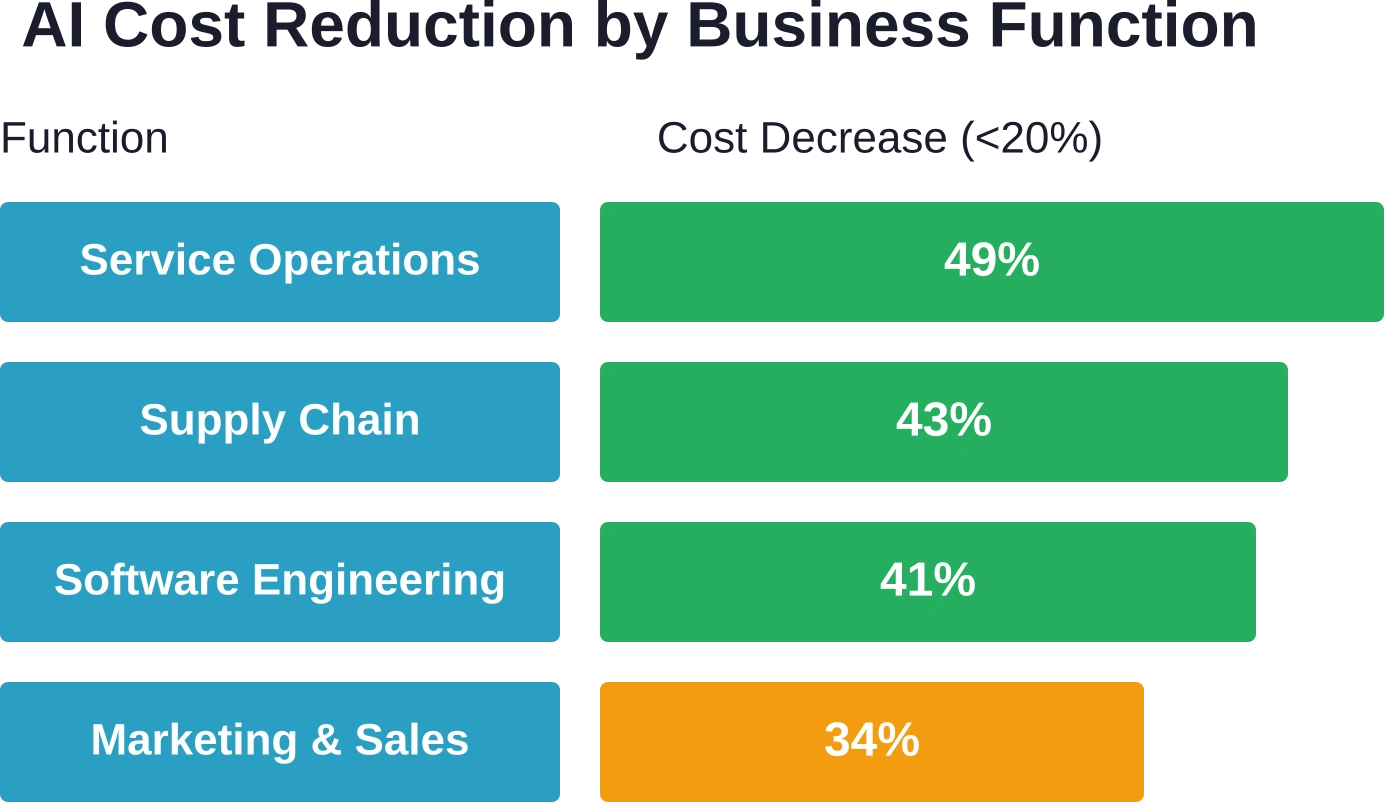
Service operations show the highest cost reduction rates, with 49% of organizations reporting cost decreases under 20%. The global AI customer service market is projected to reach $15.12 billion in 2026.
But there’s a catch. The same data shows that only 14% of customer issues actually resolve through self-service, and consumers show significant sentiment regarding AI use in certain customer service contexts.
The lesson? AI cuts service costs when it handles routine inquiries well, not when it frustrates customers who need human help.
Supply Chain and Inventory: Optimization at Scale
Supply chain applications deliver 43% cost reduction rates. The National Institute of Standards and Technology reports that 51% of manufacturers deploy AI to enhance operational visibility and responsiveness—capabilities that directly reduce inventory carrying costs and logistics expenses.
AI excels at pattern recognition across massive datasets. It identifies route optimization opportunities, predicts maintenance needs before breakdowns occur, and adjusts inventory levels based on demand signals humans miss.
Software Engineering: The 90% Myth
Software engineering shows 41% cost reduction rates, but claims of 90% cost savings don’t match controlled research. A 2025 randomized controlled trial by METR tracked experienced developers completing real tasks in mature open-source codebases using AI assistance like Cursor and Claude.
The actual productivity improvement? Useful, but nowhere near 90%.
Here’s the math that matters: developers took 19% longer to complete their work, yet those same developers perceived they were 20% faster. If AI reduces coding time by the perceived 20%, and initial coding represents 20% of total development cost, the actual total cost reduction is only 4%. Most software development costs come from understanding existing systems, debugging integration issues, and managing technical debt—work where AI helps less.
Marketing and Sales: Creativity Versus Automation
Marketing and sales show 34% cost reduction rates, the lowest among major functions. But 67% of organizations report revenue increases up to 10% in this area.
The pattern is clear: AI in marketing drives growth more than it cuts costs. Organizations that treat marketing as a cost center to minimize miss the strategic opportunity. Leading marketers use AI to create more personalized campaigns, test more variations, and identify higher-value customer segments.
Content production offers real savings. Educational publisher Cengage has cut content production costs by 40% and lead generation costs by 20% through process automation. But these gains required redesigning content workflows, not just adding AI tools to existing processes.

Reduce Costs With Practical AI Systems From AI Superior
AI can reduce costs when it is connected to specific business processes, not added as a separate experiment with no clear purpose. AI Superior helps companies approach cost reduction through AI consulting, process optimization with AI, data analysis, machine learning, predictive analytics, business intelligence, and custom AI software development. Their work can apply to workflow automation, demand forecasting, anomaly detection, resource planning, and clearer analysis of operational data.
The team can help companies find where AI may actually remove friction – repeated manual tasks, inefficient workflows, weak forecasting, or data that already exists but is not being used well. This fits businesses that want to improve planning, reduce avoidable work, and make internal processes easier to manage with practical AI tools.
AI Superior can support cost reduction with:
- Finding practical AI use cases in business processes
- Building automation and predictive analytics tools
- Improving operational and financial data analysis
- Detecting anomalies, inefficiencies, or recurring issues
- Integrating AI solutions into existing systems and workflows
Contact AI Superior to explore how AI can help reduce costs in your operations, planning, or internal processes.
Real Implementation Costs: What AI Actually Requires
Cost reduction is great. But what does AI implementation itself cost?
The range is enormous: from $2,000 for simple automation to over $1 million for enterprise-scale transformation. Scope, complexity, data infrastructure, and integration requirements all affect total cost.
Organizations often underestimate three hidden cost categories:
- Data preparation: AI models need clean, structured, accessible data. Most organizations discover their data is scattered across incompatible systems, poorly documented, and filled with quality issues. Cleaning and organizing that data costs time and money before any AI implementation begins.
- Change management: MIT Sloan research emphasizes that transformation requires everyone in the organization to reimagine their roles. Training, communication, process redesign, and organizational resistance all create costs beyond the technology itself.
- Ongoing optimization: AI systems require continuous monitoring, adjustment, and improvement. The initial deployment is just the beginning. Organizations that budget only for implementation without planning for ongoing optimization see diminishing returns.
The 6% Who Actually Achieve Profit Impact
Only 6% of companies report significant profit impact from AI deployment. What separates them from the 94% who don’t?
They redesigned their workflows instead of adding AI to existing processes.
Look at Michelin’s approach. Improved productivity from AI projects now generates more than 50 million euros in ROI per year, with a growth rate increase approaching 40% annually. That didn’t happen by installing AI tools and hoping for the best.
Michelin’s team conducts a post-deployment assessment of actual value delivered. They measure real impact, identify what works, and adjust what doesn’t. Most organizations skip this step and wonder why their AI investments underperform.
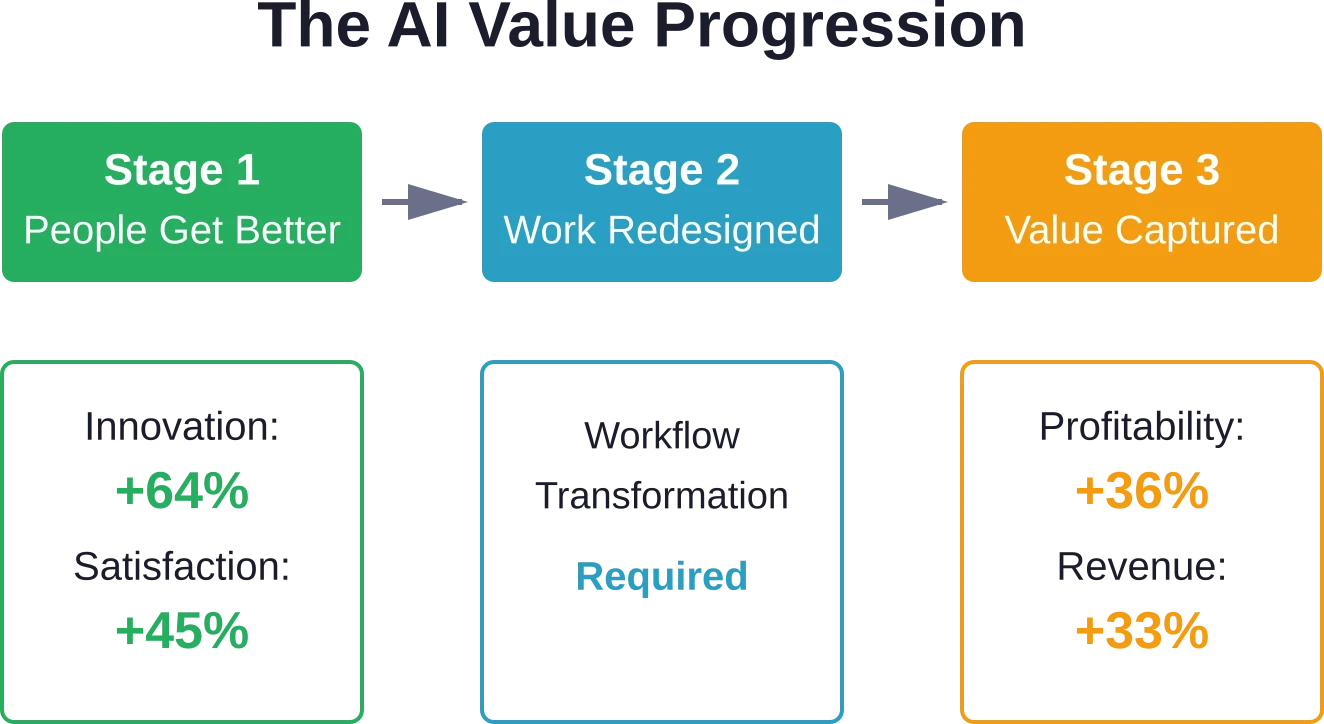
The data from McKinsey shows this progression clearly. AI improves innovation and employee satisfaction first. Those gains create the foundation for profit and revenue growth—but only when organizations actually transform how work gets done.
The 94% who don’t see profit impact? They’re stuck in stage one, using AI to do existing work slightly better instead of redesigning work around AI capabilities.
Manufacturing AI: Where Cost Reduction Is Most Mature
Manufacturing leads other sectors in demonstrated AI cost reduction. The National Institute of Standards and Technology data shows clear patterns in how manufacturers deploy AI and what results they achieve.
Key deployment areas include:
- Lifecycle management: Simulating wear and tear or potential equipment failures to plan preventive actions before breakdowns occur
- Product design and customization: Accelerating development by virtually testing design modifications before physical implementation
- Quality control: Real-time defect detection with accuracy exceeding human inspection
- Production optimization: Adjusting parameters continuously based on environmental conditions and material variations
These applications share a common characteristic: they generate value from data that already exists but was previously underutilized. Sensor data, production logs, maintenance records, and quality metrics all become inputs for AI systems that identify patterns humans miss.
But even in manufacturing—the most mature AI application area—the productivity paradox appears. Firms experience measurable productivity declines immediately after AI adoption before longer-term gains emerge. Organizations that understand this pattern plan accordingly. Those that don’t often abandon promising AI initiatives during the initial dip.
The Hidden Cost of AI: What Financial Models Miss
Traditional ROI calculations miss critical factors that determine whether AI delivers cost reduction or becomes an expensive distraction.
The Shifting Cost Problem
AI doesn’t eliminate costs—it shifts them. Community discussions reveal a pattern: startups that reduced initial development costs with AI now face higher customer acquisition costs as every competitor deploys similar AI capabilities.
Infrastructure costs shift too. Organizations reduce labor costs but increase compute costs. They spend less on routine tasks but more on AI model maintenance, data infrastructure, and specialized talent.
The question isn’t whether AI reduces costs in absolute terms. It’s whether the cost structure after AI adoption is more favorable than before—and whether the organization can sustain that new structure.
The Governance Cost
MIT Sloan Executive Education research from April 2026 emphasizes that successful AI strategy requires senior leadership to define priorities, set clear risk boundaries, and direct resources strategically. Cross-functional teams must develop a shared understanding of how to apply AI across IT, compliance, and business units.
That governance doesn’t happen automatically. It requires dedicated time, clear decision-making frameworks, and ongoing coordination. Organizations that treat AI governance as optional discover expensive mistakes, compliance violations, or strategic misalignment that erase any cost savings.
The Talent Cost
AI creates new talent requirements even as it reduces demand for routine task execution. Organizations need people who can design AI-enabled workflows, interpret model outputs, identify appropriate use cases, and manage the change process.
These roles command premium compensation. The total talent cost may decrease, but the per-person cost often increases significantly.
When AI Cost Reduction Fails: Warning Signs
Most AI cost reduction initiatives fail. Recognizing the warning signs early saves money and allows course correction.
- Productivity declining without a transformation plan: The productivity dip is normal—but only when the organization is actively redesigning workflows. If productivity drops and the organization keeps doing everything the same way with AI added on top, that’s failure in progress.
- Focusing on cost reduction instead of value creation: MIT Sloan research shows that value creation is the true measure of successful AI implementation. Organizations that optimize for cost cutting miss growth opportunities and end up with AI that makes them efficiently mediocre.
- Implementing AI without measuring actual impact: Many organizations deploy AI without establishing baseline metrics or conducting post-deployment assessment. Post-deployment assessment isn’t optional for the 6% who achieve real profit impact—it’s mandatory.
- Siloed AI initiatives without enterprise strategy: Individual departments adopting AI tools independently creates redundant costs, incompatible systems, and missed opportunities for enterprise-wide transformation.
- Ignoring the human side of transformation: Technology changes fast. Organizations change slowly. AI initiatives that ignore change management, training, and cultural transformation waste money on tools that employees resist or misuse.
Practical Steps for AI Cost Reduction That Actually Works
So what does effective AI cost reduction actually look like in practice?
Start with value mapping, not cost cutting. Identify where AI can create measurable value for customers, employees, or business operations. MIT Sloan research shows that private equity interest in building AI capabilities into portfolio companies signals AI’s potential to create value—when investors with fiduciary duties commit capital, they’ve validated the opportunity.
Prioritize processes with these characteristics:
- High volume of repetitive decisions
- Rich historical data already captured
- Clear success metrics
- Significant current cost
- Low regulatory complexity initially
Design for the productivity dip. Plan implementation timelines that account for the short-term performance decline. Communicate this expectation clearly so stakeholders don’t panic when productivity drops temporarily.
Build measurement into the foundation. Define specific metrics before implementation begins. Establish baseline performance. Create dashboards that track actual impact versus projections. Conduct formal post-deployment assessments.
Invest in upskilling everyone, not just technical teams. The organizations at 64% innovation improvement today are building the foundation for profit gains tomorrow—but only if they transform how people work, not just what tools they use.
Industry-Specific Cost Reduction Patterns
Different industries show distinct patterns in where and how AI delivers cost reduction.
| Industry | Primary Cost Reduction Area | Implementation Challenge | Typical Timeline |
|---|---|---|---|
| Manufacturing | Predictive maintenance, quality control, production optimization | Integration with legacy equipment | 12-24 months |
| Retail | Inventory optimization, demand forecasting, customer service | Data quality across channels | 6-18 months |
| Financial Services | Fraud detection, risk assessment, process automation | Regulatory compliance | 18-36 months |
| Healthcare | Diagnostic support, administrative automation, resource allocation | Privacy regulations, liability | 24-48 months |
| Logistics | Route optimization, warehouse automation, demand prediction | Physical-digital integration | 12-24 months |
Manufacturing and logistics see faster returns because AI optimizes physical operations with clear metrics. Financial services and healthcare face longer timelines due to regulatory requirements and higher risk sensitivity.
The 2026 Reality: Where We Actually Are
MIT Sloan Executive Education research from April 2026 reports that a significant portion of organizations now have generative AI applications in production. That’s dramatic growth from earlier years.
But having AI in production doesn’t equal cost reduction. The data shows most organizations still operate in stage one—people getting better at their existing work—without completing the transformation to redesigned workflows where real savings appear.
The customer service market provides a microcosm of the broader pattern. The market grows at significant rates, indicating massive investment. Yet only 14% of customer issues resolve through self-service, and consumer sentiment shows significant resistance to AI in certain contexts.
Organizations invest in AI customer service expecting cost reduction. Many discover they’ve traded labor costs for technology costs without improving outcomes or reducing total expenses.
That’s the 2026 reality. AI delivers cost reduction when implemented strategically with workflow transformation. It wastes money when treated as a technology purchase instead of an organizational transformation.
Looking Forward: AI Cost Reduction in 2027 and Beyond
What changes as AI matures?
Implementation costs will continue falling as tools become more accessible and pre-trained models handle more use cases. But transformation costs—the change management, training, and workflow redesign—won’t decrease. Those costs are fundamentally human and organizational.
The competitive dynamics shift too. When every competitor has AI, the advantage goes to organizations that transform fastest and most completely. Early cost reduction from AI becomes table stakes rather than differentiation.
MIT Sloan research shows that firms with large increases in AI use achieve 9.5% sales growth over five years. That growth matters more than cost reduction in determining long-term winners. The organizations that use AI savings to fund innovation and growth separate from those that use AI purely to cut costs.
The data suggests we’re still early in the transformation. The productivity paradox, the gap between innovation gains and profit impact, and the small percentage achieving significant results all indicate most organizations haven’t completed the journey.
But the path is clear. Value creation over cost cutting. Workflow transformation over tool adoption. Continuous measurement over assumed success. Enterprise-wide change over siloed initiatives.
Key Takeaways
The evidence from authoritative sources establishes several clear conclusions about AI in cost reduction:
First, AI does reduce costs—but not instantly and not automatically. The National Institute of Standards and Technology reports that 72% of manufacturers cite cost reduction and operational efficiency as their primary AI investment driver, and real savings appear in organizations like Michelin generating over 50 million euros annually in ROI.
Second, the productivity paradox is real and predictable. MIT Sloan research documents short-term productivity declines before long-term gains emerge. Organizations that plan for this dip succeed. Those that panic during it fail.
Third, only 6% of companies achieve significant profit impact because most add AI to existing workflows instead of redesigning work around AI capabilities. The gap between 64% innovation improvement and 36% profitability improvement shows where most organizations get stuck.
Fourth, cost reduction patterns vary dramatically by function. Service operations show 49% cost reduction rates, while marketing and sales show 34%—but marketing also shows higher revenue growth, suggesting different strategic objectives.
Fifth, real implementation requires addressing hidden costs: data preparation, change management, governance, talent, and ongoing optimization. Organizations that budget only for technology waste money on systems that underperform.
The organizations that win with AI cost reduction treat it as comprehensive transformation, not technology deployment. They measure relentlessly, invest in upskilling everyone, and redesign workflows rather than automating existing inefficiencies.
That’s harder than buying AI tools. It’s also the only approach that actually works.
Frequently Asked Questions
How much does AI actually reduce operational costs?
Research shows AI cost reduction ranges from 5% to 49% depending on the business function. Service operations show the highest reduction rates at 49%, supply chain at 43%, software engineering at 41%, and marketing at 34%. However, these gains require workflow transformation, not just technology adoption. Organizations that simply add AI to existing processes see minimal or no cost reduction.
What is the productivity paradox in AI adoption?
MIT Sloan research documents that AI adoption tends to reduce productivity in the short term before delivering long-term gains. This happens because organizations must learn new skills, redesign processes, and shift decision-making patterns. The pattern mirrors electrification in the 1890s, where productivity stagnated for 30 years before factories redesigned around distributed power. The productivity dip is normal during transformation but indicates failure if the organization isn’t actively redesigning workflows.
How long does it take for AI to pay for itself?
Payback timelines vary by industry and implementation scope. Manufacturing and logistics typically see returns in 12-24 months. Retail ranges from 6-18 months. Financial services requires 18-36 months due to regulatory complexity. Healthcare takes 24-48 months. However, MIT Sloan research shows the real value appears over five years, with firms achieving 9.5% sales growth and 6% employment growth from large increases in AI use. Organizations should plan for multi-year transformation rather than expecting immediate payback.
Why do only 6% of companies report significant profit impact from AI?
The 6% who achieve significant profit impact redesigned their workflows around AI capabilities. The other 94% added AI to existing processes without transformation. McKinsey’s State of AI data shows AI is improving innovation by 64% and employee satisfaction by 45%, but profitability only 36% and revenue growth 33%. That gap represents unfinished transformation work. Organizations stuck in stage one—where people use AI to do existing work better—never reach stage three where companies capture value through redesigned operations.
What are the hidden costs of AI implementation?
Beyond technology costs ranging from $2,000 to over $1 million, organizations face significant hidden expenses. Data preparation requires cleaning, structuring, and organizing scattered information before AI implementation begins. Change management includes training, communication, process redesign, and managing organizational resistance. Governance requires senior leadership time, cross-functional coordination, and ongoing risk management. Talent costs shift from many lower-paid workers to fewer highly-paid specialists. Ongoing optimization demands continuous monitoring, adjustment, and improvement long after initial deployment.
Which business functions show the fastest AI cost reduction?
Service operations deliver the fastest cost reduction, with 49% of organizations reporting cost decreases under 20%. The global AI customer service market is projected to reach $15.12 billion in 2026, indicating massive investment growth. However, only 14% of customer issues actually resolve through self-service, and consumers show significant sentiment regarding AI use in certain contexts. Supply chain applications show 43% cost reduction through route optimization, predictive maintenance, and inventory management. Software engineering shows 41% reduction, though claims of 90% savings don’t match controlled research data.
Is AI cost reduction different in manufacturing versus other industries?
Manufacturing shows the most mature AI cost reduction patterns. The National Institute of Standards and Technology reports 72% of manufacturers cite cost reduction as their primary AI driver, with 51% deploying AI for operational visibility and 54% for process improvement and design acceleration. Manufacturing AI applications—predictive maintenance, quality control, production optimization, and product design—generate value from existing data that was previously underutilized. However, even in manufacturing, the productivity paradox appears. Firms experience measurable declines immediately after adoption before longer-term gains emerge, requiring organizations to plan transformation timelines accordingly.
Conclusion
AI cost reduction is real, measurable, and achievable—but only for organizations willing to do the hard work of transformation.
The authoritative data from NIST, MIT Sloan, and documented Fortune 500 implementations establishes that AI delivers savings across service operations, supply chain, software engineering, and marketing. Companies like Michelin generate over 50 million euros annually in ROI from AI productivity projects.
But the same data reveals why most organizations fail. They expect instant results instead of planning for the productivity paradox. They add AI to existing workflows instead of redesigning work around AI capabilities. They budget for technology without accounting for data preparation, change management, governance, and ongoing optimization.
The path to real cost reduction is clear: start with value mapping, prioritize high-volume data-rich processes, build measurement into the foundation, plan for initial productivity decline, invest in enterprise-wide upskilling, redesign workflows completely, and optimize continuously based on actual results.
Organizations that follow this path join the 6% achieving significant profit impact. Those that skip steps join the 94% wondering why their AI investments underperform.
The choice is straightforward. The execution is hard. And the difference in outcomes is dramatic.
Ready to implement AI cost reduction that actually works? Start by mapping where AI creates value in specific workflows, establish baseline metrics before deployment, and commit to workflow transformation instead of technology adoption. The data shows this approach works. Now the question is whether organizations will follow the evidence or keep repeating the mistakes that leave 94% without real results.
 English
  German
  Arabic
  French
  Dutch
Dutch  Spanish