
Quick Summary: AI-powered knowledge management uses artificial intelligence—machine learning, natural language processing, and generative AI—to automatically capture, organize, retrieve, and apply organizational knowledge at scale. Unlike traditional systems that rely on manual tagging and keyword search, AI-driven platforms understand context, learn from usage patterns, and deliver personalized, relevant information instantly. Organizations implementing these systems report dramatic improvements in productivity, decision-making speed, and knowledge accessibility across distributed teams.
Research exists, but nobody can find it. Insights are documented, then buried. Teams ask the same questions repeatedly because answers live in someone else’s inbox.
Sound familiar?
Enterprise organizations generate unprecedented volumes of data and content daily. Yet most struggle to transform that information into accessible, actionable knowledge. Traditional knowledge management systems—built around manual categorization, rigid taxonomies, and keyword matching—can’t keep pace.
That’s where artificial intelligence enters the picture.
AI-powered knowledge management systems fundamentally change how organizations capture, organize, and share information. Instead of demanding employees manually tag and file every document, these platforms automatically understand content, learn relationships, and surface relevant knowledge precisely when needed.
But the technology goes far beyond faster search. AI is reshaping the entire knowledge lifecycle—and transforming what it means to be a knowledge worker.
What Is AI-Powered Knowledge Management?
AI-powered knowledge management applies artificial intelligence technologies to automatically handle the full lifecycle of organizational knowledge—from creation and capture through organization, retrieval, and application.
The core technologies include:
- Machine learning algorithms that improve relevance based on usage patterns. The system learns which documents, insights, or experts prove most helpful for specific questions, then prioritizes those resources over time.
- Natural language processing (NLP) enables systems to understand meaning and intent in text and speech—not just match keywords. An employee searching for “customer churn strategies” will surface relevant content even when those exact words don’t appear in the source material.
- Generative AI can synthesize information from multiple sources, answer questions conversationally, and even create new content based on organizational knowledge. Instead of returning ten document links, the system provides a direct answer with source citations.
These technologies work together to create systems that understand context, recognize patterns, and deliver increasingly relevant results without constant human intervention.
Why Traditional Knowledge Management Fails Modern Enterprises
Legacy knowledge management systems were built for a different era. They assumed relatively stable information, limited content volumes, and employees working from centralized offices with time for manual documentation.
That world no longer exists.
Modern enterprises face several critical challenges that traditional systems can’t address:
- Information overload and scattered sources: Knowledge lives everywhere—SharePoint, Confluence, Slack, email, Google Drive, specialized applications. According to IBM research cited in competitor materials, data scientists spend 80% of their time cleaning, integrating, and preparing data rather than analyzing it. Traditional systems can’t unify this fragmented landscape.
- Manual categorization doesn’t scale: When organizations relied on taxonomies and manual tagging, someone needed to classify every document, presentation, and research report. With thousands of new files created weekly, this approach creates immediate bottlenecks. Worse, different teams use inconsistent terminology, making cross-functional knowledge discovery nearly impossible.
- Keyword search misses contextual meaning: A marketing manager searching for “positioning strategy” might miss a presentation titled “competitive differentiation approach”—even though it contains exactly the needed insights. Traditional keyword matching can’t understand synonyms, related concepts, or semantic relationships.
- Static systems don’t adapt: Legacy platforms treat all content equally and can’t learn which resources prove most valuable for specific questions. The 50-page report from 2019 ranks identically to last month’s focused analysis—even though the recent document is more relevant.
Real talk: these limitations don’t just slow teams down. They create knowledge silos, duplicate effort, and ultimately undermine decision quality.
How AI Transforms the Knowledge Management Lifecycle
AI-powered systems reimagine every stage of knowledge work:
Automated Content Discovery and Ingestion
AI platforms continuously scan connected systems—document repositories, communication tools, project management software—identifying and ingesting relevant content automatically. Natural language processing extracts key concepts, entities, and relationships without manual tagging.
Research on knowledge graph-guided agentic AI for materials science demonstrates high-precision automated knowledge retrieval across large document sets without manual classification.
Intelligent Organization and Enrichment
Rather than forcing content into predetermined categories, AI systems create dynamic, multidimensional connections. Machine learning identifies relationships between concepts, documents, and people. Generative AI can summarize lengthy reports, extract key insights, and even generate metadata automatically.
This approach enables the same content to appear in multiple relevant contexts without duplication or complex folder hierarchies.
Contextual Search and Retrieval
AI-powered search understands what users are actually asking—not just the words they type. Semantic search recognizes synonyms, related concepts, and intent. Systems learn from behavior: which results get clicked, how long users engage with content, what follow-up searches occur.
Research on knowledge graph interaction platforms using 3,500 test cases demonstrates 95.12% accuracy in task classification and 90.45% success rates in task execution.
Proactive Knowledge Delivery
The most sophisticated systems don’t wait for queries. They monitor work context—current projects, meeting topics, document drafts—and proactively surface relevant knowledge. Preparing for a client presentation? The system suggests relevant case studies, competitive intelligence, and industry research automatically.
Conversational Knowledge Interfaces
Generative AI enables natural conversation with organizational knowledge. Instead of crafting precise search queries, employees ask questions conversationally: “What pricing strategies worked best for enterprise customers last quarter?” The system synthesizes information from multiple sources and provides direct answers with citations.
AI Knowledge Management Tools and Technologies
Several technology categories enable AI-powered knowledge management:
Enterprise Knowledge Platforms
Comprehensive platforms designed specifically for organizational knowledge management integrate AI capabilities across the entire lifecycle. These systems connect to existing enterprise tools, ingest content automatically, and provide unified search and discovery interfaces.
Leading platforms combine machine learning for relevance ranking, NLP for semantic understanding, and increasingly, generative AI for synthesis and question-answering.
Knowledge Graphs
Knowledge graphs create structured representations of organizational knowledge—capturing entities (people, products, projects, concepts) and their relationships. AI enhances knowledge graphs through automated entity extraction, relationship discovery, and reasoning capabilities.
Research demonstrates knowledge graphs can support complex configurations. One experimental environment modeled 32 rooms and 25 objects to test how AI agents learn and utilize long-term memory systems for decision-making in partially observable environments.
Generative AI and Large Language Models
Generative AI enables conversational interfaces to organizational knowledge. Employees interact naturally, asking questions and receiving synthesized answers rather than document lists. Systems cite sources, explain reasoning, and adapt responses based on user role and context.
Advanced deployments configure extended context lengths—up to 40,000 tokens in some implementations—allowing systems to process extensive documentation when formulating responses.
AI-Enhanced Search Engines
Specialized enterprise search platforms use AI to understand queries semantically, personalize results based on user history and role, and surface relevant content even when exact keyword matches don’t exist. These systems learn continuously from click patterns, engagement metrics, and explicit feedback.
Implementing AI-Powered Knowledge Management: Key Considerations
Successful implementation requires careful planning across several dimensions:
Data Readiness and Integration
AI systems need access to organizational content. This requires connecting disparate data sources, addressing data quality issues, and establishing governance for what content enters the knowledge system. Organizations with poor data readiness will struggle regardless of which AI platform they choose.
Change Management and Adoption
Technology alone doesn’t guarantee success. Teams need training on how to interact with AI systems effectively, examples demonstrating value, and incentives to contribute knowledge. Organizations should expect a learning curve as employees adapt from keyword search to semantic discovery.
Governance and Security
AI-powered systems must respect access controls, maintain data privacy, and comply with regulatory requirements. This becomes particularly critical with generative AI, which might inadvertently expose sensitive information in synthesized responses. Clear governance frameworks determine what content is indexed, who can access what knowledge, and how AI-generated outputs are validated.
Measuring Success
Organizations should establish metrics before implementation: time spent searching, knowledge reuse rates, employee satisfaction with information access, decision cycle times. These baselines enable measuring AI impact quantitatively.
Platform Selection Criteria
When evaluating AI knowledge management platforms, consider:
- Integration breadth: Does the platform connect to existing enterprise systems seamlessly?
- AI capabilities: What specific AI technologies are included—semantic search, generative AI, machine learning for personalization?
- Scalability: Can the system handle organizational growth in content volume and user count?
- Security and compliance: Does the platform meet industry-specific regulatory requirements?
- Customization: Can the system be tuned to organizational terminology and structure?
- User experience: Is the interface intuitive for non-technical users?
| Evaluation Criteria | Why It Matters | Key Questions |
|---|---|---|
| Integration Depth | Disconnected systems create information silos | Which repositories and tools connect natively? |
| AI Transparency | Users need to trust AI recommendations | Does the system explain how it reached conclusions? |
| Learning Speed | Value increases as the system learns | How quickly does relevance improve with usage? |
| Access Control | Sensitive information requires protection | Can permissions be inherited from source systems? |
| Deployment Model | Security and compliance requirements vary | Are cloud, hybrid, and on-premise options available? |

Organize Company Knowledge With AI Superior
AI-powered knowledge management can help companies make internal information easier to search, reuse, and connect to daily work. AI Superior works with generative AI development, AI chatbot development, LLM consulting, NLP, data analytics, and custom AI software development. Their team can help companies define what knowledge sources should be used, how information should be processed, and where AI can fit into existing workflows. This is relevant for businesses that have useful information spread across documents, platforms, reports, or internal systems.
Relevant AI Superior support includes:
- Defining AI use cases for knowledge management
- Building LLM-based search or assistant tools
- Supporting document and text-based workflows with NLP
- Developing custom AI software for internal knowledge access
- Integrating AI tools into existing business systems
👉Contact AI Superior to discuss how AI can make company knowledge easier to search, manage, and use.
Key Benefits of AI-Powered Knowledge Management
Organizations implementing AI-driven knowledge management report substantial benefits:
Dramatic Time Savings
Employees spend less time searching for information and more time applying it. Automated discovery eliminates manual classification overhead. Semantic search reduces the number of queries needed to find relevant content.
Improved Decision Quality
When relevant knowledge surfaces automatically, decisions are based on complete information rather than whatever the decision-maker happens to remember or can quickly locate. Cross-functional insights that would otherwise remain siloed become discoverable.
Reduced Knowledge Loss
AI systems capture tacit knowledge that would otherwise disappear when employees leave. Conversational AI can interview departing experts, document their insights, and make that knowledge searchable for future teams.
Enhanced Customer Service
Customer service teams equipped with AI-powered knowledge access can resolve issues faster with more accurate information. According to Salesforce research, 81% of customers expect more personalized experiences. AI enables service agents to deliver that personalization by surfacing customer-specific context and relevant solutions instantly.
Accelerated Innovation
When teams can easily discover prior research, past experiments, and related projects, innovation accelerates. Organizations avoid reinventing solutions that already exist internally and build on previous work rather than starting from scratch.
Scalable Knowledge Capture
Traditional knowledge management required dedicated resources to document, organize, and maintain information. AI systems scale effortlessly—handling thousands or millions of documents without proportional increases in administrative overhead.
Real-World Use Cases Across Industries
AI-powered knowledge management delivers value across diverse organizational contexts:
Customer Support and Service
Service teams use AI knowledge systems to access complete customer histories, product documentation, and troubleshooting guides instantly. Conversational AI suggests solutions based on issue descriptions, dramatically reducing resolution time. Self-service portals leverage the same technology, enabling customers to find answers without contacting support.
Research and Development
R&D teams discover prior research, related patents, and experimental results across organizational silos. AI identifies connections between projects that human researchers might miss. Generative AI synthesizes findings from multiple studies, accelerating literature review and hypothesis development.
Sales Enablement
Sales professionals access relevant case studies, competitive intelligence, pricing guidance, and product information contextually. Systems recommend content based on deal stage, customer industry, and specific challenges. AI-generated summaries provide quick briefings before customer calls.
Compliance and Risk Management
Compliance teams use AI to monitor regulatory changes, map requirements to organizational policies, and ensure documentation meets standards. According to NIST’s Artificial Intelligence Risk Management Framework: Generative Artificial Intelligence Profile published on July 26, 2024, organizations need structured approaches to AI governance—and AI-powered knowledge systems help maintain compliance documentation and audit trails.
Human Resources and Onboarding
New employees interact conversationally with organizational knowledge, asking questions about policies, procedures, and culture. AI systems personalize learning paths based on role, department, and expressed interests. HR teams quickly locate relevant policies when addressing employee questions.
Legal and Contract Management
Legal departments use AI to search contract databases semantically, identify relevant precedents, and extract key terms automatically. Systems flag potential risks by comparing new agreements against historical patterns and established guidelines.
How AI Changes the Role of Knowledge Workers
AI-powered knowledge management doesn’t just make existing work faster—it fundamentally changes what knowledge workers do.
From Information Hunting to Insight Application
When AI handles discovery and retrieval automatically, knowledge workers shift focus from finding information to applying it. Less time searching means more time analyzing, synthesizing, and creating value from knowledge.
From Individual Expertise to Collective Intelligence
AI systems democratize access to organizational expertise. Junior employees can quickly access insights that previously required years of experience or strong internal networks to discover. This levels the playing field and accelerates capability development across teams.
From Manual Documentation to Automated Capture
AI reduces the documentation burden on subject matter experts. Rather than spending hours writing procedural guides, experts can have conversations with AI systems that automatically structure and publish their knowledge in searchable formats.
From Reactive Search to Proactive Discovery
Advanced systems monitor work context and proactively surface relevant knowledge before employees even realize they need it. This shifts the knowledge worker’s relationship with information from active searching to passive receiving—similar to how streaming services recommend content.
New Skills Required
As AI handles routine knowledge work, humans focus on higher-order skills: critical evaluation of AI-provided information, creative synthesis across domains, relationship building, and strategic thinking. Knowledge workers need to become proficient at prompting AI systems effectively, evaluating output quality, and knowing when to override AI recommendations.
Governance and Risk Management for AI Knowledge Systems
AI-powered knowledge management introduces specific risks that organizations must address proactively.
Accuracy and Hallucination Risks
Generative AI can produce confident-sounding but factually incorrect responses. Organizations need validation mechanisms: source citation requirements, confidence scoring, human review for critical decisions, and feedback loops that correct errors.
Bias and Fairness
AI systems learn from organizational content—which may contain historical biases. Knowledge platforms might surface certain perspectives more frequently than others or perpetuate outdated practices. Regular audits of search results, recommended content, and generated responses help identify and mitigate bias.
Knowledge Monopoly Risks
Research on knowledge monopoly risks in generative AI-assisted software development lifecycle has been published in IEEE journals. When AI platforms preferentially surface certain content or sources, they can create feedback loops that amplify particular viewpoints while suppressing others. Diverse source integration and result randomization help counteract these effects.
Data Privacy and Confidentiality
AI systems that analyze organizational content must maintain strict confidentiality. This includes preventing cross-contamination between clients in multi-tenant systems, respecting individual privacy in communications, and ensuring deleted content doesn’t persist in AI training data.
Regulatory Compliance
Organizations in regulated industries face specific requirements. NIST has published standards for federal AI engagement and risk management frameworks that provide guidance for responsible AI deployment. Healthcare organizations must comply with HIPAA, financial services with various securities regulations, and European organizations with GDPR.
The Future of AI-Powered Knowledge Management
Several trends will shape how AI knowledge management evolves:
Multimodal Knowledge Systems
Future systems will process not just text but images, audio, video, and structured data seamlessly. Search queries might include visual examples, voice descriptions, or sketches. Results will span all content types relevant to the query.
Agentic AI for Knowledge Work
Rather than simply retrieving information, AI agents will complete knowledge-intensive tasks autonomously. Research on agentic AI demonstrates systems achieving 90.45% success rate in task execution on complex domain-specific problems.
Federated Knowledge Ecosystems
Organizations will increasingly participate in industry-wide or ecosystem-level knowledge sharing—with AI mediating access, maintaining confidentiality, and identifying collaboration opportunities while protecting competitive information.
Continuous Learning and Adaptation
Systems will improve continuously without manual retraining. As employees interact with knowledge, provide feedback, and create new content, AI models adapt in real-time—becoming more relevant to evolving organizational needs.
Human-AI Collaborative Knowledge Creation
The boundary between AI-generated and human-created knowledge will blur. Generative AI will draft initial documentation, humans will refine and validate it, and the system will learn from those refinements—creating a continuous improvement cycle.
Frequently Asked Questions
What’s the difference between AI-powered knowledge management and traditional KM systems?
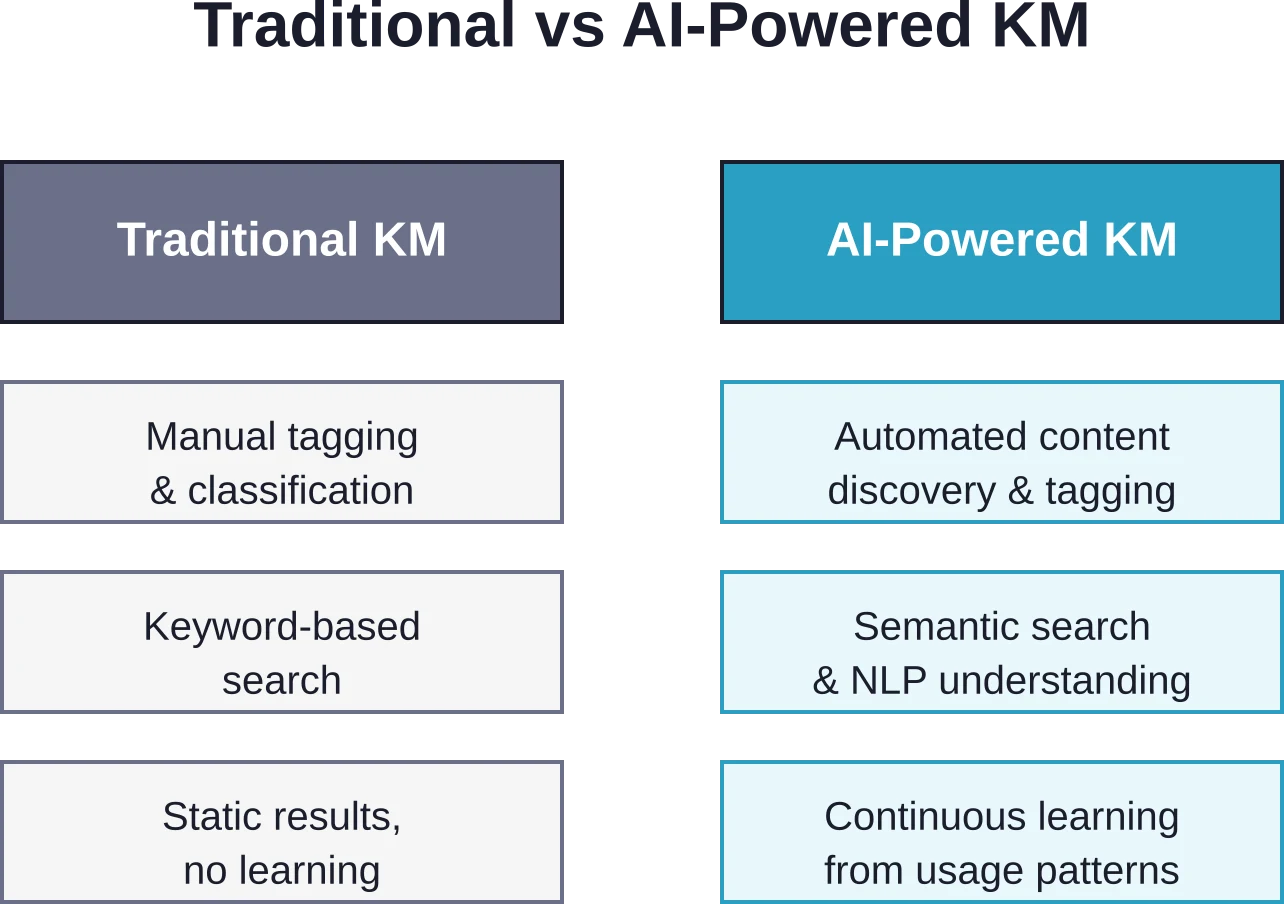
Traditional knowledge management relies on manual categorization, keyword search, and static organization structures. AI-powered systems automatically discover and organize content, understand semantic meaning rather than just keywords, learn from usage patterns to improve relevance, and can synthesize information from multiple sources to answer questions directly. The core difference is automation and intelligence—AI systems handle tasks that previously required constant human effort.
Do we need to replace our existing knowledge base to implement AI?
Not necessarily. Most AI knowledge management platforms integrate with existing systems rather than replacing them. The AI layer sits on top of current repositories—SharePoint, Confluence, file systems, databases—indexing content and providing intelligent access without requiring migration. Organizations keep their existing tools while gaining AI-enhanced discovery and retrieval capabilities.
How accurate are AI-generated answers from knowledge management systems?
Accuracy depends on implementation quality and the underlying technology. Research shows well-designed systems achieve 95.12% accuracy in task classification and 90.45% success in task execution. However, generative AI can produce hallucinations—confident but incorrect responses. Leading implementations address this through source citation, confidence scoring, and human review processes for critical decisions. Organizations should treat AI responses as highly informed suggestions requiring validation rather than definitive truth.
What happens if the AI surfaces confidential information to the wrong people?
Properly designed systems inherit and enforce access controls from source systems. If a document is restricted to specific users in SharePoint, the AI knowledge platform maintains those same restrictions—only surfacing that content to authorized individuals. Organizations should verify access control inheritance during platform evaluation and conduct security audits post-implementation to ensure permissions work correctly.
How long does it take to see value from AI knowledge management?
Initial value—improved search relevance and faster information discovery—typically appears within weeks of deployment as the system indexes content and learns basic patterns. Deeper benefits like proactive knowledge delivery, high-accuracy question answering, and meaningful productivity gains usually emerge over 3-6 months as the AI accumulates usage data and refines its understanding of organizational knowledge and user needs.
Can small and mid-sized organizations benefit from AI knowledge management, or is it only for enterprises?
Organizations of all sizes benefit, though the use cases differ. Large enterprises focus on breaking down silos across thousands of employees and petabytes of content. Smaller organizations use AI to punch above their weight—giving small teams access to insights and capabilities that would otherwise require much larger staff. The technology has become increasingly accessible, with platforms offering pricing and deployment options suitable for organizations of various sizes.
What skills do employees need to work effectively with AI knowledge systems?
The skills differ from traditional search. Employees benefit from understanding how to phrase questions conversationally, how to interpret confidence scores and citations, when to dive deeper into source material versus trusting synthesized answers, and how to provide feedback that helps the system improve. Critical thinking becomes more important—evaluating whether AI-provided information makes sense in context and recognizing when human judgment should override AI recommendations.
Conclusion: Knowledge Management Enters a New Era
AI-powered knowledge management represents a fundamental shift in how organizations capture, organize, and apply information.
The technology moves beyond incremental improvements to traditional systems—it reimagines the entire knowledge lifecycle. Automation replaces manual categorization. Semantic understanding replaces keyword matching. Continuous learning replaces static organization. Proactive delivery replaces reactive search.
Organizations implementing these systems report transformative results: dramatic reductions in time spent searching, improved decision quality from better information access, accelerated innovation through cross-functional discovery, and enhanced customer service through instant access to relevant knowledge.
But the technology also introduces new challenges. Governance frameworks must address accuracy risks, bias, privacy, and compliance. Organizations need change management strategies to help employees adapt to new ways of working. Platform selection requires careful evaluation of integration capabilities, AI sophistication, security, and user experience.
The knowledge workers who thrive in this new era will be those who learn to collaborate effectively with AI—understanding its strengths and limitations, knowing when to trust its recommendations and when to override them, and focusing their human capabilities on tasks where creativity, judgment, and relationship-building create unique value.
Here’s the thing though—the organizations that succeed won’t be those with the most sophisticated AI technology. They’ll be those that pair strong technology with clear governance, effective change management, and a culture that values knowledge sharing.
Ready to transform how knowledge flows through your organization? Start by assessing current pain points, establishing baseline metrics, and evaluating platforms that address your specific needs. The AI knowledge management era has arrived—and the competitive advantage goes to those who move decisively.
 English
  German
  Arabic
  French
  Dutch
Dutch  Spanish