
Quick Summary: ChatGPT represents a breakthrough in natural language processing, offering advanced text generation, sentiment analysis, classification, and conversational AI capabilities through OpenAI’s GPT architecture. Built on transformer models trained on vast text corpora, it enables applications ranging from customer support automation to medical documentation analysis. Businesses can leverage ChatGPT via the OpenAI API (starting at $5 per million input tokens for GPT-5.5) or through subscription plans ranging from $20/month for ChatGPT Plus to enterprise solutions.
Natural language processing has evolved dramatically over the past few years, and ChatGPT sits at the center of that transformation. What started as an experimental conversational model has become a practical tool for businesses tackling everything from customer support to clinical documentation.
The technology isn’t just hype. According to research published on arXiv, the NLP market stood at $27.73 billion in 2022 and is slated to grow at a CAGR of 40.4% from 2022 to 2030. ChatGPT’s role in that expansion can’t be overstated—it democratized access to sophisticated language models that previously required specialized expertise.
But here’s the thing: understanding how ChatGPT actually works within the broader NLP landscape matters if you want to deploy it effectively. This isn’t about throwing a model at a problem and hoping for results. It’s about knowing which tasks align with ChatGPT’s architecture, where it excels, and where traditional NLP methods still hold advantages.
Understanding ChatGPT’s Place in Modern NLP
ChatGPT belongs to a family of large language models (LLMs) built on the transformer architecture. These models learn patterns from massive text datasets, enabling them to generate coherent, contextually appropriate responses without explicit programming for each task.
The transformer architecture—first introduced in research that fundamentally changed NLP—relies on attention mechanisms that weigh the importance of different words in context. According to documentation from Hugging Face, transformers process entire sequences simultaneously rather than word-by-word, making them faster and more context-aware than earlier recurrent models.
OpenAI’s current flagship model, GPT-5.5 represents the latest evolution of this architecture. As listed on the official OpenAI API documentation, it’s designed specifically for complex reasoning and coding tasks, with a context window of 1 million tokens and maximum output of 128,000 tokens.
How Text Generation Models Actually Work
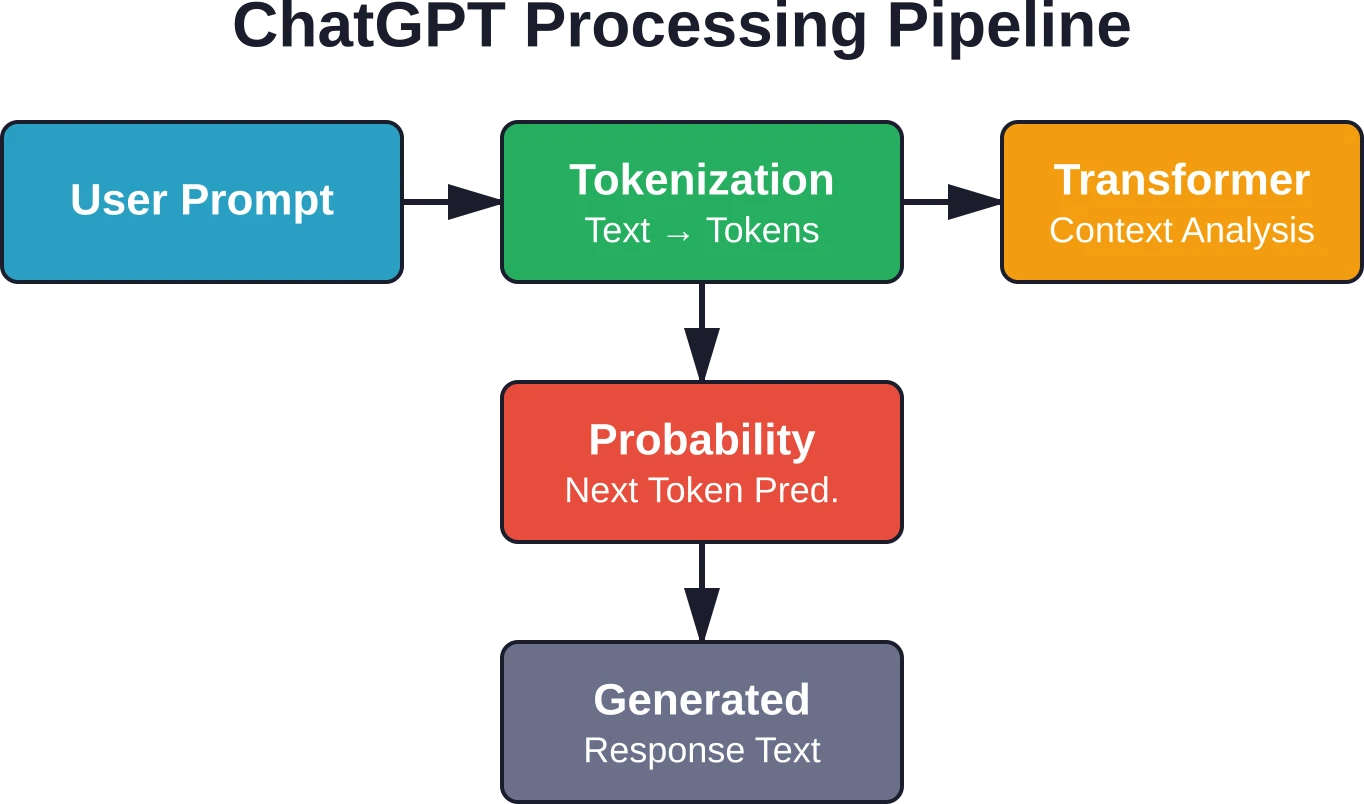
When you send a prompt to ChatGPT, you’re not querying a database or triggering pre-written responses. The model calculates probability distributions across its vocabulary, predicting the most likely next token based on everything that came before.
According to OpenAI’s key concepts documentation, these generative pre-trained transformers have been trained to understand both natural and formal language. The training process involves two stages: pre-training on vast text corpora to learn language patterns, then fine-tuning on specific tasks with human feedback to align outputs with user intent.
That fine-tuning matters. Early GPT models could generate fluent text but often veered off-topic or produced unhelpful responses. Modern ChatGPT incorporates reinforcement learning from human feedback (RLHF), which trains the model to prioritize useful, accurate, and safe outputs.
Core NLP Applications Where ChatGPT Excels
Not all NLP tasks benefit equally from ChatGPT’s architecture. The model shines in specific domains where context understanding and generative capabilities matter most.
Text Generation and Content Creation
This is ChatGPT’s home turf. According to OpenAI’s text generation documentation, the model can generate almost any kind of text response—code, mathematical equations, structured JSON data, or human-like prose.
Businesses use ChatGPT for drafting customer emails, creating product descriptions, generating technical documentation, and producing marketing copy. The context window of 1 million tokens in GPT-5.5 means the model can maintain coherence across extremely long documents.
Real talk: the quality varies based on prompt design. Generic prompts produce generic output. Specific instructions with examples (few-shot learning) consistently deliver better results.
Sentiment Analysis and Opinion Mining
ChatGPT can classify text by emotional tone, detecting whether customer feedback skews positive, negative, or neutral. According to research examining ChatGPT’s performance in clinical systematic reviews, ChatGPT 3.5 achieved a sensitivity of 100% and specificity of 50% (precision=65.2%) when screening research papers—demonstrating strong recall but occasional false positives.
For customer support applications, this means ChatGPT can reliably flag negative sentiment for human escalation while handling routine positive interactions automatically. The tradeoff between precision and recall matters here: catch every complaint (high sensitivity) even if some neutral messages get flagged too (lower specificity).
Text Classification and Categorization
Routing support tickets, tagging documents, identifying spam—ChatGPT handles these classification tasks through zero-shot or few-shot learning. According to research published on arXiv analyzing different training strategies, zero-shot learning requires $0 in training costs and offers the best out-of-domain task generalization.
That matters for businesses without large labeled datasets. Traditional classification models need hundreds or thousands of labeled examples. ChatGPT can classify with just a few examples in the prompt, or even none if the categories are clearly defined.
Question Answering and Information Retrieval
ChatGPT’s ability to synthesize information from context makes it effective for answering questions based on provided documents. The model doesn’t just match keywords—it understands relationships between concepts and can explain answers in natural language.
Medical applications demonstrate this capability. Research examining generative language models in medicine found that ChatGPT showed performance exceeding 95% positive predictive value for conditions like hypertension, dyslipidemia, and stroke when analyzing clinical text.
Named Entity Recognition and Information Extraction
Extracting names, dates, locations, medical terms, or product identifiers from unstructured text is another strength. ChatGPT can identify entities and output structured formats like JSON, making downstream processing straightforward.
According to OpenAI’s documentation, models support structured outputs that guarantee the response matches a specified JSON schema—critical for applications that need reliable data extraction.
| NLP Task | ChatGPT Suitability | Key Advantage | Typical Use Case |
|---|---|---|---|
| Text Generation | Excellent | Long-form coherence | Content creation, documentation |
| Sentiment Analysis | Very Good | Contextual understanding | Customer feedback analysis |
| Classification | Very Good | Zero-shot capability | Ticket routing, document tagging |
| Question Answering | Excellent | Synthesis across sources | Knowledge bases, support bots |
| Entity Extraction | Good | Structured output support | Data extraction, form processing |
| Translation | Very Good | Multilingual training | Content localization |
API Integration and Implementation
Deploying ChatGPT in production requires understanding the OpenAI API structure, pricing model, and integration patterns.
API Pricing and Model Selection
As of the official OpenAI API pricing page, the cost structure for flagship models breaks down as follows:
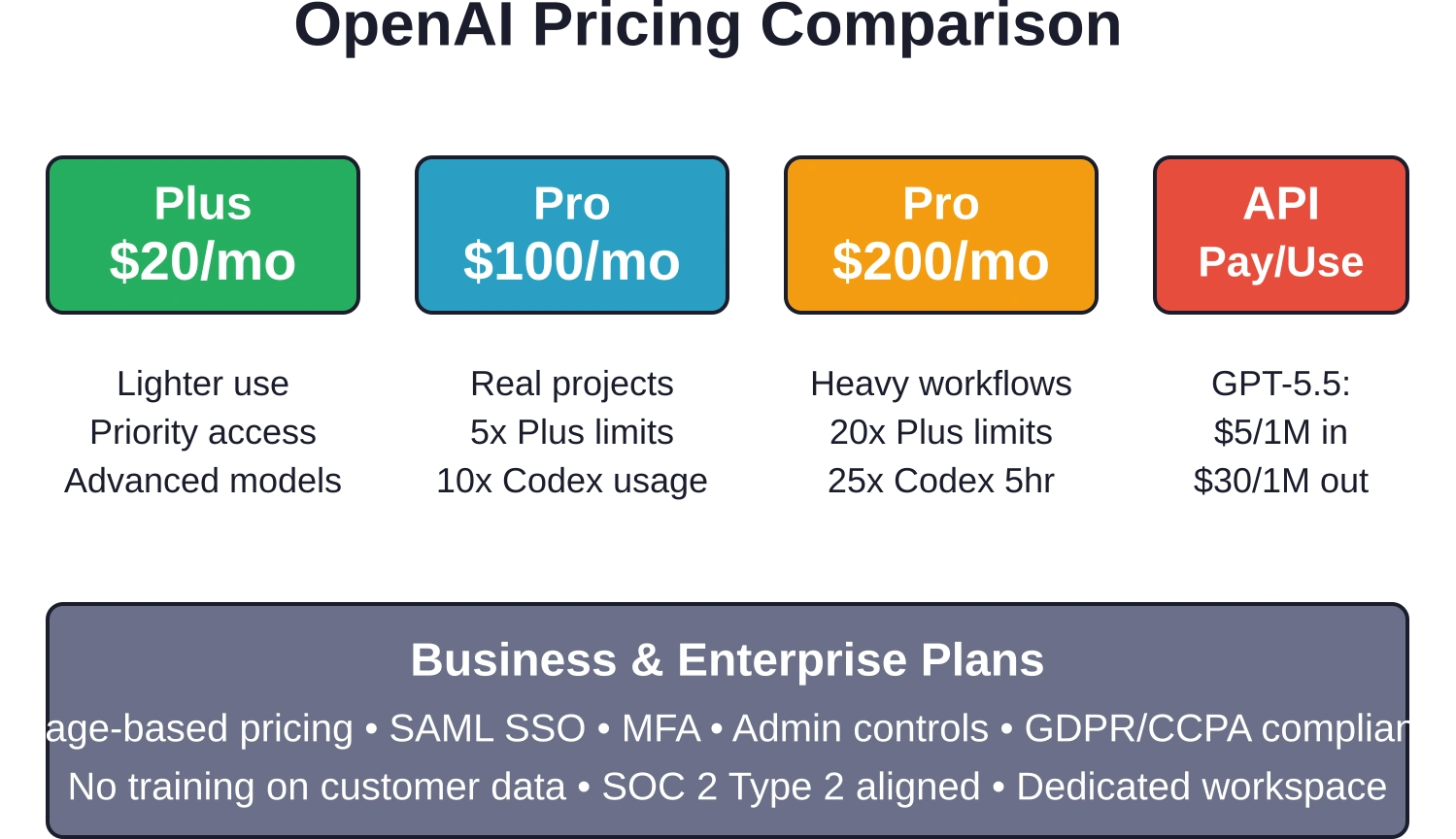
- GPT-5.5: $5 per million input tokens, $30 per million output tokens (cached input: $0.50)
- GPT-5.4: $2.50 per million input tokens, $15 per million output tokens (cached input: $0.25)
- GPT-5.4 mini: $0.75 per million input tokens, $4.50 per million output tokens (cached input: $0.075)
Batch processing offers a 50% discount, while data residency requirements add 10% to costs. For applications processing millions of tokens daily, these differences compound quickly.
According to OpenAI’s model selection guidance, teams should start with GPT-5.5 for complex reasoning and coding, or choose gpt-5.4-mini for lower-latency, lower-cost workloads.
Making API Calls
The Responses API provides the primary interface for text generation. According to the official documentation, a basic implementation using the Python client looks like this:
from openai import OpenAI
client = OpenAI()
response = client.responses.create(
model=”gpt-5.5″,
input=”Write a one-sentence bedtime story about a unicorn.”
)
print(response.output_text)
The API supports three message types: developer messages (instructions from the application, highest priority), user messages (end-user instructions), and assistant messages (model-generated responses). Structuring conversations with appropriate message types improves response quality.
ChatGPT Plans for Different Use Cases
Not every application needs API access. OpenAI offers subscription plans for direct ChatGPT usage:
- ChatGPT Plus: $20/month for lighter use with advanced capabilities like Codex and deep research
- ChatGPT Pro ($100 tier): Built for real projects with 5x higher limits than Plus and 10x Codex usage (limited time offer)
- ChatGPT Pro ($200 tier): For heavy workflows with 20x higher limits than Plus and 25x Codex 5-hour limits versus Plus (limited time)
According to the official ChatGPT Plus help documentation, the Plus plan includes priority access during high-traffic periods and access to higher GPT models—useful for teams evaluating capabilities before committing to API integration.

Build ChatGPT-Based and NLP Applications With AI Superior
ChatGPT-style tools and NLP applications work best when they are designed around specific business tasks, company data, and real user needs. AI Superior provides AI chatbot development, generative AI development, LLM consulting, NLP, AI software development, and AI integration services. These capabilities can support customer support assistants, internal knowledge search, document processing, text classification, content workflows, and LLM-based functionality inside existing products.
Relevant AI Superior services include:
- Defining ChatGPT and NLP use cases
- Developing AI chatbots and LLM-based assistants
- Building NLP tools for text and document workflows
- Connecting AI tools with company data sources
- Integrating language AI into existing platforms
Contact AI Superior to discuss ChatGPT-based or NLP applications for your business, product, or internal operations.
Real-World Applications Across Industries
Abstract capabilities matter less than concrete implementations. Here’s where ChatGPT’s NLP applications deliver measurable value.
Healthcare and Clinical Documentation
Medical professionals use ChatGPT for transcribing patient interactions, extracting diagnoses from clinical notes, and drafting discharge summaries. Research examining ChatGPT’s performance in systematic medical literature reviews found that the model achieved high sensitivity when screening research papers, though human oversight remained essential for final decisions.
The model’s ability to parse medical terminology and maintain context across long documents makes it particularly useful for documentation—one of the most time-consuming aspects of clinical practice.
Customer Support Automation
Chatbots powered by ChatGPT handle routine inquiries, freeing human agents for complex cases. The key difference from earlier chatbot generations? ChatGPT understands context across multi-turn conversations and generates responses tailored to specific situations rather than selecting from templates.
According to industry analyses, businesses implement ChatGPT for ticket classification, automated responses to FAQs, sentiment-based escalation, and drafting personalized follow-up messages. The combination of classification and generation capabilities in a single model simplifies architecture.
Content Moderation and Safety
Platforms use ChatGPT to detect harmful content, classify policy violations, and flag material for human review. The model’s training includes safety alignment, making it effective at identifying problematic content across categories like hate speech, misinformation, and graphic material.
The tradeoff between false positives and false negatives matters significantly here. Platforms typically tune for high recall (catch most violations) accepting some false positives that human moderators review.
Code Generation and Technical Documentation
Developers use ChatGPT to generate boilerplate code, explain complex functions, write API documentation, and debug errors. GPT-5.5’s focus on coding tasks shows in its performance—according to OpenAI’s model documentation, it’s specifically designed for complex reasoning and coding applications.
The Codex plan, available through Business subscriptions with pay-as-you-go pricing, provides AI-powered software engineering, automated code reviews, and security analysis. This demonstrates OpenAI’s recognition that code generation represents a distinct high-value use case.
Training Strategies and Cost Considerations
How teams deploy ChatGPT significantly impacts both performance and costs. Research published on arXiv analyzing large language model training strategies identified distinct approaches with different tradeoffs.
Zero-Shot Learning
Tasks are defined entirely in the prompt without examples. According to the research, this approach requires $0 in training costs and provides the best out-of-domain task generalization. The model relies entirely on its pre-training.
Zero-shot works well when tasks align closely with ChatGPT’s training distribution—standard classification, summarization, or question answering. Performance drops for highly specialized or unusual tasks.
Few-Shot Learning
The prompt includes a few examples (typically 2-10) demonstrating the desired behavior. Training cost remains $0, but prompt design requires more effort. Few-shot typically improves accuracy over zero-shot while maintaining flexibility.
This is the sweet spot for most business applications—enough guidance to shape outputs without the complexity and cost of fine-tuning.
Parameter-Efficient Fine-Tuning (PEFT)
Techniques like LoRA (Low-Rank Adaptation) fine-tune a small subset of model parameters on custom datasets. According to the research, PEFT approaches cost $10-$1K in training expenses—dramatically less than full fine-tuning while achieving comparable performance on specific tasks.
Fine-tuning makes sense when consistent domain-specific behavior matters more than flexibility, and when sufficient training data exists (typically thousands of examples).
Full Parameter Fine-Tuning
Training all model parameters on custom data delivers maximum performance for specific tasks but requires 2x the model size in memory and significant computational resources. For most teams, the cost and complexity don’t justify the marginal performance gain over PEFT.
Limitations and Practical Considerations
ChatGPT isn’t a universal solution. Understanding its limitations prevents costly mistakes.
Hallucination and Factual Accuracy
Language models generate plausible-sounding text based on statistical patterns, not factual databases. ChatGPT sometimes produces confident-sounding but incorrect information—particularly problematic for applications where accuracy is critical.
Mitigation strategies include retrieval-augmented generation (providing source documents in the prompt), structured outputs with validation, and human review loops for high-stakes decisions.
Context Length Constraints
Despite GPT-5.5’s 1-million-token context window, extremely long contexts affect both performance and cost. Token costs scale linearly, so processing entire codebases or document collections repeatedly becomes expensive.
Smart application design uses embeddings for initial retrieval, then passes only relevant sections to ChatGPT for processing.
Privacy and Data Security
According to OpenAI’s API data privacy documentation, the platform does not train models on API inputs and outputs. However, sensitive data still leaves organizational control when sent to external APIs.
Enterprise plans address this with SAML SSO, MFA, GDPR/CCPA compliance support, and SOC 2 Type 2 alignment. For highly regulated industries, these security features aren’t optional.
Latency and Real-Time Requirements
API calls to ChatGPT introduce latency—typically 1-3 seconds for standard requests, longer for complex reasoning tasks. Applications requiring sub-second responses may need different architectures.
Smaller, faster models like GPT-5.4-mini trade some capability for lower latency and cost. According to OpenAI’s pricing documentation, GPT-5.4-mini costs $0.75 per million input tokens versus $5 for GPT-5.5—a meaningful difference at scale.
Alternatives and Complementary Approaches
ChatGPT exists within a broader NLP ecosystem. Some tasks benefit from alternative or hybrid approaches.
Traditional NLP Methods
Rule-based systems, regular expressions, and classical machine learning models remain relevant for well-defined tasks with limited variability. They’re faster, cheaper, more predictable, and don’t require external API calls.
A hybrid architecture might use regex for initial filtering, ChatGPT for nuanced classification, then traditional models for high-throughput batch processing.
Open-Source Language Models
Models available through platforms like Hugging Face offer alternatives that run locally without per-token costs. According to Hugging Face documentation, the transformer model family includes hundreds of pre-trained models for specific languages and domains.
The tradeoff? Open-source models typically require more technical expertise to deploy and maintain, and smaller models underperform ChatGPT on complex reasoning tasks.
Specialized NLP Services
Cloud providers offer managed NLP services for specific tasks—entity extraction, translation, sentiment analysis. These services often cost less than general-purpose LLMs for narrow applications.
Architecture decisions should prioritize task requirements over technology preferences. Sometimes the best solution combines multiple approaches.
Future Developments and Emerging Patterns
The NLP landscape continues evolving rapidly. Several trends will shape how ChatGPT applications develop.
Multimodal Capabilities
According to OpenAI’s model documentation, latest models support text and image input—a significant expansion beyond pure language processing. Multimodal models can analyze screenshots, diagrams, charts, and photos alongside text.
This enables applications like visual content moderation, document understanding with complex layouts, and accessibility tools that describe images in natural language.
Function Calling and Tool Use
GPT Actions, as described in OpenAI’s developer documentation, allow ChatGPT to interact with external applications via RESTful API calls. The model converts natural language into JSON schema required for API calls.
This transforms ChatGPT from a text processor into an orchestration layer that can query databases, file tickets, retrieve real-time data, and trigger workflows—dramatically expanding practical applications.
Improved Reasoning Models
OpenAI’s documentation describes reasoning modes where models spend more time thinking before producing responses, making them ideal for complex, multi-step problems. This addresses a key limitation where earlier models sometimes rushed to answers without adequate analysis.
Frequently Asked Questions
What’s the difference between ChatGPT and traditional NLP tools?
Traditional NLP tools typically focus on specific tasks like named entity recognition or sentiment classification, requiring separate models for each function. ChatGPT is a general-purpose language model that handles multiple tasks through natural language instructions rather than task-specific training. Traditional tools often require labeled training data and custom development, while ChatGPT can adapt to new tasks through prompt engineering. However, traditional tools may offer better performance and lower costs for well-defined, high-volume tasks.
How much does it cost to use ChatGPT for business applications?
According to OpenAI’s official pricing, API costs for GPT-5.5 are $5 per million input tokens and $30 per million output tokens. For subscription plans, ChatGPT Plus costs $20/month for lighter use, while Pro tiers range from $100/month (5x higher limits than Plus) to $200/month for heavy workflows. Business and Enterprise plans use usage-based pricing without fixed seat fees. Actual costs depend on token volume—a typical customer support conversation might use 1,000-3,000 tokens total, costing $0.01-0.10 with GPT-5.5.
Can ChatGPT replace human customer support agents?
ChatGPT handles routine inquiries effectively, potentially managing 60-80% of common questions about policies, account status, or basic troubleshooting. But it struggles with complex edge cases, emotionally sensitive situations, and tasks requiring access to real-time systems. The most effective implementations use ChatGPT for initial triage and routine responses while escalating nuanced or high-stakes interactions to human agents. Complete replacement isn’t advisable—hybrid approaches that combine AI efficiency with human judgment deliver better customer satisfaction.
What are the main limitations when using ChatGPT for NLP tasks?
ChatGPT can hallucinate plausible-sounding but incorrect information, particularly for factual queries beyond its training data. Context length, while large, still imposes limits on processing extremely long documents. API latency (typically 1-3 seconds) makes it unsuitable for applications requiring instant responses. The model also lacks access to real-time information unless specifically provided in the prompt. Privacy concerns arise when sending sensitive data to external APIs. Understanding these constraints helps teams design appropriate architectures with mitigation strategies like retrieval-augmented generation and human review loops.
How does ChatGPT handle multiple languages?
According to OpenAI’s documentation, all latest models support multilingual capabilities trained on text from dozens of languages. ChatGPT can translate between languages, answer questions in non-English languages, and process mixed-language input. Performance varies by language—more training data exists for common languages like English, Spanish, French, German, and Chinese compared to lower-resource languages. For critical translation applications, specialized translation services may still outperform general-purpose language models, but ChatGPT handles most multilingual tasks competently.
Do I need machine learning expertise to implement ChatGPT?
Basic implementation through the OpenAI API requires standard software development skills—making HTTP requests, handling JSON responses, and managing API keys. No specialized machine learning expertise is necessary for straightforward applications. However, optimizing performance through prompt engineering, implementing retrieval-augmented generation, or fine-tuning models benefits from understanding NLP concepts. Teams can start with simple integrations and gradually add complexity as requirements evolve. OpenAI’s documentation provides code examples in Python and JavaScript that developers can adapt without deep ML knowledge.
What’s the best way to get started with ChatGPT for NLP applications?
Start with the ChatGPT Plus subscription ($20/month) to explore capabilities and test prompts interactively before committing to API development. Once use cases are clear, create an OpenAI API account and implement a simple proof-of-concept using the Responses API with a smaller model like GPT-5.4-mini to control costs. Focus on a single, well-defined task—sentiment classification, FAQ answering, or content summarization. Measure performance against baseline methods and gather user feedback. Scale complexity gradually, adding features like function calling or fine-tuning only when clear value justifies the added development effort.
Conclusion
ChatGPT has fundamentally changed what’s practical in natural language processing. Tasks that previously required specialized models, extensive training data, and months of development can now be prototyped in hours through prompt engineering.
But technology isn’t magic. Effective implementation requires understanding where ChatGPT excels versus where traditional approaches still make sense. It demands attention to prompt design, awareness of cost structures, and realistic expectations about limitations like hallucination and latency.
The organizations seeing the most value treat ChatGPT as one tool in a broader NLP toolkit—not a replacement for everything that came before. They build hybrid architectures that leverage ChatGPT’s strengths while mitigating its weaknesses through retrieval augmentation, human review loops, and task-appropriate model selection.
As models continue improving and pricing evolves, the practical applications will expand. Multimodal capabilities, function calling, and improved reasoning already point toward ChatGPT systems that orchestrate entire workflows rather than just processing text.
The question isn’t whether to explore ChatGPT for NLP applications—it’s how to implement it strategically for maximum business value. Start with a clear use case, measure results objectively, and scale based on demonstrated ROI rather than hype.
Ready to implement ChatGPT in production applications? Check the official OpenAI API documentation for current pricing and technical specifications, or start with a Plus subscription to test capabilities before committing to development resources.
 English
  German
  Arabic
  French
  Dutch
Dutch  Spanish