Quick Summary: AI optimization of nitric acid production uses machine learning, real-time process control, and predictive analytics to boost ammonia oxidation efficiency, cut N2O and NOx emissions, and reduce unplanned downtime in Ostwald process plants. Recent research shows combined AI and catalyst or oxygen-injection strategies can lift production rates by double-digit percentages while keeping emissions below baseline. This guide breaks down where AI fits into the process and what results are realistic today.
Nitric acid plants have run on more or less the same chemistry for over a century. Ammonia gets oxidized over a platinum-rhodium catalyst at roughly 400-600°C, the resulting nitric oxide gets cooled and oxidized further, and the gas is absorbed into water to yield the acid. It’s called the Ostwald process, and it’s been the industry backbone since the early 1900s.
What’s changed isn’t the chemistry — it’s what surrounds it. Sensors, historical process data, and machine learning models are now doing what plant engineers used to attempt with rules of thumb and periodic manual adjustments. That shift is what people mean when they talk about AI optimization of nitric acid production: using data-driven models to squeeze more output, fewer emissions, and better uptime out of the same reactors and columns.
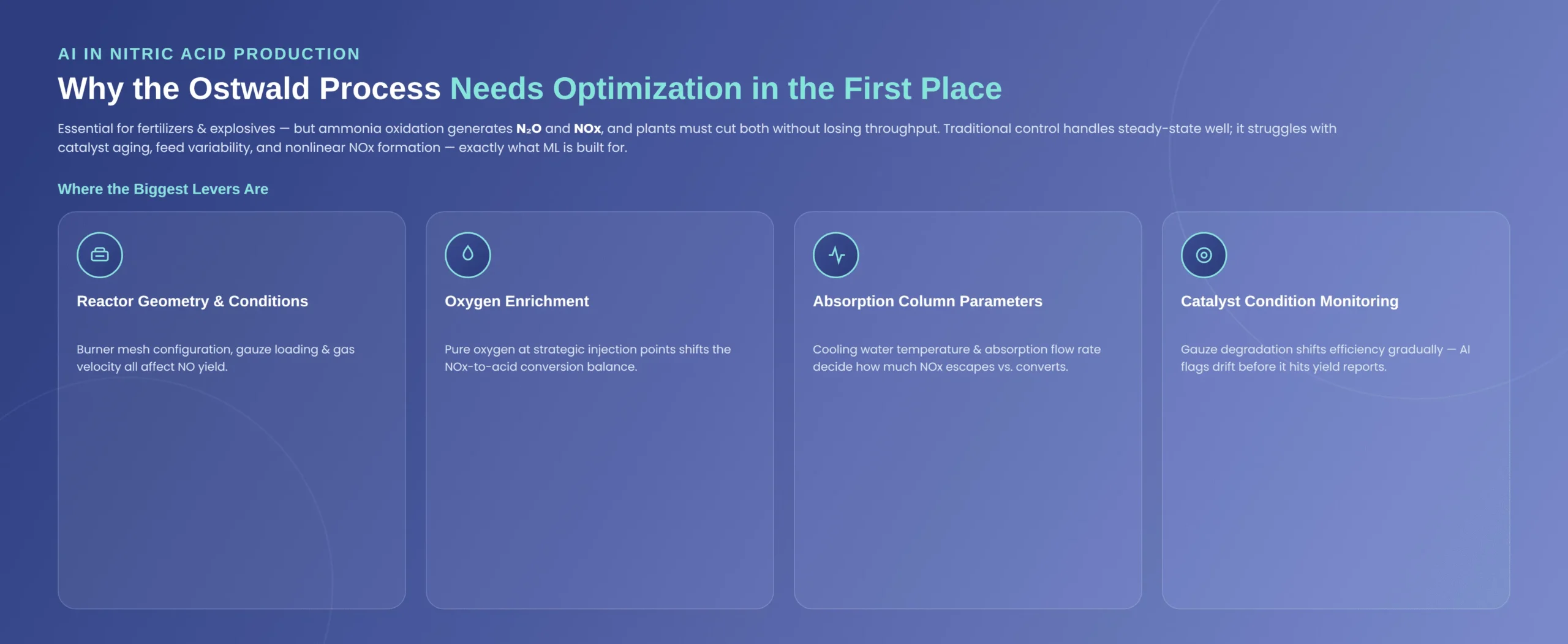
Why the Ostwald Process Needs Optimization in the First Place
Nitric acid production sits at an awkward intersection. It’s essential for fertilizers, explosives, and industrial chemicals, yet the ammonia oxidation step also generates nitrous oxide (N2O) — a greenhouse gas with a global warming potential many times higher than CO2 — alongside NOx emissions that must be scrubbed before venting. Plants are under pressure from regulators and buyers alike to cut both while not sacrificing throughput.
Traditional process control handles steady-state conditions reasonably well. It struggles with the messier reality: catalyst aging, ammonia feed variability, seasonal cooling water temperature swings, and the nonlinear relationship between operating pressure and NOx formation. That’s exactly the kind of multivariable, time-varying problem machine learning models are built to handle.
Where the Biggest Levers Are
- Ammonia oxidation reactor geometry and operating conditions — burner mesh configuration, gauze loading, and gas velocity all affect NO yield.
- Oxygen enrichment — supplementing process air with pure oxygen at strategic injection points changes the NOx-to-nitric-acid conversion balance.
- Absorption column parameters — cooling water temperature and absorption water flow rate directly influence how much NOx escapes versus converts to acid.
- Catalyst condition monitoring — gauze degradation over campaign life shifts conversion efficiency gradually, and AI models can flag drift before it shows up in yield reports.
 Apply AI to Nitric Acid Production With AI Superior
AI Superior develops AI components that can work with existing production and monitoring systems. In nitric acid plants, this may include analyzing process data, tracking equipment performance, predicting maintenance needs, and supporting more consistent operating decisions.
Looking to Optimize Nitric Acid Production With AI?
AI Superior can help with:
- evaluating plant data and suitable AI use cases
- developing models for process and equipment monitoring
- analyzing sensor, production, and maintenance data
- integrating AI components into existing plant infrastructure
👉 Contact AI Superior to discuss your production process, available data, and implementation approach.
What Recent Research Actually Shows
- A 2026 review published in Processes by Buttignol and colleagues examines sustainability metrics across nitric acid plants and makes a direct case for “integration of artificial intelligence and machine learning for real-time, multivariable process optimization” aimed at cutting N2O emissions while keeping output stable. The review frames AI not as a replacement for the Ostwald chemistry but as a layer that continuously tunes operating parameters against emissions and yield targets simultaneously — something static setpoints can’t do.
- Separately, a 2025 study in the Journal of Advanced Manufacturing and Processing modeled a medium-pressure nitric acid plant using the ProSim Plus HNO3 simulator and tested pure-oxygen injection combined with secondary air flow, absorption cooling temperature, and absorption water rate as optimization variables. The best-performing scenario increased nitric acid production by roughly 32% without exceeding the baseline’s NOx losses; a more economically conservative scenario delivered about a 25% increase without any process reconfiguration.
- A related techno-economic assessment published in the Journal of Cleaner Production looked at oxygen injection at four different points in a 700 t/day mono-pressure plant. Results were more modest on throughput — around a 0.31% daily production increase — but NOx concentration in the absorption column tail gas dropped by as much as 43.6%, and optimal injection placement cut capital costs by an estimated €0.41 million by allowing a smaller exhaust gas cleaning unit.
Those two studies land on different numbers because they’re optimizing for different things — one prioritizes production rate, the other prioritizes emissions reduction with a smaller footprint. That’s a useful reminder: “optimization” in nitric acid production isn’t a single number to chase, it’s a trade-off surface, and AI’s real value is mapping that surface faster and more precisely than manual trial-and-error ever could. 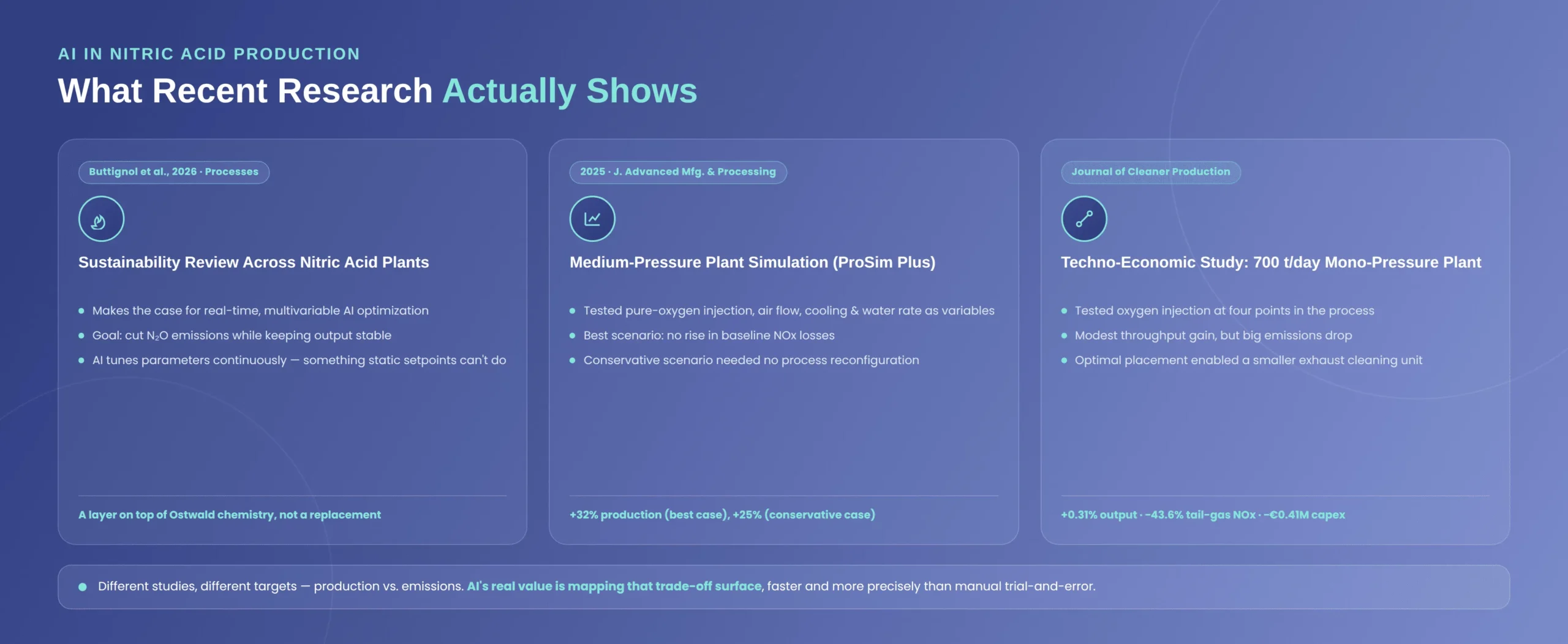
Machine Learning Techniques Applied to Nitric Acid Plants
Most of the modeling work in this space borrows from broader industrial process control research, adapted to the specific chemistry of ammonia oxidation and NOx absorption. A few approaches show up repeatedly across adjacent nitrogen-chemistry literature, including studies on N2O emissions modeling in wastewater and agricultural systems that use similar sensor-data structures:
| Technique | Typical Use in Nitric Acid Context | Strength |
|---|---|---|
| Random forest / gradient boosting | Predicting NO/NOx yield from operating parameters | Handles nonlinear interactions well, easy to interpret feature importance |
| Artificial neural networks | Modeling absorption column efficiency and N2O formation | Captures complex, multivariable relationships |
| Hybrid mechanistic + deep learning | Combining first-principles reactor kinetics with data-driven correction | More reliable outside the training data range |
| Digital twins | Simulating “what-if” scenarios for catalyst aging or feed changes | Lets engineers test changes before touching the real plant |
Digital twins deserve a specific mention here. Predictive maintenance tools and AI-driven monitoring are increasingly used across chemical process industries to catch equipment degradation early and reduce unplanned downtime — nitric acid plants, with their high-temperature catalytic reactors and corrosive absorption columns, are a natural fit. A digital twin trained on historical sensor data can simulate how a specific catalyst batch will degrade over a production campaign, letting operators plan gauze replacement windows instead of reacting to yield drops after they happen.
CFD Meets Machine Learning in Reactor Design
Computational fluid dynamics (CFD) studies of ammonia oxidation reactors have separately looked at geometric and operational modifications — burner spacing, gas distribution, gauze pack configuration — to improve NO yield and thermal uniformity. Pairing CFD-derived simulation data with machine learning surrogate models is an emerging pattern: instead of running a full CFD simulation for every candidate design, a trained model approximates the outcome in seconds, letting engineers screen far more configurations before committing to a physical trial.
| pie title Where AI-Driven Gains Concentrate in Recent Studies "Production rate increase (oxygen scenario)" : 32 "Production increase (no reconfig)" : 25 "NOx tail-gas reduction (techno-economic)" : 43.6 "Daily production gain (4-point injection)" : 0.31 |
Reported percentage gains vary widely depending on which variable a study optimizes for.
Building an AI Optimization Roadmap for a Nitric Acid Plant
Plants that have never applied data-driven process control tend to underestimate how much groundwork comes before any model delivers value. Historical sensor data needs cleaning, instrumentation gaps need identifying, and someone has to decide what “optimized” actually means for that specific site — maximum throughput, minimum emissions, or some negotiated balance between the two.
| flowchart TD A[Audit sensor dataand historical logs] --> B[Define optimizationobjective and constraints] B --> C[Build/validateprocess model] C --> D[Pilot on non-criticalparameter set] D --> E[Scale to real-timemultivariable control] E --> F[Monitor drift and retrain periodically] |
Six-step path from raw plant data to real-time AI process control.
This is where working with an experienced AI implementation partner tends to pay off. A structured AI consulting engagement can help a plant figure out which optimization objective is realistic given its existing instrumentation, before anyone commits budget to a full model build. For plants that need something custom built around their specific reactor and column configuration rather than an off-the-shelf tool, custom AI software development is usually the more durable route than retrofitting generic industrial software.
Identifying which part of the plant offers the best return on modeling effort — the oxidation reactor, the absorption column, or catalyst lifecycle management — is itself a nontrivial exercise, and it’s the kind of question AI use case identification work is designed to answer before any code gets written.
Ammonia Oxidation Optimization vs. Absorption Column Optimization
It’s worth separating these two because they respond to different levers and different AI approaches.
| Aspect | Ammonia Oxidation Reactor | Absorption Column |
|---|---|---|
| Primary goal | Maximize NO yield, minimize N2O byproduct | Maximize NOx-to-HNO3 conversion, minimize tail-gas losses |
| Key variables | Temperature, catalyst gauze condition, gas velocity | Cooling water temperature, absorption water flow, pressure |
| Common AI method | CFD-informed surrogate models, gradient boosting | Process simulators combined with multiparameter optimization |
| Typical reported gain | Yield improvements in single digits to low double digits | NOx reduction up to 40%+ in favorable oxygen-injection scenarios |
Neither optimization happens in isolation, though. Changing oxidation reactor conditions shifts the gas composition entering the absorption column, so a genuinely optimized plant needs models that treat both stages as one coupled system — which is precisely the multivariable framing the 2026 sustainability review argues for.
Realistic Expectations and Common Pitfalls
It’s tempting to read a 32% production increase headline and assume that’s the norm. It isn’t. That figure came from a specific medium-pressure plant configuration with pure oxygen as an added raw material — a change that carries its own cost and safety considerations, since higher oxygen concentrations in the ammonia combustion step raise explosion-risk questions that need careful simulation before implementation.
A few pitfalls show up consistently in early-stage AI optimization projects at process plants:
- Training models on too narrow an operating window, so the model fails the moment ammonia feed or catalyst age moves outside historical ranges.
- Treating emissions and production rate as separate optimization problems instead of a joint objective with trade-offs.
- Skipping the safety review step when a proposed change (like oxygen enrichment) alters combustion chemistry.
- Underinvesting in the data pipeline, which quietly determines whether any model stays accurate after the first few months.
None of these are reasons to avoid the approach — they’re reasons to plan for it properly. A phased pilot on a smaller parameter set, with clear rollback conditions, tends to outperform a big-bang full-plant deployment.
FAQ: AI Optimization of Nitric Acid Production
What is AI optimization of nitric acid production?
AI optimization of nitric acid production uses machine learning models, predictive analytics, and digital twins to continuously adjust operating parameters such as ammonia feed rate, oxygen injection, and absorption column conditions. The goal is to improve production efficiency while simultaneously reducing N2O and NOx emissions.
How much can AI actually increase nitric acid production?
The potential improvement depends on the optimization strategy and plant configuration. Published studies have reported production increases of up to 32% under certain oxygen-enriched operating conditions, while more conservative scenarios achieved gains closer to 25%. In projects focused primarily on emissions reduction, production improvements may be much smaller.
Does AI optimization replace the Ostwald process catalyst?
No. AI does not replace the platinum-rhodium gauze catalyst or the underlying Ostwald process chemistry. Instead, it optimizes operating conditions such as temperature, gas velocity, and feed composition while monitoring catalyst performance and degradation throughout its service life.
What role does N2O emission control play in this optimization?
Reducing N2O emissions is a major objective because nitrous oxide has a very high global warming potential. Modern AI optimization strategies aim to reduce both N2O and NOx emissions while maintaining stable nitric acid production, integrating emissions control directly into process optimization rather than treating it as a separate downstream task.
Is pure oxygen injection required for AI-driven optimization?
No. Oxygen enrichment is only one possible optimization variable. While some studies report significant benefits from pure oxygen injection, many AI optimization projects focus on existing air-feed systems, catalyst condition monitoring, and absorption column optimization without requiring oxygen enrichment.
What data does a plant need before starting an AI optimization project?
Plants should have clean historical process data from sensors measuring temperature, pressure, flow rates, and emissions, ideally collected across multiple operating conditions and catalyst campaigns. Maintenance records and consistent operating histories further improve the accuracy of AI models.
Can predictive maintenance be combined with process optimization?
Yes. Modern AI platforms often combine predictive maintenance with real-time process optimization. Machine learning models and digital twins continuously optimize operating conditions while detecting issues such as catalyst gauze degradation or heat exchanger fouling before they lead to unplanned downtime.
Where This Is Heading
Nitric acid production isn’t going to abandon the Ostwald process anytime soon — the chemistry is too well understood and too economical at scale. What’s shifting is the layer of intelligence wrapped around it: real-time multivariable models replacing static setpoints, digital twins replacing reactive maintenance schedules, and joint optimization of production and emissions replacing the old habit of treating them as separate problems.
For plants weighing where to start, the honest answer is usually smaller than the flashiest headline number suggests. A well-scoped pilot on one part of the process — the absorption column, say, or catalyst lifecycle monitoring — tends to build the confidence and data infrastructure needed before attempting a full multivariable overhaul. Teams exploring generative AI tools for summarizing plant reports or building natural-language interfaces into process data might also look at generative AI development as a complementary layer on top of the core optimization models, and broader AI-based business process optimization approaches can help tie plant-floor gains into wider operational decision-making.
Getting from a promising research paper to a working control system on a real plant is a different kind of project than running a simulation study. It requires the right data strategy, the right modeling approach for the specific reactor and column configuration, and a realistic view of what gains are achievable given existing instrumentation. Plants ready to move past the simulation stage should start with a clear-eyed assessment of their data and objectives before committing to a full deployment.