
Overview: Corporate AI training costs vary widely based on format and scope—basic online courses start around $200 per employee, while comprehensive programs range from $500 to $15,000. Five-year implementation costs for SMEs typically reach $200,000 when factoring in development, ongoing operations, and maintenance beyond initial training expenses.
AI adoption has climbed to 72% among organizations over the past eight years, according to research from MIT Sloan Management Review and BCG. But here’s what catches most companies off guard: training costs represent just the tip of the iceberg.
That initial $50,000 investment? It’ll actually run closer to $200,000 by year five when accounting for infrastructure, ongoing operations, and continuous learning requirements. The problem isn’t dishonest pricing—it’s that AI implementation resembles hiring a specialized team member rather than purchasing traditional software.
Organizations are rushing into agentic AI adoption well before strategy solidifies. This creates a dangerous gap: massive investment decisions made without understanding the full financial picture.
Understanding the AI Training Cost Spectrum
Basic online courses can start as low as $200 per employee, providing foundational knowledge about AI concepts and applications. These entry-level programs work well for general awareness but won’t transform business operations.
Advanced or specialized training sessions cost upwards of $10,000 per employee when considering in-person sessions and expert-led instruction. Complete corporate AI training packages can range between €500 and €15,000, depending on customization depth, participant count, and delivery format.
Here’s where it gets interesting. These figures cover only the training itself—not the broader implementation ecosystem that sustains AI initiatives long-term.
Format-Based Cost Variations
Training delivery method dramatically impacts budget requirements. Virtual workshops typically cost 40-60% less than on-site sessions, eliminating travel expenses and venue costs. Private corporate sessions, designed for executives and delivery teams, can support cohorts of any size but command premium pricing for tailored content.
Public training sessions offer more budget-friendly options. Participants join scheduled workshops alongside professionals from other organizations, reducing per-person costs while maintaining instructional quality.

The Five-Year Financial Reality for SMEs
Most SMEs budget for AI like they’re buying software—one price, done deal. Reality paints a different picture.
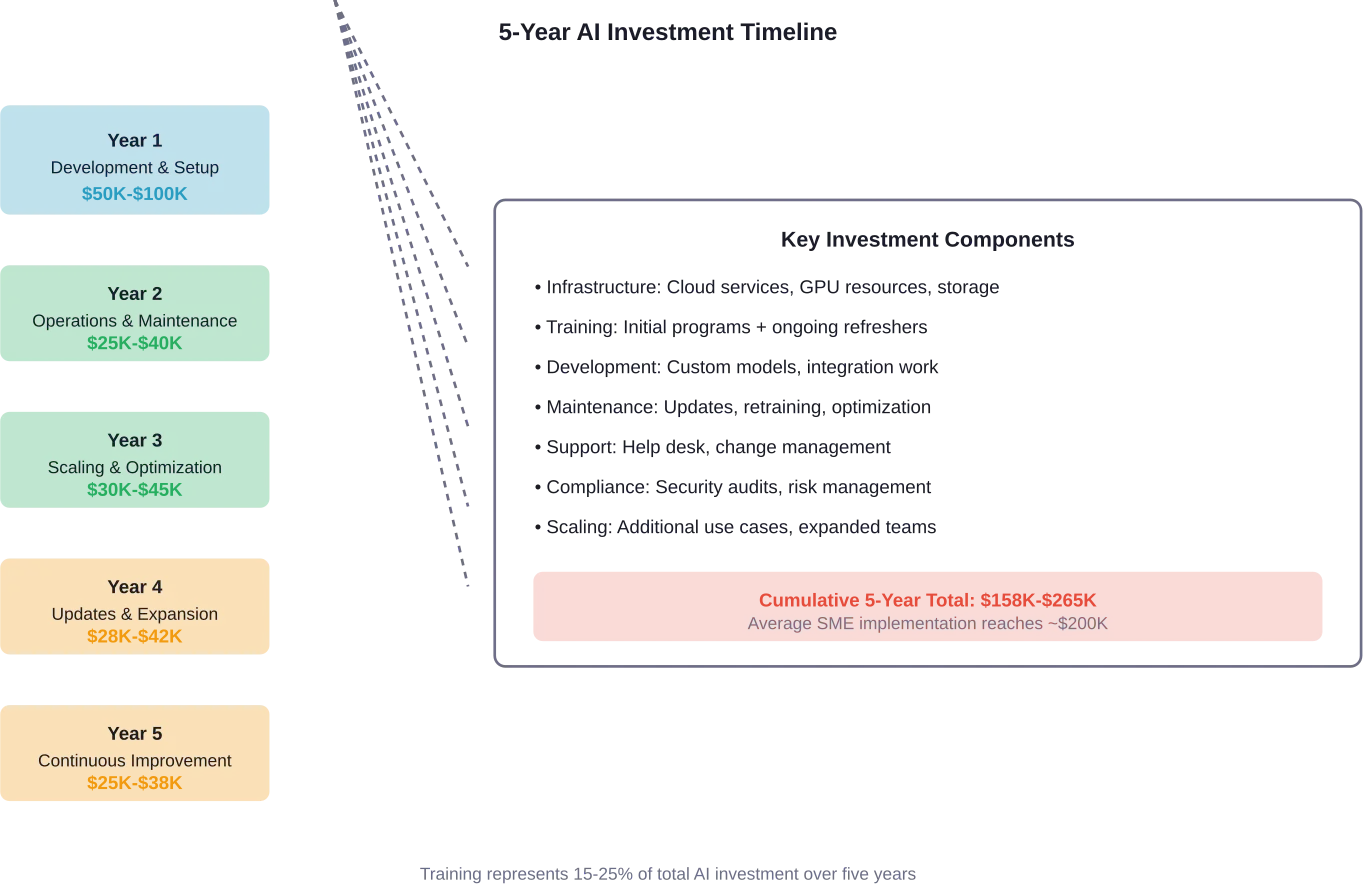
Year one costs range from $50,000-$100,000 for most SME AI implementations. This breaks down roughly as 40% for development, 35% for operations, and 25% for contingency funds covering hidden costs and unexpected requirements.
Year One: Development and Setup
Initial development and infrastructure setup consume the largest first-year allocation. Security compliance requirements add substantial overhead. Initial training for technical teams and end users represents another significant expense category.
Organizations should reserve 25% contingency for hidden costs that inevitably surface during implementation. Offshore partnerships can reduce development expenses, though communication overhead and time zone coordination introduce their own challenges.
Years Two Through Five: Ongoing Operations
Here’s the thing though—ongoing costs often exceed initial development for most enterprise AI initiatives. Maintenance, model retraining, infrastructure scaling, and continuous employee training compound annually.
By year five, cumulative costs typically reach $200,000 for SME implementations. Operations and maintenance claim an increasingly large budget share as systems mature and complexity grows.
| Year | Primary Cost Drivers | Estimated Range | Cumulative Total |
|---|---|---|---|
| 1 | Development, setup, initial training | $50,000-$100,000 | $50,000-$100,000 |
| 2 | Operations, maintenance, expanded training | $25,000-$40,000 | $75,000-$140,000 |
| 3 | Scaling, optimization, ongoing training | $30,000-$45,000 | $105,000-$185,000 |
| 4 | Updates, additional use cases, training | $28,000-$42,000 | $133,000-$227,000 |
| 5 | Maintenance, continuous improvement | $25,000-$38,000 | $158,000-$265,000 |
Key Cost Drivers Beyond Training Sessions
Training workshops represent only one component of total AI investment. Several other factors significantly impact budget requirements.
Infrastructure and Technology Costs
AI systems require robust computing infrastructure. Cloud services, GPU resources, and data storage scale with usage intensity. Open-source models can reduce costs—running inference costs 87% less on open models compared to proprietary alternatives, according to research from the MIT Initiative on the Digital Economy.
But there’s a catch. Open models achieve about 90% of the performance of closed models when they are released, but they can quickly close that gap. Teams need technical expertise to implement and optimize open-source solutions effectively.
Content Customization and Relevance
Generic training programs deliver generic results. Organizations investing in customized training that addresses specific business contexts, tools, and challenges see faster ROI realization.
Customization requires additional investment upfront but reduces time-to-productivity. Employees can immediately apply learned concepts to actual business problems rather than translating abstract examples into practical applications.
Instructor Quality and Expertise
Expert-led training commands premium pricing for good reason. Experienced instructors provide nuanced insights, real-world case studies, and practical troubleshooting guidance that self-paced courses can’t match.
The National Institute of Standards and Technology (NIST) promotes innovation and cultivates trust in the design, development, use and governance of artificial intelligence (AI) technologies and systems. Organizations following NIST’s AI Risk Management Framework benefit from structured approaches to risk mitigation—knowledge best transmitted through experienced instructors familiar with implementation challenges.

Determine Your Corporate AI Training Cost
Corporate AI training costs are shaped by audience size, curriculum depth, delivery format, and custom materials. AI Superior designs programs based on your team’s skill gaps, business goals, and technical maturity. They break down pricing by modules, hands-on labs, and follow-up support instead of flat per-seat rates. This ensures your training investment maps directly to outcomes.
Ready to Budget Your Corporate AI Training?
Talk with AI Superior to:
- assess learning objectives and audience level
- define training modules and delivery plan
- receive a clear training cost estimate
👉 Request a corporate AI training estimate from AI Superior.
Role-Based Training Requirements
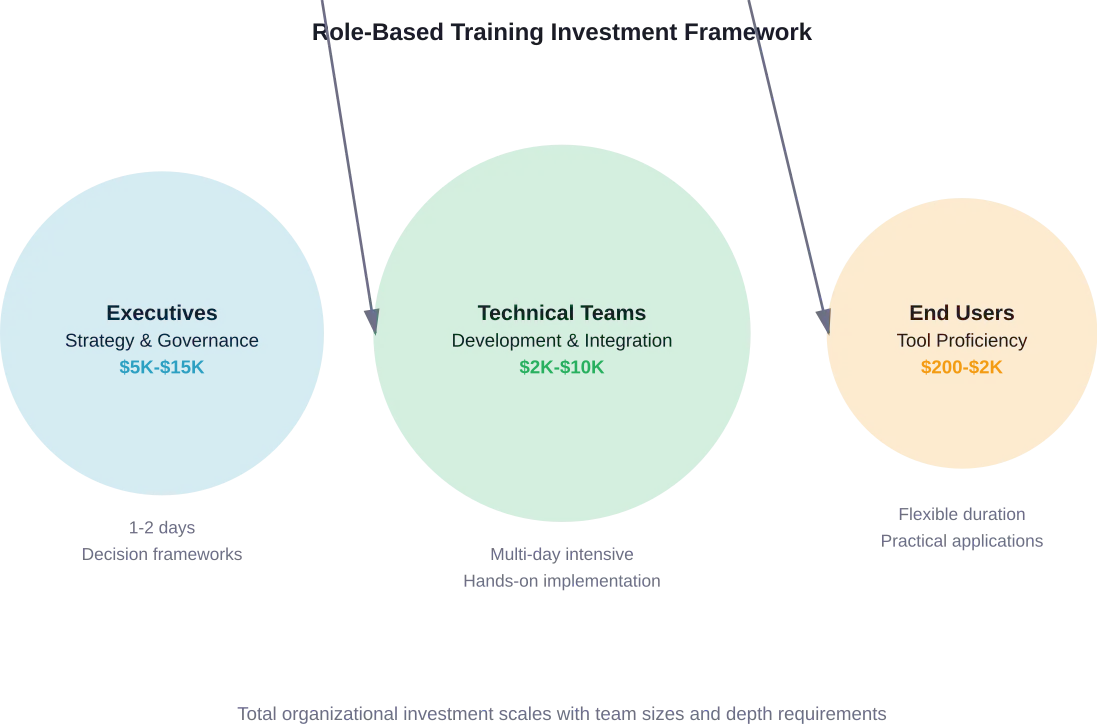
Not everyone needs the same depth of AI knowledge. Strategic role-based training optimizes budget allocation while ensuring teams have necessary capabilities.
Executive and Leadership Training
Business leaders need strategic AI literacy—understanding business implications, risk frameworks, and competitive dynamics without diving into technical implementation details.
Executive workshops typically span 1-2 days, focusing on decision-making frameworks, governance structures, and AI strategy development. These sessions cost $5,000-$15,000 per participant for private corporate delivery.
Technical Team Training
Developers, data scientists, and engineers require hands-on technical training covering model development, deployment pipelines, and system integration.
Technical workshops range from multi-day intensive sessions to ongoing certification programs. AI certification courses are available through various providers, including options designed for technical professionals implementing AI within agile frameworks.
End User Training
The broadest training category covers employees who’ll use AI tools in daily work. These individuals need practical skills for specific applications—generative AI for content creation, AI-powered analytics, or automated workflow systems.
End user training typically costs $200-$2,000 per person, depending on tool complexity and training depth. Many organizations find structured digital learning platforms provide cost-effective scalability for large employee populations.
Measuring Training ROI and Business Impact
Initial investment in employee training leads to significant long-term gains in productivity and efficiency. But quantifying that return requires clear metrics and measurement frameworks.
Productivity Improvements
Organizations report task completion speeds increasing 30-50% faster after comprehensive AI training. These efficiency gains compound across teams and workflows.
Real talk: productivity improvements manifest differently across roles. Knowledge workers using generative AI tools see immediate benefits. Technical teams require longer learning curves before productivity gains materialize.
Cost Reduction Metrics
Businesses should quantify actual cost savings—canceled software subscriptions, reduced contractor expenses, or eliminated manual processes. Concrete figures matter more than abstract efficiency claims.
Some organizations save €7,500 annually by replacing specialized software with AI-powered alternatives after proper training. Others realize savings through workflow automation reducing headcount requirements for routine tasks.
Revenue Impact
AI implementation can drive revenue growth through faster product development, improved customer experiences, or new service offerings. Training quality directly influences how quickly teams can develop and deploy revenue-generating applications.
The challenge? Revenue attribution becomes complex when AI touches multiple business functions. Establishing baseline metrics before training helps isolate AI-specific contributions.
Hidden Costs That Catch Companies Off-Guard
Traditional AI learning models come with steep hidden costs beyond sticker prices.
Static Content Obsolescence
AI technology evolves rapidly. Training content becomes outdated within months, requiring continuous updates or supplemental programs. Static courses purchased today may teach approaches already superseded by newer techniques.
Organizations must budget for ongoing training refreshers, not one-time education events. Learning platforms with regularly updated content reduce long-term costs compared to periodic comprehensive retraining cycles.
Lack of Actionable Insights
Many training programs don’t provide visibility into learner progress, knowledge gaps, or application effectiveness. This forces organizations to invest blindly without understanding training impact on business outcomes.
Learning and development teams need analytics showing skill acquisition, application frequency, and performance improvement. Without these insights, optimizing training investments becomes guesswork.
Integration and Change Management
Training alone doesn’t guarantee adoption. Change management, process redesign, and cultural alignment require additional time and resources.
Budget 20-30% beyond training costs for change management activities. This includes communication campaigns, executive sponsorship, and ongoing support structures that sustain behavior change.
Optimizing Your AI Training Budget
Smart organizations allocate training budgets strategically rather than spreading resources evenly.
Start With High-Impact Roles
Identify which teams will generate the fastest ROI from AI capabilities. Focus initial training investments on these groups, then expand to other departments as business value becomes evident.
This phased approach reduces upfront costs while building internal champions who demonstrate AI’s practical value to skeptical colleagues.
Blend Learning Modalities
Combining online self-paced courses with live workshops optimizes cost-effectiveness. Employees can complete foundational learning asynchronously, reserving expensive instructor time for hands-on practice and advanced topics.
Blended approaches typically cost 30-40% less than purely instructor-led programs while maintaining learning effectiveness.
Leverage Internal Expertise
After initial external training, develop internal trainers who can support ongoing learning at lower cost. This knowledge transfer ensures sustainable capability development without perpetual vendor dependence.
Internal trainers also customize content more naturally to organization-specific contexts, improving relevance and application.
| Strategy | Cost Reduction | Implementation Complexity | Best For |
|---|---|---|---|
| Virtual vs. on-site delivery | 40-60% | Low | Geographically distributed teams |
| Blended learning approach | 30-40% | Medium | Large organizations with diverse needs |
| Open-source model adoption | 87% | High | Technical teams with ML expertise |
| Internal trainer development | 50-70% | Medium | Long-term, ongoing training needs |
| Phased role-based rollout | 20-35% | Low | Budget-constrained organizations |
Vendor Selection and Program Evaluation
Not all training providers deliver equivalent value. Evaluation criteria should extend beyond price.
Assessing Instructor Credentials
Look for instructors with practical implementation experience, not just academic credentials. Real-world expertise translates to actionable guidance that theoretical knowledge can’t match.
Ask potential vendors about instructor backgrounds, project portfolios, and client references. The best instructors share war stories—both successes and failures—that illuminate common pitfalls.
Content Currency and Updates
Verify how frequently training content gets updated. AI capabilities advance monthly. Programs updated quarterly lag behind; annual updates are essentially obsolete at launch.
Some providers guarantee content updates for a subscription period. Others charge separately for refreshed materials, inflating long-term costs.
Customization Capabilities
Generic training forces employees to translate abstract examples into business applications. Customized programs using organization-specific data, processes, and tools accelerate practical application.
Customization costs more upfront but reduces time-to-productivity substantially. Employees leave training ready to implement learned concepts immediately rather than figuring out relevance independently.
Industry-Specific Considerations
Different sectors face unique AI training requirements influenced by regulatory constraints, technical complexity, and use case characteristics.
Regulated Industries
Financial services, healthcare, and other regulated sectors need training covering compliance frameworks, risk management, and governance structures. NIST’s AI Risk Management Framework provides structured approaches particularly relevant for organizations managing regulatory requirements.
Compliance-focused training typically costs 20-30% more than general programs due to specialized expertise requirements.
Manufacturing and Operations
Manufacturing organizations implementing Industry 4.0 technologies need training blending AI concepts with operational technology, supply chain optimization, and quality management systems.
The Manufacturing Extension Partnership offers services helping manufacturers determine best uses of advanced technologies including AI. These resources can supplement commercial training programs with industry-specific guidance.
Creative and Marketing Functions
Marketing teams adopting generative AI for content creation, campaign optimization, and customer analytics need training emphasizing practical tool usage over technical implementation.
Marketing-focused AI training typically costs less than technical programs, ranging from $500-$5,000 per participant for comprehensive workshops.
Building Long-Term AI Capability
One-time training creates temporary knowledge spikes that fade without reinforcement. Sustainable AI capability requires systematic ongoing learning.
Establishing Communities of Practice
Internal communities where practitioners share experiences, troubleshoot challenges, and discuss emerging techniques sustain learning momentum. These forums cost virtually nothing but deliver substantial value.
Communities of practice work particularly well for technical teams exploring new AI applications or optimizing existing implementations.
Continuous Learning Platforms
Subscription-based learning platforms provide ongoing access to updated content, new courses, and emerging topics. These typically cost $129-$500 per user monthly, depending on content depth and platform features.
For organizations with 50+ employees requiring ongoing AI education, platform subscriptions often cost less than periodic comprehensive training programs while maintaining current knowledge.
External Certification Programs
Industry certifications validate skills and provide structured learning paths. Certification programs specifically designed for professionals implementing AI within agile frameworks and other specialized domains are available. Other organizations provide certifications for specific AI domains like machine learning, natural language processing, or computer vision.
Certification programs typically cost $2,000-$8,000 per participant including exam fees.
Common Budget Planning Mistakes
Organizations frequently underestimate total investment requirements by focusing narrowly on training line items.
Ignoring Opportunity Costs
Employee time spent in training represents foregone productivity. A five-day intensive workshop for 20 employees consumes 100 person-days—roughly half a person-year of productive work.
Budget planning should account for productivity impacts, not just direct training expenses.
Underestimating Change Management
Technical training alone doesn’t drive adoption. Cultural resistance, competing priorities, and unclear value propositions sabotage even excellent training programs.
Organizations should allocate change management resources proportional to implementation scope. Larger transformations require dedicated change leadership, not just training programs.
Failing to Plan for Ongoing Costs
That first-year $50,000 investment? It’s the beginning, not the total cost. Organizations that budget only for initial training find themselves unable to sustain AI initiatives as ongoing expenses mount.
Build five-year financial models incorporating infrastructure, training refreshers, maintenance, and scaling costs. This prevents mid-implementation budget surprises that threaten program continuation.
FAQ: Corporate AI Training Costs
How much should a company budget for AI training per employee?
Budget ranges vary widely based on role and training depth. Basic online courses cost $200-$500 per employee, virtual workshops run $2,000-$5,000, comprehensive on-site programs reach $5,000-$10,000, and elite executive training can exceed $15,000 per participant. Most organizations should plan $1,000-$3,000 per employee for effective foundational training, with higher allocations for technical roles requiring deep expertise.
What percentage of total AI investment should go toward training?
Training typically represents 15-25% of total five-year AI implementation costs. For an SME spending $200,000 over five years, training would account for roughly $30,000-$50,000. Organizations allocating less than 10% for training often struggle with adoption and ROI realization. Those spending more than 30% may be over-investing in education relative to implementation.
How quickly can companies expect ROI from AI training investments?
Organizations typically see measurable productivity improvements within 2-4 months after comprehensive training. Task completion speeds increase 30-50% faster for well-trained employees using appropriate AI tools. However, full ROI realization usually requires 12-18 months as teams move beyond basic applications to more sophisticated implementations. Companies that implement structured measurement frameworks identify returns faster than those relying on anecdotal evidence.
Are online AI courses as effective as in-person training?
Effectiveness depends on learning objectives and employee self-direction. Online courses work well for foundational concepts, tool-specific skills, and theoretical knowledge. In-person training excels for hands-on practice, complex troubleshooting, and interactive discussion of nuanced implementation challenges. Blended approaches combining online foundational learning with targeted in-person workshops optimize cost-effectiveness while maintaining learning quality. Virtual instructor-led sessions split the difference, offering live interaction at 40-60% lower cost than on-site programs.
Should companies train all employees in AI or focus on specific roles?
Phased, role-based approaches deliver better ROI than universal training. Start with high-impact roles that’ll generate fastest business value—typically technical teams building AI systems and knowledge workers using AI tools directly. Expand to additional roles as initial groups demonstrate value and internal expertise develops. Executive training should happen early to ensure strategic alignment and resource commitment. Support functions can adopt AI capabilities later without significantly impacting overall transformation timeline.
What hidden costs should organizations watch for beyond training fees?
Major hidden costs include employee time away from productive work, ongoing content updates as AI technology evolves, change management and adoption support, infrastructure and tools for applying trained skills, measurement systems tracking training impact, and refresher training maintaining current knowledge. Organizations should budget an additional 25-40% beyond direct training costs to cover these factors. The largest hidden expense is often infrastructure—training employees on AI capabilities they can’t actually access due to missing tools or insufficient computing resources wastes investment entirely.
How often should AI training be refreshed or updated?
AI technology evolves rapidly, making annual refreshers the minimum frequency for maintaining current knowledge. Technical teams implementing cutting-edge capabilities may need quarterly updates. Executive and strategy training requires refreshers every 18-24 months as competitive dynamics and capabilities shift. Organizations using continuous learning platforms can provide ongoing micro-learning that keeps skills current without periodic comprehensive retraining. Budget planning should allocate 30-50% of initial training costs annually for ongoing education and skill maintenance.
Making Smart AI Training Investments
Corporate AI training costs extend far beyond workshop registration fees. Smart organizations build comprehensive financial models covering initial training, infrastructure, ongoing operations, and continuous learning over multi-year timeframes.
The organizations seeing strongest ROI from AI training investments share common characteristics. They align training with clear business objectives rather than pursuing education for its own sake. They customize content to organizational contexts rather than accepting generic programs. They implement role-based training strategies recognizing different teams need different capabilities.
And critically, they measure impact rigorously. Productivity improvements, cost reductions, and revenue growth get quantified, not just assumed. This measurement discipline enables ongoing optimization—doubling down on high-return training investments while cutting low-value programs.
AI adoption has reached 72% of organizations, according to MIT Sloan Management Review research. But adoption without capability just creates expensive shelfware. Training transforms AI from purchased technology into business capability that drives competitive advantage.
The question isn’t whether AI training costs too much. It’s whether organizations invest strategically in building sustainable AI capabilities or waste resources on fragmented, poorly-planned training initiatives that fail to generate returns.
Ready to develop a comprehensive AI training strategy for your organization? Start by assessing current capability gaps, identifying high-impact roles for initial training, and building a five-year financial model that accounts for total implementation costs beyond just training fees. Contact specialized AI training providers for customized proposals addressing your specific business context and technical requirements.
 English
  German
  Arabic
  French
  Dutch
Dutch  Spanish