
Quick Summary: The cost of implementing artificial intelligence ranges from $5,000 for basic solutions to over $500,000 for advanced systems. Pricing depends on project complexity, data requirements, talent costs, infrastructure needs, and ongoing maintenance. Organizations must evaluate both upfront development expenses and hidden long-term costs including computing resources, technical debt, and continuous model training to accurately budget for AI initiatives.
Artificial intelligence has moved from futuristic speculation to fundamental business infrastructure. Organizations across industries are racing to integrate AI capabilities, but one question consistently stalls progress: what’s the actual price tag?
The answer isn’t straightforward. Simple AI models can start around $5,000, while sophisticated deep learning applications scale from $50,000 to over $500,000. But those numbers only scratch the surface.
Here’s the thing though—upfront development costs represent just one piece of the financial puzzle. Hidden expenses lurk in data preparation, infrastructure scaling, ongoing maintenance, and technical debt accumulation. According to some industry estimates, computing expenses are projected to increase significantly in coming years, fundamentally reshaping budget considerations for AI initiatives.
This guide breaks down the complete cost structure of implementing artificial intelligence, from initial development through long-term operation, so decision-makers can build realistic budgets and measure true return on investment.
Understanding the AI Cost Structure
AI implementation costs break down into several distinct categories, each with its own pricing dynamics and hidden complexity.
Development expenses represent the most visible component. These include software engineering, model architecture design, algorithm selection, and integration work. But the total investment extends far beyond initial build costs.
Data acquisition and preparation typically consume 40-60% of project timelines and budgets. Raw data rarely arrives in usable format. Teams must collect, clean, label, normalize, and validate datasets before training can begin.
Infrastructure requirements vary dramatically based on deployment approach. Cloud-based solutions offer flexibility but generate ongoing usage fees. On-premise deployments require substantial capital expenditure for hardware but provide long-term cost advantages at scale.
Talent costs represent another major expense category. AI specialists command premium salaries, ranging from $100,000 to $300,000 annually depending on experience and specialization. Organizations face difficult decisions about building internal teams versus outsourcing to development agencies.
The Development Phase Price Range
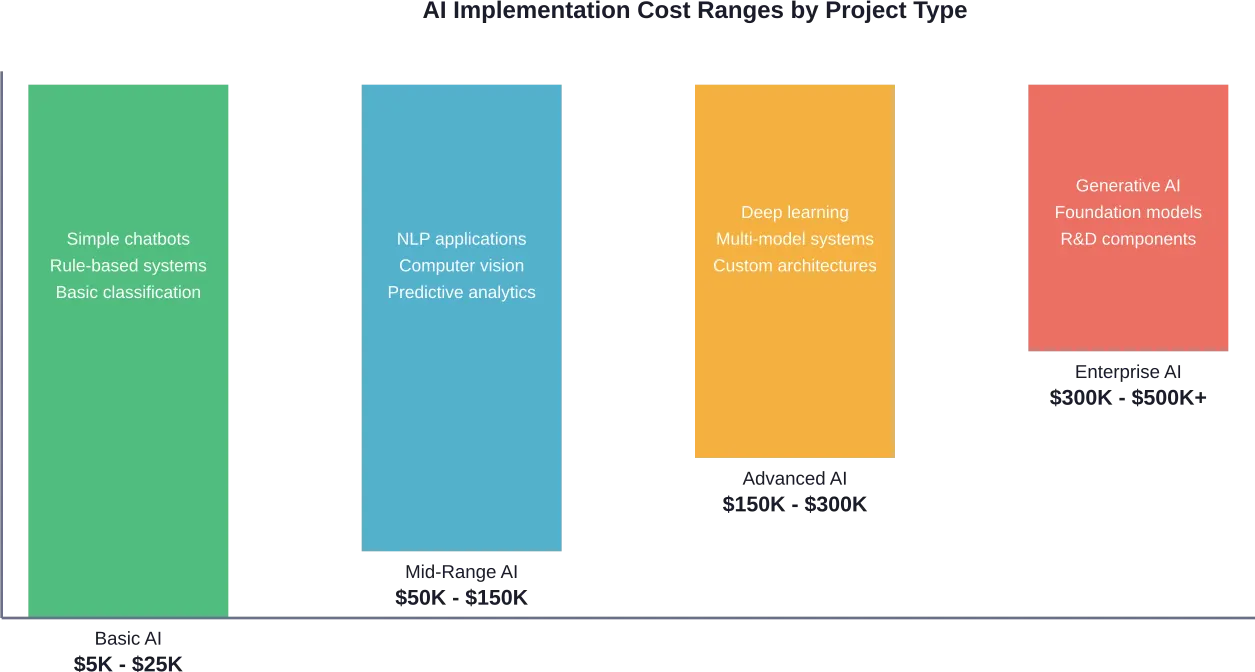
Basic AI implementations start around $5,000 for simple rule-based systems or straightforward machine learning models with limited scope. These projects typically involve single-function applications like basic chatbots, simple recommendation engines, or classification tasks.
Mid-range projects fall into the $50,000 to $150,000 bracket. These implementations include more sophisticated natural language processing, computer vision applications, or predictive analytics systems that require custom model training and integration with existing business systems.
Complex AI solutions requiring deep learning architectures, advanced neural networks, or cutting-edge generative capabilities can exceed $500,000. Projects at this level often involve research and development components, extensive data engineering, and prolonged testing phases.
According to research from Master of Code, AI development costs range anywhere from $25,000 to over $500,000, with the scope and complexity of the project serving as the primary cost driver.
Key Cost Factors in AI Implementation
Several variables significantly influence the final price of artificial intelligence projects. Understanding these drivers helps organizations build accurate budgets and avoid unexpected expenses.
Project Complexity and Scope
Complexity stands as the single largest cost determinant. Simple AI applications with narrow functionality cost substantially less than multi-faceted systems handling diverse tasks.
Feature complexity multiplies development time and technical requirements. Each additional capability—whether multi-language support, real-time processing, or advanced analytics—adds layers of engineering work and testing protocols.
Integration requirements with existing systems create additional cost pressures. Legacy infrastructure often requires custom API development, data migration strategies, and compatibility testing that extends project timelines.
Data Requirements and Quality
Data serves as the foundation for any AI system, and its cost implications extend beyond simple acquisition.
High-quality datasets command premium prices. For specialized applications like medical imaging or face recognition systems, data must achieve near-perfect accuracy. High-accuracy facial recognition verification systems can achieve accuracy scores as high as 99.97%, but building datasets to support that precision requires significant investment.
Data labeling represents another substantial expense. Human annotators must tag training data, a process that’s both time-intensive and costly for large-scale applications. Some projects require millions of labeled examples.
Data preparation and cleaning typically consume more resources than anticipated. Raw data contains errors, inconsistencies, and formatting issues that must be resolved before training can begin.
Talent and Expertise Costs
The global shortage of AI talent drives compensation into premium territory. Organizations competing for skilled professionals face steep salary requirements.
AI researchers, machine learning engineers, data scientists, and DevOps professionals with deployment experience command annual salaries from $100,000 to $300,000, depending on experience level and geographic location.
Building internal teams offers long-term advantages but requires substantial upfront investment. Recruiting, onboarding, and retaining specialized talent creates ongoing expenses beyond base compensation.
Outsourcing to AI development agencies shifts the cost structure. External teams charge project-based fees or hourly rates, typically ranging from $100 to $300 per hour for experienced AI developers.
Infrastructure and Computing Resources
Training and deploying AI models demands significant computational power, creating infrastructure costs that vary by deployment model.
Cloud-based solutions from providers like OpenAI, Anthropic, and Google offer attractive entry points with pay-as-you-go pricing. However, these services generate ongoing operational expenses that accumulate over time.
Research from Carnegie Mellon University analyzing on-premise LLM deployment found that organizations can break even with commercial LLM services when usage reaches certain thresholds based on deployment model and performance requirements. The analysis defined performance parity as benchmark scores within 20% of leading commercial models, reflecting enterprise practice where modest performance gaps are often outweighed by cost, security, and integration considerations.
Hardware investments for on-premise deployment require substantial capital expenditure. High-performance GPUs, specialized AI accelerators, and supporting infrastructure carry significant upfront costs but provide long-term economic advantages at scale.
| Infrastructure Approach | Upfront Cost | Ongoing Cost | Best For |
|---|---|---|---|
| Cloud Services (API) | Low ($0-$5K) | High (usage-based) | Startups, prototypes, variable workloads |
| Managed Cloud (dedicated) | Medium ($10K-$50K) | Medium (predictable) | Growing companies, consistent usage |
| On-Premise Deployment | High ($100K-$500K+) | Low (maintenance only) | Large enterprises, high-volume applications |
| Hybrid Approach | Medium ($25K-$100K) | Medium (mixed model) | Organizations with variable peak demands |
Hidden Costs That Catch Organizations Off Guard
Beyond the obvious line items, AI implementation carries less visible expenses that can significantly impact total cost of ownership.
Technical Debt Accumulation
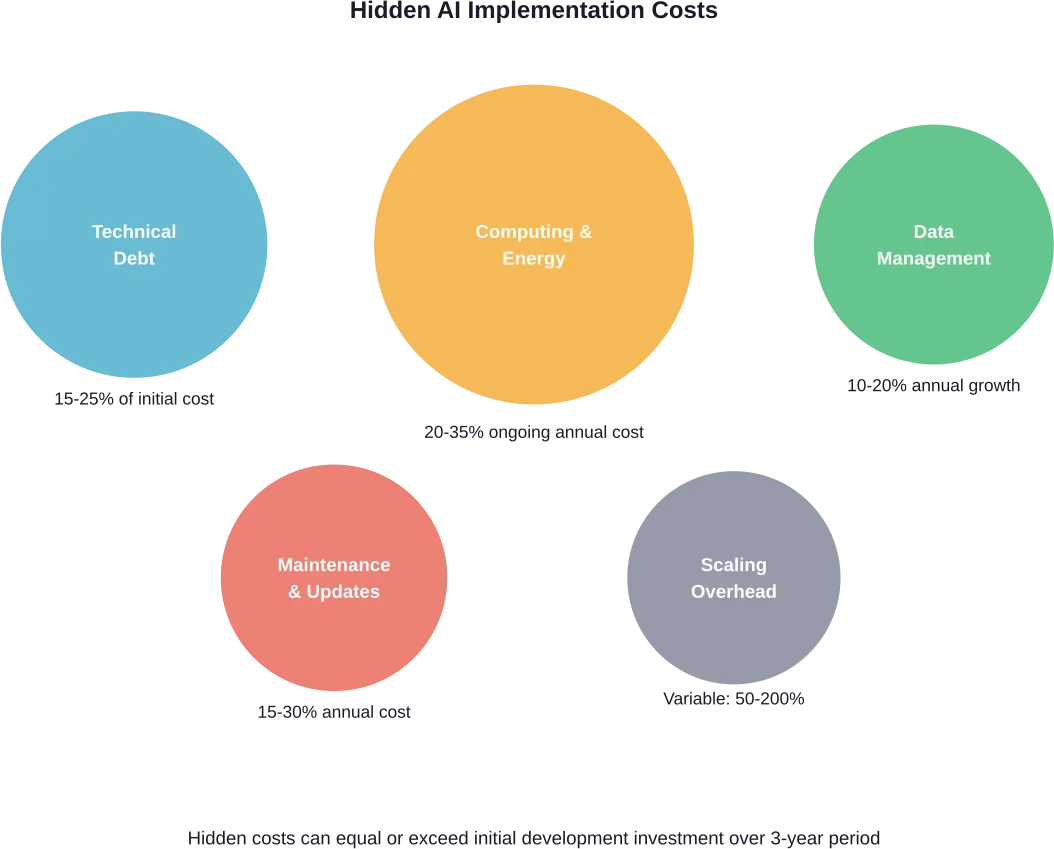
According to MIT Sloan Review research, generative AI tools like GitHub Copilot can make developers up to 55% more productive in coding tasks. But that productivity boost comes with a hidden price: technical debt.
Rapid development enabled by AI coding assistants often produces code that works initially but creates long-term maintenance challenges. Systems built quickly may lack proper documentation, contain inefficient algorithms, or use suboptimal architectures.
This technical debt compounds over time. What saves hours during initial development can cost weeks or months in future refactoring, debugging, and system optimization.
Energy and Computing Costs
AI systems, particularly generative models and deep learning applications, consume substantial computational resources that translate directly to energy expenses.
Some estimates suggest coding efficiency improvements can reduce application energy consumption by as much as 50%. The coding efficiency choices made during development determine ongoing operational costs for years.
Training large models requires enormous computing power. A single training run for advanced neural networks can consume the equivalent of thousands of dollars in cloud computing resources or electricity costs.
Ongoing Maintenance and Updates
AI systems require continuous attention to maintain performance and accuracy over time.
Model drift occurs as real-world conditions change. Systems trained on historical data gradually lose accuracy as patterns shift, requiring periodic retraining with fresh datasets.
Security updates and compliance requirements create additional maintenance obligations. As regulatory frameworks evolve—particularly around data privacy and AI governance—systems need updates to remain compliant.
Performance monitoring and optimization demand dedicated resources. Teams must track system behavior, identify degradation, and implement improvements on an ongoing basis.
Scaling Challenges
Pilot projects that work beautifully at small scale often encounter unexpected costs during expansion.
Infrastructure scaling rarely follows linear cost progression. Moving from 1,000 to 1,000,000 users doesn’t simply multiply costs by 1,000—it introduces new architectural requirements, data management challenges, and performance optimization needs.
Data storage costs accumulate as systems generate and retain more information. What starts as manageable database expenses can balloon into significant line items as data volumes grow.

Plan Your AI Implementation Budget
AI implementation costs often grow beyond initial estimates due to data preparation, experimentation, and system integration. A realistic budget requires understanding both development and operational expenses.
AI Superior works with companies to assess feasibility, define architecture, and estimate the full lifecycle cost of AI projects.
Their consulting process typically includes:
- AI opportunity assessment
- data readiness analysis
- architecture design
- development and deployment cost estimation
If you are considering AI adoption, request a feasibility assessment to understand the real implementation cost before starting development.
Build vs. Buy vs. Outsource: Cost Implications
Organizations face a fundamental strategic decision about how to approach AI implementation, each path carrying distinct cost structures.
Building In-House Teams
Developing internal AI capabilities offers maximum control and long-term strategic value but requires the highest upfront investment.
Talent acquisition costs include recruiting fees, relocation expenses, and competitive compensation packages. Building a functional AI team typically requires at least 3-5 specialized professionals, translating to $500,000+ in annual salary expenses alone.
Infrastructure investment adds to the total. Organizations need development environments, testing frameworks, deployment pipelines, and supporting tools.
The timeline for building internal capability extends 6-18 months before teams reach full productivity. That ramp-up period represents significant investment before realizing any return.
Purchasing Commercial Solutions
Pre-built AI platforms and commercial services offer faster time-to-value with lower upfront costs but less customization potential.
Subscription fees for commercial AI services vary widely. Basic access might start at hundreds per month, while enterprise deployments can reach tens of thousands monthly depending on usage volume and feature requirements.
Customization limitations represent a trade-off. Commercial solutions work well for standard use cases but may not address unique business requirements without expensive custom development.
Vendor lock-in creates long-term considerations. Switching providers later can prove difficult and expensive if systems become deeply integrated with proprietary platforms.
Outsourcing to Development Agencies
External AI development partners provide specialized expertise without long-term employment commitments, offering a middle path between building and buying.
Project-based pricing from agencies typically ranges from $50,000 to $500,000+ depending on scope. Hourly rates for experienced AI developers fall between $100 and $300.
Knowledge transfer becomes critical. Organizations must ensure internal teams can maintain and evolve systems after external developers complete initial implementation.
Quality varies significantly across vendors. Careful vetting of technical capabilities, domain expertise, and past project success becomes essential to avoiding costly mistakes.
| Approach | Initial Investment | Time to Value | Long-term Cost | Control Level |
|---|---|---|---|---|
| Build In-House | $500K-$2M+ | 12-24 months | High (salaries) | Maximum |
| Buy Commercial | $10K-$100K | 1-3 months | Medium (subscriptions) | Limited |
| Outsource Development | $50K-$500K | 3-9 months | Low-Medium (maintenance) | Moderate |
| Hybrid Model | $100K-$500K | 6-12 months | Medium (mixed) | Flexible |
Measuring ROI and Business Value
Understanding costs represents only half the equation. Organizations must also quantify returns to justify AI investments.
Defining Success Metrics
Clear measurement frameworks distinguish successful AI implementations from expensive failures.
Efficiency gains often provide the most straightforward ROI calculation. If AI automation reduces task completion time by 50%, the labor cost savings translate directly to financial return.
Revenue impact from AI-driven improvements in customer experience, personalization, or decision-making quality takes longer to manifest but often delivers the largest returns.
Cost avoidance through improved accuracy, reduced errors, or better resource allocation can generate substantial value even without top-line revenue growth.
Timeline for Realizing Returns
AI investments rarely generate immediate returns. Realistic expectations about payback periods prevent premature abandonment of worthwhile initiatives.
Simple automation projects might break even within 6-12 months. More complex implementations involving predictive analytics or decision support systems typically require 18-36 months to demonstrate positive ROI.
Strategic AI capabilities that fundamentally transform business models may take 3-5 years to fully realize their value, but can deliver exponential returns once established.
Balancing Cost and Performance
According to Harvard Business School research published in 2025, becoming an AI-enabled organization is a long-term commitment that requires significant investment in technology, data, integration, and talent. Organizations must build strategies that deliver lasting ROI and business value rather than chasing short-term cost minimization.
Performance requirements should align with business needs. Pursuing state-of-the-art accuracy when simpler models suffice wastes resources. Some applications may allow wider error margins, reducing development complexity and cost substantially.
Research on standardized economic metrics for AI deployment introduced LCOAI (Levelized Cost of AI), a framework analogous to LCOE in the energy sector, for evaluating total capital and operational expenditures across different deployment scenarios. This approach helps organizations compare options more systematically.
Emerging Considerations for 2026 and Beyond
The AI cost landscape continues evolving as technology advances and regulatory frameworks mature.
Regulatory Compliance Costs
Government oversight of artificial intelligence is expanding rapidly. Federal agencies are developing new policies on AI use and procurement. The White House Office of Management and Budget released revised policies in April 2025.
Compliance expenses will grow as organizations must implement governance frameworks, conduct bias testing, maintain detailed documentation, and undergo regular audits.
According to NIST research on AI standards, organizations should expect evolving requirements around evaluation practices and transparency standards that will necessitate ongoing investment. NIST released ‘A Possible Approach for Evaluating AI Standards Development’ in January 2026.
Ethical AI and Bias Mitigation
Addressing algorithmic bias and ensuring ethical AI deployment creates additional cost layers.
Diverse training data acquisition helps reduce bias but increases data collection and labeling expenses. Testing across demographic groups and use cases extends validation timelines.
Academic research at ESADE highlights how AI-driven decisions shape critical areas like welfare, labor, and democracy, with concerns that they may amplify existing inequalities without inclusive governance. Organizations must invest in mitigation strategies to avoid reputational and legal risks.
Sustainability Considerations
Environmental impact of AI computing is drawing increased scrutiny. Energy consumption from training and running large models carries both financial and reputational costs.
Research from ESADE explores the hidden cost of AI related to technological progress and environmental sustainability. Organizations increasingly face pressure to optimize for efficiency and consider carbon footprint in deployment decisions.

Practical Strategies to Control AI Costs
Organizations can implement several approaches to maximize value while managing expenses.
Start Small and Scale Progressively
Pilot projects allow teams to validate concepts, test assumptions, and learn operational requirements before committing to full-scale implementations.
Proof-of-concept development typically costs $10,000 to $50,000, providing valuable learning at manageable investment levels. These pilots reveal hidden requirements and technical challenges early.
Incremental scaling based on proven results reduces risk. Rather than building comprehensive systems upfront, organizations can expand functionality as each phase demonstrates value.
Leverage Pre-Trained Models and Transfer Learning
Building AI models from scratch maximizes customization but also maximizes cost. Pre-trained models offer powerful alternatives.
Transfer learning applies existing models trained on large datasets to new specific tasks with minimal additional training. This approach can reduce development time by 60-80% compared to training from scratch.
Open-source models provide strong foundations for custom applications. Organizations can fine-tune these models for specific needs at a fraction of the cost of original development.
Optimize Data Strategy
Data costs balloon when organizations collect everything rather than targeting what matters.
Focused data collection aligned with specific use cases reduces acquisition, storage, and processing expenses. Quality beats quantity for most applications.
Synthetic data generation can supplement real-world datasets, particularly for rare edge cases or privacy-sensitive scenarios, reducing collection costs while improving model robustness.
Consider Upskilling Existing Teams
Training current employees in AI capabilities costs less than hiring external specialists while building internal expertise.
Structured learning programs, certifications, and hands-on project experience can transform domain experts into capable AI practitioners over 6-12 months.
Hybrid teams combining upskilled employees with a few specialized hires often deliver better results than either purely internal or external approaches.
Frequently Asked Questions
What is the minimum budget needed to start an AI project?
Basic AI implementations can start around $5,000 for simple rule-based systems or proof-of-concept projects. However, most practical business applications require $25,000 to $50,000 to achieve meaningful functionality. Organizations should budget for iterative development, starting with focused pilot projects that demonstrate value before scaling investment.
How long does it take to see ROI from AI implementation?
ROI timelines vary significantly by project type and complexity. Simple automation projects may break even within 6-12 months, while more sophisticated implementations involving predictive analytics or decision support typically require 18-36 months to demonstrate positive returns. Strategic AI capabilities that fundamentally transform business models may take 3-5 years to fully realize their value but can deliver exponential returns once established.
Are cloud-based AI solutions cheaper than on-premise deployment?
Cloud solutions offer lower upfront costs and faster deployment but generate ongoing usage-based expenses. On-premise infrastructure requires substantial capital investment but provides long-term cost advantages at high usage volumes. Research shows organizations can break even with commercial cloud services by deploying models on their own infrastructure when usage reaches certain thresholds, typically when processing millions of requests monthly.
What percentage of AI project budgets should be allocated to maintenance?
Organizations should budget 15-30% of initial development costs annually for ongoing maintenance, updates, and optimization. This covers model retraining, performance monitoring, security updates, and infrastructure scaling. As systems mature, maintenance costs typically stabilize at 15-25% annually, though major feature additions or architectural changes can temporarily increase requirements.
How much do AI specialists and data scientists cost to hire?
AI professionals command premium salaries ranging from $100,000 to $300,000 annually depending on experience level, specialization, and geographic location. Machine learning engineers and data scientists with 3-5 years of experience typically earn $120,000 to $180,000, while senior researchers and architects with specialized expertise can exceed $250,000. Organizations should also factor in recruiting costs, benefits, and retention investments.
Can small businesses afford to implement AI?
Small businesses can absolutely implement AI within reasonable budgets by starting with focused applications, leveraging pre-trained models, and using commercial AI services rather than building from scratch. Entry-level implementations using platforms like chatbot builders or recommendation engines can start under $10,000. The key is identifying high-impact use cases that deliver clear ROI rather than attempting comprehensive AI transformation.
What hidden costs do organizations most often overlook?
Technical debt accumulation, energy consumption, data storage growth, and scaling overhead represent the most commonly underestimated expenses. Organizations also frequently overlook costs related to compliance requirements, bias testing, ongoing model retraining, and knowledge transfer. These hidden costs can equal or exceed initial development investment over a 3-year period, making comprehensive budgeting essential.
Making Smart AI Investment Decisions
The cost of implementing artificial intelligence spans a wide spectrum, from $5,000 for basic applications to over $500,000 for advanced systems. But focusing solely on development expenses misses the complete picture.
Real talk: successful AI implementation requires understanding the full cost lifecycle—development, infrastructure, talent, data, maintenance, and hidden expenses like technical debt and energy consumption. Organizations that budget only for initial development consistently underestimate total investment by 50-100%.
The strategic question isn’t whether AI is expensive, but whether the investment delivers sufficient value. With computing costs projected to increase significantly in coming years according to industry estimates, cost optimization becomes increasingly critical to maintaining positive ROI.
Several factors will influence AI pricing in 2026 and beyond. Regulatory compliance requirements are expanding as government oversight increases. Environmental sustainability considerations are adding pressure to optimize energy efficiency. And competitive dynamics continue driving demand for specialized talent, maintaining upward pressure on compensation.
Organizations that succeed with AI implementation share common approaches. They start with focused pilot projects that demonstrate value before scaling. They leverage pre-trained models and transfer learning rather than building everything from scratch. They invest in upskilling existing teams rather than relying entirely on external hiring. And they maintain realistic timelines, understanding that meaningful ROI typically requires 18-36 months to materialize.
The most important insight? AI implementation isn’t a one-time expense but an ongoing investment in organizational capability. Budgets should reflect that reality, allocating resources for continuous improvement, model refinement, and adaptation to changing business requirements.
For organizations just beginning their AI journey, the path forward starts with clear-eyed assessment of business needs, realistic budgeting that accounts for hidden costs, and commitment to measuring actual results against defined success metrics. Those fundamentals separate AI implementations that deliver lasting value from expensive failures that never achieve their promised returns.
Ready to plan your AI implementation? Start by identifying specific business problems worth solving, estimating costs across the full lifecycle, and defining measurable success criteria. The investment can transform operations—but only when approached with thorough planning and realistic expectations about both costs and timelines.
 English
  German
  Arabic
  French
  Dutch
Dutch  Spanish