
Quick Summary: Data analytics in the automotive industry transforms how manufacturers, dealerships, and insurers operate by leveraging vast amounts of vehicle and operational data. Key use cases include predictive maintenance that reduces downtime, supply chain optimization that cuts costs, customer experience personalization that boosts sales, autonomous vehicle development, insurance telematics that offers safer driver discounts up to 20%, and quality control that catches defects early. Companies implement these solutions by starting with specific high-impact use cases, building the right data infrastructure, and scaling gradually. The automotive industry generates massive amounts of data every single day. Modern vehicles come equipped with 50 to over 100 embedded microprocessors, each one collecting information about performance, driver behavior, environmental conditions, and system health. But here’s the thing—raw data alone doesn’t drive business value. The real transformation happens when automotive companies apply sophisticated analytics to turn those petabytes of information into actionable intelligence. From predictive maintenance that prevents costly breakdowns to insurance programs that reward safe driving, data analytics has become the backbone of competitive advantage in the automotive sector. According to a 2025 Deloitte survey of 600 manufacturing executives, the majority (80%) plan continued investment in smart manufacturing, reflecting the critical importance of data-driven decision making.
Understanding Data Analytics in the Automotive Context
Data analytics in automotive encompasses the systematic collection, processing, and interpretation of information from vehicles, manufacturing systems, supply chains, customer interactions, and external sources. The goal? Extract insights that improve operations, enhance safety, reduce costs, and create better customer experiences. The automotive sector deals with several distinct data types. Telematics data captures real-time vehicle location, speed, acceleration patterns, and driving behavior. Manufacturing sensors monitor production line performance, equipment health, and quality metrics. Customer data tracks purchase history, service records, preferences, and engagement patterns. The volume is staggering. Industry experts estimate that connected cars collect upward of 11 petabytes of data annually from embedded telematics devices. To put that in perspective, 11 petabytes of songs playing continuously would last over 22,000 years. Automotive companies that effectively harness this data gain competitive advantages: reduced warranty costs, optimized inventory levels, personalized customer experiences, and faster innovation cycles. 
AI Superior: Turn Data Into AI Software
AI Superior develops AI and machine learning solutions for prediction, data analysis, computer vision, BI, big data analytics, and custom software development. Their work can support projects from discovery and dataset review to MVP development, integration, and result evaluation. For automotive teams, this can support vehicle data analysis, predictive maintenance, demand forecasting, visual inspection, quality checks, or connected mobility workflows.
Need AI Connected to Automotive Data?
AI Superior can help with:
- building machine learning models
- developing predictive analytics tools
- creating computer vision solutions
- connecting AI with existing platforms
👉 Contact AI Superior to discuss your project.
Six High-Impact Use Cases for Automotive Data Analytics
1. Predictive Maintenance: Preventing Failures Before They Happen
Predictive maintenance represents one of the most mature and valuable applications of automotive analytics. Instead of following fixed maintenance schedules or waiting for components to fail, predictive systems analyze real-time sensor data to forecast when specific parts will need service. Modern vehicles continuously monitor hundreds of parameters: engine temperature, vibration patterns, fluid levels, battery performance, brake wear, and countless other indicators. Machine learning algorithms identify subtle patterns that precede component failures, often weeks or months in advance. For fleet operators, this capability translates directly to bottom-line savings. Unplanned downtime costs dramatically more than scheduled maintenance. A delivery truck that breaks down mid-route doesn’t just incur repair costs—it disrupts schedules, disappoints customers, and may require expensive emergency service. The manufacturing sector benefits equally. Production equipment that fails unexpectedly can halt entire assembly lines. Predictive analytics helps automotive manufacturers schedule maintenance during planned downtime, maximizing production uptime and equipment lifespan.
2. Supply Chain Optimization and Inventory Management
The automotive supply chain is notoriously complex. A single vehicle contains thousands of components sourced from hundreds of suppliers across multiple continents. Even minor disruptions can cascade into production delays and cost overruns. Data analytics brings much-needed visibility and agility to this complexity. By integrating data from suppliers, logistics providers, manufacturing systems, and market demand signals, automotive companies can optimize inventory levels, reduce carrying costs, and respond faster to disruptions. Real-time analytics tracks shipments in transit, identifies potential delays, and automatically adjusts production schedules or expedites critical components. Demand forecasting algorithms analyze historical sales data, market trends, economic indicators, and seasonal patterns to predict future requirements with increasing accuracy. The result? Leaner inventories, fewer stockouts, reduced expediting costs, and more resilient supply chains. For an industry operating on thin margins, these improvements matter significantly.
3. Customer Experience Personalization and Sales Optimization
Today’s automotive buyers expect personalized experiences similar to what they get from retail and technology companies. Data analytics makes that possible at scale. Dealerships and manufacturers analyze customer data to understand preferences, predict purchase timing, and tailor marketing messages. Someone who previously bought a family SUV and now has teenagers approaching driving age might respond well to offers on compact vehicles. A customer with a vehicle approaching 100,000 miles represents a prime opportunity for upgrade campaigns. Service departments use analytics to predict when customers will need maintenance based on their specific vehicle usage patterns. Proactive outreach—“Your vehicle is due for service based on your typical driving patterns”—converts better than generic reminders. The aftersales segment particularly benefits from targeted analytics. By analyzing service history, vehicle age, mileage, and usage patterns, dealerships identify customers likely to need specific repairs or upgrades. This targeted approach improves conversion rates while providing genuine value to customers who receive timely, relevant recommendations.
4. Autonomous Vehicle Development and Safety Enhancement
The development of autonomous and semi-autonomous vehicles relies fundamentally on data analytics. Self-driving systems must process torrents of sensor data in real-time: camera feeds, lidar point clouds, radar returns, GPS coordinates, and internal system states. Machine learning algorithms trained on millions of miles of driving data learn to recognize pedestrians, interpret traffic signs, predict other drivers’ behaviors, and navigate complex scenarios. Every mile driven by test vehicles generates data that improves the algorithms. Industry analysts project that autonomous vehicles will represent a growing share of automotive sales in coming years. Safety validation requires exhaustive analysis of edge cases, near-misses, and system performance under varied conditions. Simulation environments, fed by real-world data, allow engineers to test scenarios too dangerous or rare to encounter in physical testing. Even today’s partially autonomous features—lane keeping assistance, adaptive cruise control, automated emergency braking—depend on sophisticated real-time analytics. These systems continuously assess risk, predict trajectories, and make split-second decisions that enhance driver safety.
5. Insurance Telematics and Usage-Based Programs
The insurance industry has embraced automotive data analytics enthusiastically, fundamentally changing how risk gets assessed and policies priced. Traditional insurance models relied on crude proxies: age, geography, vehicle type, and accident history. These factors correlate with risk but don’t directly measure it. Telematics programs change that equation by monitoring actual driving behavior. Smartphone apps or plug-in devices track acceleration, braking, cornering, speed, time of day, and increasingly, phone usage while driving. Safe drivers benefit directly. Programs like Aviva Drive offer up to 20% discounts on comprehensive car insurance for drivers who demonstrate safe habits. Allstate’s Drivewise program provides a 10% discount simply for enrolling, with additional cash back or policy savings up to 40% based on driving behavior after completing 50 trips. The data reveals stark risk differentials. Analysis shows that 1 in 4 car accidents in the United States results from texting and driving, with an estimated economic cost of $61.5 billion and comprehensive costs reaching $209 billion. Telematics systems that detect phone usage while driving help insurers price risk more accurately and incentivize safer behavior. Some insurers use analytics to assess route-specific risk, calculating probabilities like a 30% accident risk for certain route and weather combinations. This granular risk modeling enables dynamic pricing and personalized safety recommendations.
6. Manufacturing Quality Control and Defect Prediction
Quality control in automotive manufacturing has evolved from spot checks and statistical sampling to comprehensive data-driven monitoring. Modern production lines bristle with sensors tracking thousands of parameters: torque values, paint thickness, weld integrity, component dimensions, assembly times, and environmental conditions. Advanced analytics identifies subtle patterns that precede quality issues. Maybe a particular robot arm drifts out of calibration gradually, or a specific supplier’s batch shows microscopic variations that will cause premature wear. Catching these patterns early prevents defective vehicles from reaching customers and reduces costly warranty claims. Computer vision systems powered by machine learning inspect painted surfaces, detect assembly errors, and verify correct component installation with superhuman consistency. These systems never get tired or distracted, maintaining 100% inspection rates that would be impossible with human inspectors alone. Root cause analysis becomes dramatically faster when comprehensive data exists for every vehicle produced. If a defect pattern emerges in the field, engineers can trace back through production data to identify exactly when, where, and under what conditions the affected vehicles were built.
Implementation Roadmap: Where to Start
The scope of potential automotive analytics applications can feel overwhelming. Here’s a practical approach for getting started without getting paralyzed by possibilities.
Begin with a Specific, High-Impact Use Case
Don’t try to boil the ocean. Select one use case where data analytics can deliver measurable value relatively quickly. Predictive maintenance often makes an excellent starting point because the ROI is straightforward: reduced downtime, lower repair costs, extended asset life. Choose a use case that addresses a real pain point your organization feels acutely. If warranty costs are crushing margins, focus on quality analytics. If customer retention lags competitors, start with personalization and customer experience analytics.
Assess Your Data Infrastructure
Effective analytics requires solid data foundations. Conduct an honest assessment of your current capabilities. Can you collect the necessary data? Is it stored in accessible formats? Do you have the infrastructure to process and analyze it at scale? Many automotive companies discover they’re data-rich but insight-poor. The data exists, scattered across incompatible systems that don’t talk to each other. Integration and consolidation often represents the first major hurdle. Cloud platforms have dramatically lowered the barriers to entry for sophisticated analytics. Instead of building massive on-premise infrastructure, companies can leverage elastic cloud resources that scale with needs.
Build or Buy? Choosing Your Approach
Some organizations build custom analytics capabilities in-house. Others partner with specialized vendors or consultants. Most successful implementations combine both approaches: leveraging external expertise for initial setup and knowledge transfer while building internal capabilities for long-term sustainability. Vendor solutions offer faster time-to-value and incorporate best practices from multiple implementations. Custom development provides maximum flexibility and competitive differentiation but requires significant investment in talent and time.
Start Small, Prove Value, Scale Gradually
Pilot projects reduce risk and build organizational buy-in. Launch your first analytics initiative in a limited scope: one production line, one dealership region, one vehicle model. Demonstrate clear business value before expanding. Early wins create momentum and funding for broader initiatives. That successful predictive maintenance pilot becomes the foundation for enterprise-wide rollout. The customer analytics program that boosted service revenue in one region scales nationally.
| Implementation Phase | Timeline | Key Activities | Success Metrics |
|---|---|---|---|
| Discovery | 1-2 months | Identify use case, assess data readiness, define objectives | Clear business case, executive buy-in |
| Pilot | 3-6 months | Build initial solution, test with limited scope | Measurable improvement in target metrics |
| Refinement | 2-4 months | Incorporate feedback, optimize algorithms, improve usability | Consistent performance, user adoption |
| Scale | 6-12 months | Expand to full production, integrate with existing systems | Enterprise-wide value realization |
Challenges and Considerations
Implementing automotive analytics isn’t without obstacles. Understanding common challenges helps organizations prepare and navigate them effectively.
Data Quality and Integration
Garbage in, garbage out remains an iron law of analytics. Automotive data often suffers from quality issues: incomplete records, inconsistent formats, measurement errors, and missing values. Cleaning and standardizing data can consume 60-80% of project effort. Integration challenges compound quality issues. Vehicle data, manufacturing systems, customer databases, supplier information, and external sources all speak different languages. Creating unified views requires significant technical investment.
Privacy and Security Concerns
Vehicle data raises legitimate privacy questions. Who owns the data generated by a car? How should it be used? What protections prevent misuse? Regulatory frameworks continue evolving. Europe’s GDPR, California’s CCPA, and emerging regulations worldwide impose requirements on data collection, storage, and usage. Automotive companies must build compliance into analytics initiatives from the start, not bolt it on later. Security matters equally. Connected vehicles create new attack surfaces. Protecting data in transit and at rest, securing analytics infrastructure, and preventing unauthorized access all require careful attention.
Skills and Talent Gaps
Effective automotive analytics requires a blend of domain expertise and technical skills. Understanding vehicle systems, manufacturing processes, or customer behavior matters as much as knowing machine learning algorithms and data engineering. This combination of skills is rare and expensive. Organizations compete fiercely for qualified talent. Building internal capabilities through training and development programs helps, but takes time. 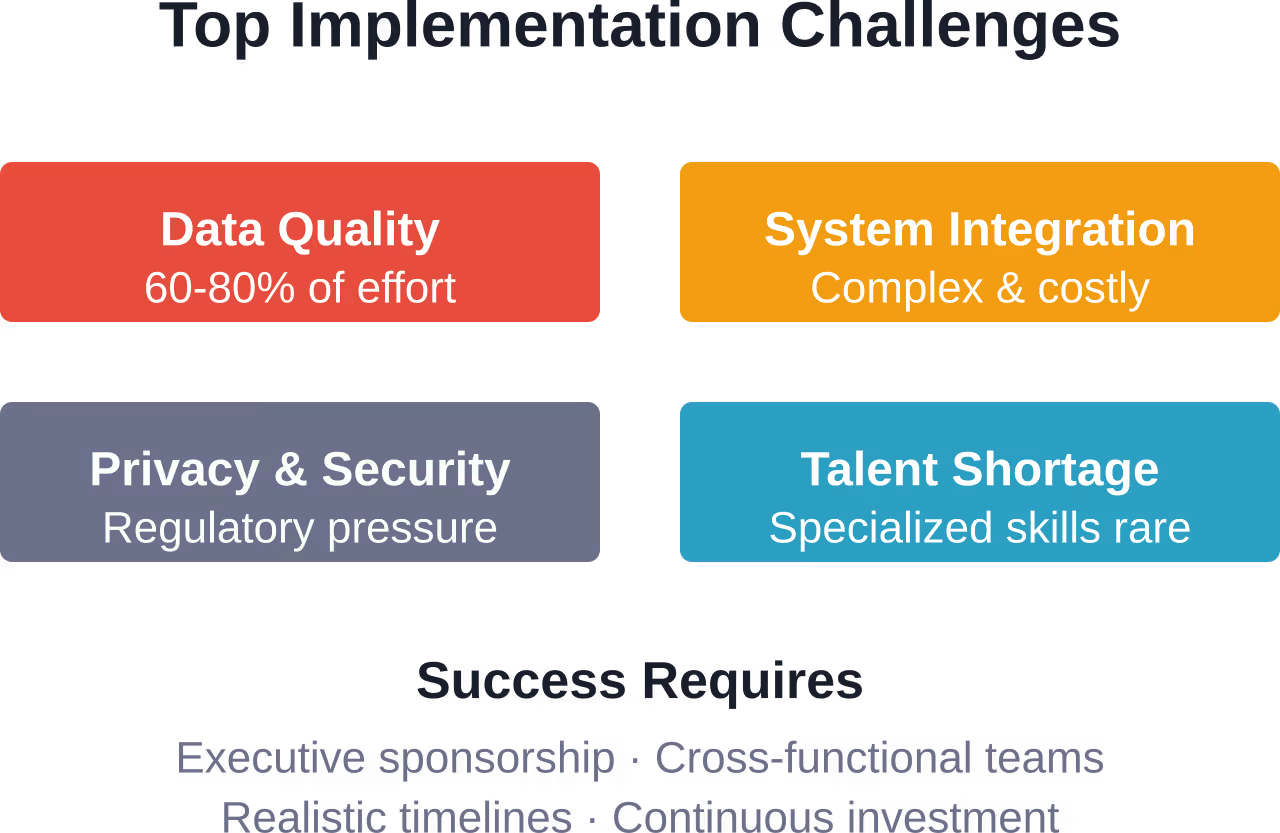
The Future Landscape
Automotive analytics continues evolving rapidly. Several trends will shape the next phase of development.
- Edge computing brings analytics closer to data sources. Instead of streaming all vehicle data to centralized cloud systems, processing moves to the vehicle itself or nearby edge nodes. This reduces latency, enables real-time decision-making, and decreases bandwidth requirements.
- Artificial intelligence capabilities grow more sophisticated. Today’s machine learning models will seem primitive compared to what’s coming. Autonomous systems will handle increasingly complex scenarios. Predictive accuracy will improve. New applications will emerge that we haven’t imagined yet.
- Data sharing and ecosystem collaboration represents another frontier. Individual companies can accomplish a lot with their own data, but industry-wide insights require broader data sharing. How do you enable collaborative analytics while protecting competitive information and privacy? Emerging technologies like federated learning and differential privacy offer potential solutions.
- The software-defined vehicle concept changes automotive economics fundamentally. When vehicles become platforms that receive continuous functionality updates—like smartphones on wheels—the relationship between manufacturers and customers extends far beyond the initial purchase. Analytics enables this transition by providing insights into usage patterns, feature adoption, and customer preferences that guide development priorities.
Frequently Asked Questions
What types of data do automotive companies collect?
Automotive companies collect several categories of data. Telematics data includes vehicle location, speed, acceleration, braking, and driving patterns captured through embedded systems or smartphone apps. Manufacturing data encompasses production metrics, equipment performance, quality measurements, and supply chain information. Customer data covers purchase history, service records, preferences, and interactions across touchpoints. External data sources include weather conditions, traffic patterns, market trends, and economic indicators that provide context for analysis.
How much does it cost to implement automotive analytics?
Implementation costs vary enormously depending on scope, complexity, and approach. Small pilot projects might run $50,000-$200,000 for consulting, software, and initial integration. Enterprise-wide implementations can reach millions of dollars for infrastructure, talent, vendor partnerships, and organizational change management. Cloud-based solutions have reduced upfront capital requirements significantly, shifting costs to operational expenses that scale with usage. Most companies find that starting with focused, high-ROI use cases helps justify investment and fund expansion.
Is automotive data analytics only for large manufacturers?
Absolutely not. While large manufacturers certainly leverage analytics extensively, dealerships, fleet operators, suppliers, insurers, and aftermarket service providers all benefit from data-driven insights. Cloud platforms and specialized software vendors have democratized access to sophisticated analytics capabilities. A regional dealership group can implement customer analytics and predictive service recommendations without building custom infrastructure from scratch. Fleet operators of any size can adopt telematics solutions that provide immediate visibility and optimization opportunities.
How do telematics insurance programs protect driver privacy?
Reputable telematics programs implement several privacy protections. Participation is typically voluntary—drivers opt in and can opt out. Data collection focuses on driving behavior metrics relevant to safety (speed, braking, acceleration) rather than detailed location tracking. Programs anonymize and aggregate data for analysis. Clear privacy policies explain what data gets collected, how it’s used, and who can access it. Regulatory frameworks like GDPR impose requirements on consent, data minimization, and user rights. That said, privacy concerns are legitimate, and drivers should carefully review program terms before enrolling.
What skills are needed for automotive data analytics roles?
Successful automotive analytics professionals typically combine technical skills with domain knowledge. Technical capabilities include data engineering, statistical analysis, machine learning, data visualization, and programming languages like Python or R. Domain expertise covers vehicle systems, manufacturing processes, supply chain dynamics, or customer behavior depending on the specific role. Communication skills matter enormously—translating complex analytical findings into actionable business recommendations that non-technical stakeholders understand. Many professionals enter from adjacent fields and build automotive-specific knowledge on the job.
Can small datasets still provide valuable insights?
Yes. While big data gets all the attention, small datasets analyzed thoughtfully often yield actionable insights. A dealership with records on a few thousand customers can still identify patterns in purchase timing, service behavior, and preferences that improve marketing effectiveness. The key is asking the right questions and applying appropriate analytical methods. As datasets grow, more sophisticated techniques become viable, but starting small doesn’t prevent value creation. In fact, many successful analytics programs begin with limited data, demonstrate value, and gradually expand scope and sophistication.
How long does it take to see ROI from automotive analytics?
Timeline varies by use case and implementation approach. Some applications deliver value quickly—targeted marketing campaigns informed by customer analytics might show improved conversion rates within weeks. Predictive maintenance programs typically demonstrate ROI within 6-12 months through reduced downtime and repair costs. More complex initiatives like autonomous vehicle development or comprehensive manufacturing optimization require longer time horizons, potentially years before full benefits materialize. Setting realistic expectations aligned with use case complexity prevents disappointment and maintains organizational support through the inevitable challenges.
Moving Forward with Confidence
Data analytics has moved from experimental curiosity to competitive necessity in the automotive industry. Companies that effectively harness vehicle data, manufacturing information, customer insights, and external signals will outperform competitors who stick with intuition-based decision making. The six use cases outlined here—predictive maintenance, supply chain optimization, customer personalization, autonomous vehicle development, insurance telematics, and manufacturing quality control—represent proven applications delivering measurable value today. They’re not speculative future possibilities but current implementations driving real business results. Success doesn’t require boiling the ocean on day one. Start with a focused use case addressing a genuine pain point. Build solid data foundations. Demonstrate value in a limited scope. Scale gradually based on results. This pragmatic approach manages risk while building organizational capabilities and confidence. The automotive industry stands at an inflection point. Software and data increasingly define competitive advantage alongside traditional engineering excellence. Companies that recognize this shift and invest strategically in analytics capabilities position themselves to thrive in an industry being fundamentally reshaped by data. The question isn’t whether to embrace automotive analytics. That ship has sailed. The question is how quickly and effectively your organization can build the capabilities needed to compete in a data-driven future.