
Quick Summary: Digital transformation in insurance involves integrating AI, cloud computing, automation, and data analytics to modernize operations, enhance customer experiences, and improve decision-making. With 74% of insurers prioritizing this shift in 2025 and 96% of CEOs acknowledging COVID-19 accelerated digitization, the industry faces both unprecedented opportunities and significant challenges in managing organizational change, cybersecurity risks, and technology adoption.
The insurance industry stands at a crossroads. Traditional models built on paperwork, face-to-face interactions, and manual processes are giving way to digital-first approaches that fundamentally reshape how insurers operate.
But here’s the thing—this isn’t just about buying new software. Digital transformation spans core products, processes, customer service, and entire business models. In 2025, 74% of insurers made this shift a priority, with technology adoption playing a key role in their strategies.
The momentum has been building for years. According to industry data, 96% of insurance CEOs say the COVID pandemic accelerated digitization across their organizations. What was once a gradual evolution became an urgent necessity.
Understanding Digital Transformation in Insurance
Digital transformation in the insurance industry means integrating new technologies to enhance customer experience, streamline operations, and improve decision-making processes. It’s not a single project with a clear endpoint.
The scope covers everything from customer-facing mobile apps to backend automation systems. Cloud platforms, big data, AI, and automation are fundamentally changing how insurers work and compete. Over the next three years, AI and data analytics alone are expected to drive significant operational changes.
Real talk: technology is only half the equation. The bigger challenge? Getting people to adopt new ways of working.
That’s why this transformation isn’t a technology problem—it’s a people problem. Insurance companies succeed when their employees embrace change, not just when they deploy new systems.
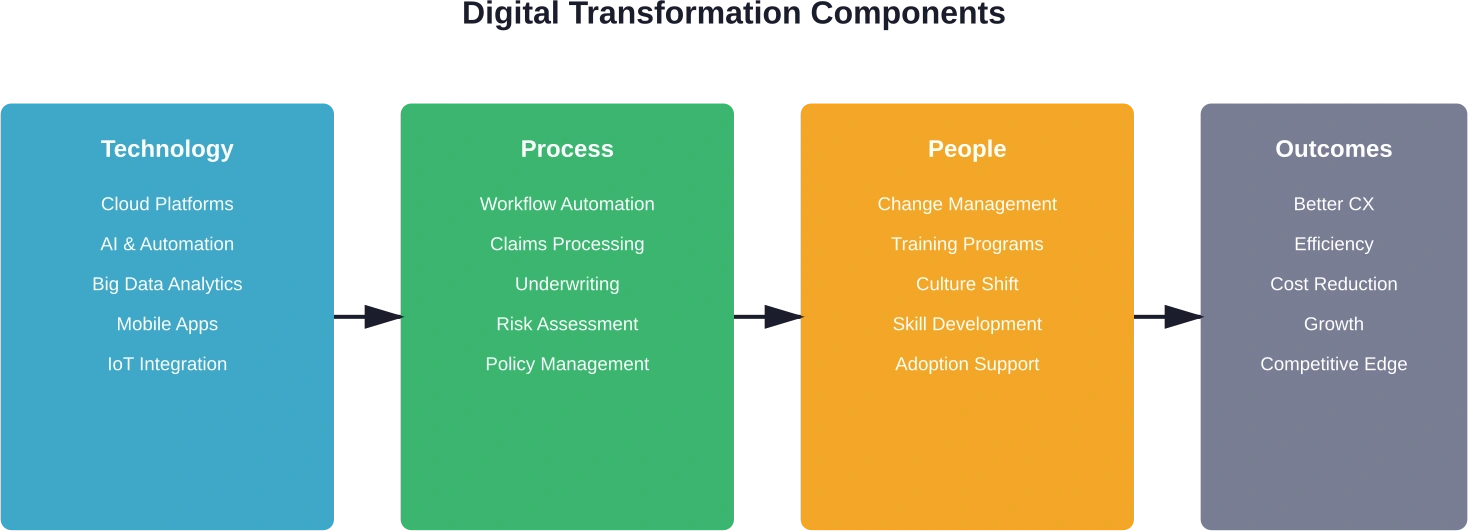
Key Technologies Driving Insurance Transformation
Artificial Intelligence and Machine Learning
AI has moved from experimental to essential. Artificial intelligence now plays a central role across multiple insurance functions in the insurance industry—from underwriting to customer service and claims processing.
Machine learning algorithms analyze vast datasets to identify patterns humans might miss. This capability transforms risk assessment, making it faster and more accurate than traditional methods.
Claims processing benefits significantly from AI automation. Tasks that once required days of manual review now happen in hours or minutes. That’s not just efficiency—it’s better customer experience.
Cloud Computing and Big Data
Cloud platforms provide the infrastructure for modern insurance operations. They enable scalability, remote access, and integration capabilities that on-premise systems can’t match.
Big data utilization allows insurers to analyze information from multiple sources simultaneously. Telematics, social media, IoT devices, and traditional databases all feed into comprehensive risk profiles.
The combination of cloud and big data creates opportunities for real-time decision-making. Pricing models update dynamically based on current information rather than historical averages.
Automation and Workflow Optimization
Robotic process automation handles repetitive tasks that consume staff time. Data entry, document verification, and routine communications run automatically, freeing employees for higher-value work.
Workflow optimization extends beyond simple automation. Intelligent systems route tasks to appropriate specialists, flag exceptions requiring human judgment, and maintain audit trails automatically.
| Technology | Primary Use Cases | Key Benefits
|
|---|---|---|
| Artificial Intelligence | Underwriting, claims processing, fraud detection, customer service | Faster decisions, improved accuracy, 24/7 availability |
| Cloud Computing | Data storage, application hosting, disaster recovery | Scalability, remote access, cost efficiency |
| Big Data Analytics | Risk assessment, pricing optimization, market analysis | Better insights, personalized products, competitive advantage |
| Automation | Policy administration, document processing, compliance | Reduced errors, lower costs, faster processing |
| IoT Integration | Telematics, smart home monitoring, health tracking | Real-time data, preventive services, usage-based pricing |

Implement AI for Insurance Transformation
Digital transformation in the insurance industry often focuses on automating claims processing, improving risk analysis, and enhancing customer experience through AI technologies.
AI Superior helps organizations design and implement AI solutions tailored to complex industries such as insurance.
Their services include:
- AI strategy and transformation consulting
- machine learning solutions for risk modeling and analytics
- AI systems for automation and decision support
If your insurance company is exploring digital transformation initiatives, AI Superior can help implement AI solutions that improve efficiency and data-driven decision making.
Customer Experience Transformation
Modern customers expect insurance interactions to match their experiences with other digital services. Amazon, Netflix, and Uber have set expectations for convenience, speed, and personalization.
Digital engagement models attract and educate customers through multiple touchpoints. Mobile apps, web portals, chatbots, and social media create an interconnected ecosystem that serves customers wherever they are.
Self-service capabilities empower customers to manage policies, file claims, and get answers without waiting for business hours. This isn’t just convenient—it significantly reduces operational costs while improving satisfaction.
Personalization goes beyond using someone’s name in an email. Data analytics enable insurers to recommend coverage based on life events, offer proactive risk management advice, and adjust services to individual preferences.
Benefits of Digital Transformation
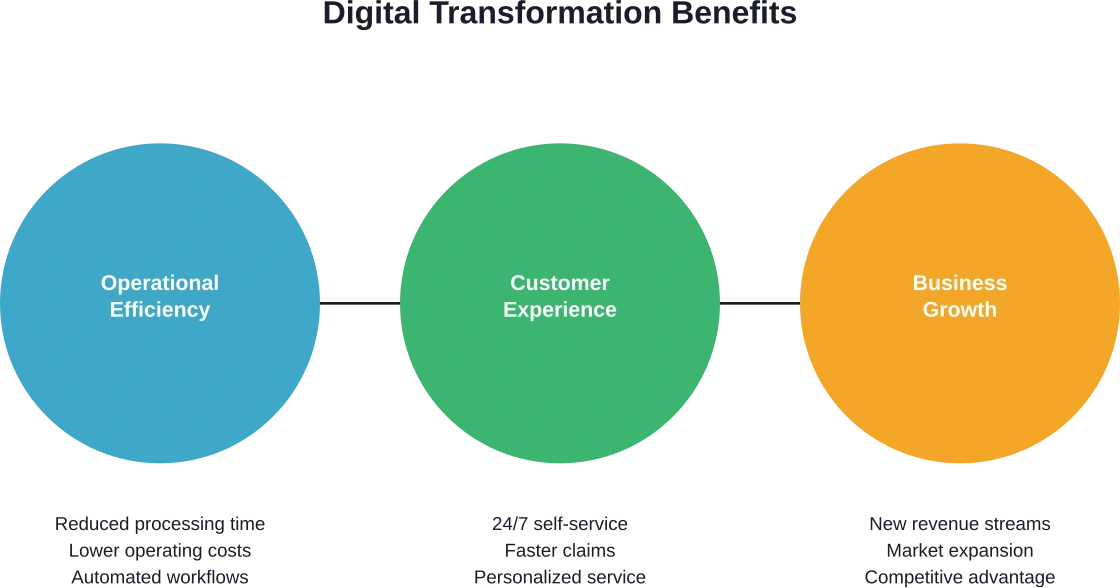
The advantages extend across every aspect of insurance operations. Efficiency gains translate directly to cost reduction—fewer manual processes mean lower operating expenses.
Decision-making improves when leaders have access to real-time data and predictive analytics. Strategic choices become evidence-based rather than instinct-driven.
Competitive positioning strengthens as digital capabilities become market differentiators. Insurers that can quote faster, process claims more efficiently, and offer better digital experiences win more business.
Employee satisfaction often increases despite initial resistance. Once people adapt to new systems, they appreciate eliminating tedious tasks and gaining tools that make their jobs easier.
Challenges and How to Address Them
Legacy systems present one of the biggest obstacles. Decades-old infrastructure wasn’t designed for digital integration. Replacing these systems involves substantial cost, complexity, and risk.
Cybersecurity concerns grow as digital footprints expand. As documented in cybersecurity research, organizations across sectors face growing threats from cybercriminals. Healthcare organizations in particular face unique cybersecurity challenges due to the sensitive nature of patient data. Insurance companies handle sensitive personal and financial data that makes them attractive targets.
Regulatory compliance adds another layer of complexity. Insurance remains heavily regulated, and digital innovations must align with existing legal frameworks while regulations struggle to keep pace with technology.
Change Management as a Solution
Change management addresses the human side of transformation. It’s a structured approach to transitioning individuals, teams, and organizations from current states to desired futures.
Successful change management includes clear communication about why changes are happening, what they mean for employees, and how people will be supported through transitions.
Training programs ensure employees develop skills needed for new systems. But training alone isn’t enough—ongoing support and feedback mechanisms help people adapt over time.
Leadership involvement matters tremendously. When executives actively champion digital initiatives and model new behaviors, adoption rates increase significantly.
The Insurtech Ecosystem
Insurtech startups have disrupted traditional models by building digital-first companies from the ground up. Without legacy system constraints, they move faster and innovate more freely.
Established insurers are responding through partnerships, acquisitions, and internal innovation labs. The insurance ecosystem increasingly connects traditional carriers, technology vendors, data providers, and insurtech ventures.
Ecosystem connectivity enables capabilities no single organization could build alone. APIs allow different systems to communicate, creating seamless experiences that span multiple companies.
Implementation Strategies
Starting with a clear vision and defined objectives prevents transformation efforts from becoming unfocused technology experiments. What specific business problems need solving? What outcomes matter most?
Phased rollouts reduce risk compared to big-bang implementations. Pilot programs in specific regions or product lines provide learning opportunities before full-scale deployment.
Measuring progress through defined metrics keeps initiatives accountable. Track not just technology adoption but business outcomes—customer satisfaction scores, processing times, cost per transaction, and revenue growth.
| Implementation Phase | Key Activities | Success Factors
|
|---|---|---|
| Assessment | Current state analysis, gap identification, priority setting | Honest evaluation, stakeholder input, realistic goals |
| Planning | Strategy development, resource allocation, timeline creation | Executive sponsorship, clear roadmap, sufficient budget |
| Pilot | Limited rollout, testing, feedback collection | Learning mindset, rapid iteration, open communication |
| Scaling | Broader deployment, integration, optimization | Change management, training, technical support |
| Continuous Improvement | Performance monitoring, updates, enhancement | Metrics tracking, user feedback, ongoing investment |
Future Outlook
The pace of technological change continues accelerating. Emerging technologies like blockchain, quantum computing, and advanced AI will create new possibilities insurers can’t yet fully envision.
Customer expectations will keep rising. The digital experiences that impress today will become baseline expectations tomorrow. Insurers must commit to continuous evolution rather than one-time transformation.
Regulatory frameworks will adapt, though likely slower than technology advances. Insurers need to engage with regulators proactively, helping shape policies that enable innovation while protecting consumers.
The companies that thrive won’t necessarily be those with the most advanced technology. Success will go to organizations that best combine technological capability with effective change management and genuine customer focus.
Frequently Asked Questions
What is digital transformation in insurance?
Digital transformation in insurance involves integrating modern technologies like AI, cloud computing, and automation into core business operations. It encompasses everything from customer-facing applications to backend processes, fundamentally changing how insurers operate, serve customers, and compete in the market.
How long does digital transformation take for insurance companies?
Digital transformation is an ongoing process rather than a project with a fixed endpoint. Initial implementations might take 18-36 months, but successful insurers treat transformation as continuous evolution. Phased approaches allow companies to realize benefits incrementally while building toward longer-term visions.
What are the biggest challenges in insurance digital transformation?
Legacy system integration, cybersecurity risks, regulatory compliance, and organizational resistance represent the primary challenges. Many insurers struggle most with the people side—getting employees to adopt new technologies and ways of working. Change management addresses this human dimension alongside technical implementation.
How does AI improve insurance operations?
AI enhances multiple insurance functions including underwriting, claims processing, fraud detection, and customer service. Machine learning algorithms analyze large datasets to identify patterns, assess risks more accurately, automate routine decisions, and provide 24/7 customer support through chatbots. Artificial intelligence now plays a central role across multiple insurance functions in the insurance industry.
What role does cybersecurity play in insurance digital transformation?
Cybersecurity becomes increasingly critical as insurers digitize operations and expand their attack surface. Insurance companies handle sensitive personal and financial data that makes them attractive targets for cybercriminals. Robust security measures, employee training, and incident response capabilities are essential components of any digital transformation strategy.
Can small insurance companies compete with digital transformation?
Small insurers can compete through focused strategies, partnerships, and cloud-based solutions that don’t require massive capital investments. Many technology vendors offer scalable platforms that level the playing field. Success depends more on strategic choices and effective implementation than company size.
How do customers benefit from insurance digital transformation?
Customers gain faster service, 24/7 access through self-service portals, more personalized products, quicker claims processing, and more convenient communication options. Digital transformation enables insurers to meet modern customer expectations for speed, convenience, and transparency that other industries have already established.
Conclusion
Digital transformation represents both opportunity and necessity for insurance companies. The data is clear—74% of insurers are prioritizing this shift, and 96% of CEOs acknowledge that external forces have accelerated the need for change.
Success requires balancing technology implementation with effective change management. The most sophisticated systems fail without people willing and able to use them properly.
The insurance sector is entering a new era where digital capabilities determine competitive positioning. Companies that embrace transformation thoughtfully—addressing both technical and human dimensions—will thrive. Those that delay risk falling behind permanently.
Start by assessing current capabilities honestly, defining clear objectives, and building a roadmap that balances ambition with realism. Focus on outcomes that matter—better customer experiences, operational efficiency, and sustainable growth. The transformation journey may be challenging, but the destination is worth the effort.
 English
  German
  Arabic
  French
  Dutch
Dutch  Spanish