
Résumé rapide : L'apprentissage automatique révolutionne la recherche en cognition sociale en permettant l'analyse de comportements interpersonnels complexes, la prédiction des conséquences sociales et la mise en évidence de schémas d'attribution des états mentaux humains. Les modèles récents atteignent des scores AUC d'environ 0,80 pour la prédiction des comportements sociaux grâce à l'intégration de la théorie psychologique et d'algorithmes avancés. Ces approches transforment la manière dont les scientifiques étudient des phénomènes aussi divers que l'isolement social et le raisonnement de type théorie de l'esprit.
La cognition sociale — la façon dont les humains perçoivent, interprètent et réagissent aux informations sociales — a traditionnellement été étudiée au moyen d'expériences contrôlées et de mesures d'auto-évaluation. Mais ces méthodes ne permettent de saisir que des instantanés du comportement.
L'apprentissage automatique change complètement la donne.
En analysant simultanément des milliers de données comportementales, les algorithmes peuvent détecter des schémas qui pourraient échapper aux chercheurs humains. Leurs applications s'étendent de la psychologie clinique au développement de l'intelligence artificielle.
Pourquoi l'apprentissage automatique est important pour la recherche en cognition sociale
Les approches statistiques traditionnelles supposent des relations linéaires et exigent que les chercheurs précisent au préalable quelles variables sont pertinentes. La cognition sociale ne fonctionne pas ainsi.
Le comportement social humain résulte d'interactions complexes entre les processus cognitifs, les états émotionnels, les contextes environnementaux et les histoires individuelles. L'apprentissage automatique gère naturellement cette complexité.
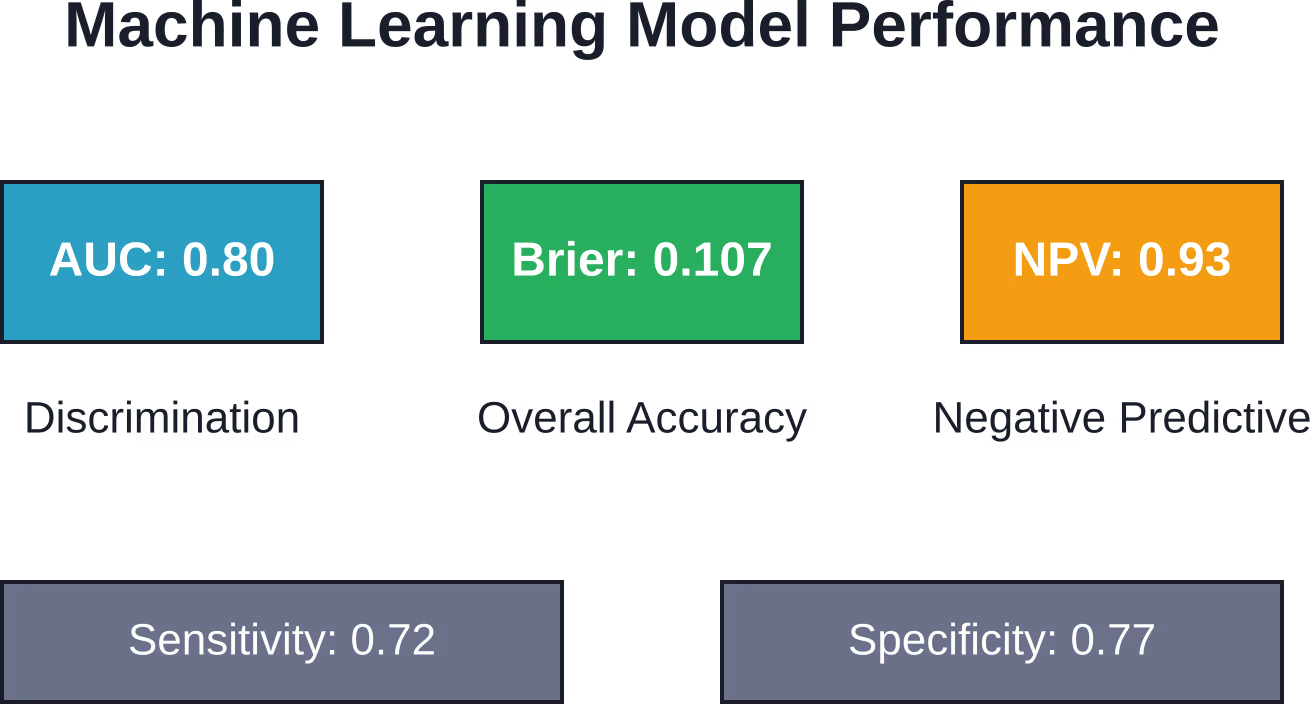
D'après une étude publiée dans Nature en août 2025, l'intégration de la théorie sociocognitive à l'apprentissage automatique a permis de créer des modèles atteignant une aire sous la courbe (AUC) d'environ 0,80 pour la prédiction de comportements sociaux complexes. Le modèle intégrait neuf prédicteurs, dont des mesures de détresse psychologique, l'estime de soi, des facteurs démographiques et le contexte comportemental.
Voici ce qui rend ces approches si puissantes : elles apprennent les schémas hiérarchiques sans que les chercheurs aient à spécifier manuellement chaque terme d’interaction.

Explorez les données de cognition sociale grâce à l'IA supérieure
Les recherches en cognition sociale combinent souvent observations comportementales, analyses du langage, enregistrements expérimentaux et ensembles de données statistiques. IA supérieure peut aider les groupes de recherche et les organisations qui appliquent l'apprentissage automatique pour mieux organiser, interpréter et analyser les informations cognitives et comportementales complexes.
AI Superior peut vous aider avec :
- Traitement des ensembles de données comportementales structurées et non structurées
- Développement de modèles de classification et de prédiction
- Application des méthodes de TAL aux documents de recherche textuels
- Construction de systèmes de validation de concept analytiques
- Évaluation de la qualité du modèle et des performances analytiques
Contactez AI Superior discuter de la structure de la recherche et des ensembles de données disponibles.
Prédire l'isolement social et la solitude
L'isolement social a de graves conséquences sur la santé. Des recherches montrent qu'il est lié à un dérèglement immunitaire et à un risque accru de mortalité.
Mais comment prédire qui souffrira d'isolement plutôt que de solitude ? Une étude publiée dans Nature en juillet 2024 a appliqué l'apprentissage automatique à cette question sur trois groupes : des personnes atteintes de schizophrénie, de trouble bipolaire et des échantillons issus de la population générale.
Les résultats ont révélé quelque chose d'inattendu.
L'anhédonie sociale — une diminution du plaisir tiré des interactions sociales — prédisait à la fois l'isolement et la solitude dans tous les groupes. Ce résultat est cohérent. Cependant, la cognition non sociale n'expliquait une variance unique de l'isolement que chez les personnes atteintes de schizophrénie.
Les modèles d'apprentissage automatique ont identifié l'anhédonie sociale et la cognition non sociale comme des prédicteurs clés de l'isolement dans les échantillons de schizophrénie, la solitude présentant des schémas similaires dans tous les groupes.
Cela démontre la capacité de l'apprentissage automatique à identifier des prédicteurs spécifiques à une population par opposition aux prédicteurs universels — chose que les méthodes traditionnelles peinent à accomplir efficacement.
Théorie de l'esprit et intelligence artificielle
La théorie de l'esprit désigne la compréhension que les autres ont des états mentaux — croyances, désirs, intentions — différents des nôtres. Elle est fondamentale pour l'interaction sociale.
Les modèles d'apprentissage automatique peuvent-ils développer des capacités de théorie de l'esprit ? Des travaux récents semblent le confirmer, avec toutefois des réserves.
Les recherches sur les modèles augmentés par la théorie de l'esprit montrent des améliorations de performance par rapport aux modèles de base, les améliorations de score variant selon la taille du modèle.
Le problème, c'est que ces modèles ne “ comprennent ” pas vraiment les états mentaux comme le font les humains. Ils effectuent une reconnaissance de formes à une échelle extraordinaire.
Trajectoires cognitives après un traumatisme crânien
La prédiction des schémas de récupération après un traumatisme crânien demeure malheureusement imprécise. Trop de variables interagissent de manière non linéaire.
Une étude publiée dans Nature en janvier 2026 a analysé les approches d'apprentissage automatique dans 30 études publiées portant sur 2 364 participants, majoritairement des hommes, présentant un mélange de traumatismes crâniens légers et modérés à graves.
Les chercheurs ont appliqué des modèles de forêt aléatoire, de gradient boosting et d'extreme gradient boosting dans le cadre de PROGRESS-Plus pour l'analyse des déterminants sociaux. Ils ont prédit le taux d'évolution cognitive, et non seulement l'état initial.
Les principaux facteurs prédictifs identifiés sont les intervalles de temps, les indicateurs structurels au niveau national, l'âge et la variabilité du niveau d'éducation. L'analyse des explications additives de Shapley a permis de déterminer les facteurs déterminants des prédictions pour chaque cas individuel.
Cette approche comble une lacune importante. Les paramètres sociaux influençant l'évolution des traumatismes crâniens ont été insuffisamment étudiés, ce qui engendre des lacunes dans la pratique clinique. L'apprentissage automatique permet de quantifier ces influences auparavant difficiles à cerner.
Statut socio-économique et développement cérébral
Le statut socio-économique laisse-t-il des traces neuronales ? Une étude d’octobre 2025 a appliqué des modèles de réseaux élastiques à des données de neuroimagerie multimodales provenant d’adolescents.
Les modèles prédisaient les revenus à partir des seules données d'imagerie cérébrale, sans aucune information démographique initiale. Les données d'imagerie par tenseur de diffusion, d'IRM structurelle et de connectivité fonctionnelle au repos ont servi d'entrées.
Le modèle multimodal le plus performant a atteint une AUC de 0,75 sur les données de test sans informations démographiques et d'environ 0,779 avec les données démographiques.
Les modèles distinguant les enfants des tranches de revenus extrêmes ont montré de solides performances, avec une AUC de 0,81 sans données démographiques et de 0,863 avec données démographiques.
L'imagerie par tenseur de diffusion s'est avérée la plus discriminante, suivie de l'IRM structurelle. Les caractéristiques les plus prédictives étaient distribuées globalement plutôt que localisées, notamment dans les régions associées aux fonctions exécutives et au langage.
L'inclusion de données démographiques a amélioré les performances du modèle, avec des améliorations plus importantes observées pour les données de connectivité fonctionnelle au repos.
| Type de modèle | AUC (Test, sans données démographiques) | AUC (Test, avec données démographiques) | Caractéristiques les plus discriminantes |
|---|---|---|---|
| Revenu multimodal | 0.75 | 0.779 | Intégrité de la substance blanche, distribution globale |
| Extrêmes de revenus | 0.81 | 0.863 | Fonction exécutive, régions linguistiques |
| DTI uniquement | modalité unique la plus élevée | +2-4% avec données démographiques | Organisation de la substance blanche |
| RSFC uniquement | modalité unique la plus basse | +10% avec données démographiques | Modèles de connectivité fonctionnelle |
Élaboration de théories unifiées de la cognition
Les sciences cognitives sont confrontées à un problème de fragmentation. Des théories existent pour des domaines spécifiques — le langage naturel à des niveaux algébriques, les algorithmes d'apprentissage, les mécanismes de plasticité cérébrale — mais les relier reste un défi.
L’apprentissage automatique pourrait-il servir de liant informatique ? Un article de Nature paru en mai 2026 examine cette possibilité.
Deux approches informatiques se révèlent prometteuses : les systèmes symboliques qui manipulent des représentations discrètes et les réseaux connexionnistes qui apprennent des modèles distribués. Historiquement, ces deux camps ont rarement communiqué.
L'apprentissage automatique, et plus particulièrement l'apprentissage profond, démontre comment ces deux approches peuvent se compléter plutôt que s'opposer. Les réseaux de neurones apprennent des représentations hiérarchiques interprétables symboliquement. Les contraintes symboliques peuvent guider l'architecture des réseaux.
Cette synthèse pourrait permettre une intégration à différents niveaux d'analyse, depuis les théories computationnelles abstraites jusqu'aux détails de l'implémentation neuronale.
Applications pratiques et orientations futures
Quelles sont les applications concrètes de cette recherche ?
Les milieux cliniques en bénéficient immédiatement. Les modèles prédictifs de l'isolement social permettent d'identifier les personnes à risque avant que la rupture ne s'installe durablement. Les évaluations de la théorie de l'esprit pourraient éclairer les interventions auprès des personnes atteintes de troubles du spectre autistique.
Pour le développement de l'IA, la recherche en cognition sociale fournit des modèles. Si l'objectif est de créer des machines qui collaborent naturellement avec les humains, il est essentiel de comprendre comment l'intelligence biologique traite l'information sociale.
Des chercheurs ont utilisé l'apprentissage automatique appliqué à des données EEG pour comprendre l'attraction subjective, générant des portraits correspondant aux préférences individuelles avec une précision supérieure à 80 % lors des tests. Ceci démontre des applications au-delà de la psychologie traditionnelle.
Des défis subsistent. Les modèles d'apprentissage automatique sont très gourmands en données. La cognition sociale implique des processus subtils et contextuels dont la mise à l'échelle peut s'avérer complexe. Les considérations éthiques liées à la prédiction des comportements sociaux exigent une attention particulière.
FAQ
Qu’est-ce que l’apprentissage automatique en cognition sociale ?
L'apprentissage automatique en cognition sociale utilise des algorithmes tels que les forêts aléatoires, le gradient boosting et les réseaux de neurones pour prédire et expliquer comment les individus perçoivent, interprètent et réagissent aux informations sociales. Ces modèles analysent les tendances dans les données comportementales, de neuroimagerie et psychologiques afin de révéler des relations que les statistiques traditionnelles pourraient ne pas mettre en évidence.
Dans quelle mesure les modèles d'apprentissage automatique sont-ils précis pour prédire le comportement social ?
Des études récentes démontrent d'excellentes performances. Les modèles guidés par la théorie ont atteint une aire sous la courbe (AUC) de 0,80 pour la prédiction des comportements sociaux, avec une sensibilité de 0,72 et une spécificité de 0,77 aux seuils optimaux. La précision du modèle dépend fortement de la taille de l'échantillon, de la qualité des caractéristiques et de la pertinence de la théorie psychologique pour la sélection des variables.
L'IA peut-elle développer une théorie de l'esprit ?
Les modèles d'IA peuvent apprendre à simuler le raisonnement de la théorie de l'esprit. Les recherches montrent que les modèles de langage enrichis par la théorie de l'esprit améliorent les performances, avec des gains plus importants pour les petits modèles et des améliorations plus modestes pour les plus grands. Cependant, ces systèmes effectuent une reconnaissance de formes plutôt que de comprendre véritablement les états mentaux comme le font les humains ; les mécanismes diffèrent fondamentalement.
Quels sont les facteurs prédictifs de l'isolement social par rapport à la solitude ?
Des études d'apprentissage automatique ont montré que l'anhédonie sociale prédit l'isolement et la solitude dans toutes les populations. Cependant, la cognition non sociale prédit spécifiquement l'isolement chez les personnes atteintes de schizophrénie. Cela suggère que des facteurs universels (diminution du plaisir social) et des mécanismes propres à chaque population contribuent à la déconnexion sociale.
Comment le statut socio-économique influence-t-il le développement cérébral ?
L'imagerie cérébrale multimodale combinée à l'apprentissage automatique montre que le revenu prédit la structure et le fonctionnement du cerveau des adolescents avec une aire sous la courbe (AUC) comprise entre 0,75 et 0,81. L'intégrité de la substance blanche et les caractéristiques distribuées globalement liées aux fonctions exécutives et au langage sont les plus discriminantes. Les différences sont les plus marquées entre les tranches de revenus extrêmes.
Quelles méthodes d'apprentissage automatique sont les plus performantes pour la cognition sociale ?
Les forêts aléatoires, le gradient boosting et la régression Elastic Net sont fréquemment utilisés dans les études concluantes. La méthode optimale dépend de la question posée : les forêts aléatoires gèrent efficacement les interactions non linéaires, les Elastic Nets corrigent la multicolinéarité dans les données cérébrales et le gradient boosting atteint souvent d’excellentes performances prédictives lorsqu’il est correctement paramétré.
Quels sont les enjeux éthiques ?
La prédiction des comportements sociaux soulève des questions de respect de la vie privée, de risques de discrimination et de consentement. Les modèles entraînés sur des données biaisées peuvent perpétuer les stéréotypes. L'utilisation de prédictions du statut socio-économique fondées sur les neurosciences pourrait stigmatiser les groupes défavorisés. Les chercheurs doivent veiller à ce que les modèles améliorent les conditions de vie sans permettre la surveillance ni renforcer les inégalités.
Conclusion
L’apprentissage automatique transforme en profondeur la recherche en cognition sociale. Les modèles prédisent désormais des comportements sociaux complexes avec une précision de discrimination de 80%, identifient les facteurs de risque d’isolement propres à certaines populations et révèlent les signatures neuronales du désavantage social.
Ces avancées permettent non seulement de décrire les phénomènes, mais aussi de prédire les résultats et d'expliquer les mécanismes. Les approches fondées sur la théorie, qui intègrent des cadres psychologiques à la puissance des algorithmes, offrent de meilleures performances que chacune prise isolément.
La convergence des sciences cognitives et de l'apprentissage automatique ouvre la voie à des théories unifiées couvrant de multiples niveaux d'analyse. À mesure que la qualité des données s'améliore et que les méthodes progressent, il faut s'attendre à des avancées plus rapides dans la compréhension des fondements computationnels de l'intelligence sociale.
Pour les chercheurs, les cliniciens et les développeurs d'IA, le message est clair : l'apprentissage automatique n'est pas seulement un outil pour la recherche en cognition sociale, il devient une infrastructure essentielle pour la prochaine génération de découvertes.
 French
  English
  German
  Arabic
  Dutch
Dutch  Spanish