Résumé rapide : L'apprentissage automatique révolutionne la biologie cellulaire en permettant l'analyse automatisée d'images cellulaires complexes, la prédiction des profils d'expression génique et la mise au jour de relations cachées dans des ensembles de données massifs. Les modèles d'apprentissage profond atteignent désormais une précision de 93 % dans la prédiction du comportement cellulaire, tandis que de nouveaux cadres aident les chercheurs à intégrer des mesures multimodales pour une compréhension plus complète des états cellulaires et des mécanismes pathologiques.
Les sciences biomédicales génèrent actuellement plus de données que presque tous les autres domaines. Avec la microscopie à haut débit, le séquençage unicellulaire et les mesures multimodales qui inondent les laboratoires de recherche, les biologistes cellulaires sont confrontés à un défi de taille : comment donner un sens à toutes ces données ?
C’est là qu’intervient l’apprentissage automatique. Mais il ne s’agit pas seulement de traiter des données plus rapidement ; il s’agit de transformer fondamentalement les questions que les chercheurs peuvent poser et auxquelles ils peuvent répondre concernant le comportement cellulaire, les mécanismes des maladies et les cibles thérapeutiques.
L'explosion des données à l'origine de l'adoption du ML
D'après une étude publiée dans Nature Cell Biology, les sciences biomédicales génèrent plus de données que de nombreux autres domaines d'application. Cela offre aux sciences de la vie une occasion unique de devenir l'un des principaux bénéficiaires de l'apprentissage automatique et de la recherche en intelligence artificielle.
Le problème est le suivant : les méthodes d’analyse traditionnelles ne sont pas adaptées à cette échelle. L’annotation manuelle d’images ? Trop lente. Les règles de traitement statiques ? Trop rigides. La complexité des systèmes cellulaires exige des algorithmes adaptatifs capables de déceler des schémas qui pourraient échapper à l’œil humain.
Les méthodes d'apprentissage automatique recherchent automatiquement des modèles plutôt que de s'appuyer sur des règles prédéfinies. Ce passage de l'analyse manuelle à l'analyse automatisée a ouvert des perspectives de recherche entièrement nouvelles.
Applications fondamentales transformant la recherche
Analyse d'images automatisée et segmentation cellulaire
Les progrès récents en matière d'automatisation des microscopes offrent de nouvelles perspectives pour la biologie cellulaire à haut débit, notamment pour le criblage par imagerie. La complexité des tâches d'analyse d'images rend souvent fastidieuse la mise en œuvre de règles de traitement statiques.
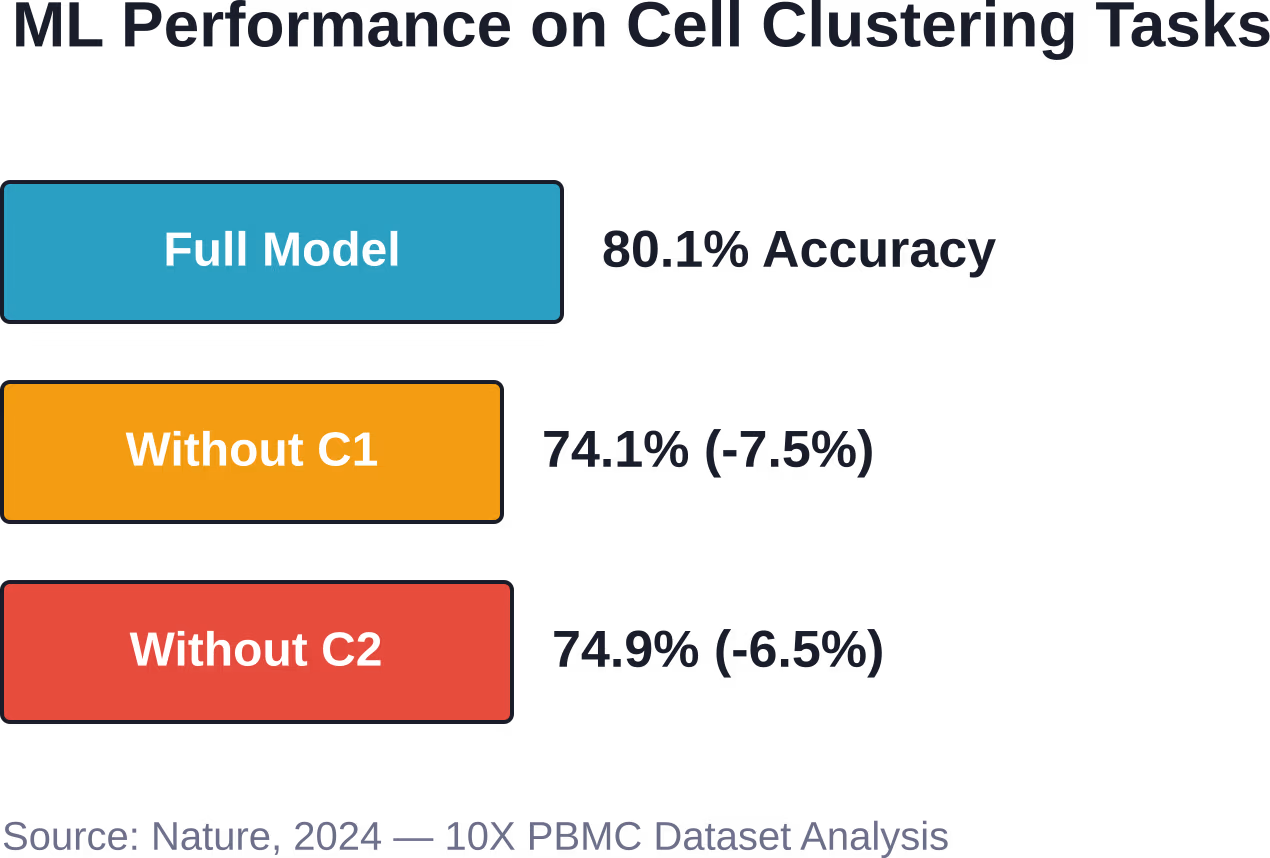
Les modèles d'apprentissage profond gèrent désormais la segmentation, le suivi et la classification cellulaires avec une précision remarquable. Une étude sur le regroupement de cellules uniques a démontré que la suppression de composants clés du modèle entraînait une baisse significative des performances : la précision est passée de 0,8010 à 0,7406 (soit une diminution de 7,54%) lorsqu'un composant de la matrice a été retiré de l'analyse de 10 jeux de données PBMC.
Prédiction de l'expression génique
Les réseaux neuronaux convolutifs peuvent désormais prédire le comportement cellulaire à partir de données de séquences avec une précision remarquable. Le modèle Optimus 5-Prime, entraîné sur des données de cellules HEK293T transfectées, a atteint une précision de 93% pour la prédiction des valeurs de charge ribosomique à partir des séquences 5′ UTR.
Ce niveau de précision était impossible à atteindre avec les méthodes de calcul traditionnelles. Le modèle a utilisé l'encodage one-hot des séquences UTR comme entrée et a appris les relations complexes qui régissent l'efficacité de la traduction.
Intégration de données multimodales
Soyons francs : les cellules sont complexes. Se contenter d’analyser l’expression des gènes ou les niveaux de protéines ne donne qu’une image partielle. Les nouveaux cadres d’IA permettent désormais d’identifier les données cellulaires capturées par une seule modalité de mesure et celles partagées entre plusieurs modalités.
Cette approche holistique aide les chercheurs à mieux comprendre les mécanismes des maladies et à concevoir des expériences plus efficaces. Au lieu de données cloisonnées, les scientifiques peuvent désormais élaborer des visions intégrées des états cellulaires.

Créez des flux de travail d'apprentissage automatique en biologie cellulaire grâce à AI Superior
Les projets de biologie cellulaire combinent fréquemment l'imagerie microscopique, les mesures de laboratoire et les observations expérimentales qui nécessitent des méthodes d'analyse avancées. AI Superior Ils peuvent aider les équipes de recherche à appliquer des techniques d'apprentissage automatique et de vision par ordinateur au traitement des données cellulaires et aux flux de travail d'imagerie biologique. Leur expertise couvre l'apprentissage automatique, la vision par ordinateur, le conseil en IA, la science des données et le génie logiciel en IA.
AI Superior peut aider les équipes de biologie cellulaire à :
- Traitement des données de microscopie et de laboratoire
- Développement de modèles d'analyse et de segmentation d'images
- Création de flux de travail d'IA de preuve de concept
- Test de la précision du modèle sur des données expérimentales
- Soutenir le déploiement dans les environnements de recherche
👉Parlez à un supérieur de l'IA concernant les objectifs de la recherche et la structure des données.
Méthodes révolutionnaires en analyse unicellulaire
Le séquençage d'ARN unicellulaire a révolutionné la recherche sur la diversité cellulaire. Le regroupement non supervisé permet d'identifier différents types cellulaires au sein d'une population, mais les méthodes conventionnelles présentent des limites.
Les méthodes de clustering profond basées sur les graphes sont prometteuses pour la préservation des relations structurelles entre les cellules. Cependant, elles négligent souvent la distribution inhérente des nœuds dans le graphe, ce qui conduit à des représentations incomplètes.
Résolution des problèmes de sur-lissage et de distribution
Les réseaux de convolution de graphes conventionnels peuvent souffrir de sur-lissage, un phénomène où le réseau perd sa capacité à différencier les échantillons ayant des profils d'expression similaires.
Les méthodes avancées intègrent désormais des graphes d'adjacence à double topologie qui intègrent des informations sur la distribution des nœuds aux graphes d'adjacence traditionnels. Ceci enrichit les représentations en capturant les relations spatiales entre les cellules, en plus des similarités par paires.
Les mécanismes d'attention pondèrent dynamiquement les caractéristiques du graphe, en privilégiant les aspects les plus informatifs pour le regroupement. Les connexions résiduelles limitent le lissage excessif, garantissant ainsi que les réseaux conservent leur capacité à distinguer les différences subtiles dans les profils d'expression cellulaire.
| Ensemble de données | Précision du modèle complet | Impact de la suppression de l'attention | Impact de l'élimination des résidus |
|---|---|---|---|
| 10X PBMC | 0.8010 | -7.54% (C1 supprimé) | -6.49% (C2 supprimé) |
| GSE60361 | 0.7953 | Les performances varient | -5,77% diminution |
| Neurone du ver | 0.6997 | -22,67% diminution | Impact significatif |
Qualité des données d'entraînement et crise de la reproductibilité
La qualité des modèles d'apprentissage automatique dépend de celle de leurs données d'entraînement. Garantir la qualité des données et la reproductibilité des expériences est essentiel pour développer des modèles fiables.
La solution réside dans une meilleure conception expérimentale et une gestion plus rigoureuse des données. Certains chercheurs utilisent des banques de variants de promoteurs avec une génération de séquences diversifiée pour améliorer la généralisation des modèles, créant ainsi des ensembles d'entraînement qui permettent aux modèles d'être plus performants dans des conditions variées.
Cartographie de référence et modèles interprétables
La disponibilité croissante d'atlas unicellulaires à grande échelle a permis une description détaillée des états cellulaires. Les progrès de l'apprentissage profond permettent une analyse rapide des nouveaux jeux de données générés en les intégrant à des atlas de référence.
Mais attendez. Les transformations de données existantes, apprises pour mapper les données de requête, ne sont pas facilement explicables à l'aide de concepts biologiquement connus comme les gènes ou les voies métaboliques.
Les architectures bio-inspirées permettent désormais une cartographie de référence unicellulaire qui apprend à représenter les cellules en composants biologiquement compréhensibles, correspondant à des programmes génétiques connus. L'activité de chaque cellule pour un programme génétique donné est apprise, tout en affinant simultanément ces programmes et en apprenant de nouveaux programmes.
Ces modèles permettent d'interpréter l'analyse intégrative de cellules uniques. Les chercheurs peuvent désormais comprendre non seulement que les cellules se regroupent, mais aussi pourquoi : quels mécanismes biologiques et programmes génétiques sont à l'origine de ces similarités ?.
Gestion des ensembles de données déséquilibrés
La distribution des types cellulaires dans les échantillons biologiques est rarement uniforme. Dans les études sur les embryons humains, les cellules 55% échantillonnées peuvent être annotées comme appartenant au trophectoderme, ce qui crée des problèmes de déséquilibre des classes pour les classificateurs.
En corrigeant le déséquilibre des classes par des stratégies rigoureuses d'équilibrage et de pondération des données, les modèles développent des représentations plus robustes, sans biais marqués en faveur des types cellulaires surreprésentés. Un traitement adéquat des données déséquilibrées améliore l'équité et la généralisation globales du modèle.
| Approche | Points forts | Limites |
|---|---|---|
| Apprentissage supervisé | Haute précision avec les données étiquetées ; résultats interprétables | Nécessite une annotation manuelle approfondie ; risque de passer à côté de nouveaux modèles |
| Clustering non supervisé | Découvre des types cellulaires inconnus ; aucun marquage nécessaire | Les résultats peuvent être difficiles à valider ; cela nécessite une expertise du domaine. |
| Transfert d'apprentissage | Exploite les atlas existants ; analyse rapide des nouvelles données | Limité par la qualité des références ; peut ne pas saisir la biologie unique |
| Réseaux à information biologique | Programmes génétiques interprétables ; combine les données avec les connaissances antérieures | Limité par les bases de données de voies métaboliques existantes ; complexe à mettre en œuvre |
La voie à double sens : la biologie, source d’inspiration pour l’apprentissage automatique
Cette relation n'est pas à sens unique. Si l'apprentissage automatique aide les biologistes à analyser les données, les systèmes biologiques inspirent également des développements fondamentaux dans les algorithmes d'apprentissage automatique.
La complexité des systèmes cellulaires — avec leurs boucles de rétroaction, leurs comportements émergents et leurs interactions multi-échelles — pose des défis qui stimulent l'innovation dans la conception d'algorithmes. Des problèmes tels que le traitement de données éparses et bruitées ou la modélisation de processus dynamiques incitent les chercheurs en apprentissage automatique à développer de meilleures méthodes.
L'établissement de ce dialogue entre la biologie cellulaire et l'apprentissage automatique crée des avantages mutuels. Les biologistes acquièrent de puissants outils analytiques, tandis que les informaticiens sont confrontés à des problèmes concrets et stimulants qui font progresser leur discipline.
Orientations futures et applications émergentes
À l'avenir, plusieurs tendances façonnent l'intersection entre l'apprentissage automatique et la biologie cellulaire :
- Analyse en temps réel : À mesure que la microscopie génère des données, les modèles d'apprentissage automatique les analysent en temps réel, permettant ainsi des expériences adaptatives qui répondent aux observations.
- Inférence causale : Dépasser la simple corrélation pour comprendre les relations mécanistiques entre les variables cellulaires
- Intégration multi-échelle : Relier les mesures moléculaires à l'organisation tissulaire et aux phénotypes de l'organisme
- Prédiction de la réponse aux perturbations : Prévoir la façon dont les cellules réagissent aux médicaments, aux modifications génétiques ou aux changements environnementaux
Le domaine est également confronté à d'importantes questions concernant l'interprétabilité des modèles, les normes de validation et les meilleures pratiques pour le partage des données et des modèles entraînés entre les groupes de recherche.
Questions fréquemment posées
Quels types d'apprentissage automatique sont les plus couramment utilisés en biologie cellulaire ?
Les réseaux de neurones convolutifs dominent les tâches d'analyse d'images telles que la segmentation et la classification cellulaires. Les réseaux de neurones graphiques excellent dans le traitement des données unicellulaires où les relations intercellulaires sont cruciales. Les forêts aléatoires et le gradient boosting restent des techniques populaires pour la prédiction de l'expression génique. Les architectures d'apprentissage profond intègrent de plus en plus de connaissances biologiques grâce à des couches basées sur les voies de signalisation.
Dans quelle mesure les modèles d'apprentissage automatique sont-ils précis pour les applications en biologie cellulaire ?
La précision varie selon la tâche. Les modèles séquence-fonction, comme Optimus 5-Prime, atteignent une précision de 93% pour la prédiction du chargement des ribosomes. Les modèles de regroupement cellulaire atteignent une précision de 70 à 80% sur les jeux de données de référence. Les performances dépendent fortement de la qualité des données d'entraînement ; la reproductibilité des données et la rigueur expérimentale influent sur la fiabilité du modèle.
Ai-je besoin de compétences en programmation pour utiliser les outils d'apprentissage automatique en biologie cellulaire ?
Pas toujours. De nombreux outils proposent désormais des interfaces graphiques ou des flux de travail simplifiés. Toutefois, la compréhension des concepts fondamentaux est essentielle pour une interprétation correcte des résultats. Pour les applications personnalisées ou les nouvelles questions de recherche, la maîtrise de la programmation en Python ou en R devient indispensable. La collaboration entre biologistes computationnels et expérimentaux donne souvent les meilleurs résultats.
Quels sont les principaux défis liés à l'application du ML à la biologie cellulaire ?
La qualité des données est primordiale : des mesures bruitées, des effets de lot et un déséquilibre des classes compliquent l’apprentissage. L’interprétabilité est essentielle, car les biologistes doivent comprendre le fonctionnement des prédictions des modèles. Le manque de données d’apprentissage pour les types cellulaires rares ou les systèmes expérimentaux novateurs limite le développement des modèles. La validation demeure difficile lorsque la vérité de terrain est incertaine.
L'apprentissage automatique peut-il découvrir de nouveaux types de cellules ?
Absolument. Les méthodes de clustering non supervisées permettent d'identifier des populations cellulaires jusqu'alors inconnues dans des jeux de données unicellulaires. Ces découvertes informatiques nécessitent une validation expérimentale, mais elles ont révélé des états cellulaires inattendus au cours du développement, des maladies et de l'homéostasie tissulaire normale. L'enjeu principal est de distinguer les variations biologiques réelles des artefacts techniques.
Comment l'apprentissage automatique gère-t-il les données cellulaires multimodales ?
De nouveaux cadres d'analyse intègrent des mesures issues de différentes technologies (transcriptomique, protéomique, imagerie) afin de construire des représentations holistiques de l'état cellulaire. Des mécanismes d'attention pondèrent la modalité qui contribue le plus à chaque prédiction. Cette approche multimodale capture des informations que les mesures isolées ne permettent pas d'obtenir, offrant ainsi une vision plus complète de la biologie cellulaire.
Quel est l'avenir de l'apprentissage automatique en biologie cellulaire ?
Attendez-vous à des expériences adaptatives en temps réel où l'apprentissage automatique guidera la collecte de données en continu. Les modèles causaux dépasseront la simple corrélation pour atteindre une compréhension mécaniste. L'intégration à différentes échelles, des molécules aux organismes, permettra de relier le comportement cellulaire aux phénotypes. Des critères d'évaluation standardisés et des ressources partagées amélioreront la reproductibilité et accéléreront les progrès entre les équipes de recherche.
Conclusion
L'apprentissage automatique est passé du statut de technique expérimentale à celui d'outil essentiel en biologie cellulaire. Grâce à des modèles atteignant une précision de prédiction de 93% et à de nouvelles méthodes révélant des schémas cachés dans des ensembles de données complexes, cette technologie démontre quotidiennement sa valeur dans les laboratoires de recherche du monde entier.
Les défis liés à la qualité et à la reproductibilité des données sont bien réels, mais la communauté scientifique s'y attelle activement grâce à de meilleures normes de conception expérimentale et de validation. À mesure que les ensembles de données biologiques augmentent et que les algorithmes se perfectionnent, ce partenariat entre les sciences informatiques et les sciences de la vie ne fera que se renforcer.
Pour les chercheurs prêts à intégrer ces méthodes, les perspectives sont immenses. Il est important de commencer par utiliser les outils existants et les jeux de données publics, de collaborer avec des experts en calcul et de garder à l'esprit que l'objectif n'est pas seulement d'améliorer les prédictions, mais aussi d'approfondir notre compréhension du vivant. Cette interaction entre la biologie cellulaire et l'apprentissage automatique profite aux deux disciplines et favorise des découvertes qu'aucune ne pourrait réaliser seule.