Résumé rapide : L'apprentissage automatique matériel repose sur des processeurs spécialisés (GPU, TPU, FPGA, ASIC) et des techniques d'optimisation qui accélèrent l'entraînement et l'inférence des modèles d'IA. Les avancées matérielles permettent un calcul écoénergétique grâce à des optimisations système telles que DVFS, qui réduit la consommation énergétique de l'inférence LLM jusqu'à 30%, et la quantification de précision à 4 bits tout en préservant l'exactitude. L'intersection entre la conception matérielle et les algorithmes d'apprentissage automatique donne naissance à une approche de co-conception qui minimise les transferts de données, améliore les performances et rend le déploiement de l'IA possible à différentes échelles, des dispositifs TinyML aux grands modèles de langage.
L'apprentissage automatique a transformé tous les grands secteurs d'activité, mais les algorithmes qui font la une des journaux n'existeraient pas sans le matériel sous-jacent. Tandis que les data scientists se concentrent sur les architectures de modèles et les techniques d'entraînement, les ingénieurs en matériel relèvent des défis tout aussi complexes : comment traiter efficacement des milliards de paramètres, comment réduire la consommation d'énergie sans sacrifier la précision et comment rendre l'IA accessible des périphériques aux centres de données.
Le paysage matériel pour l'apprentissage automatique comprend plusieurs types de processeurs, chacun présentant des atouts distincts. Les unités de traitement graphique (GPU) dominent les charges de travail d'entraînement. Les unités de traitement tensoriel (TPU) offrent des performances optimisées pour Google. Les réseaux de portes programmables (FPGA) offrent une grande flexibilité. Les circuits intégrés spécifiques à une application (ASIC) garantissent une efficacité maximale pour les tâches dédiées.
Mais voilà le hic : choisir le mauvais matériel peut paralyser tout votre pipeline d’apprentissage automatique, gaspiller de l’énergie et épuiser vos budgets. Comprendre le fonctionnement de ces technologies, leurs compromis et les nouvelles techniques d’optimisation est essentiel pour la réussite ou l’échec de vos projets d’IA.
Pourquoi le matériel est important pour les performances du machine learning
La complexité des modèles d'apprentissage automatique a explosé. Les grands modèles de langage contiennent désormais des centaines de milliards de paramètres, exigeant une puissance de calcul que les processeurs standards ne peuvent fournir efficacement. Le goulot d'étranglement ne réside pas seulement dans le débit arithmétique, mais aussi dans le transfert des données.
D'après une étude publiée sur arXiv, la consommation d'énergie et les performances sont de plus en plus limitées par le comportement du système de mémoire plutôt que par la simple vitesse de calcul. Dans de nombreux cas, le transfert de données entre la mémoire et les unités de traitement consomme davantage d'énergie que les calculs eux-mêmes.
L'accélération matérielle répond à trois contraintes essentielles : la vitesse, l'efficacité énergétique et l'évolutivité. Les processeurs spécialisés exécutent les opérations parallèles beaucoup plus rapidement que les CPU. Les optimisations au niveau du système réduisent considérablement la consommation d'énergie. Enfin, les architectures modernes s'adaptent aux environnements de calcul distribué.
L'Institut national des normes et de la technologie (NIST) développe des méthodes générales pour entraîner les réseaux neuronaux sur diverses plateformes matérielles émergentes, en tenant compte des caractéristiques réalistes du bruit. Ces recherches reconnaissent que le matériel n'est pas qu'un simple substrat passif : il influence activement les capacités de calcul.

Créez des logiciels d'apprentissage automatique avec AI Superior
AI Superior Elle développe des logiciels d'IA sur mesure, notamment des modèles d'apprentissage automatique, des applications basées sur l'IA, des applications web et mobiles, ainsi que des produits logiciels personnalisés. Son équipe accompagne les projets depuis la phase de découverte et d'analyse des données jusqu'au développement du MVP, à l'intégration et à l'évaluation des résultats.
Pour les équipes en charge du matériel, cela peut faciliter l'analyse des données des capteurs, la détection des défauts, la maintenance prédictive, la surveillance des performances ou les outils d'IA construits autour des données des appareils et de production.
Besoin d'un système d'apprentissage automatique conçu autour de vos données ?
AI Superior peut vous aider avec :
- création de solutions d'apprentissage automatique personnalisées
- outils d'analyse prédictive en développement
- Tester des idées par le biais d'une preuve de concept ou d'un développement MVP
- intégrer l'IA aux systèmes existants
👉 Contactez AI Superior pour discuter de votre projet.
Unités de traitement graphique : les bêtes de somme du ML
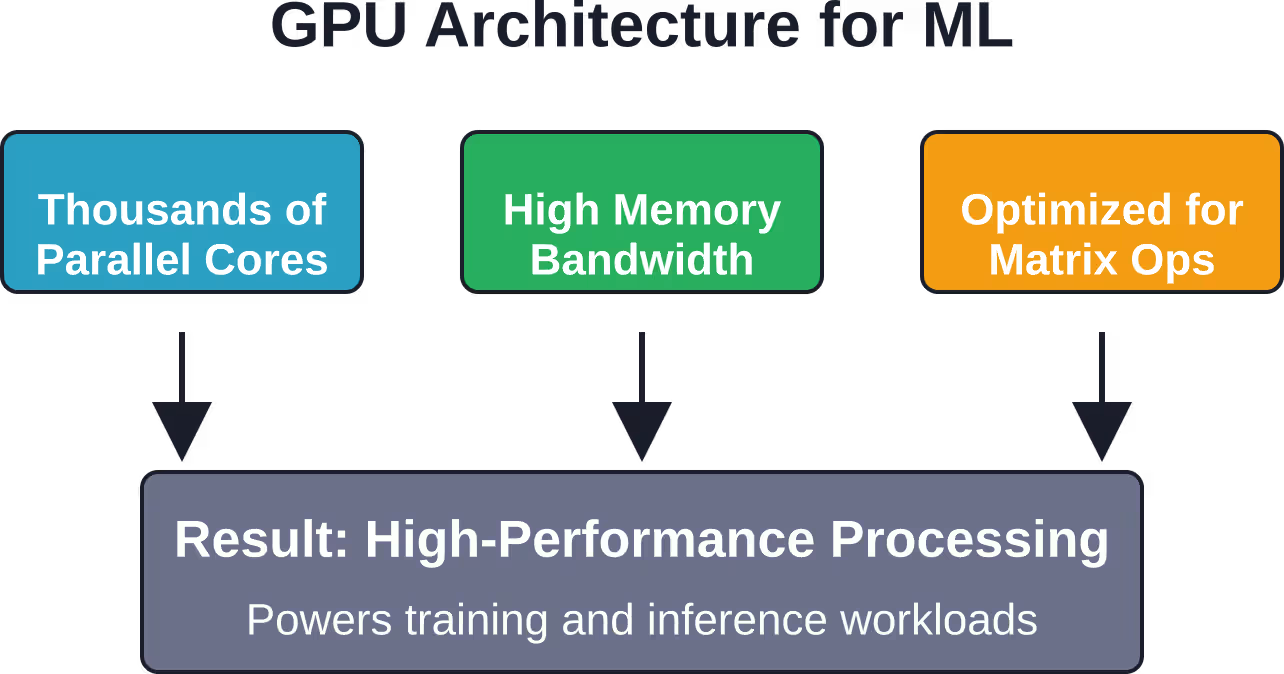
Les GPU ont révolutionné l'apprentissage profond en offrant des milliers de cœurs optimisés pour les opérations parallèles. Conçue à l'origine pour le rendu graphique, leur architecture se prête parfaitement aux multiplications matricielles qui dominent les calculs des réseaux neuronaux.
Les GPU modernes offrent des performances mesurées en TFLOPS (milliards d'opérations en virgule flottante par seconde). Epoch AI documente les spécifications de performance de plus de 170 accélérateurs d'IA à différents niveaux de précision, notamment FP32, FP16 et INT8.
L'avantage ? Les GPU prennent en charge l'entraînement et l'inférence pour quasiment toutes les architectures de modèles. Des frameworks comme PyTorch et TensorFlow offrent une prise en charge GPU éprouvée. Les fournisseurs de cloud proposent des instances GPU à différents prix. Enfin, l'écosystème de développement est robuste, avec de nombreuses bibliothèques et ressources communautaires.
Des défis subsistent toutefois. Les GPU consomment une énergie considérable — souvent de 300 à 500 watts par carte. Ils nécessitent une gestion thermique rigoureuse. De plus, pour les charges de travail d'inférence à grande échelle, leur conception généraliste implique de payer pour des fonctionnalités dont certaines tâches n'ont pas besoin.
Unités de traitement tensoriel : les puces personnalisées de Google
Google a développé les TPU spécifiquement pour les charges de travail liées aux réseaux neuronaux, en optimisant chaque aspect de leur conception pour les opérations tensorielles. Contrairement aux GPU, les TPU ne sont pas des accélérateurs à usage général ; ils sont conçus exclusivement pour l’inférence et l’entraînement en apprentissage automatique.
Les TPU excellent dans les opérations de multiplication matricielle et de convolution, essentielles en apprentissage profond. Leur architecture réduit la précision au strict nécessaire des modèles, en utilisant des entiers 8 bits pour l'inférence et des nombres à virgule flottante 16 bits pour l'entraînement. Cette réduction de la précision améliore considérablement le débit et l'efficacité énergétique.
Les gains de performance sont considérables. Les TPU offrent une inférence plus rapide pour des modèles comme BERT et ResNet par rapport aux GPU actuels, tout en consommant moins d'énergie par opération. Google Cloud propose un accès aux TPU, rendant ainsi cette technologie disponible au-delà de l'infrastructure interne de Google.
Cependant, les TPU présentent des limitations. Optimisées pour TensorFlow, elles sont compatibles avec d'autres frameworks, mais leur architecture sur mesure limite leur flexibilité : les TPU accélèrent certains types d'opérations, et les charges de travail hors de ce cadre n'en tirent qu'un bénéfice minime. De plus, leur disponibilité est limitée à Google Cloud, contrairement à l'écosystème GPU plus vaste.
FPGA et ASIC : Approches matérielles spécialisées
Les FPGA (Field-Programmable Gate Arrays) offrent une solution intermédiaire : un matériel reconfigurable après fabrication. Les développeurs programment les FPGA pour implémenter des circuits logiques personnalisés, optimisés pour des opérations d'apprentissage automatique spécifiques. Cette flexibilité permet d'expérimenter de nouvelles architectures et de réaliser un prototypage rapide.
Les documents de recherche de l'IEEE décrivent les architectures FPGA pour l'apprentissage profond et analysent comment ces plateformes gèrent les réseaux présentant des exigences de précision variables. Les FPGA peuvent implémenter des calculs en précision mixte, utilisant différentes largeurs de bits pour différentes couches afin d'optimiser le rapport précision/performance.
Les ASIC représentent l'extrême opposé : des puces à fonction fixe conçues pour un usage unique. Une fois fabriquées, leur logique est immuable. Cette spécialisation leur confère une efficacité maximale. Les ASIC éliminent les circuits superflus, minimisent la consommation d'énergie et optimisent le débit pour la charge de travail visée.
Les entreprises qui développent des puces d'IA personnalisées utilisent souvent des FPGA pour le prototypage, puis passent aux ASIC pour la production. Le coût de développement est plus élevé, mais pour les applications à grand volume, les ASIC offrent un rapport performance/consommation et performance/coût inégalé.
| Type de matériel | La flexibilité | efficacité énergétique | Coût de développement | Cas d'utilisation optimal |
|---|---|---|---|---|
| GPU | Haut | Modéré | Faible | Formation, inférence générale |
| TPU | Modéré | Haut | Faible (accès au cloud) | Charges de travail TensorFlow à grande échelle |
| FPGA | Très élevé | Haut | Modéré | Algorithmes personnalisés, prototypage |
| ASIC | Aucun | Le plus haut | Très élevé | tâches spécifiques à volume élevé |
Efficacité énergétique : la frontière critique de l'optimisation
La consommation d'énergie est devenue l'un des principaux freins au déploiement de l'IA. L'entraînement de grands modèles de langage peut consommer des mégawattheures d'électricité, tandis que les centres de données exécutant des charges de travail d'inférence sont confrontés à des coûts énergétiques considérables. Les dispositifs périphériques ajoutent une difficulté supplémentaire, car ils doivent souvent fonctionner avec des budgets énergétiques très limités, de l'ordre du milliwatt.
Réduisez votre consommation d'énergie avec DVFS
La mise à l'échelle dynamique de la tension et de la fréquence, ou DVFS, peut réduire la consommation d'énergie d'inférence LLM en ajustant la tension et la fréquence d'horloge du processeur en fonction de la charge de travail.
Lors des opérations moins intensives, le système consomme moins d'énergie sans que le modèle lui-même ne soit modifié. Des recherches suggèrent que cette approche peut réduire la consommation d'énergie d'inférence jusqu'à 30%.
Optimisation combinée du matériel et du logiciel
L'efficacité énergétique ne se limite pas au matériel. Des méthodes au niveau du système, comme la combinaison de DVFS et du traitement par lots des inférences, peuvent réduire davantage la consommation d'énergie.
Ces approches montrent que l'efficacité de l'IA dépend de l'amélioration conjointe du matériel et des logiciels, et non de leur amélioration séparée.
Utiliser la quantification pour réduire la demande de calcul
La quantification est une autre technique importante. Réduire la précision du modèle de 32 bits à 4 bits permet de préserver les performances pour de nombreuses tâches de compréhension du langage tout en diminuant la consommation de mémoire, les besoins en bande passante et la charge de calcul.
Cela rend les modèles plus légers et plus faciles à utiliser, surtout lorsque l'efficacité compte autant que la précision.
Optimisation pour les appareils TinyML
Les systèmes TinyML fonctionnant sur des microcontrôleurs nécessitent une conception encore plus rigoureuse. Ces dispositifs ne disposant que de quelques kilo-octets de RAM, chaque opération de mémoire est cruciale.
Les architectures spécialisées réduisent les transferts de données en stockant les résultats intermédiaires dans des registres au lieu d'écrire constamment en mémoire. Cela permet aux réseaux neuronaux de fonctionner sur des appareils très petits et à faible consommation.
Apprentissage automatique prenant en compte le matériel : l’approche de co-conception
Les systèmes d'apprentissage automatique les plus performants ne considèrent pas le matériel et les algorithmes comme des problématiques distinctes. L'apprentissage automatique prenant en compte le matériel intègre les contraintes de calcul dès la conception du modèle, créant ainsi des architectures optimisées pour les processeurs disponibles.
La recherche d'architectures neuronales peut intégrer des métriques matérielles comme objectifs d'optimisation. Au lieu de minimiser uniquement la perte de précision, les algorithmes de recherche équilibrent les performances du modèle avec la latence, la consommation d'énergie et l'empreinte mémoire sur le matériel cible.
Les techniques d'élagage et de compression suppriment les paramètres et connexions redondants, créant ainsi des modèles plus petits, adaptés à une mémoire limitée et plus rapides à exécuter. Ces méthodes reconnaissent que de nombreux poids du réseau neuronal contribuent peu aux prédictions et peuvent être éliminés sans perte significative de précision.
La distillation des connaissances entraîne des modèles “ élèves ” compacts à imiter des modèles “ enseignants ” plus vastes, transférant ainsi les représentations apprises vers des architectures mieux adaptées au matériel de déploiement. Cette technique permet à des modèles sophistiqués, développés sur une infrastructure d'entraînement performante, de fonctionner efficacement sur des appareils aux ressources limitées.
Le département d'apprentissage automatique de l'université Carnegie Mellon mène des recherches sur ces défis de co-conception matériel-logiciel, explorant comment les innovations algorithmiques et les avancées architecturales peuvent se compléter.
Choisir le matériel adapté à votre charge de travail d'apprentissage automatique
Le choix du matériel nécessite la compréhension des exigences spécifiques : entraînement versus inférence, traitement par lots versus traitement en temps réel, déploiement dans le cloud versus en périphérie et contraintes budgétaires.
L'entraînement de modèles complexes exige une puissance de calcul et une capacité mémoire maximales. Les GPU restent la solution privilégiée par la plupart des organisations, avec des configurations multi-GPU pour l'entraînement distribué. Les fournisseurs de cloud offrent un accès flexible aux GPU sans investissement initial.
Les charges de travail d'inférence privilégient la latence, le débit et l'efficacité énergétique à la vitesse d'entraînement brute. Les TPU excellent dans l'inférence à haut volume lorsqu'elles utilisent des frameworks compatibles. Les ASIC sont adaptés aux déploiements à grande échelle de modèles spécifiques. Les FPGA conviennent aux scénarios exigeant une faible latence et un prétraitement personnalisé.
Le déploiement en périphérie de réseau introduit des contraintes supplémentaires : des budgets énergétiques mesurés en watts ou milliwatts, un refroidissement limité et une forte sensibilité aux coûts. Des accélérateurs d’inférence spécialisés et des microcontrôleurs dotés d’extensions de réseaux neuronaux répondent à ces exigences.
Soyons francs : la plupart des projets débutent avec des GPU car l’écosystème est mature et flexible. Le matériel spécialisé devient intéressant une fois que les charges de travail sont bien définies et déployées à grande échelle, là où les gains d’optimisation justifient la complexité supplémentaire.
Tendances émergentes et orientations futures
Les architectures de calcul neuromorphique imitent les réseaux neuronaux biologiques, en utilisant des neurones à impulsions et un traitement événementiel. Ces systèmes promettent des gains d'efficacité énergétique considérables pour certaines tâches, bien qu'ils restent encore largement expérimentaux.
Le calcul en mémoire réduit les transferts de données en effectuant les calculs directement sur les données, plutôt que de faire circuler les valeurs entre la mémoire et les processeurs. Les approches de calcul analogique mettent en œuvre la multiplication matricielle en exploitant les propriétés physiques des circuits, ce qui permet d'obtenir une efficacité énergétique potentiellement bien supérieure.
La Fondation nationale pour la science finance la recherche par le biais de programmes tels que l'initiative « Cyberespace sécurisé et fiable », qui inclut la sécurité matérielle des systèmes d'apprentissage automatique. À mesure que le déploiement de l'IA se généralise, la protection des modèles et des données contre les attaques matérielles devient primordiale.
Les réseaux neuronaux photoniques utilisent la lumière au lieu de l'électricité pour les calculs, tirant parti de la vitesse et de la bande passante offertes par les systèmes optiques. Bien qu'encore à ses débuts, cette approche pourrait révolutionner les infrastructures d'IA à grande échelle.
Questions fréquemment posées
Quelle est la différence entre les exigences matérielles pour l'entraînement et l'inférence en ML ?
L'entraînement exige une puissance de calcul maximale, une grande capacité de mémoire et une arithmétique de haute précision pour mettre à jour des milliards de paramètres par rétropropagation. L'inférence utilise des poids de modèle fixes, privilégie une faible latence et l'efficacité énergétique, et fonctionne souvent avec une précision réduite, comme la quantification 8 ou 4 bits. L'entraînement se déroule généralement dans des centres de données équipés de puissants GPU, tandis que l'inférence est déployée sur divers matériels, des serveurs cloud aux périphériques de périphérie.
Les processeurs peuvent-ils gérer efficacement les charges de travail d'apprentissage automatique ?
Les processeurs (CPU) conviennent aux petits modèles, au prototypage et à l'inférence sur des modèles aux exigences de calcul modestes. Leur architecture de traitement séquentiel les rend nettement plus lents que les GPU pour l'entraînement des réseaux de neurones. En revanche, les CPU excellent dans le prétraitement, le chargement des données et l'orchestration des tâches d'entraînement distribuées. Les CPU modernes intègrent des extensions vectorielles qui améliorent les performances en apprentissage automatique, mais ils ne peuvent rivaliser avec les accélérateurs spécialisés pour les charges de travail en production.
Combien coûte le matériel d'apprentissage automatique ?
Les GPU grand public adaptés à la recherche coûtent environ 500 à 1 500 TP4T. Les GPU d'entreprise pour l'entraînement en production coûtent entre 10 000 et 30 000 TP4T par carte. Le coût des instances GPU dans le cloud varie de 0,50 à plus de 8 TP4T par heure selon le niveau de performance. L'accès aux TPU via Google Cloud coûte environ 1,35 TP4T par heure. Les entreprises investissent généralement entre 50 000 et plus de 500 000 TP4T dans l'infrastructure d'apprentissage automatique pour les systèmes de production critiques, même si le déploiement dans le cloud permet d'étaler les coûts dans le temps.
Qu’est-ce que le DVFS et comment améliore-t-il l’efficacité énergétique du ML ?
La mise à l'échelle dynamique de la tension et de la fréquence ajuste la tension et la fréquence d'horloge du processeur en fonction des besoins de calcul. Lors des opérations moins intensives, le processeur fonctionne à une vitesse réduite et à une tension plus basse, ce qui diminue la consommation d'énergie. Des recherches ont démontré que la mise à l'échelle dynamique de la tension et de la fréquence (DVFS) peut réduire l'énergie d'inférence des modèles linéaires à longue durée de vie (LLM) jusqu'à 30% sans modifier les paramètres du modèle. Il s'agit donc d'une optimisation transparente qui ne nécessite aucune modification des modèles entraînés ni du code de l'application.
Les startups devraient-elles investir dans des puces d'IA personnalisées ou utiliser des GPU existants ?
La plupart des startups devraient utiliser des GPU existants ou des accélérateurs cloud. Le développement de puces sur mesure engendre des coûts de plusieurs millions et nécessite 18 à 24 mois entre la conception et la production. Les GPU offrent la flexibilité nécessaire pour itérer sur les modèles et adapter les cas d'utilisation. Les puces sur mesure ne se justifient que pour un déploiement à grande échelle avec des charges de travail stables et bien définies, où les gains d'optimisation dépassent les coûts de développement – généralement après avoir validé l'adéquation produit-marché et constitué une base d'utilisateurs conséquente.
Quel rôle jouent les FPGA dans l'infrastructure moderne du ML ?
Les FPGA remplissent trois rôles principaux : le prototypage d’architectures personnalisées avant la production de circuits intégrés spécifiques (ASIC), la mise en œuvre de pipelines de prétraitement ou de post-traitement spécialisés en complément des accélérateurs standard, et l’inférence à faible latence pour les applications où la précision est cruciale. Microsoft et Amazon utilisent des FPGA dans leur infrastructure cloud pour accélérer des charges de travail spécifiques. Cependant, les FPGA requièrent des compétences pointues en programmation et offrent généralement des performances brutes inférieures à celles des GPU pour les réseaux neuronaux classiques.
Comment la quantification affecte-t-elle la précision du modèle ?
La quantification réduit la précision numérique, passant de 32 bits à virgule flottante à des valeurs inférieures. Des études montrent qu'une précision de 4 bits préserve l'exactitude pour de nombreuses tâches de compréhension du langage. L'impact varie selon l'architecture du modèle, la méthode d'entraînement et la complexité de la tâche. La quantification post-entraînement est la solution la plus simple, mais peut entraîner une perte de précision de 1 à 2%. L'entraînement prenant en compte la quantification maintient la précision maximale pendant l'entraînement tout en simulant les effets de la quantification, préservant généralement l'exactitude à 0,5% près des performances de référence en pleine précision.
Conclusion
Le matériel dédié à l'apprentissage automatique a évolué, passant de simples cartes graphiques recyclées à un écosystème diversifié de processeurs spécialisés, chacun optimisé pour différentes étapes du processus d'IA. La réussite d'un projet repose sur la compréhension de ces options : leurs atouts, leurs limites et leurs cas d'utilisation appropriés.
L'avenir de l'IA ne se limite pas à des puces plus rapides. Il s'agit d'une conception conjointe matériel-logiciel qui prend en compte les algorithmes et l'architecture. Il s'agit d'une efficacité énergétique qui rend l'IA durable à grande échelle. Il s'agit d'une accessibilité qui permet aux appareils périphériques et aux environnements aux ressources limitées de bénéficier de capacités d'apprentissage automatique avancées.
Les organisations qui développent aujourd'hui des systèmes d'apprentissage automatique devraient privilégier une infrastructure GPU éprouvée, surveiller attentivement les goulots d'étranglement en matière de performances et envisager du matériel spécialisé une fois les charges de travail stabilisées et les gains d'optimisation clairement établis. Le paysage matériel évolue rapidement, avec l'émergence régulière de nouvelles architectures et techniques.
Prêt à optimiser votre infrastructure d'apprentissage automatique ? Évaluez vos charges de travail, mesurez les performances et la consommation énergétique actuelles et identifiez les goulots d'étranglement avant d'investir dans du matériel spécialisé. Le choix idéal dépend entièrement de vos besoins spécifiques, lesquels évoluent au fur et à mesure que les modèles et les cas d'utilisation se développent.