
Quick Summary: The future of business intelligence is shifting from static dashboards to conversational, AI-driven systems that predict, act, and self-correct. By 2026, semantic layers, augmented analytics, and real-time data quality monitoring have become non-negotiable—transforming BI from a reporting tool into a strategic decision engine that doesn’t just show what happened, but explains why and suggests what to do next.
Dashboards on big screens are still around, but they’re no longer the main act. Business intelligence in 2026 has evolved beyond charts and pivot tables—it’s conversational, predictive, and increasingly autonomous. The early hype around generative AI has cooled off, and teams are now figuring out what actually works versus what was just a flashy demo.
So what does the future hold? Real-time analytics, semantic layers that act as the brain of BI systems, and AI that doesn’t just report what happened but explains why—and suggests what to do next. Organizations across industries are turning vast amounts of data into competitive advantages, but only if they embrace the trends reshaping how decisions get made.
AI and Machine Learning: The New BI Engine
Artificial intelligence and machine learning aren’t just buzzwords anymore. They’re fundamentally reshaping how business intelligence systems operate. According to IEEE research on machine learning for strategic business intelligence, these technologies enable pattern recognition, anomaly detection, and predictive forecasting that humans would miss.
Here’s the thing though—AI in BI isn’t about replacing analysts. It’s about augmenting their capabilities. Systems now detect patterns autonomously. For example, a BI platform might notice that sales in the South region are up 20% during mid-month—an anomaly it flags without anyone asking. That’s the power of AI-driven anomaly detection.
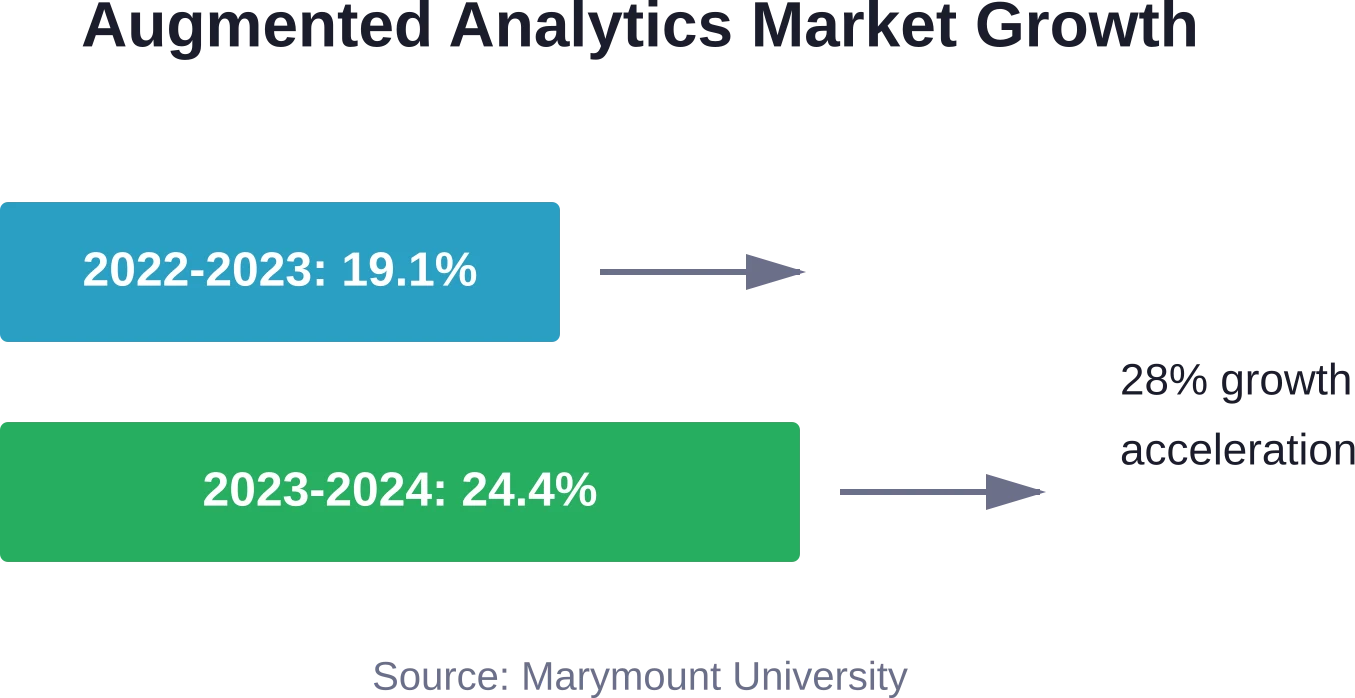
The augmented analytics market is growing explosively. According to Marymount University data, the global augmented analytics market grew at 19.1% CAGR from 2022 to 2023. That growth tells you everything about where organizations are placing their bets.
But not all AI integration is created equal. IEEE research on improving business intelligence through machine learning algorithms emphasizes that successful implementations focus on hybrid intelligence—combining large language models with traditional predictive analytics rather than replacing one with the other.
Real-World AI Impact
The financial sector has been particularly aggressive in adopting AI-driven decision-making. IEEE publications on artificial intelligence and machine learning for business analytics in financial services document how ensemble machine learning techniques now power everything from fraud detection to portfolio optimization.
Manufacturing has seen dramatic results too. Arpa Industriale reduced resource consumption—water, energy, and other materials—by 80% after implementing data analytics, according to Marymount University case studies. In the first year of SAP software implementation, the company saved €750,000 annually in production costs. Those aren’t marginal improvements—they’re transformation-level changes.

Prepare Business Intelligence for the AI Era With AI Superior
Business intelligence is becoming more useful when it goes beyond static dashboards and connects with forecasting, automation, and AI-driven analysis. AI Superior works with business intelligence solutions, data analytics, AI consulting, machine learning, predictive analytics, and custom AI software development. This can help companies improve reporting, build analytics tools, prepare data for AI models, and add predictive capabilities to existing BI workflows.
AI Superior’s BI-related work may include:
- Reviewing BI needs and data sources
- Building business intelligence and analytics tools
- Adding predictive analytics to reporting workflows
- Preparing business data for AI development
- Integrating BI and AI tools into company systems
Contact AI Superior to discuss how your business intelligence setup can evolve with practical AI and analytics solutions.
Conversational BI: Asking Questions in Plain English
Dashboards are becoming conversational interfaces. Natural language query capabilities mean business users don’t need to learn SQL or navigate complex reporting tools anymore. They ask questions like “Which products drove revenue growth last quarter?” and get structured answers instantly.
This shift matters because it democratizes data access. Marketing teams, sales managers, and operations leads can interrogate data directly without waiting for analyst support. Self-service BI has been a buzzword for years, but conversational interfaces are finally making it real.
The technology behind this is natural language processing combined with semantic understanding of business metrics. The system needs to know that “revenue” might mean different things in different contexts—gross versus net, recognized versus booked, regional versus consolidated.
That’s where semantic layers come in.
Semantic Layers: The Brain of Modern BI
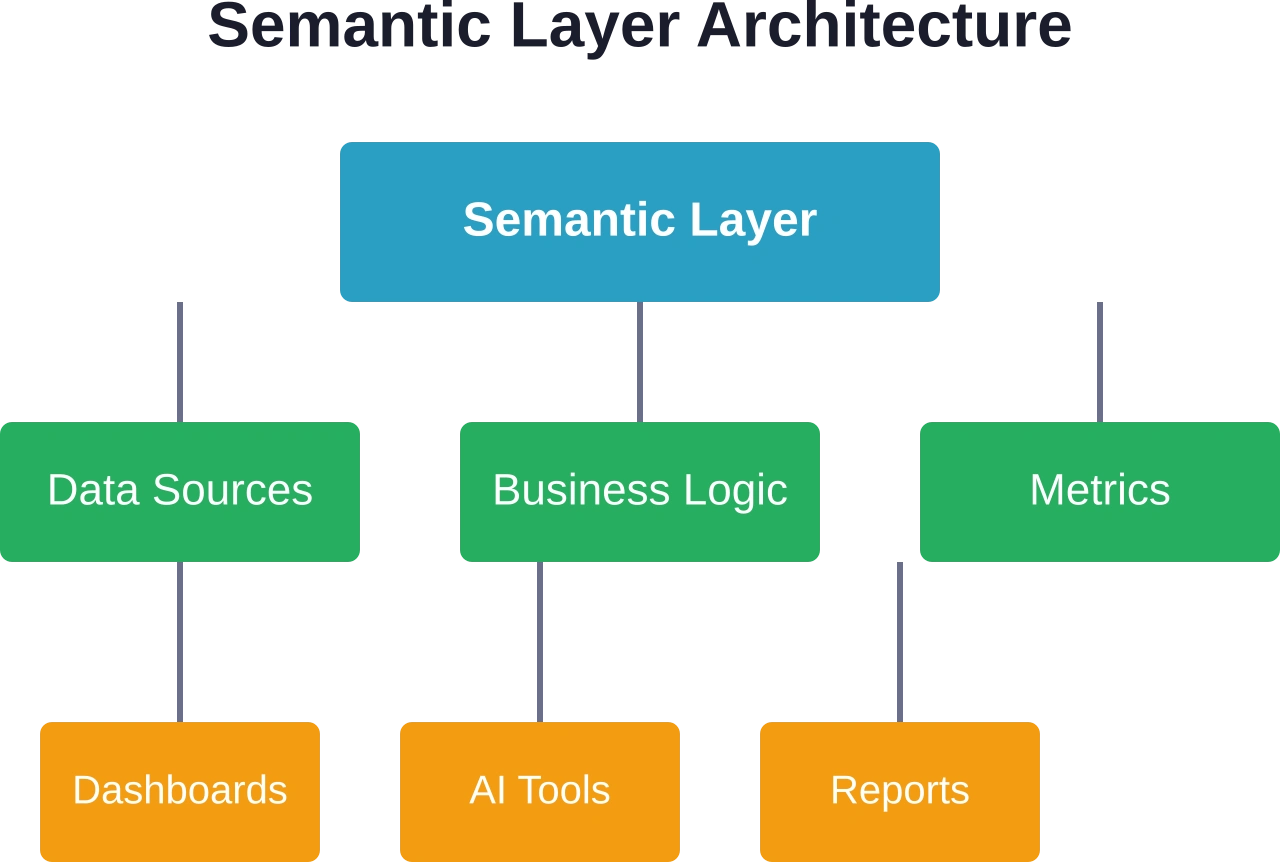
If AI is the engine, the semantic layer is the brain. It’s a unified abstraction that sits between raw data sources and BI tools, defining business logic once so every tool and user works from the same definitions.
Think of it as a universal translator. Marketing, finance, and operations might all need “customer lifetime value,” but they calculate it differently. A semantic layer standardizes that calculation and ensures everyone sees the same number—no more reconciliation meetings where teams argue about whose spreadsheet is right.
Semantic layers are expanding in importance precisely because of AI. Large language models need consistent, well-defined metrics to generate accurate insights. Feed an LLM messy, inconsistent data and it’ll give you confident-sounding nonsense. Give it clean, semantically-defined metrics and it becomes genuinely useful.
Real-Time Analytics: From Hindsight to Foresight
Batch processing is dying. Real-time analytics are becoming table stakes. Organizations need to know what’s happening now, not what happened last night when the ETL job ran.
Real-time doesn’t just mean faster dashboards—it means systems that detect anomalies, trigger alerts, and even take automated actions based on live data streams. A retailer might adjust pricing dynamically based on inventory levels and competitor moves. A logistics company might reroute shipments based on real-time traffic and weather data.
The infrastructure enabling this shift is cloud-native BI platforms. Industry analyses suggest cloud analytics is the fastest-growing segment within BI, expected to expand at a CAGR of 23%, driven by demand for flexibility and scalability.
Real-time analytics also enable decision intelligence—systems that don’t just report data but actively support decision-making workflows. When an anomaly appears, the system doesn’t just flag it; it presents context, historical comparisons, and recommended actions.
Data Quality and Observability: Trust as a Feature
AI-powered insights are only valuable if the underlying data is trustworthy. That’s why data quality and observability have become foundational requirements rather than nice-to-haves.
Data observability means monitoring data pipelines the way DevOps teams monitor applications—tracking freshness, volume, schema changes, and quality metrics continuously. When something breaks, teams know immediately rather than discovering it weeks later when executives question why the numbers look wrong.
Building trust in BI systems requires transparency. Explainable AI is critical here—users need to understand why the system made a particular recommendation or prediction. Black-box algorithms might be technically sophisticated, but they erode trust when they can’t explain their reasoning.
| Data Quality Dimension | What It Measures | Why It Matters |
|---|---|---|
| Freshness | How recently data was updated | Stale data leads to outdated decisions |
| Completeness | Missing values or gaps in records | Incomplete data skews analysis |
| Accuracy | Correctness of values | Wrong data = wrong conclusions |
| Consistency | Agreement across sources | Conflicting data erodes trust |
| Schema Validity | Structure matches expectations | Breaks in schema break pipelines |
Embedded and Collaborative BI
Business intelligence is escaping dedicated analytics platforms and embedding itself directly into operational workflows. Sales reps see predictive lead scores inside their CRM. Marketing teams get campaign performance insights within their automation tools. Finance teams access forecasts directly in planning systems.
This embedded approach reduces context-switching and meets users where they work. Instead of logging into a separate BI tool, insights surface within the applications people use daily.
Collaboration features are evolving too. Modern BI platforms support commenting, annotation, and shared investigation sessions—turning data exploration from a solitary activity into a team sport. When someone discovers an interesting pattern, they can invite colleagues to explore it together rather than just sharing a static screenshot.
The Shift from Descriptive to Prescriptive
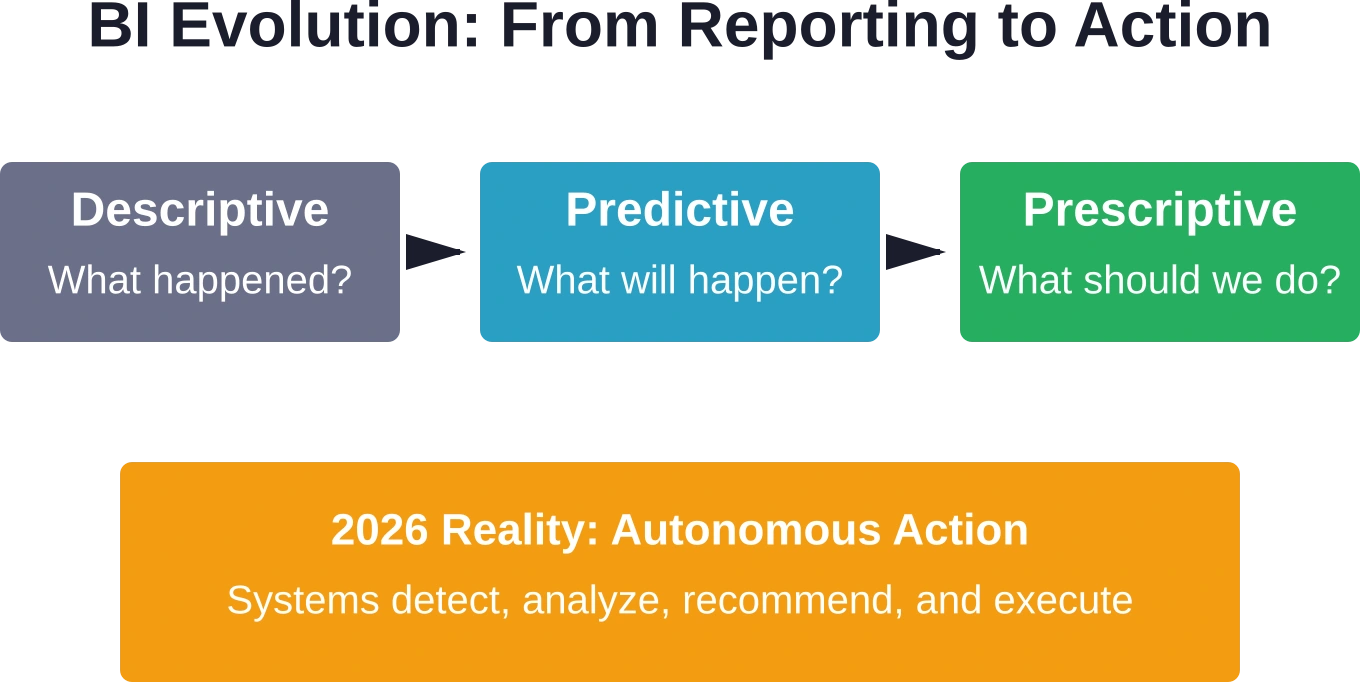
Traditional BI answered “what happened?” Predictive analytics added “what might happen?” Now prescriptive analytics is answering “what should we do about it?”
This progression represents a fundamental evolution in how organizations use data. Descriptive BI provides visibility. Predictive BI provides foresight. Prescriptive BI provides actionable recommendations backed by optimization algorithms and scenario modeling.
For example, a prescriptive system might not just predict that inventory will run low—it recommends specific reorder quantities, timing, and suppliers based on cost, lead time, and demand forecasts. It doesn’t just show that customer churn risk is rising—it suggests targeted retention offers for specific segments.
Governance and Compliance in an AI World
As BI systems become more autonomous and powerful, governance becomes more critical—not less. Organizations need clear frameworks around data access, algorithmic transparency, and audit trails.
Regulatory requirements are tightening. GDPR, CCPA, and industry-specific regulations impose strict requirements on how data is collected, processed, and retained. BI systems must enforce these rules automatically—not rely on manual compliance checks.
Data governance frameworks now include AI-specific considerations: bias detection in training data, fairness metrics for predictive models, and documentation of algorithmic decision-making logic. When a credit scoring model or hiring algorithm makes a decision, organizations need to demonstrate it’s fair, accurate, and compliant.
Industry Transformations Powered by BI
According to Saint Mary’s University analysis, business intelligence analytics now transforms industries across every sector—from predicting market shifts to improving customer experiences.
Healthcare systems have improved diagnostic accuracy through machine learning algorithms that recognize patterns in imaging data. Retail organizations personalize recommendations and optimize pricing dynamically. Financial institutions detect fraud in real-time and assess credit risk more accurately.
The University of San Diego’s Knauss School of Business research on how AI impacts business intelligence emphasizes that AI-driven tools revolutionize data analysis, predictive forecasting, and strategic planning—enabling leaders to drive decisions based on real insights rather than intuition alone.
Manufacturing has embraced predictive maintenance, using sensor data to predict equipment failures before they happen. Logistics companies optimize routes and inventory placement using sophisticated forecasting models. Energy utilities balance supply and demand more efficiently with real-time analytics.
What’s Next: The 2026 BI Landscape
So where does all this lead? Several trends are converging to shape the next phase of business intelligence.
First, agentic AI systems—autonomous agents that can execute multi-step workflows based on natural language instructions—are beginning to integrate with BI platforms. Instead of just answering questions, these systems can investigate anomalies, generate hypotheses, and even implement changes to operational systems.
Second, the composable architecture movement is gaining traction. Rather than monolithic BI suites, organizations are assembling best-of-breed components—a semantic layer from one vendor, visualization tools from another, ML platforms from a third—all orchestrated through APIs and open standards.
Third, the line between BI and operational systems is blurring. Insights aren’t just consumed by humans anymore—they feed directly into automated processes. A demand forecast doesn’t just inform procurement decisions; it automatically triggers purchase orders. A churn prediction doesn’t just alert the retention team; it provides personalized offers instantly.
| Trend | Impact | Adoption Timeline |
|---|---|---|
| Conversational Interfaces | Democratizes data access across roles | Mainstream now |
| Semantic Layers | Ensures consistency and AI readiness | Rapidly accelerating |
| Real-Time Analytics | Enables immediate response to events | Mainstream in large enterprises |
| Augmented Analytics | Automates insight discovery | 19.1% CAGR (2022-2023) |
| Prescriptive Systems | Moves from insight to action | Early majority adoption |
| Embedded BI | Brings insights into workflow | Growing across sectors |
Building Your BI Strategy for 2026
Organizations looking to stay competitive need to prioritize several foundational elements:
- Start with data quality and observability infrastructure: No amount of sophisticated AI compensates for unreliable data. Implement monitoring, testing, and documentation practices before layering advanced analytics on top.
- Invest in a semantic layer: Whether built in-house or adopted from a vendor, having a single source of truth for business metrics is non-negotiable in an AI-driven world.
- Democratize access without sacrificing governance: Self-service BI fails when it becomes a free-for-all. Provide guardrails, training, and clear policies about what data can be used for which purposes.
- Focus on business outcomes, not technology features: The goal isn’t to implement AI for AI’s sake—it’s to make better decisions faster. Measure success by business impact: faster time-to-insight, more accurate forecasts, better customer outcomes.
- Build hybrid teams: The future of BI requires people who understand both business context and technical capabilities. Data fluency needs to become a core competency across roles, not just within IT or analytics departments.
Frequently Asked Questions
What is the biggest change in business intelligence for 2026?
The shift from descriptive reporting to prescriptive action represents the biggest change. BI systems now detect patterns, explain root causes, and recommend specific actions—often executing those actions autonomously. According to Marymount University research, augmented analytics adoption has grown significantly as organizations moved beyond static dashboards to AI-driven insight engines.
How does AI improve business intelligence?
AI enhances BI through automated anomaly detection, natural language interfaces, predictive forecasting, and pattern recognition that humans would miss. IEEE research on machine learning for strategic business intelligence shows that hybrid intelligence approaches—combining AI with traditional analytics—deliver the strongest results. AI doesn’t replace human analysts; it augments their capabilities.
What is a semantic layer and why does it matter?
A semantic layer is a unified abstraction between raw data and BI tools that standardizes business logic and metric definitions. It ensures every user and system works from the same definitions—no more reconciliation arguments between departments. Semantic layers are increasingly critical because AI systems require consistent, well-defined metrics to generate accurate insights.
Is real-time analytics really necessary?
For many use cases, yes. Real-time analytics enable organizations to detect and respond to events as they happen—adjusting pricing, rerouting shipments, or triggering alerts based on live data streams. Cloud analytics platforms supporting real-time capabilities are expected to expand at a CAGR of 23% according to industry analyses, reflecting strong demand for immediate visibility into operations.
How important is data quality for AI-driven BI?
Critical. AI amplifies whatever data quality you feed it—garbage in, garbage out still applies. Organizations need data observability practices that continuously monitor freshness, completeness, accuracy, consistency, and schema validity. Explainable AI and transparent algorithmic decision-making also build trust in BI systems.
What industries benefit most from advanced BI?
Every industry gains value, but financial services, healthcare, retail, manufacturing, and logistics have seen particularly dramatic transformations. Saint Mary’s University research documents how BI analytics drives innovation across sectors—from predicting market shifts to improving customer experiences. Arpa Industriale reduced resource consumption by 80% and saved €750,000 annually through data analytics implementation.
Should we build or buy our BI infrastructure?
Most organizations benefit from a hybrid approach—composable architectures that combine best-of-breed components through APIs and open standards. Core infrastructure like semantic layers and data quality monitoring often warrant vendor solutions, while custom dashboards and domain-specific models might be built in-house. Prioritize open, API-driven platforms that avoid vendor lock-in.
Conclusion: From Insight to Impact
The future of business intelligence isn’t about bigger dashboards or fancier charts. It’s about systems that act—detecting opportunities, explaining root causes, and executing decisions at machine speed with human oversight.
By 2026, the distinction between BI and operational systems has blurred. Insights flow directly into workflows. Predictions trigger actions. Data quality is monitored continuously rather than checked periodically. And business users ask questions in plain English, getting answers backed by sophisticated analytics without needing technical expertise.
Organizations that embrace conversational interfaces, semantic layers, augmented analytics, and real-time processing gain competitive advantages that compound over time. Those that cling to static dashboards and batch reporting will struggle to keep pace.
The transformation is already underway. The question isn’t whether to adopt these trends—it’s how quickly you can implement them before competitors do. Start with data quality foundations, build your semantic layer, and progressively layer AI capabilities on top. The future of business intelligence rewards those who act decisively.